Short verdict
Most Malaysian SMEs get the best results from a hybrid: in-house for voice, community and WhatsApp, a specialist agency for paid social and creative testing. In the social media agency vs in house decision, pure in-house wins when you need a high daily volume of content, can fund three or more roles, and sell something that takes insider knowledge to explain. Pure agency wins when no one inside the business can own social and you need paid social producing enquiries quickly.
Most businesses frame this as a choice between two options. It’s really a staffing question: which parts of social media can your team do well, and which parts are you paying someone to do badly? This guide compares cost, skills and control, gives you a worked ringgit example, and shows you exactly which jobs to keep and which to hand over.
Social Media Agency vs In-House: The Comparison That Matters to Malaysian Businesses
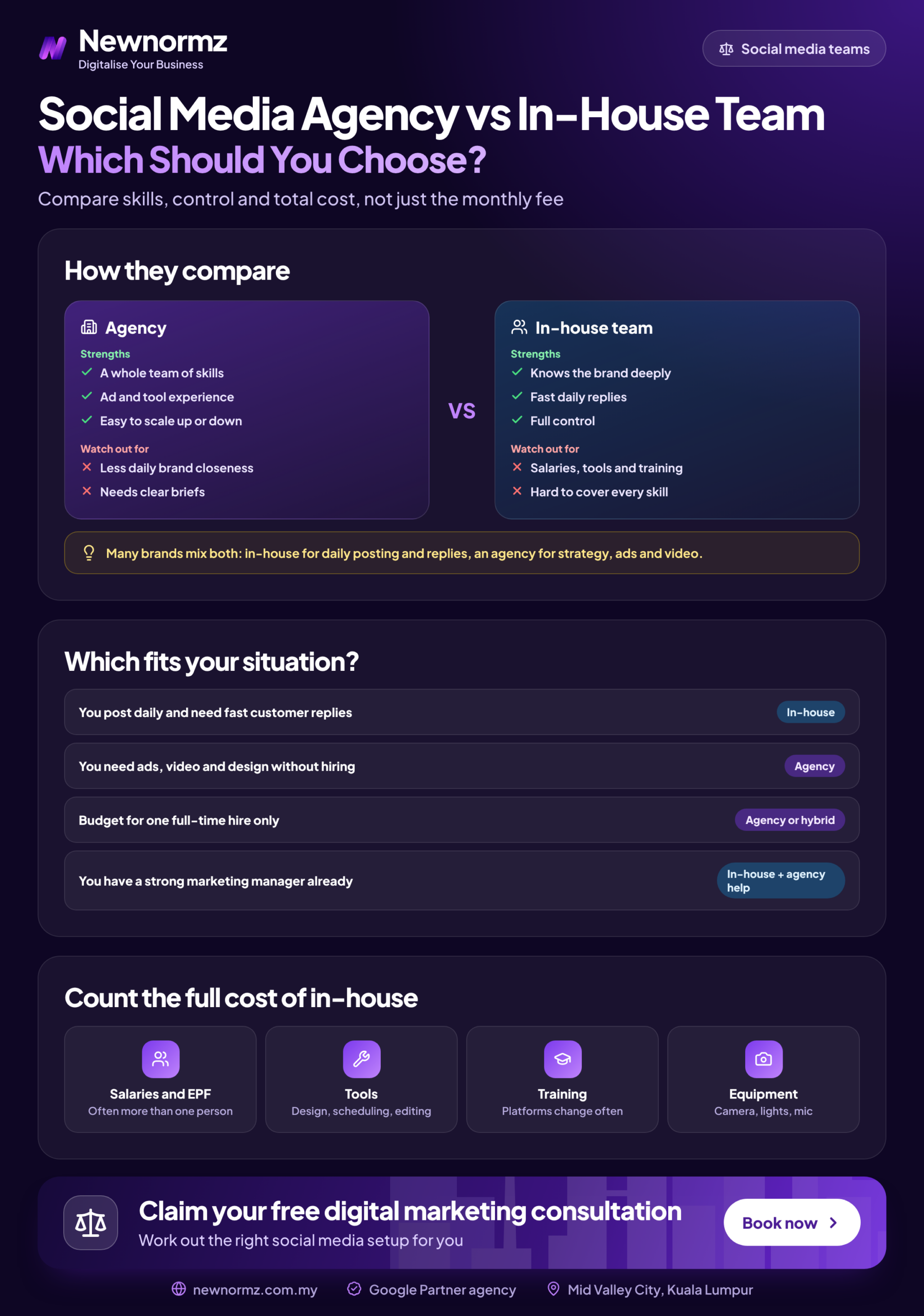
Here is the in-house social media team vs agency comparison on the eight criteria that actually change outcomes. The third column, hybrid, is the one most comparison articles leave out.
| Criteria | In-house team | Agency | Hybrid |
|---|---|---|---|
| Real monthly cost | Salary plus employer EPF and SOCSO, tools, training and recruitment. Rises with every extra role. | A retainer plus ad spend. No statutory costs or hiring time. | One in-house role plus a narrower specialist retainer. |
| Skills covered | Usually two or three of the seven jobs done well. | Strategy, paid social, tracking, creative and reporting under one contract. | Each job goes to whoever does it best. |
| Speed to start | Weeks to hire, then typically 2 to 3 months to ramp up. | Usually weeks, once access and the brief are sorted. | Paid side starts while you hire for the in-house side. |
| Brand knowledge | Deep and daily. Knows the product, staff and customers. | Has to be briefed, and kept briefed. | In-house owns the voice; agency works from approved briefs. |
| Multilingual output (EN/BM/CN) | Rare to find one person strong in all three. | Can assign writers per language (ask whether they’re native). | In-house covers the main language; agency fills the gaps. |
| Paid social and tracking | Often limited to boosted posts, with no Conversions API. | Ads Manager, Pixel and CAPI, and testing patterns seen across many accounts. | Run by the specialist, reported to the business. |
| Continuity (leave, resignation, festive peaks) | One resignation stops everything. | A team covers leave and peak periods. | Each side covers the other. |
| Ownership and control of accounts | Full, by default. | Full only if you own the assets and give partner access. Risky if the agency created them. | Same rule: the business owns, the agency is a partner. |
Social Media Is Seven Jobs, Not One Hire
The comparison only makes sense once you see what “doing social media” actually involves. There are seven separate jobs:
- Strategy: choosing platforms, audiences, content pillars (the three to five recurring themes you post about) and what a lead is worth.
- Content production: shooting and editing Instagram Reels and TikTok videos, plus designing static posts in Canva or editing in CapCut.
- Copywriting in three languages: captions, hooks and ad copy in English, Bahasa Malaysia and Chinese, written for each audience rather than translated.
- Paid social: building, testing and scaling campaigns in Meta Ads Manager and TikTok Ads Manager.
- Tracking: setting up the Meta Pixel and Conversions API (a server-side connection that sends conversion data to Meta even when browsers block the Pixel), so the algorithm optimises for real enquiries.
- Community management: replying to comments and DMs, in the right tone, quickly.
- WhatsApp enquiry handling: answering leads from Click-to-WhatsApp ads and qualifying them before they go cold.
Now read a typical Malaysian job ad for a “social media executive”. It asks for all seven, at a junior salary. Nobody is good at all of them. A strong video editor is rarely a strong media buyer, and a fluent Chinese copywriter is rarely the person debugging Conversions API events.
From our audits
The setup we see most often: one junior hire posting daily on Instagram, no Pixel or Conversions API, boosted posts as the only paid activity, and WhatsApp enquiries waiting hours or days for a reply. The business pays a full salary plus ad spend for reach it can’t connect to a single sale, and the few leads that do arrive go cold before anyone answers.
If you’re weighing the same decision for SEO, the logic is similar, but social has more daily, customer-facing work. That’s why the split looks different here.
When an In-House Social Media Team Is the Better Choice
When in-house works
- Your best content happens on site, every day
- Comments and WhatsApp chats need real product knowledge
- You can fund separate content and paid social roles
- Approvals need to happen in hours, not days
When it doesn’t
- One person is expected to cover all seven jobs
- Ads are your main lead source but nobody knows Ads Manager
- You need EN, BM and CN creative
- A resignation would stop output for months
You Need Daily, Insider Content That Only Staff Can Shoot
For F&B outlets, retail stores and clinics, the content is the business: the kitchen at 7am, the new stock arriving, the physio explaining a stretch. An agency can’t be there every day. A staff member with a phone and CapCut can post a same-day Reel that looks native to the feed. On Reels and TikTok, that usually outperforms a polished studio video.
Your Comment Section and WhatsApp Are a Sales Channel
Most Malaysian enquiries end up on WhatsApp. When a lead asks “ada slot Sabtu?” or “how much for two pax?”, reply speed and product knowledge decide whether it becomes a booking. Who answers the chat often matters more than the ad that produced it.
That work needs someone who knows the prices, the stock and the calendar. Our guide to handling customer service on social covers response times and tone in detail.
You Can Fund More Than One Role
An in-house team starts to beat an agency once different people cover content and paid social. Until then, you have one person doing one job well and five jobs badly. If you can’t fund at least two roles, go hybrid.
When Outsourcing Social Media Marketing to an Agency Makes More Sense
The pros and cons of outsourcing social media come down to this: you gain specialist skills and continuity, and you give up some speed and closeness to the brand.
Pros of outsourcing
- Paid social specialists from day one
- Testing patterns learned across many accounts
- No recruitment, statutory costs or ramp-up
- Cover during leave and festive peaks
Cons of outsourcing
- Slower to capture on-site moments
- Brand voice drifts without strong briefs
- Some agencies report reach, not enquiries
- Ownership problems if the agency set up your assets
Paid Social Is Where the Money Is Won or Lost
On Meta and TikTok, creative now does most of the targeting. Broad audiences with varied, well-tested creative usually beat narrow interest stacks, so the skill that matters is producing and testing enough ad variations to find winners before creative fatigue sets in. That means watching frequency and a falling CTR (click-through rate) and refreshing on a schedule.
It also means optimising for the right event. Cheap Instant Form leads look great in a report and often don’t pick up the phone. Higher-intent forms with qualifying questions, or Click-to-WhatsApp ads, usually cost more per lead and less per customer. Judge paid social management on cost per qualified lead, not cost per lead.
This is the job a good social media marketing agency in Malaysia earns its fee on, because it sees what is working across many accounts at once. Newnormz’s positioning is “Turn Attention into Enquiries. Not Just Views.” Whoever you hire for social media lead generation should be judged the same way.
You Need Multilingual Creative Without Hiring Three Writers
One translated ad rarely works for three audiences. A BM ad for a Klang Valley family and a Chinese ad for a Penang shopper need different hooks, references and often different offers. Chinese-Malaysian lifestyle and beauty audiences may also need Xiaohongshu, which is a different platform with its own content style. Hiring native writers for all three is the hidden cost of in-house. A social media agency in Malaysia that already works across platforms spreads that cost over many clients. Newnormz has run campaigns ranging from Facebook for Taiwan Excellence to TikTok for Hot & Roll, and each platform needed its own creative approach.
You Can’t Afford a Gap When Someone Resigns
Ramadan and Hari Raya, Chinese New Year and the 9.9 to 12.12 sales are when ad costs and competition rise, and when your plan needs to be ready weeks ahead. If your only social media person resigns in October, you lose the year’s most expensive quarter. An agency team covers leave and handovers. A single hire can’t.
The Hybrid Model: What to Keep In-House and What to Hand Over
A hybrid social media model gives each job to whoever can do it best. Use this split as a starting point:
| Job | Keep in-house | Outsource | Why |
|---|---|---|---|
| Community management | Yes | Overflow only | Needs product knowledge and the brand’s real tone. |
| WhatsApp follow-up | Yes | No | This is where leads turn into sales. Speed and pricing authority matter. |
| Brand approvals | Yes | No | Someone senior must own what goes out under your name. |
| Daily behind-the-scenes content | Yes | Editing support | Only staff are there to shoot it. |
| Paid social on Meta and TikTok | Oversight | Yes | Specialist skill, and expensive to learn on your own budget. |
| Pixel and Conversions API setup | No | Yes | Technical, done once and then checked regularly. |
| Creative testing plans | Input on offers | Yes | Agencies see what’s working across many accounts. |
| Ad video production | No | Yes | Ads need volume and variation that one person can’t produce. |
| Monthly reporting | Sales data | Yes | Only the business knows which leads closed, so both sides feed the report. |
If your in-house person shoots good raw footage but can’t turn it into enough ad variations, bring in short-form video production for the ads and keep the daily posts in-house.
Cost Comparison: A Worked RM Example
Every figure below is an example to show the maths. Replace each one with your own numbers, and get real quotes before you decide.
Example A: one in-house executive. Say the salary is RM4,000 a month. Add the employer’s EPF and SOCSO contributions (check your payroll for the exact amount; we’ll use RM600 here as an example) and around RM200 for tools such as Canva, CapCut and a scheduler. That’s RM4,800 a month, or RM57,600 a year. The cost of an in-house social media team also includes weeks of recruitment time and a 2 to 3 month ramp-up when output is low. And this person still has to cover all seven jobs.
Example B: an agency. Say a social media agency retainer is RM5,000 a month for strategy, paid social, creative and reporting. You still need someone inside the business to approve content and answer WhatsApp.
Example C: hybrid. Say you keep a RM3,500 in-house coordinator (about RM4,200 with example statutory costs and tools) for content, community and WhatsApp, and pay an example RM3,000 retainer for paid social and tracking. That’s RM7,200 a month. On paper, it’s the most expensive option.
Monthly fees are the wrong lens, though. Social media ROI depends on what you pay per customer. Take an example RM5,000 ad spend:
- Setup 1 (cheap Instant Forms, no CAPI): 100 leads at RM50 each. 5% become customers, so 5 customers at RM1,000 each.
- Setup 2 (qualifying questions, Click-to-WhatsApp, proper tracking): 60 leads at about RM83 each. At three times the conversion rate (15%), that’s 9 customers at about RM556 each.
The team that looks cheaper on paper can be the expensive one per customer. Run your own numbers through our free social media ROAS calculator.
Whichever model you choose, report on numbers like these, not reach. Our guide to social media KPIs that track revenue shows which ones to put in the monthly report.
Non-Negotiables Whichever Model You Choose
The most expensive mistake we see in audits isn’t picking the wrong model. It’s letting an agency or a departing employee own the accounts. Before you sign anything, make sure every item below is in place:
Account and reporting checklist
- ✓The business owns the Facebook page, the Meta Business portfolio (Meta Business Suite and Business Manager), ad accounts and Pixel, with two internal admins.
- ✓TikTok Ads Manager and TikTok Business Center are registered to the business, not an agency employee.
- ✓Agencies get partner access only, which you can remove in minutes.
- ✓Every ad and bio link carries UTM tags, so you can see social traffic and enquiries in analytics.
- ✓A monthly reporting rhythm built on enquiries and cost per qualified lead, not reach or likes.
- ✓Lead data from forms and WhatsApp Business is stored and handled in line with PDPA, whoever runs the campaigns.
- ✓A named person answers WhatsApp enquiries within an agreed time.
Not sure where your accounts stand today? Work through this step-by-step social media audit first.
How to Decide: Agency, In-House or Hybrid
If you’re asking “should I hire a social media manager or an agency?”, run your situation through these rules:
Whichever model you choose, it only works with a clear plan behind it. Start with our guide to building a social media strategy, so whoever runs it knows what success looks like.
FAQ
Is it cheaper to hire a social media agency or an in-house team in Malaysia?
It depends on how many roles you need. One in-house executive often costs about the same as a retainer once you add EPF, SOCSO, tools and ramp-up time, but covers fewer skills. The fairer comparison is cost per qualified lead and cost per customer, not the monthly fee.
Can one in-house social media executive handle content, ads and community management?
Rarely, at least not well. Content production, paid social and community management need different skills and compete for the same hours. Usually the ads suffer first, because they’re the hardest to learn and the easiest to put off.
What should a business keep in-house if it outsources social media?
Keep WhatsApp follow-up, community replies and brand approvals in-house. These need product knowledge, pricing authority and fast responses. Daily behind-the-scenes content is usually better shot by staff as well.
Who should own the Facebook page, Meta Business Manager and ad accounts when working with an agency?
The business should own all of them, and the agency should get partner access only. That includes the Pixel and TikTok Ads Manager. If an agency created your assets under its own account, ask for ownership to be transferred before anything else.
When should a business move social media from an agency to in-house?
Move once you can fund separate content and paid social roles and have documented what is working. Transfer asset ownership, tracking setup and the creative testing history first. Most businesses move the daily content in-house and keep specialist help for paid social.
Not sure which parts of your social media to hand over?
Newnormz plans, creates and runs social media and paid social for Malaysian brands, and judges every campaign on enquiries, not just views. The team also runs SEO and Google Ads, so it can connect social with search and WhatsApp enquiries. 5.0 rating from 214+ Google reviews.
No obligation. We’ll tell you what to keep in-house too.

Bryan Tan is an SEO Specialist and CEO at Newnormz, helping hundreds of businesses achieve first-page rankings on Google. With a passion for driving organic growth, Bryan blends innovative strategies with hands-on experience to optimize websites for maximum visibility. Always at the forefront of the latest SEO insights and trends, he consistently adapts to the evolving digital landscape.