The short answer on YouTube ads cost Malaysia: there is no fixed rate card. Google Ads has no minimum spend. You set a daily budget, and you pay per view (CPV), per thousand impressions (CPM), or per click or conversion, depending on the campaign type you choose. What you actually pay is set by the auction: your bidding model, your audience, your creative and the time of year. A cheap cost per view tells you very little on its own. What matters is how many of those views turn into WhatsApp messages, form fills and customers, and what each of those costs you.
This guide is for Malaysian business owners and marketing managers deciding whether YouTube deserves part of the budget. By the end you will know what you are paying for under each format and how to set a test budget you can defend.
What YouTube Ads Cost in Malaysia Depends on What You Are Actually Paying For
You don’t buy YouTube ads inside YouTube Studio. Studio is where you upload and manage the video. The ads are bought, targeted and billed in Google Ads, as video campaigns or Demand Gen campaigns, and the same Google Ads account can run your Search ads too.
Inside Google Ads you can be charged in four different ways:
- CPV (cost per view): you pay when a viewer counts as a “view” under Google’s rules, explained below.
- Target CPM (cost per thousand impressions): you pay for every 1,000 times the ad is shown, watched or not.
- CPC (cost per click): you pay when someone clicks through to your site or clicks to watch.
- Conversion-based bidding (CPA or maximise conversions): you still pay for impressions or clicks, but Google bids to get you the action you track, such as a lead.
So comparing a YouTube CPV with a Meta CPM is apples to oranges. One is a price for a person who watched 30 seconds. The other is a price for 1,000 ad appearances, most of them scrolled past in under a second. Before you compare channels, convert both into the same unit: cost per qualified enquiry.
Cost per view: when a “view” is charged (and why skippers are free)
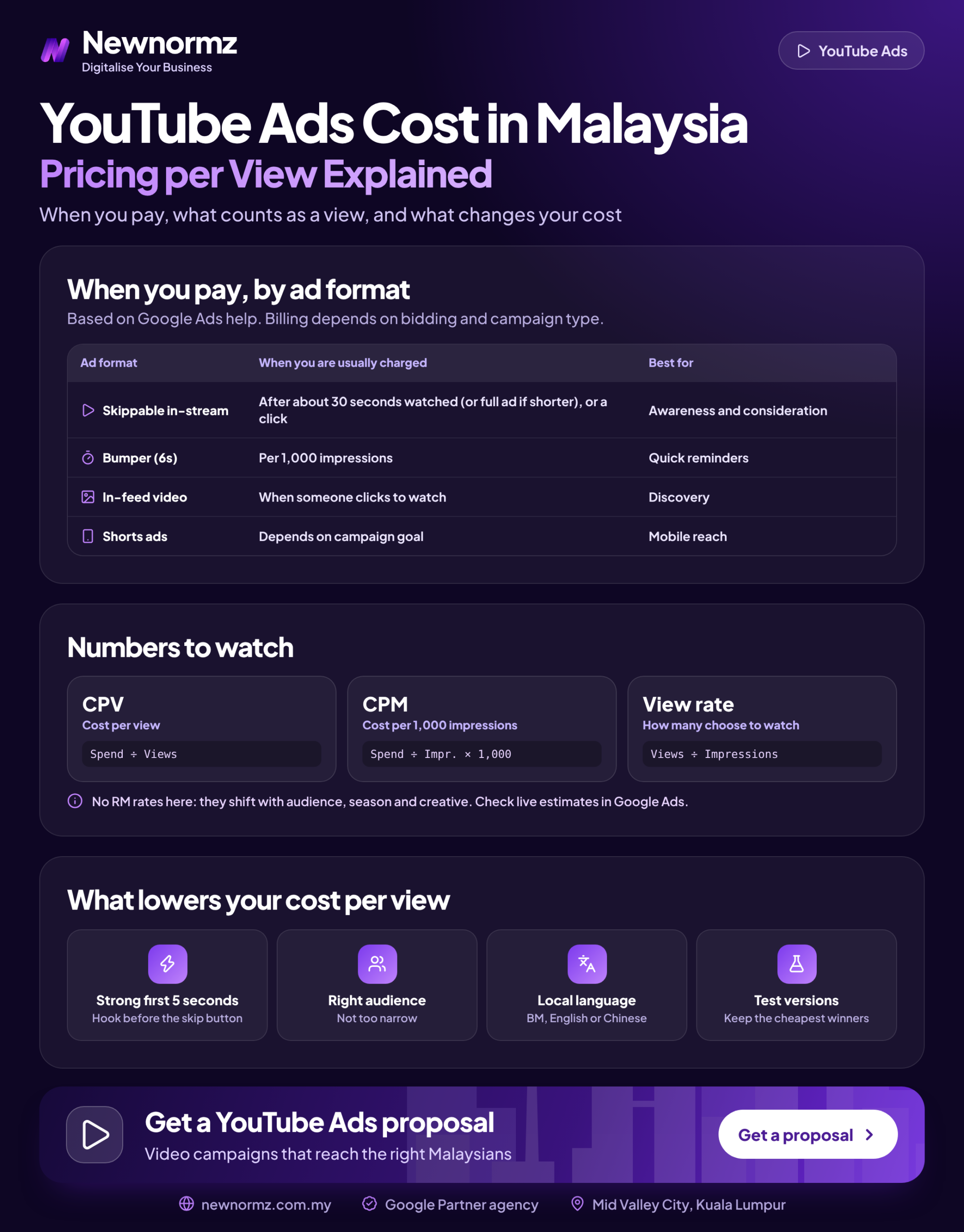
With skippable in-stream ads on CPV bidding, Google charges you when someone watches 30 seconds of the ad (or the whole ad if it is shorter than 30 seconds), or interacts with it, for example by clicking your call to action. Anyone who hits “Skip” at 5 seconds costs you nothing.
That changes how you should build the ad. The first 5 seconds are effectively free reach. Everyone sees them, and you only pay for the people who stay. So the skippable in-stream ads cost you least per useful result when the opening does two jobs at once: it shows your brand and your offer for the viewers who leave, and it gives the right viewers a reason to stay.
Newnormz take
Put the brand name, the product and the offer on screen before the skip button appears. After that, use the remaining 25 seconds as a filter: talk to the specific buyer you want (price range, location, problem). The people who skip were never your buyer, and you didn’t pay for them. The people who stay are the ones you want to pay for.
Bumper and non-skippable ads: paying per thousand impressions
Bumper ads (up to 6 seconds) and non-skippable in-stream ads (short ads that viewers must watch before the video plays) are bought on target CPM. You pay for impressions whether or not the viewer was paying attention. That makes bumper ads cost more predictable for reach, and less useful for leads.
Use them for recall: a new product launch, a festive campaign, or reminding people who already watched your longer ad. When you judge YouTube CPM in Malaysia for these formats, judge it against reach, frequency and brand searches afterwards, not against enquiries. A 6-second ad rarely persuades anyone to fill in a form.
In-feed, Shorts and Demand Gen: paying for clicks and actions
In-feed video ads appear in YouTube search results, beside related videos and on the home feed. You are charged when someone clicks the thumbnail to watch, so the click itself is a signal of interest. YouTube Shorts ads appear between Shorts in the vertical feed and run through campaign types such as Demand Gen and video reach or view campaigns rather than a standalone “Shorts” option.
Demand Gen campaigns can bid on conversions, which makes them the closest YouTube gets to a lead-generation campaign on Meta. If Shorts is part of your plan, read our guide on turning Shorts views into brand equity before you budget for it.
One warning: Google keeps renaming, merging and retiring video campaign types. Check which campaign types and bidding options appear in your own Google Ads account before you plan around any of them.
Pricing Table: Which YouTube Ad Format Fits Which Goal
Here is how each format charges you and what to measure it on. There are no ringgit rates here on purpose: your rates come from your own auction, not from someone else’s account.
| Format | How you are charged | Best for | Not for | What to judge it on |
|---|---|---|---|---|
| Skippable in-stream | CPV (30 seconds, full ad or interaction), or CPM / conversion bidding | Explaining a product, consideration, remarketing | Brands with no video longer than a few seconds | View rate, site visits, cost per enquiry |
| Non-skippable in-stream | Target CPM | Guaranteed full message, launches | Direct lead generation | Reach, frequency, brand search lift |
| Bumper (up to 6 seconds) | Target CPM | Recall, festive reminders, follow-up to longer ads | Anything that needs explaining | Unique reach and cost per 1,000 people reached |
| In-feed video | When someone clicks to watch | Tutorials, reviews, “how to” searches | Fast reach at scale | Watch time, channel subscribers, assisted enquiries |
| YouTube Shorts ads | Depends on the campaign type running them | Younger audiences, native vertical creative | Long explanations, landscape-only footage | Reported separately: clicks and conversions, not views |
| Demand Gen | Clicks or conversion bidding | Leads and sales across YouTube, Shorts and other Google feeds | Accounts with no conversion tracking | Cost per qualified enquiry or ROAS |
What Pushes Your YouTube Advertising Rates Up or Down in Malaysia
YouTube advertising rates in Malaysia move with the auction. Five things decide most of it, and four of them are in your hands.
Targeting width and audience competition
Narrow audiences cost more per impression because you are competing for fewer people. Remarketing lists (people who visited your site or watched your videos) and custom segments built from search terms are usually the most expensive per view and often the cheapest per enquiry, because those viewers already know what they want. Broad audiences with strong creative usually stretch a budget further. Start with one warm audience and one broad audience, and let the cost per enquiry tell you which deserves more money.
Language segment: English, Bahasa Malaysia and Chinese creative
One English ad with Malay and Chinese subtitles is the cheapest to produce and the hardest to read in your reports. Make separate creative for each language segment you sell to, and put each in its own ad group with matching language targeting. Then you can see cost per view and cost per enquiry by segment, and you will often find one language carrying the account while another quietly burns budget.
The festive and sales calendar
In our experience, competition and CPMs climb around Ramadan and Hari Raya, Chinese New Year, Deepavali, Merdeka and Malaysia Day, and the 9.9, 10.10, 11.11 and 12.12 sales, as bigger advertisers push budgets into the same weeks. If your campaign depends on one of these dates, finish the creative early and run a small test four to six weeks before the peak. You want to know which ad works before prices rise, not during.
Creative quality and audience retention
Creative is the biggest cost lever you control. A weak hook means more skips, fewer paid views per thousand impressions, and fewer of the viewers you do pay for reaching your offer. Check the view rate in Google Ads, then open the audience retention report in YouTube Analytics (in YouTube Studio) to see the exact second people drop off. If half your viewers leave before the offer appears, move the offer earlier.
Plan two to three hook variants per language from the start. If your team can’t shoot that volume, outside video production for ads is often cheaper than paying for weeks of views on a single tired cut.
Frequency and creative fatigue
Showing the same ad to the same people again and again inflates your cost per result. Set a frequency cap in your video campaign settings and watch view rate and click-through rate week by week. When both slide while frequency rises, the audience is tired of the ad. Swap in a new hook or a new opening scene rather than raising the budget.
A cheap view is only cheap if the person watching it can become a customer.
Worked Example: Turning a YouTube Ads Budget Into Cost per Enquiry
All numbers below are a hypothetical example to show the maths. They are not Malaysian market rates. Plug in your own figures once your test is running.
Say you set a YouTube ads budget of RM3,000 for a one-month test on skippable in-stream ads. Version A uses a sharp, targeted ad. Version B uses a broader, more general ad that wins cheaper views but attracts less interested viewers.
| Example step | Version A (targeted ad) | Version B (cheaper views) |
|---|---|---|
| Monthly budget | RM3,000 | RM3,000 |
| Example CPV | RM0.10 | RM0.05 |
| Paid views | 30,000 | 60,000 |
| Cost per 1,000 views | RM100 | RM50 |
| Example click rate to site | 1% = 300 visits | 0.3% = 180 visits |
| Example enquiry rate | 5% = 15 enquiries | 5% = 9 enquiries |
| Cost per enquiry | RM200 | about RM333 |
Version B halves the YouTube ads cost per 1,000 views and doubles the view count. It also costs about two-thirds more per enquiry. If you reported on CPV alone, you would scale the wrong ad.
For context, a different channel: a confinement centre in KL running Google Search ads (not YouTube) with Newnormz spent RM2,550 a month and got 266 qualified leads in the first 30 days at RM9.58 per lead. That is a paid search benchmark, not a YouTube one. Search catches people already looking for you, while YouTube reaches people before they search, so expect a higher cost per enquiry on YouTube and judge it partly on how it feeds your search and remarketing.
To run this maths with your own margins and average order value, use our free social media ROAS calculator and work out the highest cost per enquiry you can afford before you set a bid.
How Much Should You Budget for Your First YouTube Ads Test?
There is no YouTube ads minimum budget set by Google. There is a practical minimum, though: the amount below which you learn nothing. A test that produces three enquiries can’t tell you whether YouTube works or whether you got lucky.
So the honest answer to “how much does YouTube ads cost” for a first test is: work backwards from the number of results you need to judge it, not from a round number.
Set your maximum affordable cost per enquiry
Use your close rate and profit per customer. If 1 in 5 enquiries buys and a customer is worth RM1,500 in profit (example numbers), you can afford up to RM300 per enquiry and still break even.
Decide how many results you need to judge
Aim for a few dozen enquiries across the test, or at least a meaningful sample of paid views per creative, so one good day doesn’t decide the verdict. In the example above, 30 enquiries at RM200 means about RM6,000 of spend.
Add the costs people forget
Video production, plus two to three hook variants per language segment. A test with one ad tests that ad, not YouTube.
Spread it over enough time
Run for at least four weeks, avoid starting during a festive peak, and only change one thing at a time so you know what moved the numbers.
If that budget feels too big, run fewer creatives in one language rather than spreading a small budget thin. If you’d rather hand the setup to a team, our YouTube ads management runs inside Google Ads, where Newnormz is a Google Partner certified Google Ads agency in Malaysia. The client owns the ad account and the data, and ad spend is paid directly to Google with no markup.
The Mistake We See Most in YouTube Ad Accounts: Celebrating Cheap Views
✗ Judging the campaign on cost per view
The pattern repeats in account after account: a views campaign reported on CPV, no conversion tracking, Shorts and in-feed views lumped into one total, and no idea which views turned into a WhatsApp chat or a form. The report looks great. The sales team says nothing changed. Budget gets cut, or worse, raised, based on a number that never touched revenue.
✓ The fix
Track the actions that make money, including clicks on your WhatsApp button, as conversions in Google Ads or GA4. Split reporting by format (in-stream, in-feed, Shorts) and by language. Then judge every campaign on cost per qualified enquiry, with view rate and CPV as diagnostics only.
In Malaysia, most enquiries end up in WhatsApp, so a YouTube account without WhatsApp click tracking is blind to its main result. If you haven’t done this yet, here’s how to set up conversion tracking in Google Ads properly before you spend another ringgit.
YouTube vs Meta and TikTok Ads: Where YouTube Earns Its Cost
YouTube is rarely the cheapest place to buy attention. It earns its cost when the viewer needs to understand something before buying: a clinic treatment, a property, a renovation service, a software product or a financial plan. Thirty seconds of real attention is worth more than a scroll-past for those. It also works well for older decision-makers who watch long-form video, and for remarketing to people who already visited your site. For companies selling to other companies, see our guide on YouTube ads for B2B brands.
Most brands that do well on video don’t pick one platform. They run YouTube, Meta and TikTok together, with different creative cuts for each and one view of cost per enquiry across all of them. That gets complicated fast, which is when a social media marketing agency in Malaysia that also runs Google Ads and tracks WhatsApp enquiries starts to pay for itself.
FAQ
Do you pay if someone skips a YouTube ad?
No, not on skippable in-stream ads with CPV bidding. You pay only when someone watches 30 seconds (or the whole ad if it is shorter) or interacts with it. On CPM-based formats such as bumpers and non-skippable ads, you pay per impression either way.
Is there a minimum budget for YouTube ads in Malaysia?
No, Google Ads has no minimum spend for YouTube campaigns. The practical minimum is whatever it takes to collect enough enquiries or views per creative to make a fair decision, plus the cost of producing the videos.
How much does a YouTube ad cost per view in Malaysia?
There is no fixed price per view. CPV is set by the auction and changes with your audience, creative, language segment and the time of year. Use the forecasts Google Ads shows while you build the campaign as a starting point, then rely on your own test data.
Is a YouTube ads cost per 1000 views figure useful for planning a budget?
Only as a starting point. Cost per 1,000 views tells you how much attention you can buy, not how many customers you will get. Plan from your maximum affordable cost per enquiry and use view costs as a diagnostic.
Are YouTube ads cheaper than Facebook or TikTok ads?
They aren’t directly comparable, because each platform charges for a different thing. Compare them on cost per qualified enquiry or cost per customer. YouTube often wins for products that need explaining and loses for low-ticket impulse buys.
Do YouTube ads actually bring leads, or only views?
They can bring leads, but only if the campaign is built and measured for leads. That means conversion tracking (including WhatsApp clicks), a format such as Demand Gen or skippable in-stream with a clear call to action, and reporting on cost per enquiry rather than views.
Not sure whether your YouTube budget is buying views or enquiries?
Newnormz plans, creates and runs social media and paid social for Malaysian brands, and judges every campaign on enquiries, not just views. 5.0 rating from 214+ Google reviews. Send us a WhatsApp message and a strategist will reply within business hours.
Prefer a form? Free YouTube channel review

Bryan Tan is an SEO Specialist and CEO at Newnormz, helping hundreds of businesses achieve first-page rankings on Google. With a passion for driving organic growth, Bryan blends innovative strategies with hands-on experience to optimize websites for maximum visibility. Always at the forefront of the latest SEO insights and trends, he consistently adapts to the evolving digital landscape.