Picture an aircond company in Shah Alam with a clean English website. A customer types “servis aircond murah” into Google, sees only competitors, and the WhatsApp stays quiet because nothing on the site uses those words. An SEO Bahasa Malaysia website fixes this with three things: pages on their own URLs, keyword research based on what customers really type, and copy that reads as if a Malaysian wrote it. Translating your English site is not enough on its own.
This guide is for Malaysian business owners and marketing managers who want to set up BM pages themselves or brief someone to do it, and a first batch of 5 to 10 pages usually takes a few weeks, depending on your writer and CMS.
What You Need Before You Start on BM Website SEO
Most of the work here is editorial, so the writer matters more than any tool. Get these five things in place first, because missing one tends to stall the project halfway.
Your pre-start checklist
- ✓Google Search Console access for your domain, so you can see existing BM queries and inspect new pages.
- ✓CMS access that lets you edit URLs, templates, menus and page code, or a developer who can.
- ✓A fluent BM writer or editor who knows Malaysian usage and can spot Indonesian wording.
- ✓A list of 5 to 10 revenue pages, meaning the services or categories that bring in paying customers.
- ✓Some way to track WhatsApp enquiries, such as a separate pre-filled message on BM pages (“Hai, saya nak tanya harga”), so you can count leads by language.
Separate BM Site or BM Section: Make This Call First
This decision shapes every URL you create, so settle it before anyone starts writing. For bilingual website SEO in Malaysia, these are our recommendations rather than Google rules, because Google does not require any one structure.
The structure also affects navigation, language switchers and page layouts. Our guide to multi-language website design covers that side, so involve your designer before templates are finalised.
SEO Bahasa Malaysia Website Setup: 7 Steps From Query List to Indexed Page
Statcounter puts Google at roughly 93 to 96% of Malaysian search, so Google is the target here. If you have been wondering how to rank in Bahasa Malaysia on Google, work through these steps in order, because each one depends on the one before it.
Phase 1: Find the Words Your Customers Actually Type
Malay language SEO starts with evidence, not a dictionary. A translated keyword can be correct BM and still be a phrase nobody searches.
Collect BM and mixed queries
Pull your Bahasa Malaysia keywords from four places: Search Console queries you already appear for, Google Keyword Planner set to Malay and Malaysia, Google autocomplete, and your customers’ own WhatsApp messages. That last source is often the most useful, since it shows the exact words people use when they are ready to buy. For the full method, see our guide to finding Bahasa Malaysia keywords.
Map one primary query to each page
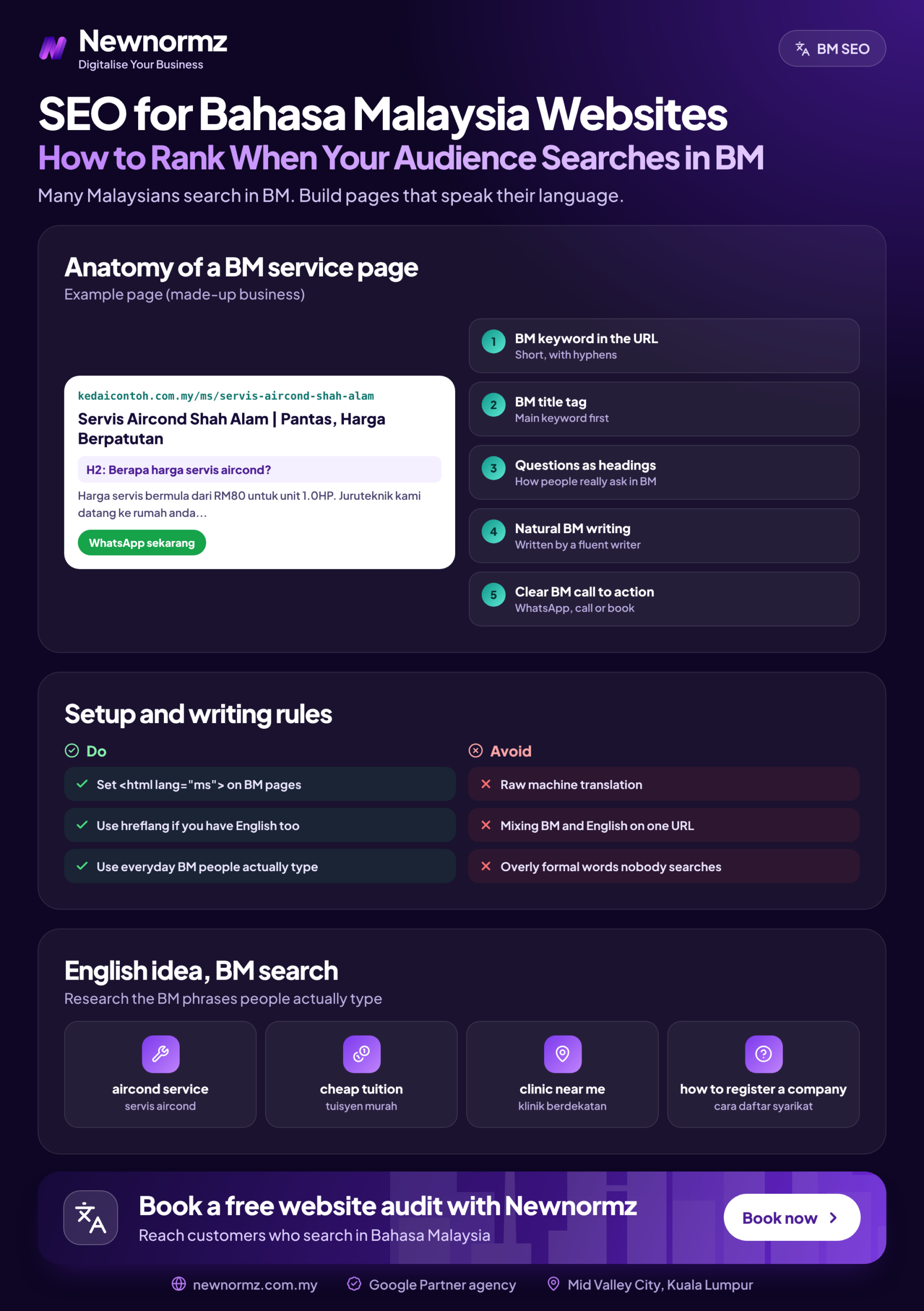
Give every page a single main query and a few close variants, so two pages are not chasing the same search. Keep English-BM mixes such as “servis aircond” wherever customers use them. Rewriting that as “servis penyaman udara” may look more formal, but it moves the page away from the search you want.
Phase 2: Build Pages Google Can Read as BM
Give each language its own URL
A BM page needs an address of its own, such as /ms/servis-aircond/. Use a language switcher made of normal HTML links, so crawlers can follow it from any page. Google’s documentation advises against using cookies or browser settings to change the language, because a crawler may then only ever see one version.
Set the language signals
Set the html lang attribute to ms on BM pages, which helps browsers and screen readers. Where English and BM equivalents exist, add hreflang for Bahasa Malaysia on both pages. Each page must list itself and its counterpart, and the links must point both ways. An ms-my hreflang value suits a site aimed at Malaysia, paired with en-my on the English page, while plain ms covers Malay speakers anywhere.
These tags cannot rescue English copy. Google’s documentation says it identifies a page’s language from the visible content, not from the lang attribute or the URL. The same rules carry over if you later add Chinese or a Singapore version, which is where multilingual SEO becomes a project of its own.
Phase 3: Write and Localise What Google Ranks
Write every visible element in Malaysian BM
Good BM content SEO covers the title, meta description, H1, body copy, image alt text, FAQ and buttons. If you translate a website to Bahasa Malaysia for SEO, treat that translation as raw material and rewrite it around your query list. Structure and intent still follow the same rules as any page, and our guide to writing posts that can rank covers those.
Then check the wording against the table below, since Indonesian terms are the usual giveaway in translated copy.
Update the XML sitemap and schema markup
Add each BM URL to your XML sitemap and confirm the sitemap is submitted in Search Console. Then localise the text inside your schema markup, including service names, descriptions and FAQ answers, so it matches what is visible on the BM page.
Link the BM pages and request indexing
Link BM pages to each other using BM anchor text, so the section is not a set of orphan pages reachable only through the switcher. Request indexing for your priority URLs through URL Inspection in Search Console, and let the sitemap handle the rest. If most local customers search in BM, consider pointing your Google Business Profile website link to the matching BM page.
Use this table during the edit. The point is reader trust and query match: a Malaysian customer who sees “mobil” knows the page was not written for them. It is not a named Google ranking factor.
| Malaysian BM | Indonesian wording | Where to check |
|---|---|---|
| percuma | gratis | Offers, buttons, meta descriptions |
| kereta | mobil | Automotive and service pages |
| pejabat | kantor | Contact and about pages |
| telefon | ponsel | Product and contact copy |
| kedai | toko | Ecommerce and local pages |
| muat turun | unduh | Buttons and brochure links |
Malaysia note
Malaysians mix BM and English when they search, so the pure BM term is not always the one to target. Let the query data decide, even when an editor prefers the formal word. BM results are not automatically easier to rank in either, so check the live results for each query and see who you are up against before you commit a page to it.
How to Check Your BM Pages Are Working in Search Console
To see whether you are starting to rank for Bahasa Malaysia on Google, begin with indexing. Paste each new URL into URL Inspection and confirm it is on Google. If it isn’t, nothing further down this list will move. It also helps to know the four stages of Google ranking, so you can tell a crawling problem from a relevance problem.
Next, isolate your Google Search Console Bahasa Malaysia queries in the Performance report:
Filter by page
Add a Page filter for URLs containing /ms/ to see only your BM section.
Filter by country
Set Country to Malaysia. This keeps searches from other Malay-speaking and Indonesian markets out of your numbers.
Run a query regex
Add a Query filter, choose Custom (regex) and enter harga|murah|terdekat|kedai. Add your own mixed terms, such as servis or aircond, so BM-English searches are captured too.
Read the results in order: impressions first, then clicks, then enquiries. Rising impressions with no clicks usually points to weak positions or poor BM titles. Clicks with no enquiries points to the page itself, or to a WhatsApp prompt that doesn’t match the language of the page.
The timeline we give clients is first ranking movement at day 60 to 90, with traffic and lead growth in months 4 to 8. That is a typical pattern and not a promise. Google has stated publicly that no one can guarantee a specific ranking position.
Common BM SEO Problems and How to Fix Them
These four technical and editorial problems can each hold a BM section back, even when the rest of the setup is sound.
✗ Machine translation published without human review
It is fast and cheap, but the result often reads stiffly and misses the phrases customers search, so the page gets neither the query nor the customer’s trust.
✓ The fix
Have a fluent editor rewrite each page against the query list from Step 2, instead of only correcting the grammar.
✗ Indonesian words in the copy
Translation tools and writers trained on Indonesian text can bring in terms like “gratis” or “kantor”. Malaysian readers notice immediately, and the page may drift from the words they type.
✓ The fix
Run a separate Malaysian-language edit on every page, using the table above as a starting list and adding terms from your own industry.
✗ BM body copy under English titles and menus
Templates are often left untouched, so a BM article ends up with an English title tag, menu and buttons. The page looks unfinished, and the title misses the BM query you mapped to it.
✓ The fix
Localise every template element, including navigation, footer, forms, breadcrumbs and error messages, not only the main content area.
✗ BM pages hidden behind a cookie or JavaScript switcher
The switcher works for a human clicking a button, but if the URL never changes or no crawlable link exists, Google may never find the BM version.
✓ The fix
Give each language a unique URL and link to it with standard HTML links, then confirm with URL Inspection that Google sees the BM content.
That is a lot of template, editing and reporting work to carry alongside a business. If you would rather hand it to an SEO agency in Malaysia, Newnormz strategists work in English, BM and Chinese within an SEO department of 10+ specialists.
Get your BM pages planned by a team with a 5.0 rating from 214+ Google reviews, with strategists working in English, Bahasa Malaysia and Chinese.
Explore our SEO services
Bahasa Malaysia SEO Questions We Get Asked
Does Google treat Bahasa Malaysia and Bahasa Indonesia as the same language?
No, they have distinct language codes: ms for Malay and id for Indonesian. Their vocabulary overlaps heavily, but how Google groups them internally is not something it publishes. Write for Malaysian readers and use the Malaysian term wherever the two differ.
Should I build a separate BM website or add a BM section to my English site?
Add a BM section if you already have an established domain, which we recommend for most businesses. A /ms/ subfolder keeps everything on the domain you have already built up. Go BM-first only if your audience is entirely BM-speaking.
Can I use Google Translate or AI to create BM pages for SEO?
Yes, but only as a first draft that a fluent human editor reviews and rewrites before publishing. Google’s spam policies target mass-produced pages with little value for readers, however they were made. Google Translate and AI tools also tend to miss mixed queries and can bring in Indonesian wording.
Do I need hreflang if my website only has English and BM versions?
It is not strictly required, but we recommend it whenever a page has a true equivalent in the other language. Hreflang helps Google show the right version to the right searcher. Skip it for BM pages with no English counterpart, as there is nothing to pair them with.
How long does a Bahasa Malaysia page take to rank on Google?
Expect first ranking movement at around day 60 to 90, with traffic and lead growth in months 4 to 8, though no one can guarantee a position. Competition for the query and your domain’s existing authority both change this. Appearing in Google AI Overviews and Malay-language answers from engines such as Nur AI is a further layer of work, which our AI search optimisation covers.
Not sure whether your customers are searching in BM?
5.0 rating from 214+ Google reviews, with strategists working in English, Bahasa Malaysia and Chinese. Send us a WhatsApp message and a strategist will reply within business hours.
Prefer a form? Explore our SEO services

Bryan Tan is an SEO Specialist and CEO at Newnormz, helping hundreds of businesses achieve first-page rankings on Google. With a passion for driving organic growth, Bryan blends innovative strategies with hands-on experience to optimize websites for maximum visibility. Always at the forefront of the latest SEO insights and trends, he consistently adapts to the evolving digital landscape.