Key takeaways
- ✓This Core Web Vitals Malaysia audit takes about 20 minutes. It tells you whether your three scores point to a real ranking problem or only a cosmetic one.
- ✓The pass marks are LCP of 2.5 seconds or less, INP of 200 milliseconds or less and CLS of 0.1 or less. Google measures them at the 75th percentile of real visits and scores mobile and desktop separately.
- ✓INP replaced FID on 12 March 2024, so any checklist that still lists FID is out of date.
- ✓Field data from real visitors is what counts, and in Malaysia that usually means people on mid-range Android phones. A Lighthouse score of 100 on your office desktop proves very little.
- ✓Core Web Vitals work as a tiebreaker, not a ranking lever. A slow mobile LCP still costs you enquiries even when your rankings hold.
Run this check in any of three situations: Search Console has started flagging “Poor URLs”, your developer has quoted you for a speed rebuild, or you are planning a redesign. By the end you will know whether you have a problem, where it comes from and who should fix it.
Core Web Vitals Malaysia in 2026: Three Scores and the Pass Mark Google Uses
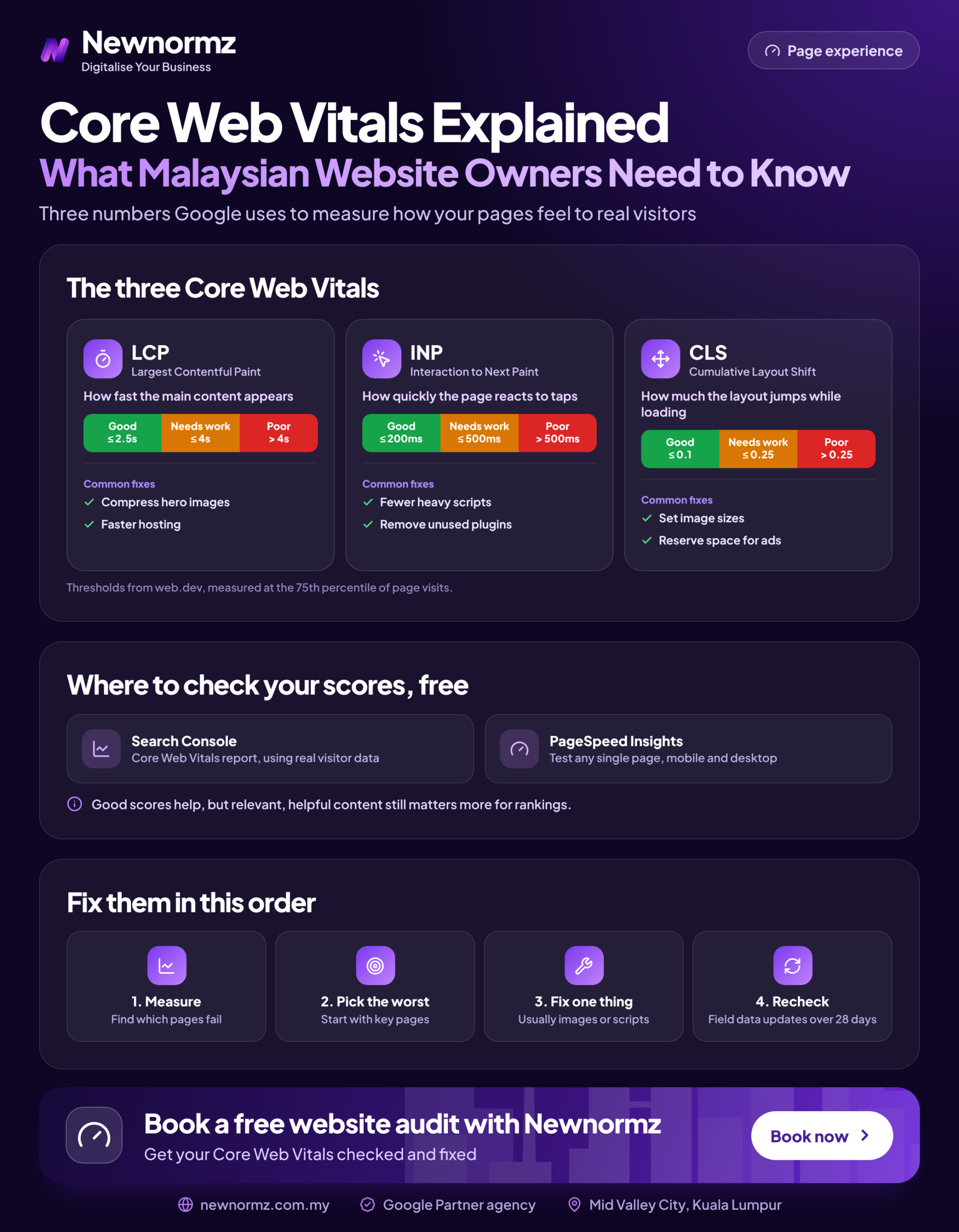
Google measures three things about how a page feels to a real visitor. The first is how quickly the main content appears. The second is how quickly the page responds when someone taps it. The third is whether the layout jumps around while it loads. Google publishes a threshold for each one.
| Metric | What it measures | Good | Needs improvement | Poor |
|---|---|---|---|---|
| Largest Contentful Paint (LCP) | When the biggest visible element finishes loading | 2.5s or less | 2.5s to 4s | Over 4s |
| Interaction to Next Paint (INP) | How quickly the page visibly responds to taps, clicks and keypresses | 200ms or less | 200ms to 500ms | Over 500ms |
| Cumulative Layout Shift (CLS) | How much the layout moves unexpectedly while the page loads | 0.1 or less | 0.1 to 0.25 | Over 0.25 |
A page passes only when all three metrics are “good” at the 75th percentile of visits. That means at least three out of four real visits must hit the mark, not just your best visit on office Wi-Fi. Mobile and desktop are scored separately, and for most Malaysian SMEs it is the mobile score that fails.
If you searched for “LCP FID CLS Malaysia”, the list you are working from is out of date. Google retired First Input Delay, and INP replaced FID as the responsiveness metric on 12 March 2024. INP is stricter because it looks at every interaction during the visit, not only the first one. If your developer still reports FID, read this fuller breakdown of what changed when INP replaced FID.
Before You Audit: What Passing Will and Won’t Do for Your Rankings
Here is the honest version. Google’s own Search documentation describes Google page experience as a group of signals, not one ranking factor, and it says Google will still rank the most relevant, helpful page even when that page’s experience is weaker. Google has also said publicly that no one can guarantee a ranking position. Be wary of anyone who promises a ranking jump from a speed fix alone.
The Core Web Vitals ranking factor is real, but it is small. It matters in close contests: when two pages answer a query equally well, the faster and more stable page tends to win. That happens mostly on mobile, because Google indexes the mobile version of your site. For the background, here is how mobile-first indexing works for Malaysian sites.
The 20-Minute Core Web Vitals Test: Four Checks
Run these checks in order. Check 1 tells you whether you have a real problem. Checks 2 to 4 tell you where the problem comes from.
Check 1: Are You Looking at Field Data or Lab Data?
Most bad decisions about Core Web Vitals start at this step. Field data comes from real Chrome users through the Chrome UX Report (CrUX). Lab data comes from Lighthouse, which simulates a single page load on a throttled phone. Google’s ranking systems use field data.
Field data check
- ✓Open the Core Web Vitals report Search Console builds from CrUX data, under Experience in the left menu. Read the Mobile chart first, then Desktop.
- ✓Note how many URLs are Poor, Need improvement and Good. Then open each issue group to see which page templates are affected.
- ✓Read the PageSpeed Insights field data (the real-users section at the top) before you look at the Lighthouse performance score.
- ✓If the page shows no field data, switch to the Origin view to see the figures for your whole site.
- ✓Only if origin data is also missing, run Lighthouse on mobile. Treat the result as a rough guide, not a verdict.
- ✓Write down today’s date. CrUX uses a rolling 28-day window, so any fix takes about four weeks to show in full.
The step people skip is the “not enough usage data” message. It is common on Malaysian SME sites with a few thousand visits a month, because CrUX only reports pages that get enough Chrome traffic. The message does not mean you are failing. It means Google has little real-world data about your site. In that case a red Lighthouse score is a reason to look closer, not proof of a ranking problem. Search Console and PageSpeed Insights are both free, and here are some other free SEO tools worth installing alongside them.
Check 2: LCP on a Mid-Range Android Over Malaysian 4G
Largest Contentful Paint measures when the biggest visible element finishes loading. That element is usually a hero image or the main headline. Most of your customers browse on mid-range Android phones over mobile data, not on the new iPhone and office fibre your designer tested with. That is why Core Web Vitals mobile scores fail far more often than desktop ones.
LCP check
- ✓Home page hero slider with three or more full-width images.
- ✓Banner images uploaded straight from the designer at several megabytes each, with no WebP or AVIF version.
- ✓Lazy loading switched on for the hero image, which delays the exact element LCP measures.
- ✓Cheap shared hosting in the US or Europe with no CDN, so every request crosses an ocean before the page can start loading.
- ✓Chinese web fonts loaded in full on an English and Chinese bilingual site.
- ✓Slow server response time flagged in the PageSpeed Insights diagnostics.
Two items on this list are often misread. Lazy loading helps images further down the page but hurts the hero image, yet many WordPress speed plugins apply it to every image. Chinese fonts are the second. A Latin font file is usually tens of kilobytes, while a full Chinese font covering thousands of characters can run to several megabytes. On a bilingual site, a Chinese font that hasn’t been subset can be the biggest single cost to LCP. The actual fixes are speed work, and our separate guide covers how speed shapes user experience in more depth.
Check 3: INP and the Widgets Malaysian Sites Stack Up
Interaction to Next Paint measures how long the page takes to respond visibly after a tap, click or keypress. Poor INP shows up as a menu that ignores the first tap or a WhatsApp button that freezes. The cause is almost always JavaScript competing for the phone’s processor.
INP check
- ✓A floating WhatsApp button plugin plus a separate live chat widget doing the same job.
- ✓Meta Pixel, TikTok Pixel, the Google Ads tag and GA4 each hard-coded separately instead of loaded through one tag manager.
- ✓Popup builders firing on page load for newsletter, voucher and exit-intent offers.
- ✓Heavy Elementor add-on packs where only one or two widgets are in use.
- ✓Tracking tags left behind by past agencies or campaigns that ended long ago.
- ✓On Shopify, uninstalled apps that left script snippets in the theme code.
The most useful task in this check is simple. List every third-party script on the site and write next to each one who still uses it. Expect to find several that nobody owns. This is where most Core Web Vitals WordPress problems come from, because every plugin can add its own scripts to every page without telling you.
Check 4: CLS From Promo Bars, Cookie Banners and Late Images
Cumulative Layout Shift measures how much the page jumps around while it loads. It is why someone taps “Add to cart” and hits a banner instead.
CLS check
- ✓A sale or free-shipping bar inserted above the header after the page has started rendering.
- ✓PDPA cookie notices that push content down instead of sitting over the bottom of the screen.
- ✓Images, YouTube embeds and Google Maps iframes with no width and height set.
- ✓Web fonts that swap in late and reflow headings, which is common with Chinese and decorative fonts.
- ✓Review widgets or ad slots that load into empty space with no height reserved for them.
The cookie banner is the item people get wrong. Many Malaysian sites added a notice as a top bar for PDPA compliance, and it shifts the whole page on every first visit. Moving it to a bottom overlay fixes the shift without removing the notice. CLS problems often come with other technical SEO issues that are worth checking at the same time.
How to Prioritise What the Core Web Vitals Test Finds
Rank each fix by what it is worth in ringgit and what it costs to make, not by which score shows the most red. Here is how the usual findings compare.
| Issue | Metric affected | Ranking / conversion impact | Effort |
|---|---|---|---|
| Oversized hero image or slider | LCP | High for mobile conversions; can tip close rankings | DIY |
| Overseas shared hosting with no CDN | LCP | High, because it affects every page | Developer |
| Full Chinese web font on a bilingual site | LCP, CLS | Medium to high on CN pages | Developer |
| Stacked chat, pixel and popup scripts | INP | Medium; slows taps on enquiry buttons | DIY inventory, developer removal |
| Page builder bloat (Elementor add-ons) | INP, LCP | Medium | Developer |
| Promo bar or cookie banner shifting content | CLS | Low to medium; causes mis-taps | DIY |
| Images and embeds with no dimensions | CLS | Low to medium | DIY |
| Failing templates across hundreds of product or category URLs | All three | High where many pages compete | Agency with developer |
Most SMEs stall on the rows marked developer or agency, because those fixes touch templates, hosting or tracking that someone else set up. Our SEO agency in Malaysia team handles this as part of technical SEO, together with crawling and indexing.
Technical foundations still matter when no single score explains the result. For Sunway TCM Centre, a technical rebuild plus crawl and indexing fixes helped put 80% of target keywords on page 1 within 4 months. We don’t credit that to Core Web Vitals scores. It shows what becomes possible once the technical basics work.
Worked Example: What a Faster LCP Is Worth in Ringgit
This is an illustration, not a study. Take an online store with 12,000 mobile sessions a month, a 1.2% conversion rate and an average order of RM180. That works out to 144 orders, or RM25,920 a month.
Now assume that fixing a 5-second mobile LCP lifts conversion to 1.4%. That figure is an assumption, and your real lift could be higher, lower or zero. The store would get 168 orders, or RM30,240, which is about RM4,320 more each month from a one-off fix. At 1,500 sessions a month the same lift is worth around RM540 a month. That is the decision rule: the more mobile traffic you have, the faster an LCP fix pays for itself.
Not sure which of these issues is behind your Poor URLs? We’ll go through your Search Console report and rank the fixes by ringgit impact.
From Our Audits: The Speed Plugin That Broke the Site
From our audits
We keep seeing two mistakes. The first is stacking a caching plugin, a minify plugin and a lazy-load plugin, all of which do overlapping jobs, until menus or layouts break. The second is rebuilding the whole site “for speed” and changing every URL in the process. The fix is to change one thing at a time, then re-check field data after 28 days before you change the next.
Client example
My Lovely Baby: 100% of lost traffic recovered after a site upgrade
Problem: A site upgrade broke URLs, and traffic dropped overnight.
What we did: A full migration audit and recovery to restore the broken URL paths and the rankings attached to them.
Result: 100% of the lost traffic recovered, and 85% of target keywords on page 1 within 9 months for terms such as “baby shop”, “baby stroller” and “baby car seat”.
The lesson is simple: never redesign a site for speed without a URL migration plan. A faster site with broken URLs loses far more than a slow site that keeps its rankings. If this has already happened to you, start with this guide to recovering from a ranking drop.
Core Web Vitals FAQ
Are Core Web Vitals a ranking factor in Malaysia?
Yes, but they are a minor one, and Google uses the same signals in Malaysia as everywhere else. Google’s documentation says its ranking systems use Core Web Vitals but still favour the most relevant, helpful content. In practice they mostly decide close contests on mobile.
Is FID still part of Core Web Vitals?
No. Interaction to Next Paint (INP) replaced First Input Delay on 12 March 2024. A tool or report that still shows FID is out of date and tells you nothing about how Google assesses your site today.
Why does Search Console say there is not enough usage data for my site?
It means not enough real Chrome visits reached those pages in the last 28 days for the Chrome UX Report to publish figures. This is common for smaller Malaysian sites and does not mean you are failing. Check origin-level data in PageSpeed Insights first, then use Lighthouse on mobile as a rough guide.
Does a 100 PageSpeed Insights score improve my Google ranking?
No. The 100 score comes from Lighthouse, which runs a lab simulation, while Google’s assessment uses field data from real visitors. A page that scores 70 in the lab can pass in the field, and a page that scores 100 can fail on real phones.
Does hosting my website in Malaysia or Singapore improve Core Web Vitals?
It can improve LCP by cutting server response time for Malaysian visitors, especially if you are moving away from US or European shared hosting. A CDN with nearby edge servers often gives most of the same gain without changing host. Neither will fix heavy images or too many scripts.
If you’d rather have someone run these four checks for you, our free SEO audit reviews your Search Console Core Web Vitals report, checks your mobile field data, lists every third-party script on your site and checks crawling and indexing. This work falls under Architecture, the technical SEO stage of our RANKED Framework. Technical fixes usually happen in weeks 2 to 6, and the first ranking movement tends to appear between day 60 and day 90.
Find out whether your Core Web Vitals are costing you rankings or just showing red
Newnormz runs SEO for 200+ Malaysian businesses on month-to-month terms, with a written page 1 guarantee and a 5.0 rating from 214+ Google reviews.
No obligation and no lock-in contract.

Bryan Tan is an SEO Specialist and CEO at Newnormz, helping hundreds of businesses achieve first-page rankings on Google. With a passion for driving organic growth, Bryan blends innovative strategies with hands-on experience to optimize websites for maximum visibility. Always at the forefront of the latest SEO insights and trends, he consistently adapts to the evolving digital landscape.