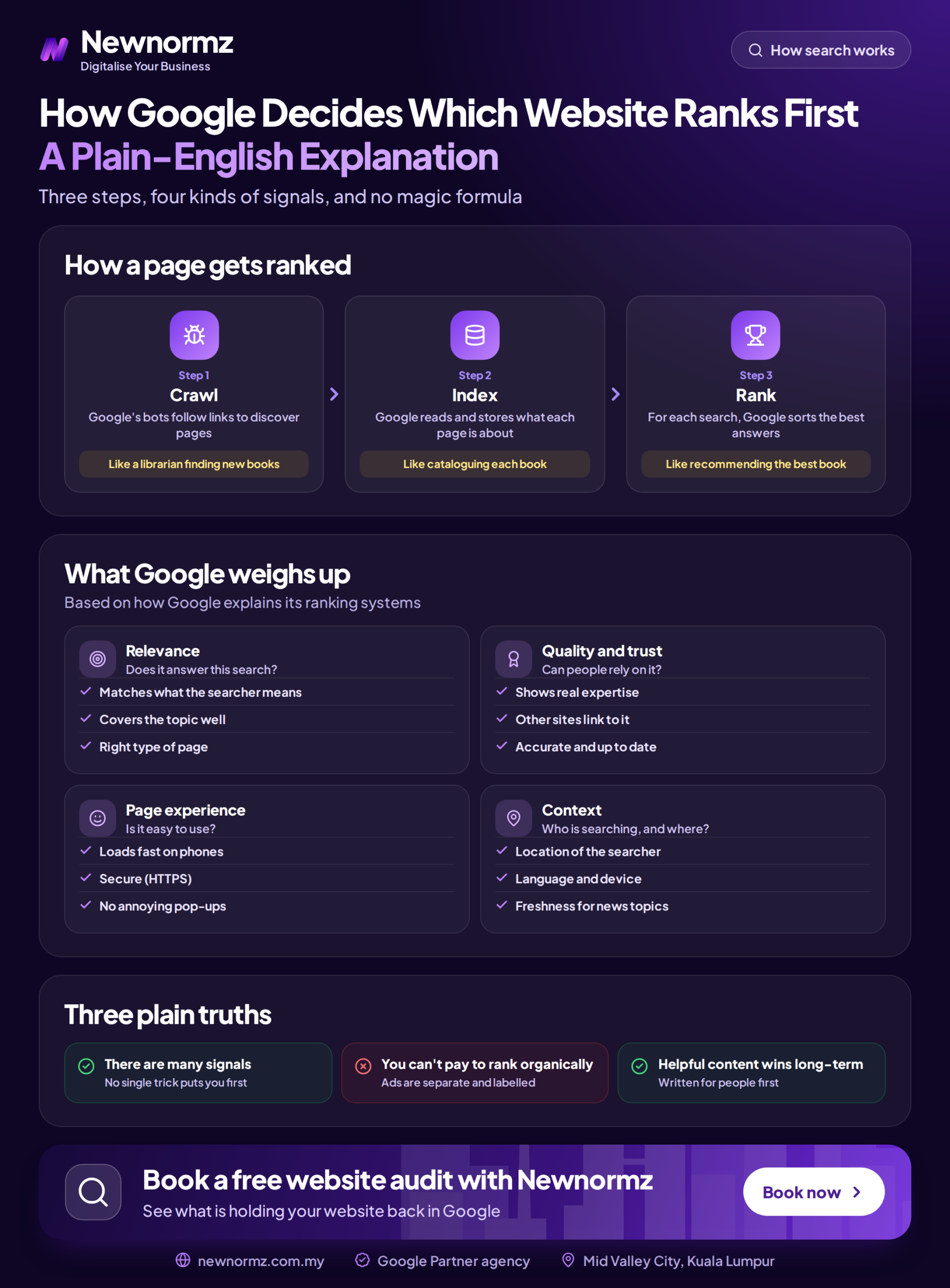
If you searched “how does Google rank websites Malaysia”, the short answer is four stages, one after the other. Google finds your page, stores it in its index, works out what the page means, and then ranks it against every other indexed page for one searcher’s query, location, language and device. Google’s own “How Search Works” documentation calls these steps crawling, indexing and serving results. Statcounter puts Google at roughly 93 to 96% of Malaysian search, so this process decides most of your organic traffic. If your site isn’t ranking, one of those stages is broken, and you can work out which one.
How Does Google Rank Websites in Malaysia? The Four Stages Every Page Must Pass
Most ranking advice treats Google like a scoring machine: add keywords, get backlinks, wait. It works more like a series of gates. A page that fails stage one never gets to stage two, and a page Google doesn’t understand never competes in stage four, however good the writing is.
That’s why “why is my website not ranking” has no single answer. The useful question is which stage your page is stuck at.
Stage 1: Googlebot Has to Find the Page Before Anything Else Counts
Googlebot is the program Google uses to discover pages. It finds them mainly by following links from pages it already knows about, and by reading your XML sitemap. If your robots.txt file blocks a folder, Googlebot won’t fetch anything inside it.
Google crawling and indexing are two separate steps, and plenty of Malaysian sites fail the first one without knowing it. The usual case is a business that adds a new service page, say “office renovation Puchong”, but never links to it from the menu, the homepage or any related page. To Google, a page with no internal links pointing to it may as well not exist.
Stage 2: Being Found Isn’t the Same as Being Indexed
Once Googlebot has fetched a page, Google decides whether to store it in Google’s index. Many pages don’t make it. Near-duplicate pages, thin pages with a few lines of text, and pages carrying a “noindex” tag (often left on by a developer after a redesign) get crawled and then left out.
Google also uses mobile-first indexing, which means it stores and judges the mobile version of your page, not the desktop one. If your mobile layout hides content in tabs that never load, or drops whole sections, that missing content doesn’t count. Most Malaysian customers search on their phones anyway, so Google indexes the mobile version first for a good reason.
Stage 3: Google Has to Understand What You Actually Offer
An indexed page still needs Google to work out what it’s about and who it serves. Clear headings, plain service and location wording (“dental implants in Petaling Jaya” rather than “smile solutions”), and schema markup that labels your business, services and address all help Google connect your page to the right searches.
Language makes this harder in Malaysia. A page written only in English may not be treated as the best match for a Bahasa Malaysia query like “klinik gigi murah PJ”, and a Chinese-language query may return a different set of winners again. If your customers search in more than one language, you need a plan for ranking in English, BM and Chinese, not one page and a translation plugin.
Being understood also means matching search intent. Oriental Kopi’s content was built around the exact terms its buyers search for, such as “kopi”, “white coffee” and “3 in 1 coffee”, with full schema markup, and its ranked keywords grew 350%.
Stage 4: The Ranking Itself, Decided for One Searcher at a Time
Only now does ranking happen. Google’s documentation on how results are generated groups its main considerations into five areas:
- Meaning: what the searcher actually wants, including spelling fixes and synonyms.
- Relevance: whether your page covers that need better than the alternatives.
- Quality: signals of expertise and trust (what Google calls E-E-A-T), including backlinks, which feed Google’s original PageRank idea that links act as votes.
- Usability: mobile-friendliness and page experience, measured partly through Core Web Vitals.
- Context: the searcher’s location, language, past searches and settings.
Context is the part most guides skip, and in Malaysia it carries a lot of weight. Someone searching “aircond service” in Bangsar and someone searching the same words in Georgetown will see different results, because Google uses location to rank both the Google Business Profile listings in the local pack and the regular results under it. This is why the local search results Malaysia users see can change from one neighbourhood to the next. These Google ranking factors in Malaysia work on every search, every time.
There is no single ranking for your keyword. There is a ranking for each searcher.
The Google Ranking Factors Malaysia Businesses Actually Control
Search for “Google ranking factors 2026” and you’ll find lists of 200 items, most of them guesswork. Google keeps most of its weighting private, and leaked internal documents have fuelled even more speculation. If you’re curious, you can read what the Google algorithm leak revealed, but treat it as background. The table below sticks to what Google documents and what you can change on your own site.
| Ranking factor | What Google is checking | What it looks like on a Malaysian site | Effort to fix |
|---|---|---|---|
| Indexability | Can the page be crawled and stored? | Noindex tags left on after a redesign, broken sitemaps | Low, once found |
| Search intent match | Does the page type fit what searchers want? | A blog post trying to rank for “lawyer KL” when Google shows firm service pages | Medium |
| Content depth | Does it answer the question fully and credibly? | Service pages with three lines of text and no prices, process or areas served | Medium |
| Internal links | Which pages the site itself treats as important | Key services only reachable through a WhatsApp button or a PDF | Low |
| Backlinks and mentions | Whether other trusted sites vouch for you | No coverage in Malaysian media, associations or supplier sites | High, ongoing |
| Page experience on mobile | Loading speed, stability, ease of use (Core Web Vitals) | Heavy sliders and pop-ups that crawl on a mid-range phone over mobile data | Medium |
| Local signals | Proximity, relevance and prominence for map results | Unverified Google Business Profile, wrong category, few reviews | Low to medium |
| Language match | Whether a page exists in the language of the query | English-only site losing BM and Chinese searches to smaller competitors | Medium to high |
From our audits
One pattern comes up again and again. A business spends months buying backlinks or publishing two blog posts a week, while the service pages that bring in money are stuck at stage 1 or 2: not linked internally, excluded from the index, or set to noindex. Authority can’t help a page Google hasn’t stored. Check the first two stages before you spend a ringgit on stage four.
What This Looks Like in Practice: Two Malaysian Sites, Two Different Broken Stages
Both of these were Newnormz campaigns. Neither was fixed by writing more content.
Client example
Sunway TCM Centre: 80% of target keywords on page 1 within 4 months
Problem: The site’s trouble sat in the technical stages, where crawling and indexing problems held back pages that should have been competing.
What we did: A technical rebuild, crawl and indexing fixes, and AEO structuring so Google could understand each treatment page.
Result: +150% keywords, 80% of target keywords on page 1 within 4 months, with rankings for “TCM Malaysia”, “Acupuncture KL” and “Best TCM in Klang Valley”.
Client example
My Lovely Baby: 100% of lost traffic recovered
Problem: A site upgrade broke the URLs, so stages 1 and 2 failed overnight and traffic dropped with them.
What we did: A migration audit and recovery to reconnect the old URLs and get the pages crawled and indexed again.
Result: 100% of lost traffic recovered and 85% of target keywords on page 1 within 9 months, including “baby shop”, “baby stroller” and “baby car seat”.
To see what a lost position costs, here is some illustrative arithmetic, not a client figure. Say a keyword would cost RM2.00 per click in Google Ads, and the top organic result for it gets around 800 visits a month. That position is worth roughly RM1,600 a month in traffic you would otherwise pay for, every month you hold it. If you have ten keywords like that, a broken migration could be costing you RM16,000 a month without anyone noticing.
Recovery work like this means going through redirect maps, index reports and crawl logs page by page. If you’d rather not do it yourself, that is the kind of work an SEO agency in Malaysia should be able to scope for you before charging anything.
Why Is My Website Not Ranking? Match the Symptom to the Stage
Business owners often ask whether the Google algorithm Malaysia sites face is somehow different from the one used in Singapore or the US. It isn’t. The same systems run everywhere, with local context layered on top. So before you blame the algorithm, your competition or your copywriter, find out where the chain breaks. These rules cover the problems we see most often. Most can be checked for free with a site: search and Google Search Console.
How Long Google Takes to Move Your Rankings (and Why It’s Never Overnight)
Every fix has to wait for Google to recrawl, reindex and reassess the page, so results come in phases. The timeline Newnormz gives clients is this: technical fixes in weeks 2 to 6, first ranking movement around day 60 to 90, traffic and lead growth in months 4 to 8, and compounding authority from months 8 to 12 onward.
Be wary of anyone who promises faster. Google’s own guidance on hiring an SEO says no one can guarantee a specific ranking position. If you’re starting with a domain that has no history, expect the slower end of that range, and read our guide to getting a brand new site ranked.
How Google’s Ranking Now Feeds AI Overviews
Google AI Overviews don’t skip the four stages. They draw on them. Industry studies put about 76% of AI Overview citations as coming from pages already in the traditional top 10, so a page that fails crawling, indexing or understanding is unlikely to be quoted in an AI answer either.
Sunway TCM Centre is a good example: once the technical stages were fixed and the content was structured for answers, it started appearing in Google AI Overview results for treatment searches. Other AI tools choose their sources in their own ways, so read up on how AI search picks its sources before you plan content for them.
What to Do Next: A 20-Minute Check of Your Own Site
Most advice on how to rank higher on Google Malaysia-wide jumps straight to fixes. Run these checks first. They won’t fix anything, but they’ll tell you which stage is failing before you spend money.
Your four-stage diagnostic
- ✓Run URL Inspection in Google Search Console on your most important service page and confirm it says the page is on Google.
- ✓Open the Page indexing report and look at the pages listed as not indexed, especially anything excluded by a noindex tag.
- ✓Search site:yourdomain.com on Google and count whether all your service pages appear.
- ✓Load your key page on your own phone over mobile data and check that all the content and the WhatsApp button work.
- ✓Search your main keyword in English and in BM, both in regular search and in Google Maps, and note who wins each.
- ✓Make sure every service you sell has its own page, not just a line on a general “Services” page.
- ✓Compare the dates of any traffic drop in Search Console with your last redesign, plugin change or hosting move.
Frequently Asked Questions About How Google Ranks Websites
How does Google Search work, in plain terms?
Google Search works in three steps: it crawls the web to find pages, indexes the ones it decides to keep, and serves the most useful indexed pages for each query. Understanding what each page means happens between indexing and serving, which is why this guide treats it as a separate fourth stage.
How does Google decide which website ranks first?
Google ranks first the indexed page it judges to best meet that searcher’s intent, considering relevance, quality, usability and the searcher’s context. The “best” page can change with the searcher’s location, language and device, so first place isn’t fixed.
How many ranking factors does Google use?
Google has never published a full list or the weights. The “200 factors” figure comes from Google comments made years ago, and Google now describes ranking as a set of systems rather than a checklist. For ranking factors in 2026, focus on what it documents: search intent, relevance, quality, usability and context.
Why is my website not showing on Google at all?
If your site doesn’t show up at all, Google either hasn’t crawled it or has chosen not to index it. The usual causes are a noindex tag, a robots.txt block, a missing sitemap or a brand-new domain. URL Inspection in Search Console will tell you which.
How long does it take to rank on Google in Malaysia with a new website?
Expect first ranking movement around 60 to 90 days after the technical basics are fixed, with real traffic growth from months 4 to 8. New domains with no links or history usually take longer than established sites, and competitive keywords take longest.
Does Google rank Bahasa Malaysia and English pages separately?
In practice, yes. Google tries to match the language of the query, so a BM search is mostly answered with BM pages. An English page can still rank for mixed-language queries, but a dedicated BM page usually wins for BM searches.
Can you pay Google to rank higher in the organic results?
No. Google Ads buys you a place in the sponsored slots, which are labelled, but it has no effect on organic rankings. Organic positions are earned by passing the four stages better than competing pages.
Find out which of Google’s four stages your site is stuck at
Newnormz runs SEO for 200+ Malaysian businesses on month-to-month terms, with a written page 1 guarantee and a 5.0 rating from 214+ Google reviews. If the agreed target keywords are not on page 1 within 12 months, the team keeps working free until they are.
No lock-in contracts. Or WhatsApp +60 17-588 2291.

Bryan Tan is an SEO Specialist and CEO at Newnormz, helping hundreds of businesses achieve first-page rankings on Google. With a passion for driving organic growth, Bryan blends innovative strategies with hands-on experience to optimize websites for maximum visibility. Always at the forefront of the latest SEO insights and trends, he consistently adapts to the evolving digital landscape.