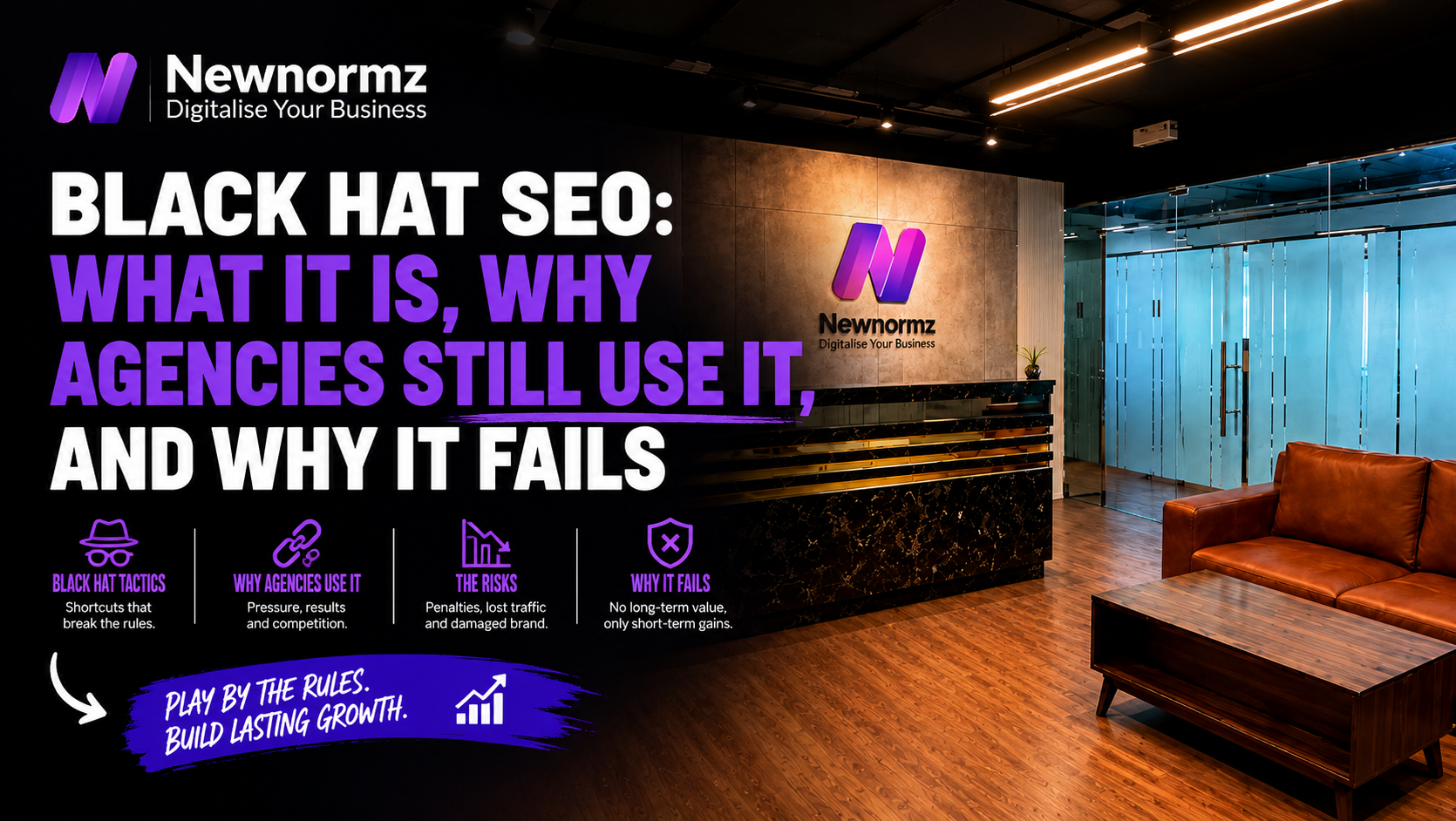
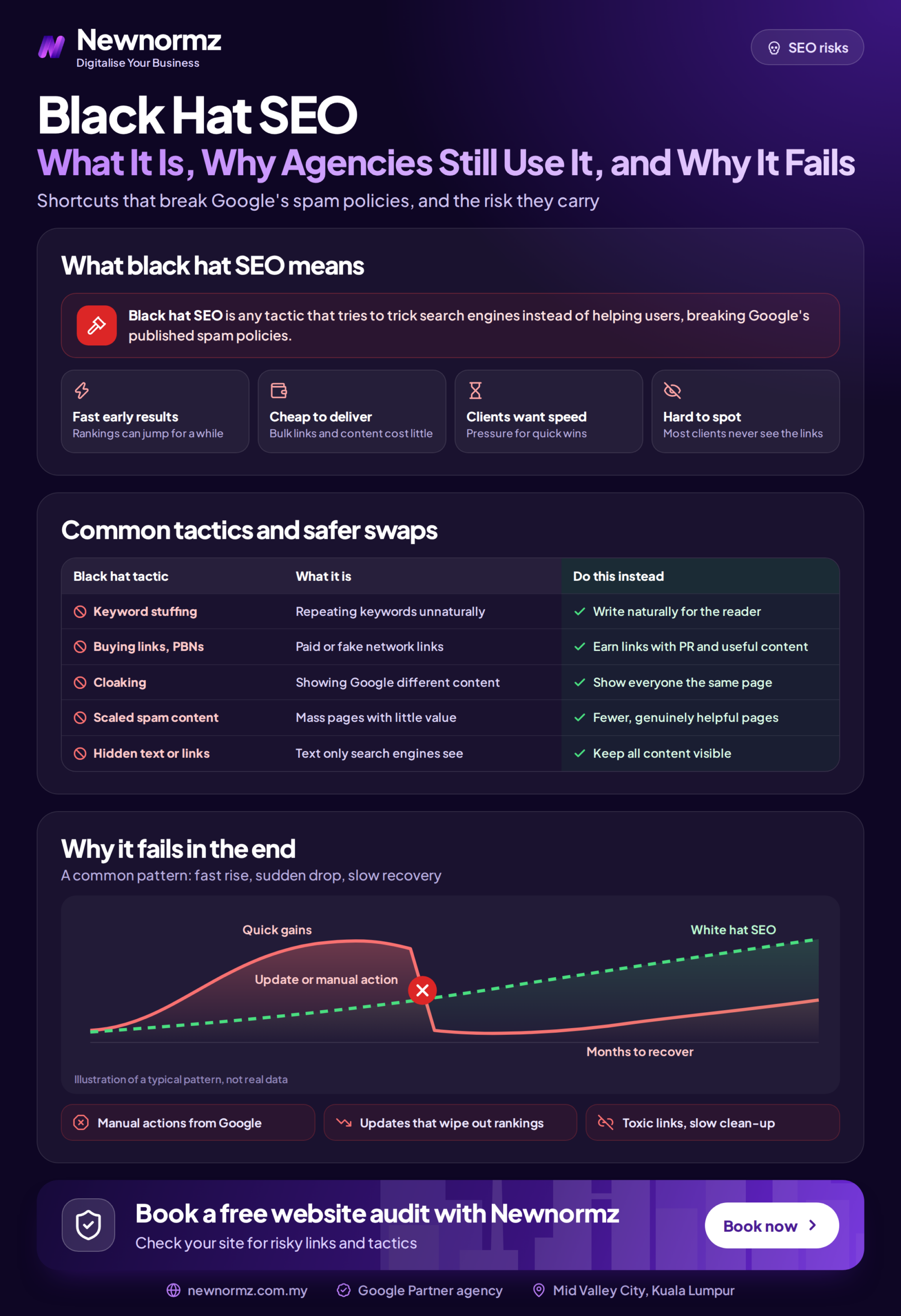
Black hat SEO means trying to rank by tricking Google instead of earning the ranking. Common examples are buying links, publishing mass-produced pages, hiding keywords, and posting fake reviews. Some agencies still sell it because it can move rankings fast, it costs them very little, and many clients can’t tell the difference until it’s too late. It fails because Google is built to find this kind of manipulation. When it does, the gains disappear and your site can end up worse off than before you started. Your domain is the one that carries the penalty, not the agency.
A Simple Way to Think About It
The Fake Queue vs the Real One
🎭 The hired queue
A new stall at the food court pays twenty people to stand in line every lunchtime. It looks like the busiest stall in the building, right up until mall management notices and shows it the door.
🍜 The real queue
The stall next door has a queue because the food is good. It grew slowly, but every person in that line came back, and they brought friends.
Google is the mall management here, and it is far better at spotting hired queues than most business owners realise. Here’s how that works in practice.
What black hat SEO actually is
Google publishes its spam policies openly. Black hat SEO is anything that breaks them on purpose: tactics built to make a page look more relevant or more trusted than it really is, so it ranks higher than it deserves to.
The white hat versus black hat split isn’t really about which tools you use. It comes down to intent. If you’re building something useful and helping Google understand it, that’s legitimate SEO. If you’re building signals that only exist to fool the algorithm, that’s black hat, however it gets packaged in a sales deck.
There is a grey area in between, and agencies love to hide there. “Guest posting” can mean real editorial placements, or it can mean paying a link farm that publishes for anyone. The label doesn’t tell you much. What’s actually being done tells you everything.
The tactics you’ll still see sold in Malaysia
None of these are new. They keep coming back under new names because they’re cheap to deliver and easy to report on in a monthly PDF.
| Tactic | How it’s usually pitched | What’s really happening |
|---|---|---|
| Private blog networks (PBNs) | “High-authority backlinks from our network” | Sites set up only to link out, often on expired domains that were bought for their old authority |
| Bulk link packages | “500 backlinks for a few hundred ringgit” | Automated spam links in comments, forums, and directories that nobody reads |
| Mass-produced content | “100 SEO articles a month” | Spun or unedited AI pages produced at volume. Google calls this scaled content abuse |
| Doorway pages | “A landing page for every area in the Klang Valley” | Near-identical pages where only the town name changes: Cheras, Puchong, Subang, Shah Alam |
| Keyword stuffing and hidden text | “On-page keyword optimisation” | English, Bahasa Malaysia, and Chinese keyword variants crammed into footers or hidden in white-on-white text |
| Fake reviews | “Reputation boosting for your Google profile” | Paid or made-up five-star reviews on your Google Business Profile |
The last two are the ones Malaysian SMEs get caught by most often, because they’re sold as part of local SEO. Real local SEO builds genuine reviews, accurate listings, and location pages that actually say something different about each area. A page that only swaps “Petaling Jaya” for “Seremban” and changes nothing else doesn’t count.
Why agencies still use it
If black hat SEO fails, why is it still everywhere? The incentives explain it.
It produces a nice-looking first report
Buying a batch of links can push a page up for a while, sometimes within weeks. An agency on a monthly retainer needs something to show you by month two. Honest SEO usually takes longer to show results, and some agencies would rather not have that conversation with you.
It’s cheap to deliver
Writing content that actually answers a customer’s question takes skill and time. Earning a link from a real Malaysian publication takes relationships. A link package from an overseas vendor takes a credit card. When an agency charges RM500 a month and still makes a profit, work like this is often how.
The client carries the risk, not the agency
This is the uncomfortable part. When a penalty lands, it lands on your domain. The agency has usually been paid, and the contract has often ended by then. Some are open about running on churn: collect the fees, show a spike, and move on before it crashes.
Guarantees sell
“Number one on Google in 30 days” closes deals. Google has said publicly, more than once, that nobody can guarantee a specific ranking position. An agency promising you the top spot is either misunderstanding how search works or planning to hit that spot by any means available.
Why it fails
Google holds roughly 93% of the Malaysian search market (Statcounter, May 2026). Being penalised by Google isn’t like losing one channel among many. For most businesses here it means dropping out of search altogether.
Google detects this automatically now
Google has publicly described SpamBrain, its AI-based spam detection system, and it names link spam and scaled content as specific targets. In 2024 Google widened its spam policies to cover scaled content abuse, expired domain abuse, and site reputation abuse by name. The tactics in the table above aren’t loopholes. They’re on a published list of things Google is actively looking for.
Two kinds of damage
The first kind is algorithmic. Google quietly ignores or devalues the manipulative signals, so the rankings you paid for fade and you’re never told why. The second is a manual action: a human reviewer flags your site, and a notice shows up in Google Search Console. A manual action can drop certain pages, or your whole site, out of the results.
Cleaning up costs more than the shortcut saved
Recovering means auditing every link, asking for removals, disavowing whatever you can’t remove, rewriting or deleting thin pages, and, for manual actions, sending a reconsideration request and waiting. It often takes months. Throughout that time you’re paying for recovery work instead of growth, and your competitors keep moving.
What the durable alternative looks like
Legitimate SEO is slower at the start and compounds over time. Every useful page and every earned link keeps paying off, instead of sitting there waiting to be detected.
Oriental Kopi is a good example of the timescale. Over a two-year campaign, the brand grew traffic by 43,300, reached 6.31 million impressions, gained 24,500 more ranking keywords, and earned 468,000 clicks. Shorter campaigns can show real movement too: Sunway Medispa saw a 700% traffic increase in six months. Neither result came from a hired queue, and neither one has to be defended against the next spam update.
If you’re weighing up an SEO agency in Malaysia, the most useful thing you can do is ask exactly how the work gets done.
| Question to ask | Red flag answer |
|---|---|
| Where will our backlinks come from? | “Our network” or a fixed number of links every month, with no named sites |
| Can you guarantee the number one position? | “Yes” |
| Who writes our content, and who checks it? | Dozens of articles a month, with no mention of anyone editing or checking facts |
| Will we have access to Google Search Console? | Reluctance to share access, or reports built only from their own tools |
Frequently asked questions
How do I know if my previous agency used black hat SEO?
Look in Google Search Console first. The Manual Actions report will tell you if a reviewer has flagged the site. Next, check the Links report for sudden spikes, unrelated foreign sites, or dozens of links with the exact same keyword as anchor text. Also look for thin location pages or articles nobody on your team remembers approving.
Is using AI to write content black hat?
Not in itself. Google’s position is that it cares about whether content is helpful, not how it was produced. The trouble starts when AI is used to churn out large numbers of unedited pages mainly to rank. That falls under scaled content abuse.
Can a competitor hurt my site with spammy links?
Google has said its systems are built to ignore most random spam links rather than penalise the site they point to. If you see a large, deliberate attack, the disavow tool in Search Console is there for that. Most sites never need to use it.
Is it faster to start a new domain than to fix a penalised one?
Occasionally, if the old domain is badly burned and has little brand value. Usually, though, a proper cleanup is the better option, because a new domain starts with no history at all. Moving the same tactics to a fresh domain just starts the countdown again.
Not sure what your last agency did to your site?
Find out before Google does, then build rankings that last.
Newnormz has run SEO campaigns across F&B, healthcare, ecommerce, and local services in Malaysia, backed by a performance guarantee of 70 percent of targeted keywords on Google’s first page.
30 minutes, no obligation, including a check of your backlinks and any manual actions.

Bryan Tan is an SEO Specialist and CEO at Newnormz, helping hundreds of businesses achieve first-page rankings on Google. With a passion for driving organic growth, Bryan blends innovative strategies with hands-on experience to optimize websites for maximum visibility. Always at the forefront of the latest SEO insights and trends, he consistently adapts to the evolving digital landscape.