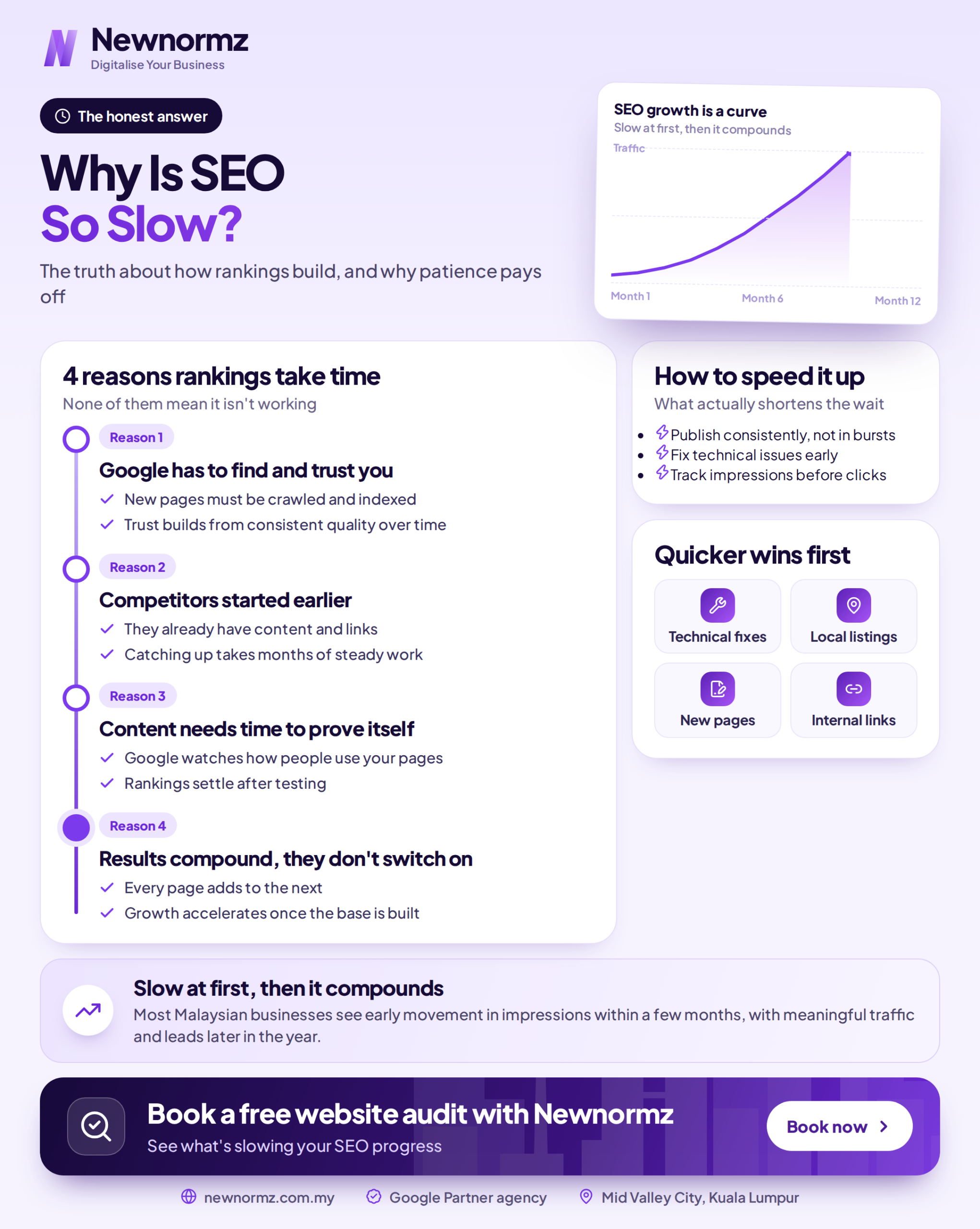
SEO is slow because Google does not trust a new page or a new change immediately. It takes weeks just to crawl and index your content, months to gather enough trust signals like backlinks and real user behaviour, and even longer to out-rank competitors who started earlier. The part most business owners miss is what happens after that: once those trust signals build up, rankings become far more stable and keep paying off long after the initial work is done.
A Simple Way to Think About It
SEO Is Like Growing Bamboo, Not Flipping a Light Switch
💡 Paid Ads Is Flipping a Switch
Turn it on and the light is instant. Turn it off and the room goes dark straight away. Google Ads works the same way: results appear the moment you pay, and disappear the moment you stop.
🎋 SEO Is Growing Bamboo
Chinese bamboo spends its first years building roots underground with almost nothing visible above the soil. Once those roots are strong enough, it can shoot up several feet in weeks. SEO works the same way: the early months build the roots, technical fixes, content, and trust signals, and the visible growth comes after.
This is exactly why SEO campaigns look slow at first, and then suddenly do not. The businesses that quit in month 2 are usually the ones who were closest to the growth phase.
Why Does SEO Actually Take So Long?
Every time you publish a page or fix something technical, Google does not simply “notice” it. A page has to be discovered, crawled, indexed, and then evaluated against every other page already ranking for the same keyword. That evaluation is not a one-time check either. Google keeps reassessing pages over weeks and months as it gathers more data on how real users interact with them.
On top of that, a brand-new page has zero history. No backlinks pointing to it, no user click data, no track record of being useful. Google is deliberately cautious about ranking pages with no history highly, because that is exactly the kind of gap spam sites try to exploit. Earning that trust takes time, not tricks.
The Real Timeline: What Is Actually Happening Behind the Scenes
This is the part most agencies do not explain clearly. Here is what is actually happening at each stage, even when it looks like nothing is changing on the surface.
| Timeframe | What Is Happening Behind the Scenes | What You Actually See |
|---|---|---|
| Month 1 to 2 | Technical audit, site structure fixes, and on-page optimisation | Little to no visible change |
| Month 2 to 4 | Google crawls and indexes new and updated pages | Small upticks in impressions, rankings still not visible |
| Month 4 to 6 | Content starts ranking for long-tail keywords, early trust signals build up | First keyword rankings appear, usually page 2 to 3 |
| Month 6 to 9 | Backlinks and real user engagement data accumulate | Rankings climb toward page 1 for target keywords |
| Month 9 onward | Compounding effect kicks in as authority and content library grow | Consistent traffic growth with less new effort required |
This pattern matches what we have seen across real Malaysian campaigns. A parking management company (Times Parking) barely moved in month 1 and 2, then grew to 528,000 impressions and 416 ranking keywords by month 6. An F&B brand (Oriental Kopi) looked slow for the first few months before reaching 6.31 million impressions and 468,000 clicks over 2 years. The slow start was never a sign that SEO was not working, it was the roots building.
Why Google Does Not Rank New Pages Immediately
Three things specifically slow Google down, and none of them are things an agency can simply skip past.
Crawl and index delay. Google has to physically discover your page exists, which can take days to weeks depending on how well your site is structured and how often Google already crawls it.
The trust gap. New pages, and especially new domains, go through what many SEOs call a sandbox period. Google is cautious about ranking anything highly until it has enough signals to know the page is genuinely useful, not spam.
Missing local and authority signals. For businesses that depend on nearby customers, local SEO signals like Google Business Profile reviews and citations take time to accumulate too, and Google weighs these heavily for local search results.
What Speeds SEO Up vs What Slows It Down
| Helps Your SEO Move Faster | Slows Your SEO Down |
|---|---|
| A technically healthy, fast website | Slow site speed and broken pages |
| Consistent publishing over months | Publishing once, then stopping |
| Content that matches real search intent | Content nobody is actually searching for |
| Backlinks from relevant, trusted sites | No backlink strategy at all |
| An established domain with real history | A brand-new domain with no track record |
Common Reasons Business Owners Think Their SEO Is Not Working
- Checking rankings too early. Looking for page 1 results in week 3 is checking before the roots have even formed.
- Comparing to a competitor with years of history. A domain that has been publishing since 2019 has a trust head start no amount of budget can buy back overnight.
- Judging by rankings alone. Impressions and click-through data often move weeks before rankings do, and that early movement is a sign things are working.
- Stopping right before the compounding phase. Most of the traffic gains we see happen after month 6, which is exactly when businesses under pressure tend to cancel.
Can You Make SEO Faster?
Not fundamentally, but you can avoid wasting the time you do spend. A technically clean site, content built around real search demand, and consistent publishing all shorten the path. What you cannot do is force Google to trust a brand-new page overnight, no agency can promise that honestly.
If you need leads while SEO is still building its roots, running Google Ads alongside your SEO campaign is the more realistic fix, not a faster SEO timeline. Many Malaysian businesses run both together for exactly this reason: ads cover the gap while the organic traffic compounds underneath.
Frequently Asked Questions
How long does it really take to see SEO results in Malaysia?
Based on real Malaysian campaigns, expect little visible movement in the first 2 months, early keyword rankings by month 4 to 6, and consistent compounding growth from month 9 onward.
Why did my rankings drop after a Google algorithm update?
Algorithm updates re-evaluate trust and quality signals across the entire web. A drop usually means a competitor’s page matched user intent better, not that your SEO stopped working, and this is a good moment to review content quality rather than panic.
Can I speed up SEO with more content or more backlinks?
To a point. Publishing consistently and earning genuine backlinks helps, but flooding a site with low-quality content or spammy links usually backfires and can slow you down further.
Why is my competitor ranking higher with a worse website?
Usually domain age, accumulated backlinks, or years of consistent content are doing the work, even if their current site design looks weaker. Rankings reward history as much as polish.
Should I pause SEO if I do not see results in the first 3 months?
This is usually the worst time to stop. Most Malaysian campaigns we have run start showing real movement between month 4 and 6, right after most of the early groundwork is done.
Does a brand-new domain take longer to rank?
Yes. A new domain has no history for Google to evaluate, so it typically takes longer to build the same trust an established domain already has, even with identical content quality.
Not Sure If Your SEO Timeline Is On Track?
Let us check the roots, not just the rankings.
Newnormz has run SEO campaigns across F&B, healthcare, ecommerce, and local services in Malaysia, backed by a performance guarantee of 70 percent of targeted keywords on Google’s first page.
30 minutes, no obligation, and we will tell you honestly where your SEO timeline stands.

Bryan Tan is an SEO Specialist and CEO at Newnormz, helping hundreds of businesses achieve first-page rankings on Google. With a passion for driving organic growth, Bryan blends innovative strategies with hands-on experience to optimize websites for maximum visibility. Always at the forefront of the latest SEO insights and trends, he consistently adapts to the evolving digital landscape.