SEO copywriting is writing built to do two jobs at once: satisfy the exact query a Malaysian buyer typed into Google, and then persuade that same buyer to book a call, request a quote, or make a purchase once they land on the page. Most business blogs only do the first job badly and skip the second entirely, which is why a company can publish for a year and still see flat traffic and zero enquiries. Getting this right means mapping keyword intent before writing a word, structuring the page for both Google’s crawlers and a skimming reader, and building separate strategies for English and Bahasa Malaysia searchers rather than translating one article into two.
A Simple Way to Think About It
The Shop in the Alley vs. the Shop on the Main Road
🚪 The shop hidden in the alley
Good products, a clean fit-out, a fair price. None of it matters because nobody walks past. Foot traffic never happens, so sales never happen either.
🪟 The shop on the main road
Same products, but people see it while walking to somewhere else, stop, and step inside. The location does half the selling before a single word is said.
The four elements below are what move a piece of content from the alley to the main road, and what keep a reader inside once they’ve stepped through the door.
What Is SEO Copywriting, Really?
SEO copywriting sits between two disciplines that most businesses hire for separately. Search engine optimisation governs where keywords go, how a page is structured, and what makes Google trust it enough to rank it. Copywriting governs whether a reader who arrives actually believes the business and takes the next step. A page can do only one of these well and still fail: an article stuffed with keywords reads like it was written for a robot, while a persuasive article with no search structure never gets found in the first place.
In Malaysia, there’s a third layer most agencies skip. Search behaviour splits across English and Bahasa Malaysia, and Google indexes and ranks each language as its own opportunity. A business writing only in English is invisible to a real, searching slice of its own market.
Want the mechanics behind this in more depth? Our guide to SEO services in Malaysia breaks down how content fits into a full campaign.
Why Rankings Alone Aren’t the Goal
A first-page ranking puts a business in front of people who are already looking to buy, not people scrolling past an ad they didn’t ask to see. That’s why organic traffic tends to convert better than most paid traffic: intent already exists before the click happens. But a ranking with no conversion path is just a vanity number. Content has to be built to move a reader from “found this on Google” to “filled in the form,” or the ranking is doing half a job.
Google’s own SEO Starter Guide is blunt about this: it recommends original, useful content organised around the terms people actually search for, not content written to satisfy an algorithm’s guesswork. That’s the bar SEO copywriting has to clear, and it’s a higher bar than most freelance-written blog posts ever reach.
Rankings Take Time, So Build for the Long Game
SEO typically takes three to six months to show measurable ranking movement. Content written for a quick spike in clicks rarely survives the next algorithm update, because it was never built around durable search intent in the first place. Newnormz’s two-year campaign for Oriental Kopi is a useful example of what patience compounds into: 43,300 more monthly visitors, 6.31 million impressions, and 24,500 additional ranking keywords, built from consistent, structured publishing rather than a burst of articles in month one.
The Four Elements of Content That Actually Ranks
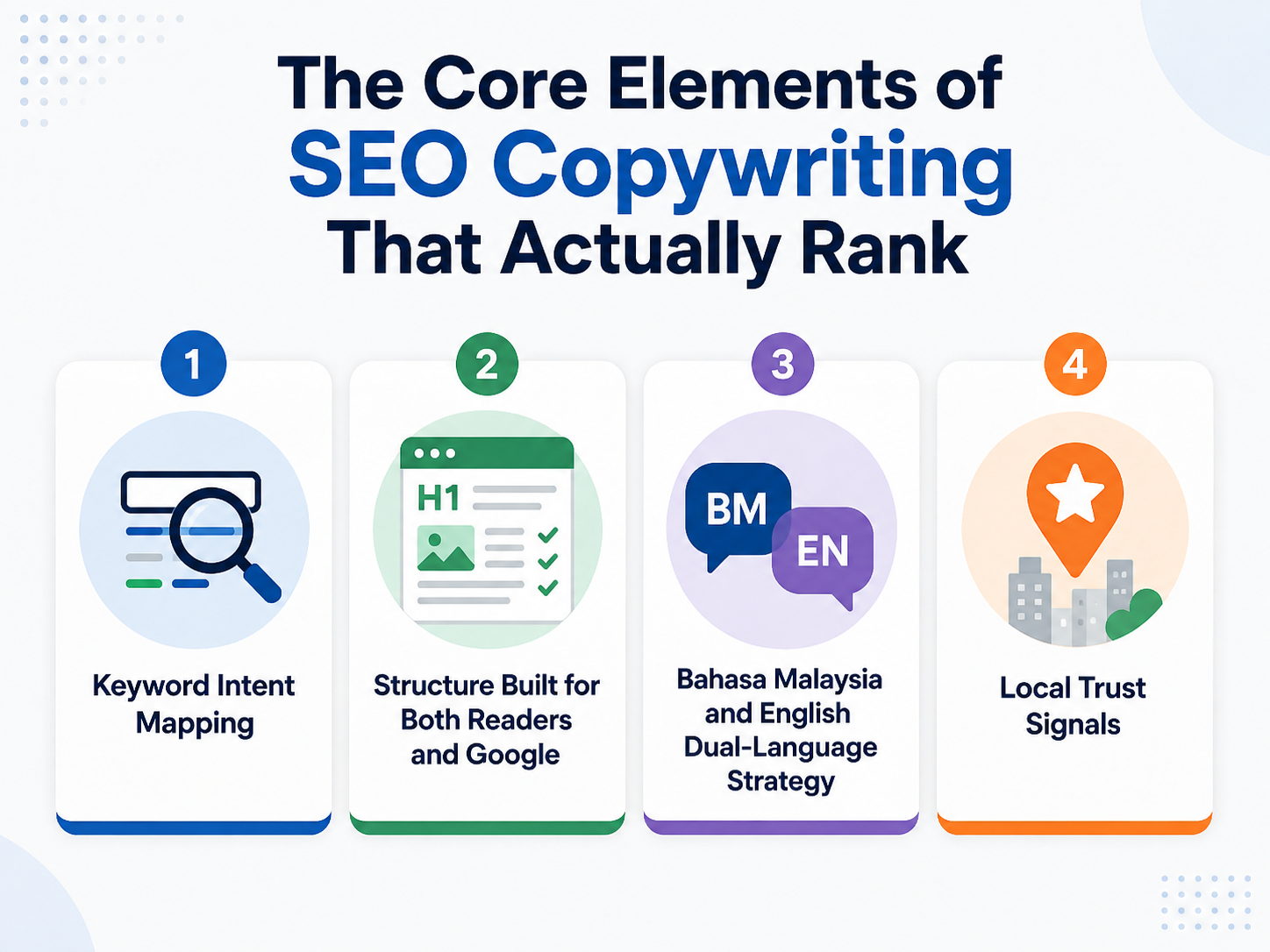
Content that ranks and converts shares four traits. Skip any one of them and a competitor’s article, published later and written by a smaller team, will usually outrank it anyway.
1. Keyword Intent Mapping
Every keyword carries an intent behind it: informational, commercial, or transactional. A search for “what is SEO copywriting” wants an explanation. A search for “SEO copywriting agency Malaysia” wants a decision framework. Writing the wrong intent for the right keyword is one of the most common reasons a page ranks on page two and stays there. Newnormz’s six-month campaign for Times Parking added 416 ranking keywords largely by matching content to the exact terms its buyers were already typing, not terms the business assumed they’d use.
2. Structure Built for Both Readers and Google
Google’s crawlers and human readers scan a page the same way: headings first, then bullet points, then bolded terms. A page with a clear H1, logical H2 sections, and short paragraphs gets pulled into featured snippets far more often than a dense wall of text, and it keeps a skimming reader on the page long enough to reach the call to action.
3. A Real Bahasa Malaysia and English Strategy
A direct translation of an English article rarely ranks in Bahasa Malaysia search, because it ignores how Bahasa Malaysia searchers phrase the same question differently. Treating this as one strategy with two output languages, rather than one article and one afterthought, is what actually captures both audiences.
What this looks like in practice:
- Separate keyword research for each language, not a shared list
- Localised examples, MYR pricing, and Malaysian regulatory references
- Distinct meta titles and descriptions per language version
4. Local Trust Signals
Malaysian buyers look for proof that a business is real and accountable before they pick up the phone: SSM registration details, a physical office address, and testimonials from other Malaysian businesses they can recognise. Content that earns links and shares from local directories and industry associations tends to rank better precisely because it’s also earning trust, and the two reinforce each other.
DIY, Freelancer, or Agency: Choosing the Right Approach
| Approach | Time Investment | Typical Monthly Cost (MYR) | Best For |
|---|---|---|---|
| In-house / DIY writing | 15 to 20 hours per article | RM0 direct cost, high opportunity cost | Founders with spare capacity and basic SEO knowledge |
| Freelance copywriter | 2 to 5 hours of briefing and review | RM1,500 to RM4,000 | Businesses needing occasional articles without a full strategy |
| SEO agency partnership | 1 to 2 hours of review per month | RM3,000 to RM8,000+ | SMEs that want a content strategy tied to measurable growth |
How to Evaluate an Agency Before You Hire
Most agencies pitch on traffic screenshots. Ask harder questions before signing anything:
- Ask for ranking evidence, not just traffic charts. A serious agency should be able to show keyword positions improving over months, alongside the traffic growth those positions produced.
- Confirm they write for the reader first. Keyword stuffing violates Google’s spam policies and can actively reduce a page’s visibility. Google recommends useful, people-first content with keywords used naturally, not forced in.
- Check whether content is mapped to buyer stage. An agency that only produces top-of-funnel blog posts is leaving the conversion half of the job undone.
- Ask how they handle Bahasa Malaysia and English separately. A one-size-fits-all answer is usually a sign of shallow local market experience.
- Request a sample audit before a retainer. It shows how an agency actually thinks about your content, not just how they write.
This is also where local SEO matters: content that ranks nationally still needs to earn trust with a local audience first.
Why do my blog posts get published but never rank?
Usually one of three things: the keyword intent doesn’t match what was written, the page structure isn’t scannable for Google or readers, or the content was never mapped to a real search term with demand behind it. Checking all three before writing new content is faster than publishing more of the same.
When should SEO copywriting start showing results?
Most campaigns take three to six months to show measurable ranking movement, and results should be tracked monthly through rankings, traffic, and enquiries rather than judged after a single article.
Should a Malaysian business publish in English, Bahasa Malaysia, or both?
It depends on where keyword demand actually sits for a given topic, not a blanket rule. Some queries have far more search volume in Bahasa Malaysia; others sit almost entirely in English. The right call comes from keyword research per topic, not a fixed policy.
Does regular blogging remove the need for SEO copywriting?
No. Publishing frequency doesn’t fix weak keyword targeting, poor structure, or a missing conversion path. An audit of existing posts usually finds more quick wins than writing new articles on top of the same problems.
Can SEO copywriting work for a technical or niche industry?
Yes, but it takes real research into the industry’s specific terms, customer questions, and buying concerns first. Generic content written without that groundwork tends to sound thin to the exact readers it’s trying to convince.
Is your content ranking or just sitting there?
Find out what your existing pages are missing before you write another article
Newnormz has run SEO campaigns across F&B, healthcare, ecommerce, and local services in Malaysia, backed by a performance guarantee of 70 percent of targeted keywords on Google’s first page.
30 minutes, no obligation, and you’ll know exactly which pages are costing you rankings.

Bryan Tan is an SEO Specialist and CEO at Newnormz, helping hundreds of businesses achieve first-page rankings on Google. With a passion for driving organic growth, Bryan blends innovative strategies with hands-on experience to optimize websites for maximum visibility. Always at the forefront of the latest SEO insights and trends, he consistently adapts to the evolving digital landscape.