Content marketing in Malaysia only earns its budget when the blog ranks for the exact questions your buyers are typing into Google and turns that traffic into WhatsApp messages, form fills, and calls. That means keyword research before a single word is written, articles grouped into topic pillars instead of scattered posts, on-page SEO on every article, and a clear next step for the reader once their question is answered. Skip any one of those four and the blog becomes a cost centre instead of a lead source.
A Simple Way to Think About It
The Salesperson Versus the Shop Assistant Who Never Sleeps
💸 The salesperson on a daily rate
Pull the pay and the selling stops that same day. No budget, no calls, no leads, no matter how good the pitch was last month.
🌙 The shop assistant who never clocks out
One well-ranked article keeps answering the same customer question at 2am, every night, without asking for a raise.
That difference is the entire business case for treating a blog as an asset rather than a marketing expense, and it shapes every decision in the framework below.
What Content Marketing Actually Means for a Malaysian SME
Content marketing, in practice, is publishing blog articles, buyer guides, and service pages that answer the exact questions a prospect searches before they ever reach out. It sits next to SEO and social media in a marketing plan, but it is the one asset that keeps producing enquiries after the ad budget runs out.
Malaysia’s search behaviour makes this more layered than in a single-language market. Most buyers research in a mix of Bahasa Malaysia and English within the same journey, sometimes switching languages between the awareness search and the decision-stage one. A blog strategy that only publishes in one language is, by definition, invisible to a share of its own market.
Why a Blog Still Produces Leads When Ads Stop
Malaysia had 35.4 million internet users at the end of 2025, a 98 percent penetration rate of the population, and Google handles roughly 93 percent of search traffic in the country as of May 2026. Almost every one of those searchers is typing a question into Google before typing a phone number into WhatsApp. A blog is how a business shows up for that question ahead of a bare pricing page or a directory listing.
Oriental Kopi’s two-year SEO and content campaign with Newnormz grew traffic by 43,300 visitors, 6.31 million impressions, and 24,500 additional ranking keywords, generating 468,000 clicks along the way. That kind of result does not come from one campaign burst. It comes from articles that keep ranking, month after month, long after they were published.
This is also why content marketing and Google Ads work best paired rather than treated as a choice. A confinement centre in KL running a RM2,550 monthly budget alongside Google Ads generated qualified leads within 30 days, because the ads produced immediate enquiries while the content built the ranking that keeps producing them for free.
The Framework: Four Disciplines That Turn a Blog Into a Lead Source
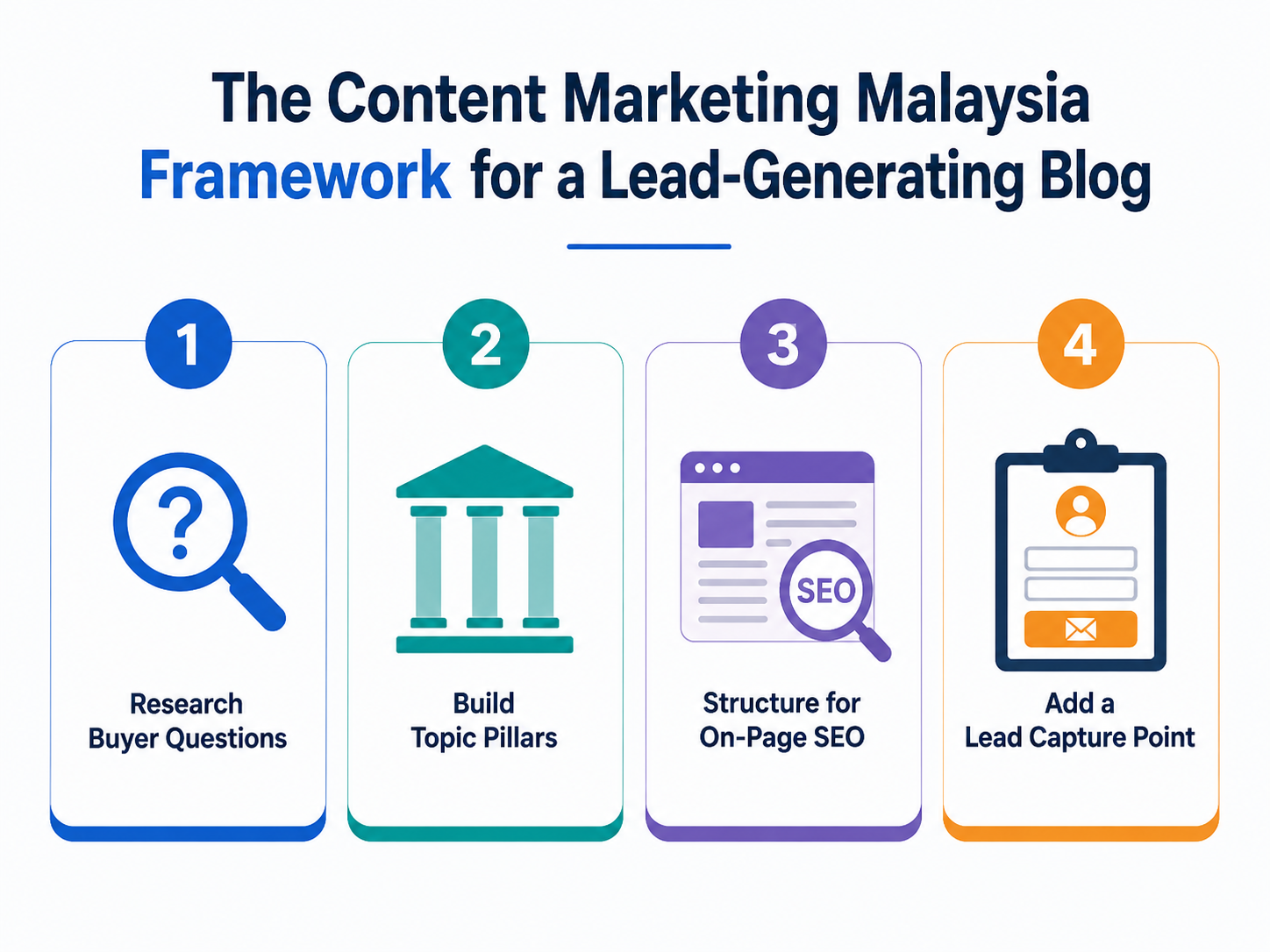
A blog that converts needs four disciplines working together. Miss one and the other three carry less weight than they should.
1. Research the questions buyers actually search
Pull real search terms from Google Search Console, the “People Also Ask” panel, and the questions the sales team hears on every call. Sort them by buying stage: awareness questions, comparison questions, and decision-stage questions that include words like “cost,” “near me,” or “best for.”
2. Group articles into pillars, not scattered posts
Related articles should sit under one pillar page and link back to it, so Google reads the site as an authority on the topic rather than a pile of disconnected posts. A logistics SME, for example, might build a pillar around shipping costs, with cluster articles on customs clearance, freight type, and delivery timelines all linking back to it.
3. Structure every article for on-page SEO
The primary keyword belongs in the H1, in the first 100 words, and in at least one H2. The meta description stays under 160 characters, and the heading hierarchy runs cleanly from H1 to H3 without skipping a level. None of this replaces good writing, but skipping it means good writing never gets found.
4. Give every article a lead capture point
A blog post without a call to action is a diary entry, not a business asset. Every article needs a contextual link to a service page, a click-to-WhatsApp button, or a short enquiry form placed after the point where the reader’s question has actually been answered, not buried above it.
| Approach | How It Works | Best Fit |
|---|---|---|
| In-house blogging | One team member writes part-time alongside other duties | A business with a subject expert who can commit a few hours weekly |
| Outsourced content team | A dedicated writer and SEO strategist manage research, writing, and optimisation | A business that needs consistent monthly output without hiring a full-time writer |
Five Mistakes That Keep Malaysian Blogs From Converting
Most SME blogs do not fail because the writing is bad. They fail because the strategy stops the moment the article gets published.
| Mistake | Why It Costs Leads |
|---|---|
| No keyword research before publishing | Articles use the words the business prefers instead of the words customers actually type into Google |
| No internal links between articles | Each post stays isolated instead of building topical authority |
| No call to action on the page | A reader ready to enquire has nowhere obvious to click |
| Slow page speed and weak Core Web Vitals | Suppresses rankings even on well-written articles |
| Only one language published | Misses the share of Malaysian searchers who complete their research in the other language |
How Newnormz Builds a Content Marketing Strategy That Converts
Newnormz plans keyword-focused articles, fixes the technical SEO issues that suppress rankings, and improves the conversion points on the pages that traffic actually lands on. Sunway Medispa’s six-month campaign produced a 700 percent increase in traffic, 54,000 impressions, and 70 percent more keywords ranking, the kind of movement that only happens when content, technical SEO, and on-page structure are handled as one system rather than three separate jobs.
Times Parking’s six-month campaign added 600 visitors, 528,000 impressions, and 416 ranking keywords, at 31,500 clicks, working from a much narrower niche than F&B or healthcare. The pattern across e-commerce, F&B, healthcare, and professional services clients is the same: content works when it is mapped to keyword gaps and tied to a monthly report that tracks rankings, traffic, and enquiries rather than traffic alone.
Turn Blog Content Into Measurable Leads
A blog that is never structured around real search demand and a clear next step stays a cost centre, no matter how many articles get published. Structured around keyword-mapped topics, bilingual coverage, and a lead capture point on every page, it becomes the one channel that keeps producing enquiries after the month’s ad spend is gone.
Frequently Asked Questions
When should a Malaysian SME expect blog content to generate leads?
Timelines vary by industry and competition, which is why tracking rankings, traffic, and enquiries against a 90-day plan matters more than fixating on a fixed date. Some keywords move in weeks, others take a full quarter.
How many articles should a business publish each month?
The right volume depends on keyword gaps, how competitive the niche is, and whether quality can be maintained at that pace. Four well-researched articles a month beat twelve rushed ones every time.
How does bilingual content reach more Malaysian buyers?
Bahasa Malaysia and English topics get planned around the actual search terms each audience uses, since the two often differ in phrasing even when the buyer’s question is the same.
Why does a business need both SEO and content marketing?
Content without technical SEO struggles to rank no matter how good the writing is, and technical SEO without content has nothing worth ranking. The two only work as one strategy.
Should an SME use a freelancer or a content marketing agency?
A freelancer can work for a single subject expert with time to spare. A business that needs consistent monthly output, SEO support, and reporting tied to leads usually needs an agency’s structure instead.
Is your blog producing traffic or producing leads?
Find Out What Your Content Marketing Strategy Is Missing
Newnormz has run SEO campaigns across F&B, healthcare, ecommerce, and local services in Malaysia, backed by a performance guarantee of 70 percent of targeted keywords on Google’s first page.
30 minutes, no obligation, just a clear read on what your blog needs to start converting.

Bryan Tan is an SEO Specialist and CEO at Newnormz, helping hundreds of businesses achieve first-page rankings on Google. With a passion for driving organic growth, Bryan blends innovative strategies with hands-on experience to optimize websites for maximum visibility. Always at the forefront of the latest SEO insights and trends, he consistently adapts to the evolving digital landscape.