SEO trends in 2026 come down to one shift: Google and AI platforms increasingly answer the question directly, before anyone clicks through to a website. For Malaysian SMEs, three things now decide whether you get seen: whether your content gets cited inside AI Overviews and AI Mode answers (Generative Engine Optimisation), whether your brand carries enough trust and expertise signals to be treated as a credible source, and whether the technical basics, page speed, mobile experience, clean crawling, are still solid enough to get indexed in the first place. A high ranking on its own no longer guarantees a visit.
A Simple Way to Think About It
The Receptionist Standing at the Door
🚪 The Shop Nobody Enters
Picture a shop with a receptionist stationed right at the entrance. She answers every question a customer has before they even step inside, so most people just say thanks and walk off without ever seeing what’s on the shelves.
🏆 The Name Everyone Already Trusts
Now picture a shop known specifically for one thing. Customers skip the browsing entirely, or tell the receptionist to send them straight in by name, because the reputation already did the convincing.
That split is exactly what’s happening in Malaysian search right now, and which side your business sits on depends on the ten shifts below.
Malaysia isn’t a small audience to lose. The country had 35.4 million internet users at the end of 2025, equal to 98.0% of the population, and Google still holds roughly 93% of Malaysian search market share as of May 2026. That’s the pool most SMEs are trying to reach, and a growing share of it is getting its answer from an AI-generated summary before it ever sees a website link.
Why Position One on Google Doesn’t Guarantee a Click Anymore
Ahrefs initially measured a 34.5% decline in click-through rate for position-one results affected by AI Overviews, then revised that estimate up to roughly 58% in its 2026 update. Separately, Seer Interactive found click-through rate on affected queries drop from 1.41% to 0.64% in early 2025. Two different research teams, similar direction of travel.
For Malaysian businesses in retail, education and professional services, where a lot of search traffic starts as an informational question rather than a brand search, this is where the click-through drop bites hardest. A page can hold its ranking position and still lose the visitor, because the answer already appeared above it. That’s why a technical audit in 2026 needs to check AI Overview exposure alongside the usual ranking report, not rankings alone.
Getting Cited by AI Matters as Much as Ranking
Generative Engine Optimisation is the practice of structuring content so that ChatGPT, Google AI Mode and Perplexity choose to cite it as a source. These systems tend to favour clearly structured content, precise answers and named expertise over pages built purely around keyword repetition.
Google has reported that AI Mode queries run two to three times longer than a typical search box query. That’s a meaningful signal: people are asking fuller, multi-part questions, which means content built to answer one narrow keyword phrase is increasingly incomplete by design.
| Factor | Traditional SEO Focus | GEO-Ready Approach |
|---|---|---|
| Content format | Keyword density and repetition | Structured answers organised under clear headings |
| Proof of expertise | Backlink count | Named credentials, real data and case examples |
| Source of citation | Search engine crawlers ranking a page | AI systems synthesising and comparing several sources |
| Success metric | Ranking position for a keyword | Whether the answer gets cited inside an AI-generated response |
Google AI Mode Turned Search Into a Multi-Step Research Tool
Google AI Mode goes further than a standard AI Overview. It runs several searches at once behind the scenes and stitches the results into one combined answer, a method Google calls query fan-out. That two to three times longer query length mentioned earlier isn’t a one-off stat, it reflects people using AI Mode for comparisons, follow-up questions and detailed research rather than a single search term.
For a Malaysian SME, that means content built around one keyword phrase is competing against content built to answer the whole customer question, including the follow-up they haven’t typed yet.
Google Still Dominates Malaysian Search, AI Platforms Are the Add-On Channel
It’s easy to overcorrect toward AI platforms and forget the scale gap. SparkToro estimated over 14 billion Google searches happen globally per day, compared with up to 37.5 million search-like ChatGPT prompts. Google’s own share of Malaysian search sits around 93% as of May 2026.
| Search Channel | Approximate Daily Volume (Global) |
|---|---|
| Google search | Over 14 billion searches per day (SparkToro, 2024 estimate) |
| ChatGPT search-like prompts | Up to 37.5 million per day (SparkToro estimate) |
Read that correctly: Google is still the priority channel, and AI platforms are an additional place buyers now research a business, not a replacement. Google itself rewards original, genuinely helpful content regardless of how it was produced, and has reported growing interest in forums, reviews and first-hand accounts. Malaysia had 30.7 million social media user identities in October 2025, equal to 85% of the population, which is a strong reminder that trust is often built off Google entirely before a search even happens.
Brand Trust and E-E-A-T Are Outweighing Backlink Counts
Search engines are increasingly evaluating overall brand credibility rather than isolated SEO tactics. Sites with consistent business information across platforms and demonstrated Experience, Expertise, Authoritativeness and Trustworthiness hold up better through algorithm updates than sites relying purely on backlink volume.
This turns visibility into a leadership decision rather than a marketing task, because search performance in 2026 spans website structure, PR activity and the actual customer experience, not just what happens inside a content calendar.
SEO in 2026 Is No Longer a One-Person Job
Visibility now touches several teams at once. Technical teams manage Core Web Vitals and crawlability. PR builds the brand mentions that feed E-E-A-T. Customer service generates the reviews that support trust signals. A Malaysian SME handing all of this to a single freelancer risks falling behind competitors running it as one coordinated plan.
This is the logic behind pairing an SEO agency in Malaysia with corporate website support and content strategy under one roof rather than three disconnected vendors: technical, brand and customer touchpoints all move the same visibility number.
Reviews and Real Customer Voices Are Becoming Ranking Assets
As AI-generated pages multiply, search engines are leaning harder on genuinely human, authentic content. Customer reviews and community discussion threads can earn their own organic visibility. For Malaysian brands, testimonials are worth treating as both a trust signal and an SEO asset, not just social proof for a landing page.
With 85% of the population active on social platforms, customers are already discussing businesses, swapping recommendations and posting reviews in places a website audit alone won’t catch. Feeding that activity back into content and search strategy is no longer optional.
AI Tools Changed How SEO Teams Work, Not Whether You Need One
AI tools now draft outlines, cluster keywords and flag technical errors before a strategist opens the page. That doesn’t remove the need for a strategist, it changes the job from writing every draft by hand to reviewing and directing AI output for accuracy and brand voice. A tool has no idea what a Malaysian customer actually means by “confinement centre near me” or how a Klang Valley buyer compares two competitors. That context still has to come from a person.
Core Web Vitals Are Still the Entry Fee, Not a Bonus
None of the AI-era shifts above matter if the website underneath them is technically broken. Google recommends a Largest Contentful Paint of 2.5 seconds or less, an Interaction to Next Paint of 200 milliseconds or less, and a Cumulative Layout Shift of 0.1 or less. A page that’s perfectly structured for AI citation can still fail to surface at all if crawling, indexing or basic user experience are getting in the way.
Mobile and Local Search Keep Growing Across Malaysia
Malaysia had 44.0 million cellular mobile connections in late 2025, equal to 122% of the population, with median mobile download speeds reaching 143.56 Mbps. Google indexes and ranks primarily off the mobile version of a page, and complete, consistent business information strengthens how a listing performs in local SEO results. A slow site or an incomplete Google Business Profile costs a Malaysian SME real, findable customers, not just a ranking position.
What This Actually Means for Your Website
Google has said publicly, more than once, that no one, including Google itself, can guarantee a specific ranking position. Anyone promising a fixed spot on page one in 2026 is selling something else. What’s realistic instead is a plan built around the things that are actually measurable: AI Overview exposure, citation readiness, Core Web Vitals, and whether the brand has enough trust signals to hold up when the algorithm shifts again.
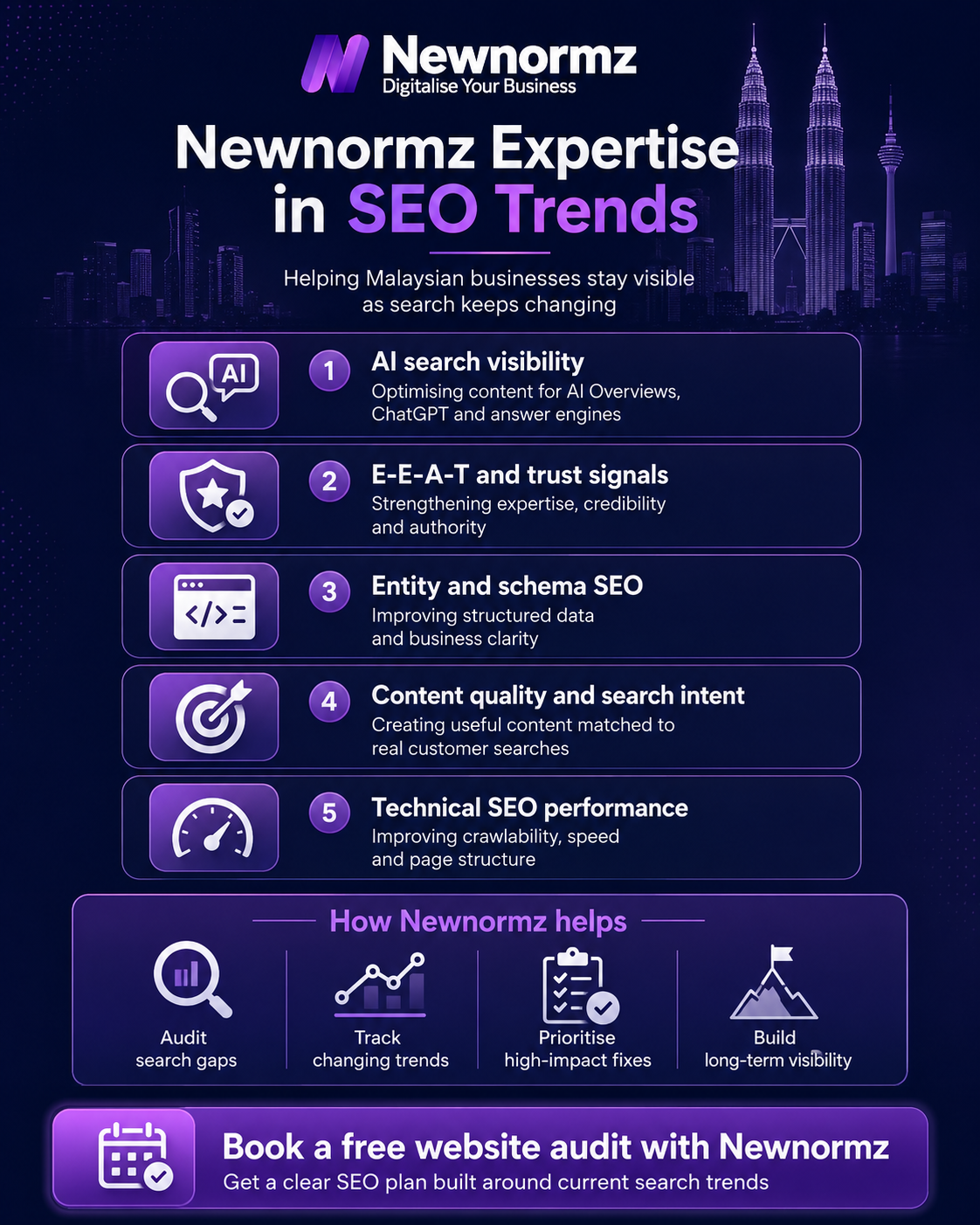
Newnormz builds that plan by combining SEO and Generative Engine Optimisation work: reviewing traditional rankings, technical health and AI citation readiness together, then handing back a prioritised action plan with a dedicated strategist assigned to the account. The team has worked across retail, education, healthcare, F&B and professional services in Malaysia, including campaigns like Sunway Medispa’s 700% traffic increase over six months and Oriental Kopi’s growth to 6.31 million impressions over two years, so the recommendations are grounded in what’s actually moved the needle for comparable businesses, not generic best practice.
Frequently Asked Questions About SEO Trends 2026
Why are my Google rankings stable while organic clicks are falling?
This is usually AI Overviews absorbing clicks on informational queries, not a ranking problem. An audit that checks AI Overview exposure and click-through changes alongside ranking data will usually show exactly where the traffic is leaking.
How should a Malaysian SME balance Google SEO with AI search visibility?
Treat them as one strategy, not two competing budgets. Technical SEO, content optimisation and Generative Engine Optimisation should be planned together, since they draw on the same underlying content and site structure.
Which SEO improvements should a business prioritise in 2026?
Crawlability and Core Web Vitals first, since nothing else matters if a page can’t be indexed or loads too slowly. After that, content quality, entity and brand signals, and pages tied to real commercial value.
How soon can rankings and AI citation visibility improve?
It depends heavily on how competitive the space is and the current state of the site. A realistic agency sets milestones after completing the audit, not before seeing the actual data.
What does a 2026 website audit actually check?
Indexing status, crawl errors, Core Web Vitals, content gaps against real search intent, AI visibility and citation readiness, and a prioritised list of technical fixes ranked by impact.
How is SEO pricing structured for Malaysian SMEs?
Pricing should follow the audit findings, business goals and the actual amount of work required, not a flat package sold before anyone has looked at the site.
Is your website ready for the AI search era?
Find Out Where You Stand Before Competitors Close the Gap
Newnormz has run SEO campaigns across F&B, healthcare, ecommerce, and local services in Malaysia, backed by a performance guarantee of 70 percent of targeted keywords on Google’s first page.
30 minutes, no obligation. Includes an AI visibility check alongside your ranking report.

Bryan Tan is an SEO Specialist and CEO at Newnormz, helping hundreds of businesses achieve first-page rankings on Google. With a passion for driving organic growth, Bryan blends innovative strategies with hands-on experience to optimize websites for maximum visibility. Always at the forefront of the latest SEO insights and trends, he consistently adapts to the evolving digital landscape.