The future of SEO in Malaysia is not about disappearing rankings, it is about where those rankings now show up. Google AI Overviews, Google AI Mode, ChatGPT Search and Perplexity already answer many questions directly on the results page, before a user ever clicks a blue link. For Malaysian SMEs, this means visibility now depends on two things at once: ranking well in traditional search, and being the source AI systems choose to cite or recommend. Businesses that structure their content and local signals for both will keep capturing customers over the next twelve months. Businesses that only optimise for the old ten blue links will start losing visibility they cannot even see in a standard rank tracker.
A Simple Way to Think About It
The Street Corner vs the Concierge
📢 Shouting on a Crowded Street
Picture a busy street lined with shop signs, and yours is the loudest one on the block. For years, that was enough to win a walk-in customer. Now imagine most people passing by never look up at the signs at all, they just ask the person standing at the corner for a recommendation instead.
🤝 Being the Name the Concierge Gives
Now picture that same corner has a concierge who already knows which shops actually deliver what people ask for. When they say your name, the customer arrives already trusting you, before they have even seen your shopfront.
The rest of this article covers what it actually takes to become the name the concierge gives, not just the loudest sign on the street.
What “AI-First SEO” Actually Means
The shift underway is a move from ranking web pages to earning a mention inside AI-generated answers. Google AI Overviews and Google AI Mode now summarise information directly on the results page. Platforms such as ChatGPT Search and Perplexity go a step further and often answer the question without sending the user to any website at all.
Two new disciplines describe this work. Generative Engine Optimisation (GEO) focuses on getting a brand mentioned or cited inside AI-generated summaries. Answer Engine Optimisation (AEO) focuses on structuring content so it directly answers a specific question, which matters because Google has said publicly that clear site structure and genuinely helpful content support visibility across standard Search, AI Overviews and AI Mode alike.
Traditional SEO has not disappeared. GEO and AEO now sit alongside it, not instead of it. A page that ranks well but is written for keyword density rather than a real answer will struggle in both worlds.
Why This Matters for Malaysian SMEs Right Now
Malaysia is one of the most connected markets in the region. DataReportal recorded 35.4 million internet users and 98 percent internet penetration in Malaysia at the end of 2025. Google also holds roughly 93 percent of the Malaysian search market, according to Statcounter data from May 2026. Almost every SME’s customer is already searching on Google, and a growing share of those searches now surface an AI-generated answer before any website link.
Google AI Overviews are live in Malaysia and support Malay-language queries, so local consumers are already meeting AI-generated answers while researching products and services near them. When an AI Overview answers a question directly, the business it cites earns trust before the customer ever clicks through. SMEs that are not structured for this get skipped entirely, no matter how strong their traditional rankings look on paper.
Traditional SEO vs AI-Era SEO: What’s Actually Different
| Factor | Traditional SEO | AI-Era SEO (GEO and AEO) |
|---|---|---|
| Primary goal | Rank in the top 10 organic results | Get cited inside AI-generated answers |
| Success metric | Organic click-through rate | Share of voice in AI answers, branded search volume, qualified leads |
| Content approach | Keyword coverage, backlink volume | First-hand expertise, direct answers, structured content |
| Discovery channels | Google Search results only | Google AI Overviews, AI Mode, ChatGPT Search, Perplexity, Google Business Profile |
Both approaches share one foundation: search engines and AI models still reward content that shows real expertise and answers the reader’s question clearly. Nothing about AI search rewards vague or thin content, if anything it rewards the opposite.
How Malaysian SMEs Can Prepare
Preparing for this shift is not a one-time project. It is a set of habits that need to become part of how a business publishes and maintains its website.
Strengthen Your E-E-A-T Signals
Google’s guidance points to Experience, Expertise, Authoritativeness and Trustworthiness as core indicators of content quality, and the same helpful, people-first content principles support visibility in AI Overviews and AI Mode. In practice, this means author bios, verifiable credentials, real client testimonials, and original photos or data on the website, not generic stock content that could belong to any business.
Structure Content for Direct Answers
AI systems favour content that answers a question in the first sentence, then supports it with detail. Every important page should open with a clear answer, use descriptive headings, and include a concise FAQ section, since this format is the easiest for AI models to extract and cite correctly.
Keep Local Signals Consistent
Keep the Google Business Profile complete and active. Use the same business name, address and phone number across every directory, and collect genuine customer reviews on an ongoing basis, not in one rushed batch. These same signals feed the local answers that AI Overviews and Google Maps show to nearby customers, so inconsistency here quietly costs visibility elsewhere.
Track New Metrics, Not Just Rankings
Rankings alone no longer show the full picture. SMEs should also track branded search volume, AI referral traffic where it’s measurable, and how often AI tools mention the business by name in relevant recommendations. A page can hold its position and still lose enquiries if an AI Overview is now answering the question above it.
The Fundamentals Still Decide Who Wins
It’s worth being honest about one thing: no agency, including Newnormz, can guarantee a specific position on Google, a point Google has made publicly on multiple occasions. What a good SEO process can deliver is steady, measurable improvement built on the fundamentals that AI search has not changed.
Oriental Kopi’s two-year SEO campaign with Newnormz grew traffic by 43,300 visitors, added 6.31 million impressions and 24,500 newly ranking keywords, and produced 468,000 clicks, all built on consistent content and technical work over time, not a single tactic. Sunway Medispa saw a 700 percent traffic increase within six months, alongside 70 percent more keywords ranking, driven by the same kind of expertise-led, well-structured content that AI models now also favour when choosing what to cite. The platforms answering the question have changed. What earns visibility on them has not.
How Newnormz Helps Malaysian Businesses Win in the AI Search Era
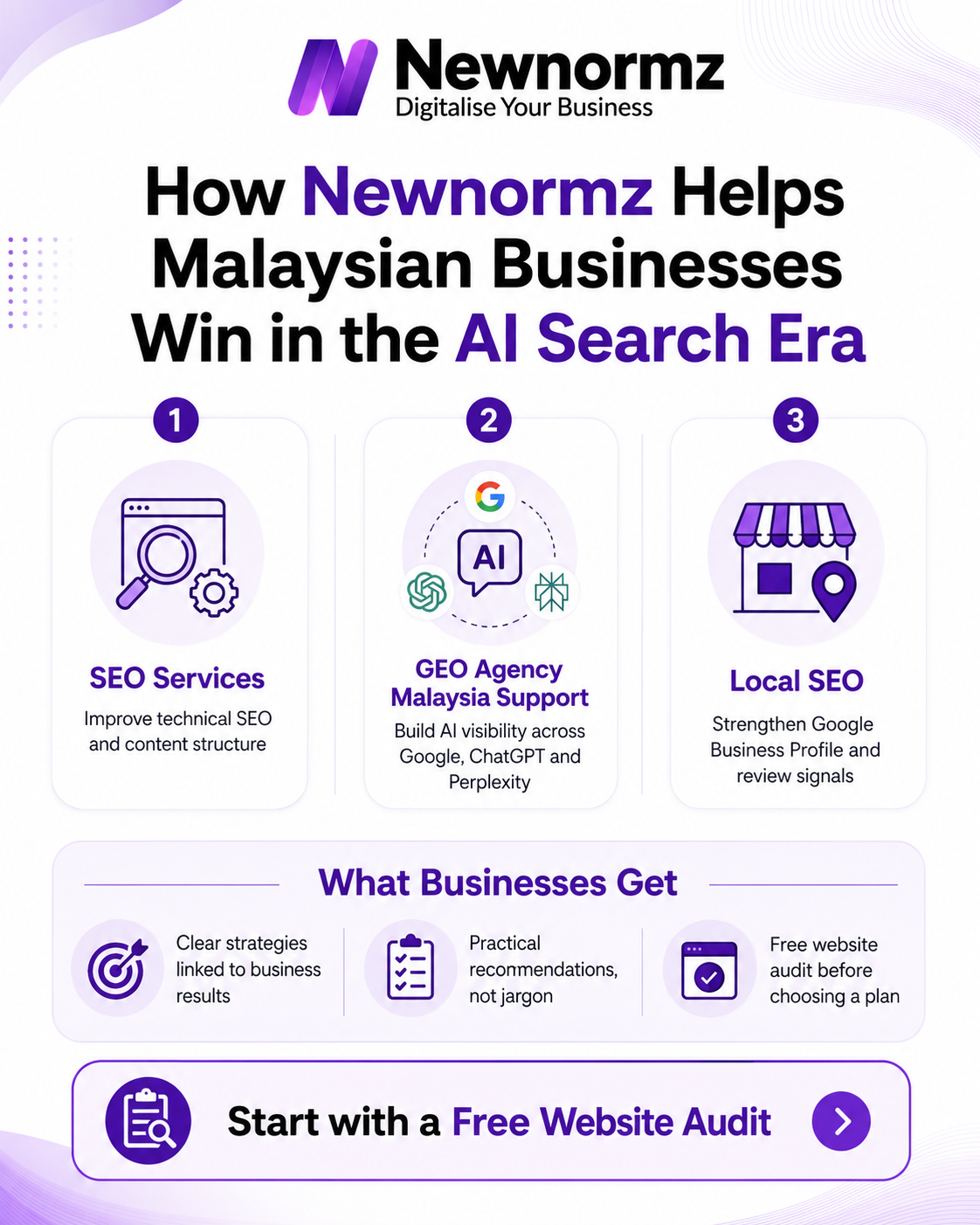
Newnormz’s SEO service covers the technical and content work needed for both traditional rankings and AI visibility, including author signals, page structure and answer-ready formatting. Its local SEO work keeps Google Business Profile and review signals strong, which matters for the local answers Google and AI tools both surface to nearby customers.
Every engagement starts with a free website audit, so an SME owner can see exactly where the gaps are, in classic rankings and in AI visibility, before committing budget to a plan.
My rankings look stable, so why are enquiries from search falling?
Rank position alone doesn’t capture zero-click behaviour. If an AI Overview or AI Mode answer sits above your listing and answers the question directly, a searcher may never scroll down to click, even while your ranking stays unchanged. Checking AI Overview presence and zero-click queries alongside standard rankings usually explains the gap.
Do I need to drop traditional SEO in favour of GEO and AEO?
No. GEO and AEO build on traditional SEO, they don’t replace it. A technically sound, well-ranking site is still the foundation that gives AI systems something credible to cite in the first place.
Which changes should a Malaysian SME prioritise first?
Start with technical health and commercial pages, since neither AI models nor Google can cite a page that’s slow, broken or thin. From there, a complete Google Business Profile and clearly structured, answer-first content give the fastest visibility gains.
Does Google Business Profile still matter as AI search grows?
Yes, arguably more than before. Local answers in AI Overviews and Google Maps draw heavily on Business Profile data and review signals, so an incomplete or inconsistent profile limits visibility across both classic and AI-driven search.
Can a smaller brand realistically compete for AI citations against bigger names?
Yes, because AI systems tend to cite the clearest, most specific answer to a question, not necessarily the biggest brand. A smaller business with genuine expertise and well-structured content around the exact questions its customers ask can out-cite a larger competitor that hasn’t bothered to structure its content that way.
Is your website ready for AI-driven search?
Find Out Where Your SEO Stands Before AI Search Moves Ahead of You
Newnormz has run SEO campaigns across F&B, healthcare, ecommerce, and local services in Malaysia, backed by a performance guarantee of 70 percent of targeted keywords on Google’s first page.
30 minutes, no obligation, covering both your Google rankings and your AI search visibility.

Bryan Tan is an SEO Specialist and CEO at Newnormz, helping hundreds of businesses achieve first-page rankings on Google. With a passion for driving organic growth, Bryan blends innovative strategies with hands-on experience to optimize websites for maximum visibility. Always at the forefront of the latest SEO insights and trends, he consistently adapts to the evolving digital landscape.