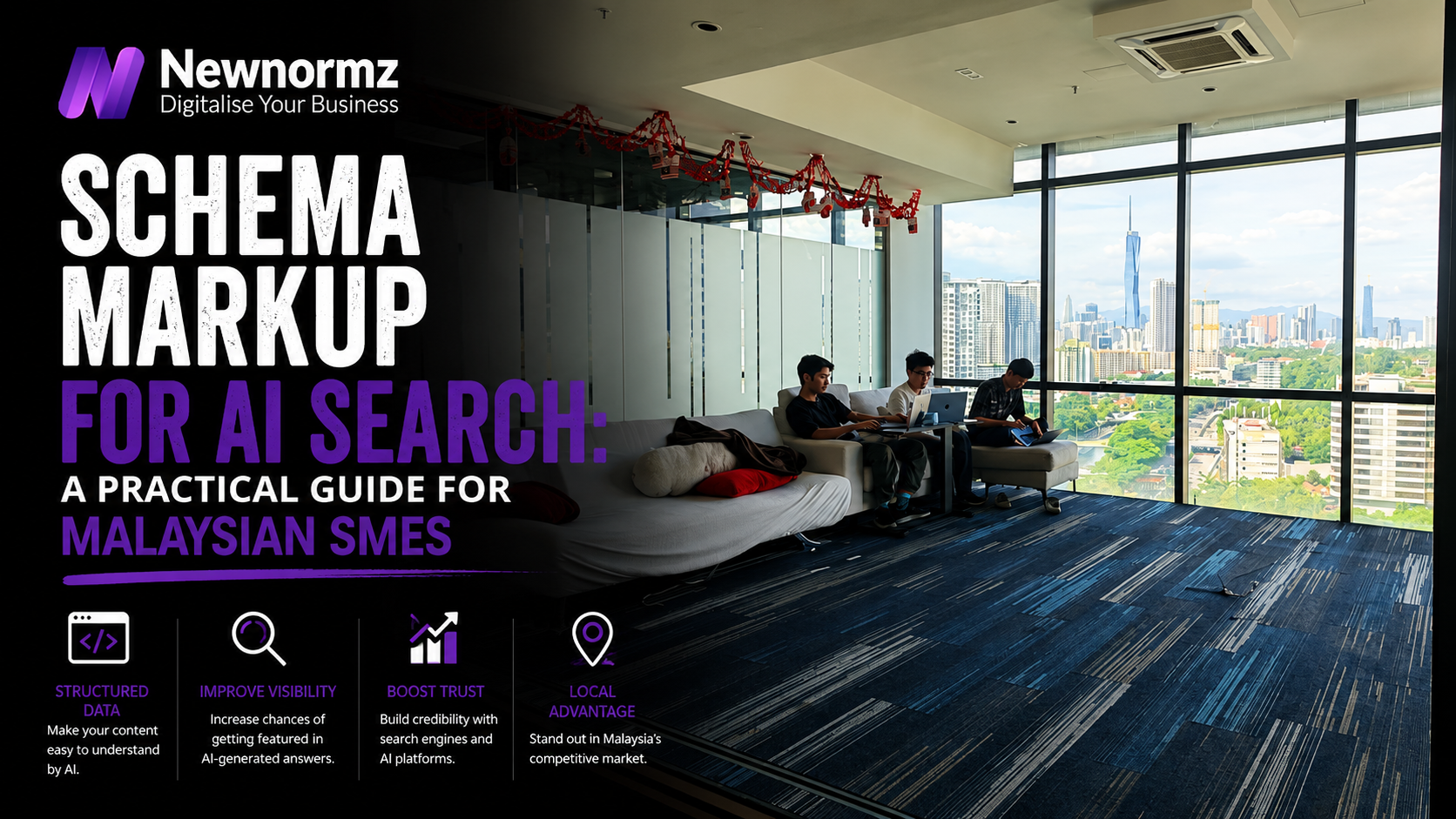
Schema markup is structured data, usually written in JSON-LD, that tells search engines and AI systems exactly what a page contains: a price, a business address, an author, a review score. Google uses it to qualify pages for rich results, and AI Overviews, ChatGPT, and Perplexity lean on the same clean signals when deciding what to cite. For a Malaysian SME, the practical starting point is almost always Organization schema on the homepage, LocalBusiness on the contact page, FAQPage on service pages, and Product schema on catalogue pages, added carefully enough that every property matches what a visitor can actually see on the page.
A Simple Way to Think About It
The Warehouse With No Labels
📦 No labels on the shelves
A warehouse where every box looks the same. Workers can still find what they need eventually, but when an order is urgent, the ones that take too long to identify just get left behind.
🏷️ Every shelf clearly labelled
A warehouse where every box states its name, price, and quantity in plain sight. Anyone new to the job can walk in and pull the right item in seconds, no guesswork involved.
That is the difference schema markup makes to your website. The sections below cover exactly which labels a Malaysian SME site needs first, and which mistakes strip the labels back off.
Why This Matters More Now That AI Writes the Answers
Search results used to be a list of blue links. Increasingly, they are a paragraph an AI system wrote after reading several pages and picking which ones to trust. Google’s own AI Overviews are built on top of its existing Search index, so a page that already ranks and is well-structured has a real head start. ChatGPT Search and Perplexity work a similar way: they retrieve live pages and cite the ones they can parse with confidence.
Schema does not force an AI system to quote you. What it does is remove ambiguity, telling the system that a number is a price rather than a phone number, that a name belongs to the author rather than a random mention, that an address belongs to your business rather than a customer’s testimonial. Google has published real numbers on what this is worth: Rotten Tomatoes saw a 25% higher click-through rate on marked-up pages, Food Network saw a 35% increase in visits, and Nestlé recorded an 82% higher click-through rate on rich results. Those are Google rich-result figures rather than AI citation studies, but the underlying mechanism, clearer machine-readable content, is the same one AI systems rely on.
The Schema Types Malaysian SMEs Should Prioritise
Most SME sites do not need every schema type Schema.org offers. They need the handful that match how the business actually operates, added correctly, rather than a long list added carelessly.
| Schema Type | Best For | What It Helps With |
|---|---|---|
| Organization | Every business homepage | Confirms who you are as an entity, which underpins knowledge panels and AI citation |
| LocalBusiness | A physical address or a defined service area | Feeds Google Business Profile and local AI Overview answers, and supports local SEO more broadly |
| FAQPage | Service pages and blog articles | Matches the exact question-and-answer format users type into AI chatbots |
| Product | Ecommerce and retail catalogues | Surfaces price, stock status, and rating in shopping-style AI answers |
| Article | Blog posts and long-form guides | Signals authorship and publish date, which AI crawlers weigh when judging freshness |
| BreadcrumbList | Websites with more than a handful of pages | Clarifies site structure, so crawlers understand how a page fits into the wider site |
How to Add Schema Without Breaking Something Else
Schema is code sitting on a live website, and the biggest risk is not that it does too little, but that it introduces an error that quietly ignores the whole block. A sensible rollout looks like this:
- Audit what is already live. Run existing pages through Google’s Rich Results Test before adding anything new, since some CMS plugins already inject partial or outdated schema without anyone realising.
- Map schema to page templates, not individual pages. Organization on the homepage, LocalBusiness on the contact page, FAQPage on service pages, Product on catalogue pages. Template-level mapping keeps a hundred-page site manageable.
- Write JSON-LD against Schema.org’s actual property requirements for each type, and place it in the page head rather than scattered inline.
- Validate every template before publishing. Malformed markup is usually just ignored by Google rather than penalised, which makes it easy to miss unless you actively check.
- Check the Search Console structured data report monthly. CMS updates and plugin conflicts are the most common reason working schema quietly breaks months later.
Mistakes That Quietly Block AI Citations
Most schema problems on Malaysian SME sites are not missing markup. They are markup that exists but works against the site instead of for it.
Duplicate or conflicting schema. Different page templates, or a plugin stacked on top of a manual implementation, sometimes describe the same page in two contradicting ways. Search engines cannot tell which version to trust, so they may discount both.
Schema that does not match what a visitor can see. Marking up a review count or a discount that is not actually visible on the page violates Google’s structured data guidelines and can trigger a manual action, which is a far worse outcome than having no schema at all.
Missing required properties. A LocalBusiness entry with no address, or a Product entry with no price, is not a smaller version of that schema type. It is not eligible for rich results at all.
Where Newnormz Fits In
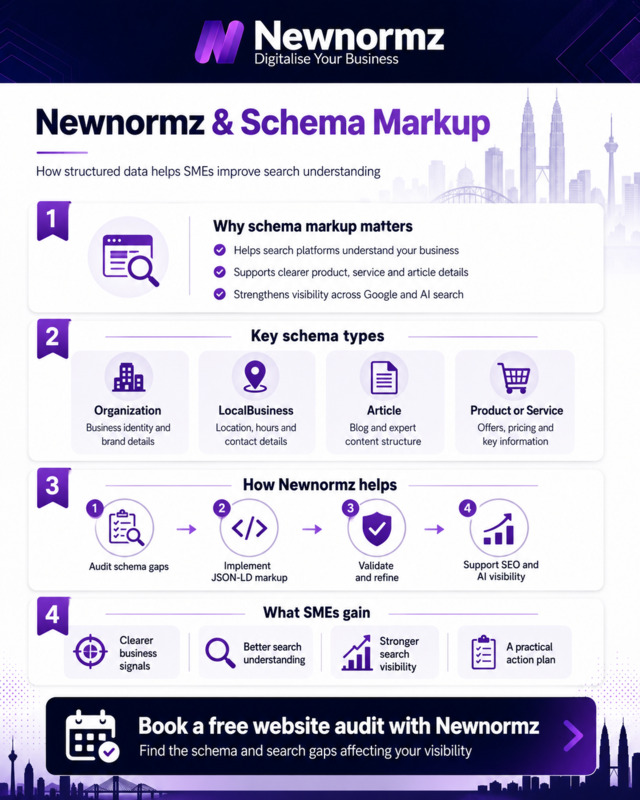
Newnormz’s technical SEO team runs this as a rollout, not a one-off code drop: auditing what schema already exists, prioritising the types above by page template, and validating every implementation against the Rich Results Test before it goes live. That work sits inside Newnormz’s broader SEO service, alongside content and on-page work, so schema decisions connect to the rest of the site rather than sitting as an isolated technical fix nobody revisits.
The Bottom Line
A Malaysian SME site without schema markup is not invisible to AI systems, but it is harder to read correctly, and content that is hard to read correctly gets skipped rather than cited. Clean, validated structured data will not guarantee a citation on its own. Paired with solid content and accurate business information, it removes one of the easiest reasons an AI system has to pass your page over.
Frequently Asked Questions
My schema passes validation. Why doesn’t it show up in search?
Valid code alone does not guarantee a rich result. Google still checks page eligibility, whether the content is genuinely useful, and whether it matches what is visible on the page, before deciding to display anything extra.
Which schema type should a Malaysian SME add first?
Organization and LocalBusiness first, since they establish who you are and where you operate. Product or FAQPage usually comes next, depending on whether the business sells online or mainly answers service questions.
Do I need to rebuild my website to add schema?
No. JSON-LD can be added into existing templates on most CMS platforms and page builders without touching the site’s design or structure.
Will schema markup get my site into AI Overviews?
It gives Google clearer information about your page and business, which supports eligibility. It works alongside strong content and accurate business details, not as a substitute for either.
Does the same schema work for Google, ChatGPT, and Perplexity at once?
Schema is built to Schema.org and Google’s requirements, since that is the shared standard. ChatGPT and Perplexity read the same structured pages, so consistent, standards-based markup supports visibility across all three rather than needing separate versions.
Not sure what schema your site is missing?
Get a prioritised schema markup roadmap for your website
Newnormz has run SEO campaigns across F&B, healthcare, ecommerce, and local services in Malaysia, backed by a performance guarantee of 70 percent of targeted keywords on Google’s first page.
30 minutes, no obligation, and you’ll leave with a clear list of schema gaps to fix.

Bryan Tan is an SEO Specialist and CEO at Newnormz, helping hundreds of businesses achieve first-page rankings on Google. With a passion for driving organic growth, Bryan blends innovative strategies with hands-on experience to optimize websites for maximum visibility. Always at the forefront of the latest SEO insights and trends, he consistently adapts to the evolving digital landscape.