Generative search means Google, ChatGPT, Gemini and Perplexity can now write a direct answer to a question right on the results page, often before anyone visits a website. For Malaysian SME owners, that changes what an SEO agency needs to deliver: a page one ranking still matters, but so does whether your business actually gets mentioned inside that AI-written answer. This article explains what generative search is, how it differs from the search you have been optimising for, and what your website needs to keep getting found, and cited, as more searches end in an AI answer instead of a click.
A Simple Way to Think About It
The Pasar Malam vs. the Friend Who Already Tasted Everything
🏮 Just Another Stall in the Row
Your shop is one of ten identical stalls in a row at a pasar malam, and every shopper has to walk past the other nine before they even notice yours.
🌟 The One Your Friend Points To
Now a friend who already checked every stall walks up and points shoppers straight to yours, skipping the other nine entirely.
That is roughly the shift generative search has already made. The sections below cover what it actually is, and what it takes for a Malaysian business to be the stall that gets pointed to.
What Is Generative Search?
Generative search pulls information from several sources and compresses it into one written answer, with a handful of supporting links attached underneath. Google tested this format as SGE starting in May 2023, made it a default feature called AI Overviews in May 2024, and had rolled it out to more than 200 countries and territories by May 2025. An experimental AI Mode, which replaces the results page with a full AI chat interface, followed in March 2025.
Generative engine optimisation, or GEO, is the practice of improving the odds that your content gets pulled into these AI-written answers. It does not replace SEO, it builds on it. The technical performance, clear writing and site authority that good SEO already requires are still the foundation. GEO adds a layer focused on how clearly AI systems can extract and trust your information once they find it.
Our SEO agency in Malaysia builds this layer into every campaign rather than selling it as a separate add-on.
How Generative Search Differs From Traditional Search
| Factor | Traditional SEO | Generative Search / GEO |
|---|---|---|
| Output | Ten ranked blue links | One synthesised answer with a few citations |
| Success metric | Ranking position, click-through rate | Citation frequency, share of voice in AI answers |
| Content need | Keyword-optimised pages | Structured, fact-dense, quotable passages |
| Trust signal | Backlinks, domain authority | E-E-A-T signals, third-party citations, digital PR |
| User behaviour | Clicks through to compare options | Reads the answer, may never visit the site |
Three shifts that matter most for Malaysian SME owners
AI answers cut into website clicks. A Pew Research study of US Google users found that a standard organic result was clicked in just 8% of visits when an AI summary appeared above it, compared with 15% of visits when no summary showed up at all.
A page one ranking no longer guarantees visibility. Research from Botify and DemandSphere found that when AI Overviews and featured snippets both appeared on a results page, together they occupied 67.1% of the visible screen on desktop and 75.7% on mobile, pushing organic listings further down.
Being cited is a separate goal from ranking well. Ahrefs reported in March 2026 that only 38% of pages cited inside AI answers also ranked in Google’s top 10 organic results. A strong ranking helps, but it does not guarantee a citation.
In Malaysia, where Google still handles roughly 93% of search traffic (Statcounter, May 2026) and the country counts around 35.4 million internet users at 98% penetration (DataReportal Digital 2026 Malaysia), this shift touches nearly every search a Malaysian customer runs, not just a niche segment of them.
Why This Changes SEO Forever
Generative search adds a second objective to every SEO campaign: getting cited inside the answer, not just ranking above it. A page can hold the top organic spot and still lose the click, because the AI Overview or chatbot response has already answered the question by the time a user scrolls down. Google has stated publicly that AI Overviews and AI Mode still draw on its core Search ranking and quality systems, so none of the SEO fundamentals become irrelevant. What changes is that ranking well is now necessary but no longer sufficient on its own.
For Malaysian SME owners comparing agencies, that is a useful filter. An agency still selling packages built purely around keyword repetition and backlink counts is optimising for half the problem. The original GEO research (a Princeton-led study that coined the term) found that reliable citations, relevant quotations and concrete statistics measurably improved how often content got referenced inside generated answers. That is a different skill from classic link building, and it needs to sit inside one strategy, not bolted on as a separate service later.
What Malaysian SME Websites Need to Change
1. Structure content so it can be lifted, not just read
Put the direct, quotable answer near the top of the page, ahead of the background story and the sales pitch. Use clear headings and short factual statements that could stand alone as a sentence if an AI system pulled them out of context. If the answer to “what does this business do” is buried three paragraphs down, an AI summary has nothing clean to grab.
2. Strengthen your E-E-A-T signals
Name the actual person who wrote the page, list credentials where they are relevant, and keep your business registration number, address and contact details consistent everywhere they appear online. AI systems weigh expertise, experience, authoritativeness and trustworthiness heavily when deciding which source to cite by name.
3. Build the kind of authority that gets referenced
Digital PR, coverage in industry publications and consistent directory listings all raise the odds that ChatGPT, Perplexity or Google’s AI Overviews mention your business specifically when someone asks a related question. This is closer to reputation building than classic link building, though the two overlap, and it is the same groundwork covered in our local SEO work.
4. Add schema and structured data
Structured data gives AI crawlers a clean, machine-readable version of your product details, pricing, operating hours and location. Without it, an AI system is guessing at these details from unstructured text, and a wrong guess (an outdated price, a branch that has closed) reflects badly on your business, not on the AI tool that made the mistake.
How Newnormz Helps Malaysian SMEs in Generative Search
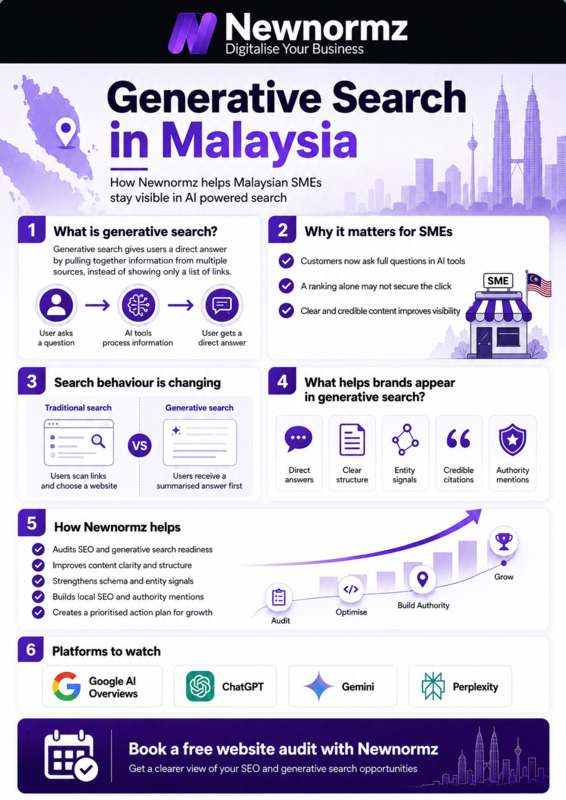
We start every engagement with an audit of technical SEO, page structure, business information consistency and existing authority signals, the same groundwork that determines both classic rankings and AI citations. From there we prioritise whatever moves fastest for that specific business: clearer service pages, structured data, Google Business Profile optimisation, local citations and stronger brand mentions.
Our track record is built on the SEO fundamentals this approach depends on. Oriental Kopi’s two-year campaign with us grew organic traffic by 43,300 visitors and added 24,500 ranking keywords, the kind of content depth and authority that also makes a brand easier for AI systems to find and reference. We apply that same groundwork to generative search visibility for Malaysian SMEs across F&B, healthcare, ecommerce and local services.
Frequently Asked Questions
Which pages should a Malaysian SME optimise for generative search first?
Start with the pages tied directly to enquiries: service pages, comparison content and location pages. These are the pages most likely to be pulled into an AI answer when someone is close to a buying decision, so they carry the most weight.
Does existing content need to be rewritten from scratch for AI search?
Usually not. Most pages just need restructuring: a sharper direct answer near the top, stronger evidence, and the entity details and credible sources the page is currently missing.
How do you check whether a business is actually appearing in AI answers?
We run the same questions a real customer would ask through Google AI Overviews, ChatGPT, Gemini and Perplexity, then track where and how often a brand gets mentioned, alongside standard ranking and traffic data.
What makes AI platforms trust a Malaysian business as a source?
Consistency matters more than volume: the same business details everywhere they appear online, structured data, local citations, and mentions from third-party sources an AI system already trusts.
Does this apply to local service businesses, or mainly to larger ecommerce brands?
It applies just as much to local service businesses. The recommendation and comparison searches people run before choosing a clinic, a contractor or a confinement centre are exactly the queries generative search now answers directly.
Can SEO and generative search visibility run under one campaign?
Yes, and they generally should. The technical and content groundwork both depend on the same foundation, so splitting them into separate budgets usually just creates duplicate work.
Still ranking, but not getting found in AI answers?
See Where Your Site Stands in Google AI Overviews and ChatGPT
Newnormz has run SEO campaigns across F&B, healthcare, ecommerce, and local services in Malaysia, backed by a performance guarantee of 70 percent of targeted keywords on Google’s first page.
30 minutes, no obligation, and you will see exactly where AI tools currently mention, or miss, your business.

Bryan Tan is an SEO Specialist and CEO at Newnormz, helping hundreds of businesses achieve first-page rankings on Google. With a passion for driving organic growth, Bryan blends innovative strategies with hands-on experience to optimize websites for maximum visibility. Always at the forefront of the latest SEO insights and trends, he consistently adapts to the evolving digital landscape.