Generative engine optimization (GEO) is the practice of structuring your website’s content, evidence, and technical markup so that AI tools such as ChatGPT, Google AI Overviews, Gemini, and Perplexity can understand, summarise, and cite your business when someone asks for a recommendation. For Malaysian SME owners, GEO does not replace SEO. It builds on the same groundwork: clear answers, credible evidence, and a site structured so both search engines and AI models can trust what they read. Businesses that only chase the traditional blue links risk becoming invisible in the growing share of searches that now happen inside an AI conversation instead of a results page.
A Simple Way to Think About It
SEO Gets You Listed. GEO Gets You Recommended.
😕 Listed, but never mentioned
A restaurant that shows up on every directory and every map search, but when a friend asks “where should I eat near Bangsar”, nobody thinks to say its name.
🗣️ The name people say out loud
A restaurant that’s the first name a friend blurts out the moment someone asks for a recommendation, before they’ve even opened an app to check.
That gap, between being findable and being the name an AI tool actually recommends, is what the rest of this guide walks through.
What Is Generative Engine Optimization (GEO)?
GEO improves how AI systems read your business, not just how Google ranks your pages. Where SEO focuses on earning a position in a list of search results, GEO focuses on earning a place inside the answer itself, the sentence an AI tool writes when a customer asks it a question directly.
A widely cited academic study on generative engine optimization tested a range of content methods across thousands of queries and found that adding credible citations, relevant quotations, and specific statistics could meaningfully improve how often a source got referenced in AI-generated answers. The pattern is consistent: AI models favour content that is specific, sourced, and easy to lift a clean answer from, over content that is vague or promotional.
If you want a deeper breakdown of where the two disciplines overlap and where they diverge, see our full comparison of local SEO versus GEO for Malaysian businesses.
Why Malaysian SMEs Can’t Afford to Ignore AI Search in 2026
Malaysia entered 2026 with an estimated 35.4 million internet users, around 98% of the population, according to DataReportal’s Digital 2026 Malaysia report. Google still handles roughly 93% of Malaysian search traffic (Statcounter, May 2026), but a growing share of that search behaviour now includes an AI Overview at the top of the page, or happens entirely inside a chat window on ChatGPT, Gemini, or Perplexity instead of a search results page.
Google has said publicly, more than once, that no agency can guarantee a specific ranking position. The same honesty applies to AI citations: no one can guarantee your business gets quoted by an AI model. What you can control is whether your content gives these systems a reason to trust and cite you, clear answers, real evidence, and a structure that’s easy to extract from. SMEs that treat GEO as optional today are choosing to be invisible in a channel their customers are already using to shortlist businesses.
How Generative Engine Optimization Actually Works
| GEO Factor | What It Means for SMEs | Action to Take |
|---|---|---|
| Direct answer structure | AI tools tend to pull from the opening lines of a page as the citable answer | Open every key page with a direct answer to the customer’s actual question |
| Entity precision | AI models trust content that names specific people, credentials, and locations | Replace vague phrases like “our team” with named services, qualifications, and branch addresses |
| Citation density | Pages backed by verifiable data are more likely to be treated as a trustworthy source | Support claims with real data, and cite the source rather than stating a number on its own |
| Structured data | Schema markup helps AI systems classify what a page is actually about | Add Article, FAQ, and LocalBusiness schema to your most important pages |
Common GEO Mistakes Malaysian SME Owners Make
Three patterns show up again and again on SME websites we review. Product and service pages open with a slogan instead of an answer, so AI systems skip past them entirely. Certifications, named staff, and specific locations get left out in favour of generic “about us” language, which weakens how confidently an AI model can identify the business as a real, trustworthy entity. And GEO gets treated as a one-off project rather than an ongoing content and schema cycle, when in practice it needs the same regular attention as SEO.
GEO vs Traditional SEO in Malaysia
| Factor | Traditional SEO | Generative Engine Optimization |
|---|---|---|
| Goal | Rank a page in a list of links | Get cited inside an AI-generated answer |
| Output | A blue link on a results page | A quoted or paraphrased sentence with attribution |
| Key signal | Backlinks and keyword relevance | Citations, entity precision, direct answers |
| Malaysia example | A KL cafe’s page ranking on Google for “cafe Bangsar” | ChatGPT naming that cafe when asked “best cafe in Bangsar” |
How Newnormz Approaches SEO and GEO Together
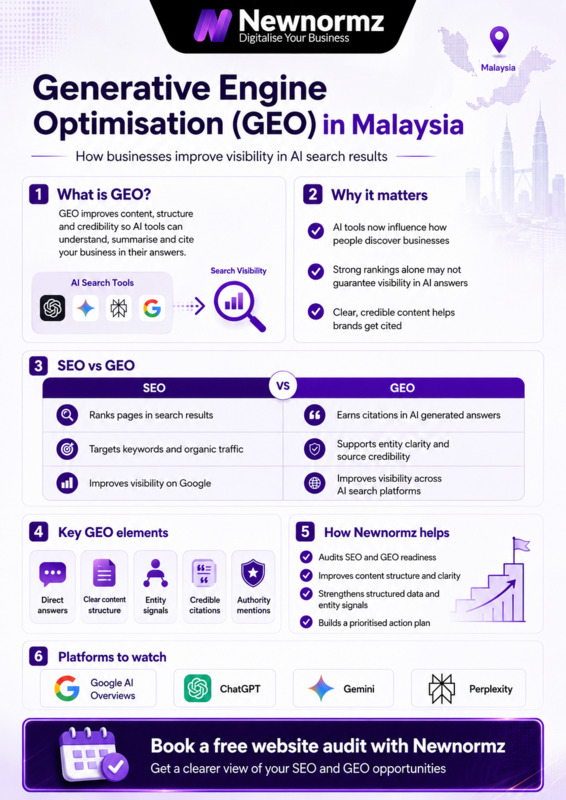
Newnormz audits the areas that affect both Google rankings and AI citation readiness: technical health, content structure, source credibility, entity signals, and schema coverage. That audit identifies which pages are weak, which trust signals are missing, and where the content gap sits relative to competitors.
The groundwork is the same discipline that has produced results for existing clients. Times Parking gained 528,000 impressions and 416 ranking keywords over a 6-month campaign. Oriental Kopi grew organic traffic by 43,300 and added 24,500 ranking keywords over 2 years. Sunway Medispa saw a 700% increase in traffic within 6 months. None of these were GEO campaigns specifically, but they show the same foundation, credible, well-structured, evidence-backed content, that AI citation depends on. An SEO agency in Malaysia that already builds this kind of foundation is better placed to extend it into AI search than one starting from scratch.
Frequently Asked Questions About Generative Engine Optimization in Malaysia
Can GEO help my business appear when customers ask AI tools for recommendations?
It can improve the odds. Newnormz strengthens service pages, business entity information, and source credibility so AI tools have clearer material to cite, though no agency can guarantee a specific mention.
Which pages should be optimised for GEO first?
Service, location, and comparison pages tend to carry the most weight, since these are the pages most likely to answer the specific questions customers ask AI tools.
Do I need to rewrite my whole website for GEO?
No. Most sites just need clearer opening answers, stronger evidence, better structure, and schema added to existing pages, not a full rebuild.
How is GEO performance actually measured?
Through a combination of AI citation tracking, brand mention monitoring, organic visibility in Google, and commercial keyword performance over each optimisation cycle.
Should local SEO and GEO be handled separately?
They work better combined. Google Maps visibility, technical SEO, content quality, and AI citation readiness all draw on the same underlying signals, so splitting them tends to create gaps rather than efficiency.
Would an AI tool recommend your business today?
Find Out Where You Stand in Google and AI Search
Newnormz has run SEO campaigns across F&B, healthcare, ecommerce, and local services in Malaysia, backed by a performance guarantee of 70 percent of targeted keywords on Google’s first page.
30 minutes, no obligation, includes a look at your current AI visibility.

Bryan Tan is an SEO Specialist and CEO at Newnormz, helping hundreds of businesses achieve first-page rankings on Google. With a passion for driving organic growth, Bryan blends innovative strategies with hands-on experience to optimize websites for maximum visibility. Always at the forefront of the latest SEO insights and trends, he consistently adapts to the evolving digital landscape.