The honest answer is 3 to 6 months for the first early movement in rankings and impressions, and 6 to 12 months before that turns into traffic and enquiries you can actually count. New domains in competitive niches often sit at the longer end of that range. If someone promises you page one within a few weeks, they are either using tactics that will get your site penalised later, or they are simply not being straight with you.
A Simple Way to Think About It
SEO Is a Durian Tree, Not a Grocery Run
🪓 Cutting the tree down in month two
A young durian tree with no fruit yet gets pulled out because the owner expected a harvest within weeks. The tree was never given the years it actually needs to put down roots.
🌳 Watering it through the quiet years
A farmer keeps watering and weeding the same tree through its first quiet seasons, because they know the payoff only comes once the roots are deep enough to support it.
SEO rewards the same patience. The next section breaks down exactly what happens month by month, and what real client campaigns looked like along the way.
Why the Timeline Looks the Way It Does
SEO is compounding interest, not a light switch. The technical fixes and content you publish in month one do not stop working after they go live, they keep earning trust with Google for as long as the site exists. That trust just takes time to build.
This lines up with what Google itself has said for years. Former Google engineer Maile Ohye put the window at four months to a year for SEO work to be implemented and then show benefit. It also matches the raw ranking data. Ahrefs studied roughly 2 million pages and found the average page sitting in the top 10 is over 2 years old, with 72.9% of top 10 pages being more than 3 years old. Age itself is not a ranking factor Google admits to directly, but it is a very strong proxy for the accumulated trust, links and content depth that actually are.
What Actually Moves Your Timeline
Two businesses can start SEO on the same day and be a year apart in results. These five factors explain most of that gap.
| Factor | How It Changes Your Timeline |
|---|---|
| Site age and history | A domain with a clean, established history has already earned some trust. A brand-new domain starts the clock at zero. |
| Domain authority and backlinks | Existing quality backlinks compress the timeline. Starting from none puts you at the slower end of the range. |
| Competition in your niche | A local, low-competition term can move in months. A national commercial keyword with well-funded competitors can take a year or more. |
| Content velocity | Publishing one page a quarter versus several useful pages a month produces very different curves over the same 12 months. |
| Budget | Budget buys more content, more technical work and more link building per month. A thin retainer just spreads the same work over more months. |
Which Keywords Rank First
Progress does not spread evenly across every keyword you are chasing. It climbs a ladder, and knowing the rungs stops you from panicking in month three.
Long-tail terms move first
Specific, lower-volume phrases face less competition, so a single strong page can reach the top 10 within a few months. This traffic is often more qualified and converts better anyway, which is why leads can start arriving before you own any of the bigger keywords.
Mid-volume terms follow
As long-tail pages earn traffic and links, the site’s overall authority rises, and slightly broader terms start moving into striking distance.
Head terms rank last
The one or two-word keywords with the highest search volume are defended by the most established sites in the market. Treat these as a 9 to 18 month goal, not something to expect at launch. If you need visibility while that builds, pairing SEO with Google Ads covers the gap.
A Realistic Timeline, With Real Numbers
Below is what this actually looked like across real Newnormz campaigns, so you can see what “normal” progress looks like at each stage rather than a hypothetical curve.
| Timeframe | What Happens |
|---|---|
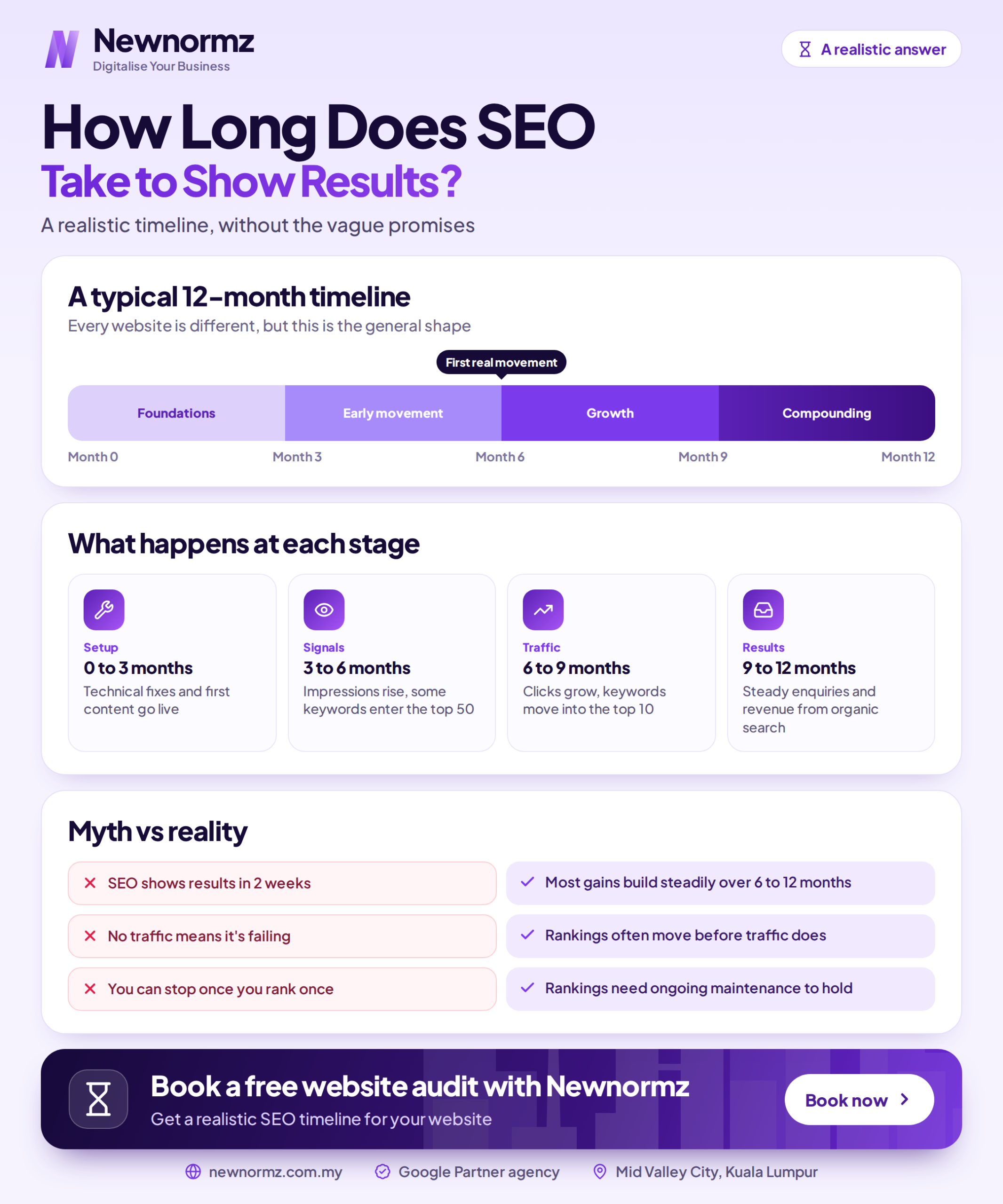
| Months 1 to 3 | Technical fixes, site structure and the first content go live. Pages get indexed and impressions start appearing in Search Console. Clicks are close to zero. This is normal, not a red flag. |
| Months 4 to 6 | Long-tail keywords start entering the top 10. In this window, Sunway Medispa’s 6-month campaign delivered a 700% traffic increase and 70% more ranking keywords, while Times Parking reached 528,000 impressions and 416 ranking keywords over the same period. |
| Months 7 to 12 | Mid-volume keywords join the long-tail wins, and traffic starts trending up month over month instead of arriving in spikes. |
| Year 2 and beyond | This is where compounding really shows. Oriental Kopi’s 2-year SEO campaign produced 43,300 in additional monthly traffic, 6.31 million impressions, 24,500 more ranking keywords and 468,000 clicks. |
Signs SEO Is Working Before the Traffic Shows Up
The most common mistake is judging SEO by clicks in month two. Clicks are the last thing to move. Watch these instead, in Google Search Console:
Indexing
Confirm new pages are actually indexed first. Nothing ranks until Google has crawled and stored it.
Impressions
Rising impressions mean your pages are starting to show up in results. This is usually the earliest visible sign that the work is taking effect, and it moves well before clicks do.
Average position
A keyword climbing from position 45 to position 18 earns zero extra clicks, but it tells you the strategy is on track. Movement on page two is a strong signal that page one is next.
High impressions, low clicks
Once a page is showing up often but not getting clicked, you have already earned the ranking. The fix at that point is usually a better title and meta description, not more content.
Why SEO Feels Slower Than It Used to
If it feels harder to rank than it did a few years ago, that is not just a feeling. Competition has increased, there is far more content published overall, and AI-generated results in search have raised the bar for what earns a top spot. The practical response is simple: plan for the slower end of the range, invest in genuine quality over sheer volume, and treat SEO as a 12-month commitment at minimum. Our SEO services in Malaysia are structured around that exact timeline, not a shortcut around it.
Frequently Asked Questions
How long does SEO take to show results?
Expect 3 to 6 months for the first movement in rankings and impressions, and 6 to 12 months before that becomes meaningful traffic and enquiries. New domains in competitive niches often land at the longer end.
Why is my SEO taking so long?
Usually one of five reasons: a young domain, low authority and few backlinks, a highly competitive niche, low content velocity, or a budget too thin to fund enough monthly work. Check whether impressions and average positions in Search Console are climbing. If they are, it is working, even if traffic still looks flat.
Can SEO work faster than 3 months?
On an established, high-authority domain targeting a genuinely low-competition long-tail term, sometimes yes. For a brand-new site, this is rare, and any promise of fast rankings on a fresh domain deserves scrutiny.
What is the first sign that SEO is working?
Rising impressions in Google Search Console, followed by improving average positions. Both move before clicks do, so a keyword climbing from position 40 to position 15 is real progress even though it has not earned a click yet.
Does a new website take longer to rank than an established one?
Yes, noticeably. Established domains with a clean history are trusted faster, which is reflected in how old the average top 10 page tends to be. A new site can absolutely rank, it just starts from zero and needs to earn that trust first.
Not sure if your SEO is on track or just stuck?
Get a Free Audit That Tells You Where You Actually Stand
Newnormz has run SEO campaigns across F&B, healthcare, ecommerce, and local services in Malaysia, backed by a performance guarantee of 70 percent of targeted keywords on Google’s first page.
30 minutes, no obligation, just an honest read of your rankings and impressions.

Bryan Tan is an SEO Specialist and CEO at Newnormz, helping hundreds of businesses achieve first-page rankings on Google. With a passion for driving organic growth, Bryan blends innovative strategies with hands-on experience to optimize websites for maximum visibility. Always at the forefront of the latest SEO insights and trends, he consistently adapts to the evolving digital landscape.