Shopify SEO is the work of making your store’s product pages, collection pages, and technical setup good enough for Google to rank and for Malaysian shoppers to trust once they click. It is not a plugin you install once. It is titles, meta descriptions, URL handles, page speed, and site structure, all rebuilt around what your buyer actually types into Google, then kept in shape month after month. For a Malaysian store in 2026, that means writing for local search habits, loading fast on the phones most of your buyers are shopping from, and giving Google a clean site to crawl instead of the messy defaults Shopify ships with.
Why Google Traffic Decides Whether a Malaysian Shopify Store Scales
Malaysia now has 35.4 million internet users, about 98 percent of the population, and Google handles roughly 93 percent of all search activity in the country. That is where your buyers are looking, whether or not your store shows up. Organic search already accounts for roughly 53 percent of all website traffic, making it the single biggest channel most ecommerce stores have, and it is the only one that does not disappear the moment you stop paying for it.
The market itself is not small. Malaysia’s e-commerce sector is estimated at USD 12.26 billion in 2025 and is growing at a 14.32 percent compound annual rate through 2030. That growth is not evenly split. Stores that rank pull further ahead every quarter, while stores stuck on page two watch the category grow without them.
A Simple Way to Think About It
Two Shoplots in the Same Mall
🚪 The Unlabelled Shoplot
A shoplot buried past the escalators, its unit still listed on the mall directory as “Lot 12.” Shoppers walk right past it looking for something they can actually recognise by name.
🏪 The Storefront With a Sign
A shoplot near the entrance with a lit sign and its actual name printed on the directory. People find it before they have even finished deciding what to buy.
That gap between an untouched Shopify default and a store built to be found is exactly what the rest of this guide closes, page by page.
Click Position Is Basically Revenue
Ranking on page one is not a vanity metric. The first organic position captures roughly 39.8 percent of all clicks on that search, and the top three results between them take the majority of clicks on the page. Everything past position four is fighting over scraps, and page two might as well not exist.
| Google Position | Average Click-Through Rate | What It Means for Your Store |
|---|---|---|
| Position 1 | 39.8% | Roughly 4 in 10 searchers click you first |
| Position 2 | 18.7% | Less than half of position one |
| Position 3 | 10.2% | Still solid, but the drop is steep |
| Position 4 | 7.2% | Diminishing returns start here |
| Page 2 and beyond | Under 2% | Effectively invisible to buyers |
Speed compounds this. Shopify’s own data across 30 million sessions shows that every 0.1 second a store loads faster is tied to 8.4 percent more sales. And in a market where smartphones generated 72.67 percent of 2025 e-commerce transactions, a store that ranks but loads slowly on mobile still loses the sale before the buyer ever reaches checkout.
Fix Your Product and Collection Pages First
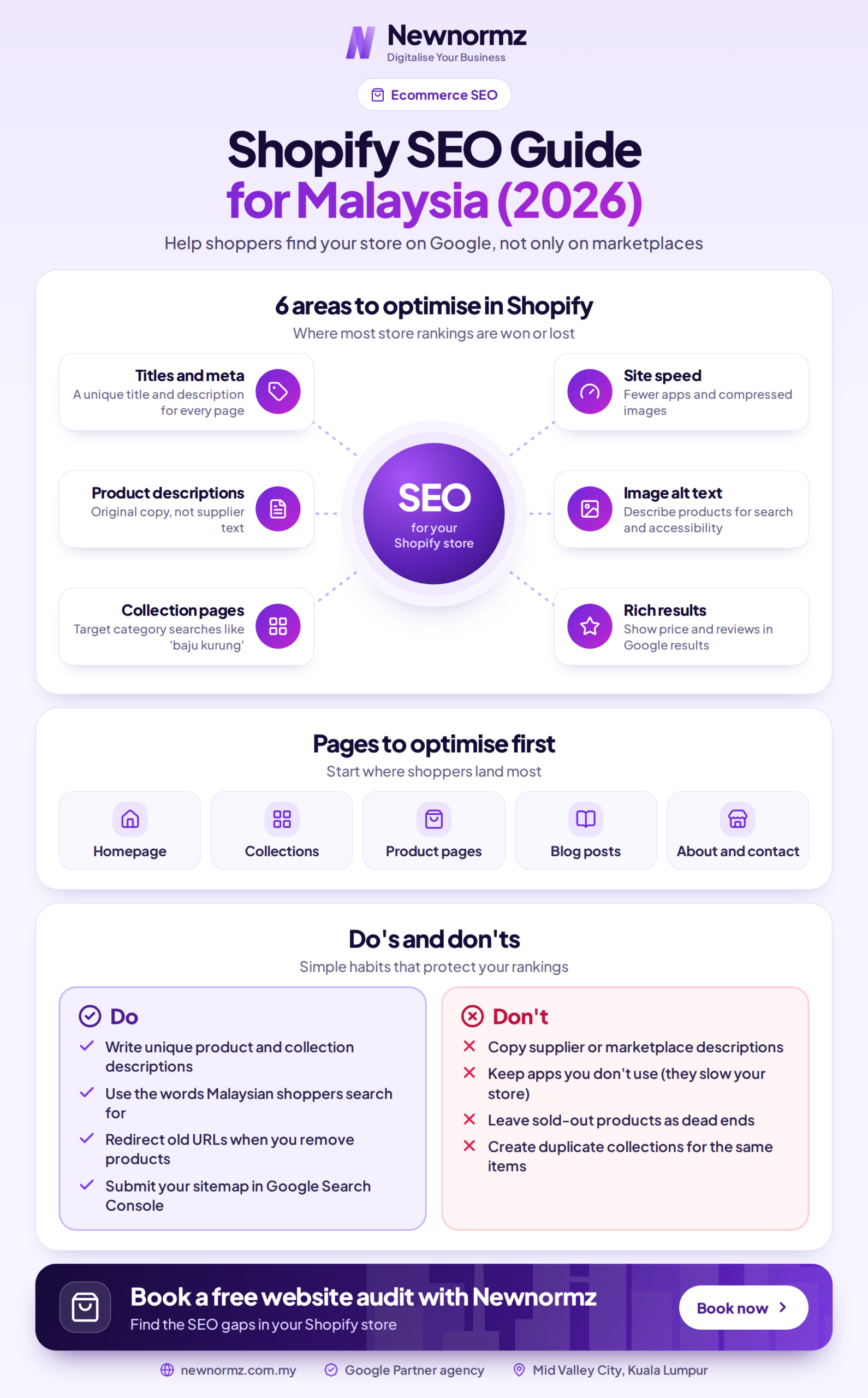
Shopify auto-generates titles, meta descriptions, and URL handles for every product you add, and those defaults are almost never written for search. That is the highest-leverage fix available to you, because it takes no development work, just discipline.
Map one primary keyword to each product and collection page, based on how Malaysian shoppers actually search: brand plus product, product plus “Malaysia,” or product plus the use case they have in mind. Use that keyword once in the title, once in the meta description, once in the URL handle, and once in the opening line of the description. Do not repeat it beyond that. Google reads keyword stuffing as a warning sign, not a ranking signal.
Prioritise collections and product pages over blog posts. A shopper searching a product name is closer to buying than one reading an article, so your money pages deserve the first pass. None of this works, though, if the underlying site is a mess of dead-end links and duplicate variants, which is where solid SEO service work on site architecture pays for itself.
A Real Before-and-After
Here is what that fix looks like on an actual product page, using a hypothetical Malaysian store, “KopiKita,” selling a local cold brew coffee concentrate.
Before:
Title: “Product | KopiKita Official Store”
Meta description: “Welcome to our store. Buy now. Free shipping available on selected items.”
URL: /products/product-12345-copy
No keyword, no reason to click, and a URL that means nothing to a shopper or to Google.
After:
Title (48 characters): “Cold Brew Coffee Concentrate Malaysia | KopiKita”
Meta description (150 characters): “Buy KopiKita cold brew coffee concentrate in Malaysia. Smooth, low-acid, ready in seconds. Free Peninsular shipping over RM120. Order online today.”
URL: /products/cold-brew-coffee-concentrate
Opening line: “KopiKita Cold Brew Coffee Concentrate is a smooth, low-acid coffee made for busy Malaysian mornings. Just add water or milk for cafe-quality cold brew in seconds, no equipment needed.”
The keyword now leads the title, the meta description earns the click with a real benefit and a local offer, and the URL reads cleanly for both the shopper and the crawler.
The Technical Layer: Speed, Structure, Indexing
Technical SEO is the plumbing behind all of this. Get it wrong and even a well-written product page stays buried.
Speed
Compress every product image before upload, limit the number of apps you install, and avoid themes bloated with features you do not use. The stakes are steep: 53 percent of mobile users abandon a page that takes more than 3 seconds to load, and conversion rates drop around 7 percent for every additional second. In a mobile-first market like Malaysia, a 4 second load time is a quiet, ongoing leak of revenue you never see in your analytics.
Structure and schema
Keep one H1 per page, use short and logical URL handles, and add product schema markup so Google can display price, stock status, and review stars directly in search results. Shopify covers some of this automatically, but review-rich snippets and breadcrumb schema usually need manual configuration or an app.
Indexing
Submit your sitemap in Google Search Console and check that tag or filter pages are not quietly generating thousands of thin, duplicate URLs. Uncontrolled faceted navigation is one of the most common reasons Shopify stores waste crawl budget on pages that were never meant to rank. This is also usually where a store pairs organic work with Google Ads to keep traffic flowing while the technical fixes take hold.
Common Mistakes That Keep Shopify Stores Invisible
Leaving Shopify’s default titles and meta fields untouched wastes your best ranking real estate before you have even started. Too many apps and uncompressed images quietly kill both load times and conversions. Near-identical product variant pages confuse Google and split your ranking signals across duplicates instead of one strong page. Orphaned products that nothing links to rarely get crawled, let alone ranked. Chasing high-volume keywords instead of buyer-intent, long-tail terms means fighting harder for traffic that converts worse. And treating SEO as a one-time task, rather than an ongoing habit of monitoring and refreshing pages, is why rankings that took months to build quietly slip away.
The Shopify SEO Checklist
| Checklist Item | Why It Matters |
|---|---|
| Unique, keyword-led title under 60 characters on every product and collection | Overrides Shopify’s generic default and gives Google something to rank |
| 150 to 160 character meta description with a benefit and a call to action | Directly drives click-through rate at your position |
| Short, readable, keyword-based URL handles | Removes machine-generated noise that means nothing to shoppers or Google |
| Keyword-rich opening paragraph on every product description | Confirms relevance to both the shopper and the search engine |
| Compressed images and an app audit to keep load times under 3 seconds | Protects both ranking and conversion on mobile |
| Product, review, and breadcrumb schema markup | Earns rich snippets with price, stock, and star ratings in search |
| Sitemap submitted in Google Search Console, indexing errors fixed | Stops crawl budget being wasted on thin or duplicate pages |
| Monthly review of Search Console with underperforming pages refreshed | Keeps rankings compounding instead of quietly decaying |
Frequently Asked Questions
Is Shopify good for SEO?
Yes. Shopify handles many technical basics well, including clean code, automatic sitemaps, and strong Core Web Vitals out of the box. Its weak spots are URL structure control and default metadata, but with proper on-page work and schema, Shopify stores compete fine against any other ecommerce platform in Malaysia.
How long does Shopify SEO take to work?
Expect three to six months for meaningful movement, longer for competitive keywords. Early work on titles, speed, and structure pays off gradually because Google needs time to crawl and build trust in your store, especially if the domain is new.
Do I need to blog for Shopify SEO?
Not to start. Fix your product and collection pages first since they carry the strongest buyer intent. Blog content targeting informational searches is worth adding later, once your money pages are solid and you want internal links pointing back to them.
How important is page speed for Shopify SEO?
Very. Speed is both a ranking signal and a conversion driver, and Shopify’s own data ties faster load times directly to more sales. In a market where most shopping happens on a phone, a fast store protects rankings and revenue at the same time.
Should I use Shopify SEO apps?
Some help with schema, image compression, or bulk meta editing, but every extra app risks slowing your store. Install only what solves a specific problem, audit your app list regularly, and remove anything you are not actively using.
Does SEO or Google Ads work better for a Shopify store?
They solve different problems. Google Ads buy instant traffic for as long as you pay, which suits launches and promotions. SEO builds traffic that compounds and gets cheaper over time. Most stores that scale well in Malaysia run both together rather than betting on one alone.
Not sure why your Shopify store gets traffic but few sales?
Get a Free Audit That Shows Exactly What’s Blocking Your Rankings
Newnormz has run SEO campaigns across F&B, healthcare, ecommerce, and local services in Malaysia, backed by a performance guarantee of 70 percent of targeted keywords on Google’s first page.
30 minutes, no obligation, and you’ll leave with a prioritised action plan for your store.

Bryan Tan is an SEO Specialist and CEO at Newnormz, helping hundreds of businesses achieve first-page rankings on Google. With a passion for driving organic growth, Bryan blends innovative strategies with hands-on experience to optimize websites for maximum visibility. Always at the forefront of the latest SEO insights and trends, he consistently adapts to the evolving digital landscape.