B2B sales lead generation in 2026 works best when you get found by buyers who are already researching, instead of chasing people who never asked to hear from you. Most corporate buyers do their homework quietly, on Google and increasingly in AI tools, and they build a shortlist before they speak to any vendor. So the job is simple to describe and hard to do well: be visible when a decision maker searches for the problem you solve, give them enough substance to trust you, and have a clear process that separates real buyers from casual browsers. Bought lists and mass cold emails still exist, but they cost more in wasted sales hours and domain reputation than most teams realise. Search, paid search, and a strict qualification process do the heavy lifting now. None of it is instant, and nobody can promise you a fixed number of leads, but done consistently it builds a pipeline that doesn’t dry up the moment you stop spending.
A Simple Way to Think About It
The Flyer and the Shortlist
📄 Handing out flyers
You stand outside an office tower at lunch and hand a flyer to everyone who walks out. Almost all of them go straight in the bin, and the few people who keep one weren’t looking to buy anything.
📋 Making the shortlist
A procurement manager’s boss asks for three vendors by Friday. They search, and your company is one of the first names they find.
The rest of this guide covers how to become the second business, and how to tell a real buyer from a curious visitor once they arrive.
Why the Old B2B Lead Playbook Keeps Stalling
Most B2B companies I audit in Malaysia have the same pipeline problem. They buy a contact list, run a cold email sequence, get a few replies, and then wonder why sales keeps complaining about lead quality. There are three reasons it keeps happening.
Contact data goes stale quickly. People change roles, companies restructure, and email addresses stop working. A list that looked clean when you bought it starts bouncing within months, and every bounce chips away at your sending reputation.
Inbox filters are good at spotting bulk outreach. Hundreds of near-identical emails from a single domain look like spam because, to the recipient, they basically are. Once your domain gets flagged, even your genuine follow-ups to real prospects start landing in junk.
Compliance risk is real. Malaysia’s Personal Data Protection Act 2010 governs how personal data is collected and used for commercial purposes. If you can’t show where a purchased list came from or how consent was obtained, you’re carrying risk you don’t need.
The deeper problem is timing. A cold message lands whenever it suits you, not when the buyer has a problem. Even a perfectly written pitch loses if it arrives six months before they need you, or a week after they’ve already signed with someone else.
Your Buyers Research Before They Talk to You
A widely cited piece of industry research says B2B buyers get through roughly 70 percent of their research before they contact a vendor. You don’t need that exact figure for the point to hold. Anyone who has sold into corporates knows it already: by the time someone fills in your contact form, they’ve read your website, compared you with two or three competitors, and often decided what they’re willing to pay.
That has a practical consequence. The shortlist gets made during the quiet research phase, and you’re either on it or you aren’t. Buyers usually research through search. Malaysia had 35.4 million internet users at the end of 2025, about 98 percent of the population (DataReportal Digital 2026 Malaysia), and Google handles around 93 percent of search in the country (Statcounter, May 2026). If your company doesn’t show up for the questions buyers type, you’re invisible to them at the moment it matters most.
B2B sales cycles also tend to be long, and several people are usually involved: the person who searches, the manager who approves, finance, and sometimes a technical evaluator. Each of them will look you up separately. Your content has to answer the operational questions for the person on the ground and the ROI questions for the person who signs.
Search Is Where B2B Intent Shows Up First
For most B2B companies, organic search is the most dependable lead source over time, because it catches people at the exact moment they’re looking. A sustained SEO service in B2B isn’t about chasing high-volume keywords. It’s about owning the specific, often low-volume searches that only a genuine buyer would type.
Target the problem, not just the product
“Industrial chiller supplier Selangor” is a buyer search. So is “how to reduce cold room energy cost” or “ISO 9001 consultant for manufacturing SME”. Map the questions your sales team hears on every discovery call, then build pages that answer them properly. A page that genuinely solves a problem builds more trust than any brochure.
Cover the languages your buyers actually use
Plenty of Malaysian decision makers search in English for technical terms, but local SMEs and family-run businesses often search in Bahasa Malaysia or Chinese. If your buyers include those segments, check whether competitors are ranking for those terms. It’s often the easiest gap to close.
Make the technical foundation boring and reliable
Fast pages, clean site structure, clear service pages for each offering, and schema markup that tells search engines what you sell and where you operate. None of it is exciting, but when it’s broken, every piece of content you publish performs below its potential.
For a real example of what consistent search work does to visibility, our six-month campaign for Times Parking, a parking management company, produced 528,000 impressions, 416 ranking keywords, and 31.5K clicks. That’s the kind of groundwork that puts a B2B service in front of the right people repeatedly.
What AI Search Changes, and What It Doesn’t
Buyers now also ask ChatGPT, Perplexity, and Google’s AI Overviews to summarise options. This is what people call Generative Engine Optimisation (GEO): making it more likely that your brand is mentioned or cited in those AI answers.
Let me be straight about the limits. Nobody controls what an AI model says, just as nobody can guarantee a specific Google ranking, and Google itself has said so publicly many times. What you can do is make your company easy to understand and easy to cite:
- State clearly what you do, who you serve, and where, on pages that are easy to crawl.
- Publish specific, factual answers rather than vague marketing copy.
- Get mentioned on credible industry sites, directories, and publications.
- Use structured data so machines can read your services, locations, and company details correctly.
Most of this overlaps with good SEO. Treat GEO as an extension of solid search work, not a separate magic channel, and be wary of anyone selling it as a guaranteed shortcut.
Paid Search Fills the Gap While SEO Builds
SEO takes months to compound. If your pipeline needs activity this quarter, Google Ads lets you show up for commercial searches straight away. In B2B, the trick is to be disciplined:
- Bid on high-intent terms (supplier, vendor, quotation, price, specific product codes), not broad informational ones.
- Add negative keywords aggressively. Filter out “jobs”, “course”, “free”, “DIY”, and consumer variations.
- Send clicks to a dedicated landing page with one clear action, not your homepage.
- Track leads that turn into sales conversations, not just form submissions.
The strongest setups use paid search to learn quickly which keywords actually bring in qualified enquiries, then feed those findings into the SEO plan so organic traffic eventually covers the same ground at a lower ongoing cost.
Qualify Hard, or Sales Will Stop Trusting Marketing
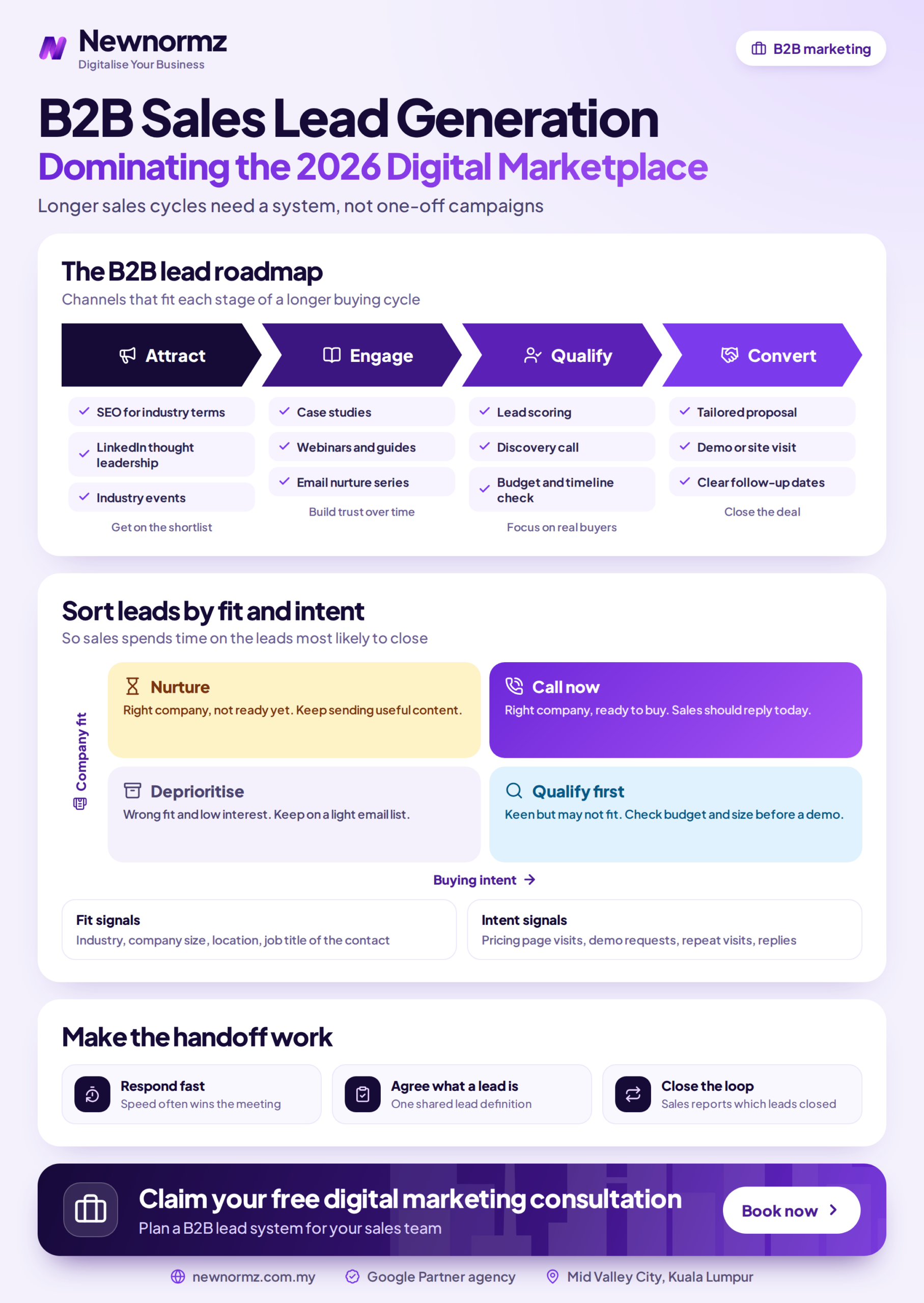
More leads is not the goal. Commonly quoted benchmarks put the average MQL to SQL conversion rate at around 13 percent, which means most “leads” never become real sales conversations. Every unqualified lead that reaches a salesperson costs time and erodes trust between the two teams.
Agree on a written definition of a sales-ready lead before you spend on any channel. A simple framework works fine:
| Criterion | What to confirm | Warning sign |
|---|---|---|
| Budget | A budget exists or is being approved for this financial year | “Just getting quotes to compare” with no funding in place |
| Authority | You know who signs off and how they’re involved | Your contact can’t name the decision maker |
| Need | A specific problem your solution actually fixes | Vague interest with no defined pain point |
| Timeline | A realistic decision window, ideally within the next two quarters | “Maybe next year” with no trigger event |
Behavioural scoring helps on top of this. A visitor who reads your pricing page, a case study, and a service page in one session is far warmer than someone who downloaded one ebook. CRM tools such as HubSpot and Salesforce now include AI features that automate part of this scoring, but they only work if the rules behind them reflect how your buyers actually behave. Set the criteria yourself, then let the software apply them.
What’s Different About Selling B2B in Malaysia
Global B2B playbooks usually assume a buyer who fills in a form and waits for an email. Malaysian B2B often works differently.
- Relationships still close deals. Digital channels get you onto the shortlist, but trust is usually sealed in a meeting, a call, or a WhatsApp conversation. Make it easy to reach a real person quickly.
- WhatsApp is a real business channel. Many decision makers would rather send a quick WhatsApp message than fill in a long form. Offer both, and track both.
- Geography matters. The Klang Valley has the densest corporate buyer base, while Penang and Johor are major manufacturing and export hubs. If you serve specific regions, build location-specific pages around them rather than a single generic “we serve Malaysia” line.
- Local proof beats global logos. A case study from a Malaysian company in a similar industry is worth more to a local buyer than a famous overseas name they can’t relate to.
- Timing follows the calendar. Budget cycles, year-end approvals, and major festive periods such as Chinese New Year and Hari Raya affect when decisions actually get made. Plan campaigns so you’re visible in the weeks before budgets are set, not during the holiday lull.
Metrics That Actually Tell You If It’s Working
Traffic and form fills are easy to report and easy to inflate. These are the numbers worth watching:
| Metric | Why it matters | Red flag |
|---|---|---|
| MQL to SQL rate | Shows whether marketing is attracting real buyers | Lead volume rising while the rate falls |
| Cost per qualified lead | The real cost of each usable opportunity, by channel | Only cost per raw lead is being reported |
| Rankings for buyer-intent keywords | Tells you if you’re visible during the research phase | Rankings reported only for informational, low-intent terms |
| Pipeline value from each channel | Links marketing spend to revenue, not just activity | No CRM tracking of lead source |
| Sales cycle length | Better-qualified leads usually close faster | Deals dragging on because unready leads were passed to sales |
If your agency or internal team can’t connect a lead back to its source and then to a closed deal, fix the tracking before you increase the budget. Scaling spend without that visibility just scales the guesswork.
A Realistic Timeline
| Period | What typically happens |
|---|---|
| Weeks 1 to 4 | Tracking set up, qualification criteria agreed, paid search launched on high-intent terms |
| Months 1 to 3 | Early paid enquiries, technical SEO fixes, first buyer-focused pages published and indexed |
| Months 3 to 6 | Organic rankings start moving for niche commercial terms; lead quality data guides where to invest next |
| Months 6 and beyond | Organic visibility compounds; paid spend can be focused on the terms SEO hasn’t won yet |
Competitive industries and new domains take longer. Anyone promising a flood of qualified B2B leads in the first month is either relying entirely on paid spend or overselling.
Frequently Asked Questions
How is B2B lead generation different from B2C?
B2B purchases usually involve several people, larger contract values, and longer decision cycles. You’re earning the trust of a committee over weeks or months, not prompting one person to buy on impulse. That’s why detailed content, case studies, and a clear qualification process matter more in B2B.
Is cold outreach dead for B2B in Malaysia?
Not completely. Well-researched, personalised outreach to a small list of target accounts can still work. What no longer works is mass, generic blasting to purchased lists. It damages your email domain, raises PDPA questions, and rarely reaches anyone at the right moment. Outreach works best once your prospect has already come across your brand through search.
Can SEO really bring in leads for manufacturing and industrial companies?
Yes, and it’s often underused in those sectors. Engineers and procurement teams search for specific specifications, certifications, and suppliers by location. Search volumes are small, but the people searching are usually serious buyers, and competition for those terms is often weaker than in consumer markets.
How much should we budget for B2B lead generation?
It depends on your deal size, how competitive your keywords are, and how fast you need results. A useful way to frame it: work out what one closed client is worth to you over a year, then decide what you can afford to pay to acquire one. Start with a focused budget on high-intent channels, measure cost per qualified lead, and scale what works.
Do we need GEO, or is regular SEO enough?
Start with strong SEO, because most of what helps you appear in AI answers (clear, factual, well-structured content and credible mentions elsewhere) is the same work. Once that foundation is in place, it’s worth checking how AI tools describe your company and adjusting your content to fill any gaps. Treat anyone guaranteeing AI citations with caution.
Are your buyers finding you, or your competitors?
Get on the shortlist before the first sales call happens
Newnormz has run SEO campaigns across F&B, healthcare, ecommerce, and local services in Malaysia, backed by a performance guarantee of 70 percent of targeted keywords on Google’s first page.
30 minutes, no obligation, and a clear view of which buyer searches you’re missing today.

Bryan Tan is an SEO Specialist and CEO at Newnormz, helping hundreds of businesses achieve first-page rankings on Google. With a passion for driving organic growth, Bryan blends innovative strategies with hands-on experience to optimize websites for maximum visibility. Always at the forefront of the latest SEO insights and trends, he consistently adapts to the evolving digital landscape.