AI answers now handle many simple questions right on the results page, so SEO lead generation in Malaysia is no longer about piling up traffic. It’s about showing up when a buyer is close to deciding. That means targeting commercial-intent searches (in English, Bahasa Malaysia and Chinese where your customers use them), writing pages that answer questions clearly enough for Google and AI tools to quote, backing them with real proof, and making it easy for visitors to contact you. Then you measure leads and sales, not clicks. Nobody can promise you a particular ranking or an AI citation. Google has said so publicly. What you can do is make your business the most credible and useful answer, and that is the part you control.
A Simple Way to Think About It
Busy Corridor vs a Friend’s Referral
🚶 The Busy Corridor
A stall in the busiest corridor of a mall. Thousands of people walk past every day, and hardly any of them stop to buy.
🤝 The Referral
A friend tells you which stall to visit and why it’s the right one. You walk in already planning to buy.
The sections below show how to build the second kind of visibility, the kind that sends you people who are ready to talk.
What Actually Changed in Malaysian Search
Search is still where your buyers begin. Malaysia had 35.4 million internet users at the end of 2025, which is 98% of the population (DataReportal Digital 2026 Malaysia). Google handles about 93% of search in the country (Statcounter, May 2026). Google is still the place to win.
What changed is what happens after someone types a query. Google’s AI Overviews, along with tools like ChatGPT and Perplexity, now answer many simple questions directly. Someone searching “what is SEO” may get their answer without clicking anything. You lose that visit, but it was rarely a lead to begin with.
The searches that still produce clicks are usually the ones that lead to money: comparing providers, checking prices, looking for a service in a specific area, or wanting to talk to someone. So there may be fewer clicks overall, but a higher share of them come from real buyers. If your SEO plan still treats total traffic as the goal, you’re measuring the wrong thing.
A note on terms. You’ll hear agencies say GEO (Generative Engine Optimisation) and AEO (Answer Engine Optimisation). They’re useful labels, but they aren’t a separate field. Google has said publicly that you don’t need anything extra to appear in its AI features beyond sound SEO practice. The same fundamentals decide whether you rank and whether you get quoted. The difference is that sloppy work now costs you more.
Stop Measuring Traffic. Start Measuring Leads.
Many SEO reports look impressive and say nothing about revenue. A traffic chart going up is easy to show. What you actually need to know is whether that traffic turned into enquiries, and whether those enquiries turned into sales.
| Vanity Metric | Why It Misleads | Track This Instead |
|---|---|---|
| Total organic traffic | Blog readers from other countries count the same as a buyer in Petaling Jaya | Traffic to service, pricing and location pages |
| Number of ranking keywords | Hundreds of keywords with no buying intent add nothing to your pipeline | Rankings for the commercial terms your customers actually search |
| Total form submissions | Spam and wrong-fit enquiries make the number look better while they waste your sales team’s time | Qualified leads, and lead-to-opportunity rate |
| Cost per click | Cheap clicks that never convert are still wasted money | Cost per acquisition and revenue traced back to organic |
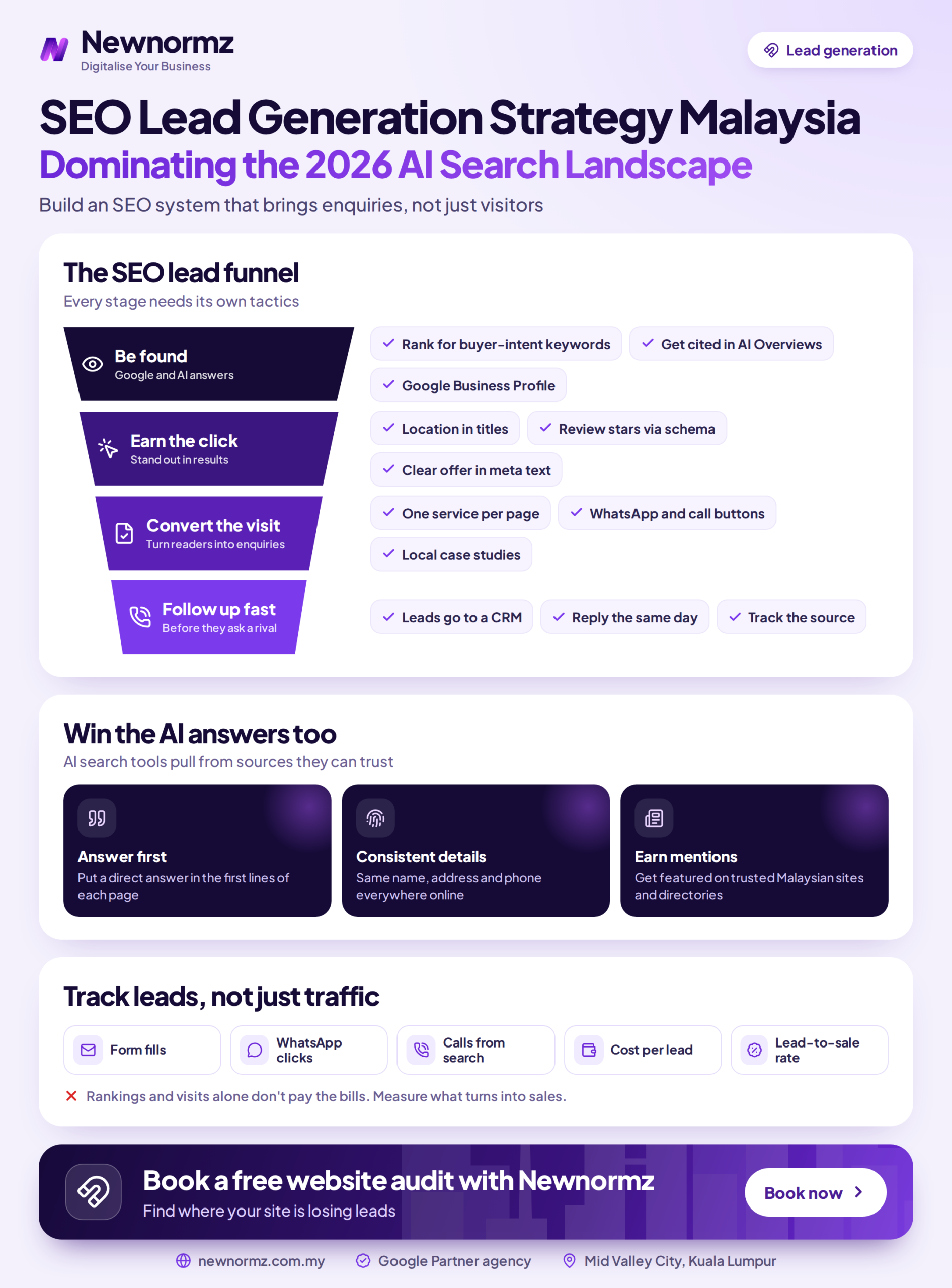
To track any of this, your website has to connect to wherever leads end up. That could be a CRM, a shared inbox, or a WhatsApp Business account. If you can’t trace a closed deal back to the search that started it, you’re guessing.
The Strategy: Six Things That Actually Move Leads
1. Target intent, not volume
Start with the searches people make when they’re ready to buy: “[service] price Malaysia”, “[service] near me”, “best [provider] in KL”, “[product] supplier Penang”. These often have low search volume and high value. Then check the language. Many Malaysian buyers search in Bahasa Malaysia or Chinese, and competition for those terms is often thinner. If your customers search “servis SEO” or in Chinese, you need pages that match.
2. Write pages that answer the question directly
AI tools and featured snippets pull from pages that give a clear, direct answer. Put the answer near the top of the page and explain it afterwards. Use plain headings that match how people phrase their questions. Add structured data (schema markup) for your business, services, reviews and FAQs so search engines can read your details without guessing. Keep your business name, address and phone number the same everywhere they appear online.
3. Prove you’re credible
Google’s quality guidelines put weight on experience, expertise, authoritativeness and trust (E-E-A-T). In practice, that means real case studies with real numbers, named authors with real experience, genuine Google reviews, and mentions on reputable Malaysian sites. Generic content that could have come from any agency won’t earn trust from either Google or your prospects.
4. Fix the technical basics
Google’s Core Web Vitals measure three things: loading speed (LCP), how quickly the page reacts when someone taps or clicks (INP), and whether the layout jumps around while it loads (CLS). Most Malaysian buyers research on their phones, often during a commute or between meetings. A slow mobile page loses them to the next result. None of this is glamorous, and all of it matters.
5. Make contacting you effortless
Ranking is only half the work. The other half is what the page asks the visitor to do. In Malaysia, a WhatsApp button often gets far more responses than a long form. Keep forms short. Put a clear call to action on every service page. Then connect every channel to your tracking so you know which pages bring in leads.
6. Use paid search to cover the gap
SEO takes months to build momentum. If you need enquiries now, run Google Ads while the organic work matures. One KL confinement centre we worked with spent RM2,550 a month on SEO paired with Google Ads and was getting qualified leads within 30 days. Paid search brings in leads quickly while SEO lowers your long-term cost per lead.
If You Sell B2B or Industrial
B2B buyers, especially in manufacturing, don’t search generic industry terms. They search for specifications, certifications, materials and compliance standards. Build pages around those details: technical product pages, application case studies, and downloadable spec sheets. Sales cycles are long and several people are involved in each decision, so you need content for each stage, from the engineer checking capability to the procurement officer comparing suppliers. If you serve particular industrial areas such as the Klang Valley or Penang, say so clearly on your pages.
What Realistic Results Look Like
A credible SEO agency in Malaysia will show you real campaign results, not projections. Here are three of ours:
- Times Parking (parking management), 6 months: 528,000 impressions, 416 ranking keywords, 31.5K clicks.
- Sunway Medispa (healthcare), 6 months: 700% traffic increase, 54,000 impressions, 70% more keywords ranking.
- Oriental Kopi (F&B), 2 years: 6.31M impressions, 468,000 clicks, 24,500 more ranking keywords.
Look at the time frames. Six months is when steady campaigns usually start to show clear results. Two years of consistent work is when you see numbers like Oriental Kopi’s. The first three months usually go into technical fixes, content and trust signals, and the results show up in the months after. Anyone who promises a pipeline full of leads in week two is selling you something else.
Questions to Ask Before You Hire Anyone
| Question | Why It Matters | Red-Flag Answer |
|---|---|---|
| How will you report on leads, not just traffic? | Shows whether they understand what you’re paying for | “Our monthly report covers traffic and rankings” |
| Can you guarantee we appear in AI Overviews? | Tests their honesty | “Yes, guaranteed” |
| Which keywords will you target, and why? | Shows whether they’re thinking about buyer intent | A list chosen only by search volume |
| Can we see Malaysian case studies with real numbers? | Local results show they know local search | Vague “we’ve helped hundreds of clients” with no specifics |
Frequently Asked Questions
Is GEO a replacement for SEO?
No. GEO builds on SEO. AI tools tend to quote pages that are already well structured, credible and easy to crawl. Get the SEO fundamentals right and you’re doing most of what GEO asks for.
Can SEO replace paid ads for lead generation?
In the long run, SEO can take over a large share of the work because you don’t pay for each click. In the short term, ads are faster. Most businesses do best running both, then shifting budget toward organic as it matures.
How long before SEO produces leads?
It depends on your starting point and how competitive your industry is. Most campaigns show clear progress around the six-month mark. If your site has serious technical problems or very little content, expect it to take longer.
Should I create content in Bahasa Malaysia or Chinese?
Only if your customers search in those languages. If they do, it’s often one of the easiest wins available, because fewer competitors bother to do it properly.
Why am I getting traffic but no enquiries?
Usually the traffic is going to informational pages with no buying intent, or your service pages make it hard to get in touch. Check which pages visitors land on, then look at what those pages ask them to do next.
Getting Traffic But Not Enough Leads?
Find out where your search visibility is leaking enquiries
Newnormz has run SEO campaigns across F&B, healthcare, ecommerce, and local services in Malaysia, backed by a performance guarantee of 70 percent of targeted keywords on Google’s first page.
30 minutes, no obligation, with a clear look at which pages should be bringing you leads.

Bryan Tan is an SEO Specialist and CEO at Newnormz, helping hundreds of businesses achieve first-page rankings on Google. With a passion for driving organic growth, Bryan blends innovative strategies with hands-on experience to optimize websites for maximum visibility. Always at the forefront of the latest SEO insights and trends, he consistently adapts to the evolving digital landscape.