
Most Malaysian businesses rank in one language and wonder why their website feels invisible to a large chunk of their market. Malaysia runs on three languages, and each one operates as a separate search ecosystem.
Multilingual SEO Malaysia refers to the practice of optimising a website to rank on Google for searches in English, Bahasa Malaysia, and Chinese (Simplified or Traditional) simultaneously.
Each language targets a distinct buyer persona, uses different keywords, and expects content that speaks to them naturally.
This guide breaks down exactly how multilingual SEO works in the Malaysian context, what separates it from simple translation, and how to execute it in a way that drives real leads.
Table of Contents
Why One-Language SEO Is Not Enough in Malaysia
In Malaysia, search behaviour changes by language. English users may search for corporate services, B2B vendors, and professional solutions. Bahasa Malaysia users often search with practical, everyday intent. Chinese-speaking users may use different terms entirely, especially in industries like healthcare, home services, education, retail, and SME supply chains.
That means one English-only SEO strategy can miss a large share of potential customers.
For example, someone searching for “mechanical engineering contractor Malaysia” may compare companies in English, while another user searching “水电工程公司” may be looking for a trusted Chinese-speaking provider. Both searches can lead to business enquiries, but only if your website is visible in the language your customer actually uses.
Newnormz helps Malaysian businesses map English, Bahasa Malaysia, and Chinese keyword opportunities based on real search intent, then structure website pages and content so each audience can find the right service at the right decision stage.
Book a free website audit call with Newnormz and uncover new multilingual SEO opportunities.
Translation vs Multilingual SEO: The Critical Difference
| Factor | Simple Translation | Multilingual SEO |
| Keyword Research | None; uses translated terms | Language-specific research per market |
| Search Intent | Assumed from source language | Mapped independently for each language |
| Content Structure | Mirrored from original | Adapted to each language’s reading patterns |
| Technical Setup | Same URL, different text | hreflang tags, separate URL structure |
| Internal Linking | Ignored | Cross-language linking strategy applied |
| CTA Language | Directly translated | Written natively for each audience |
One of the most common mistakes Malaysian SMEs make is treating multilingual SEO as a translation exercise. Run your English page through Google Translate, paste it in Mandarin, done. Unfortunately, that approach fails on every level.
Search engines do not rank translated pages the same way they rank original, keyword-researched content.
A translated page rarely contains the exact phrases that Malay or Chinese speakers actually type into Google. It also signals low content quality, which hurts your overall domain authority.
The Three-Language SEO Strategy for Malaysia
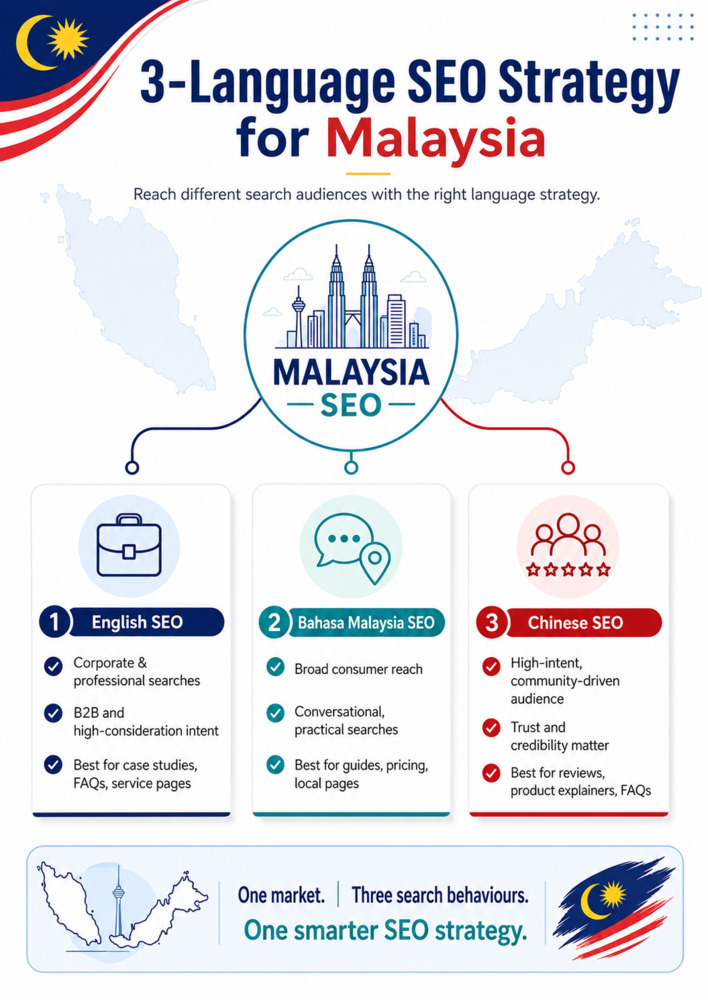
An effective multilingual SEO strategy in Malaysia treats each language as its own SEO campaign with shared technical infrastructure.
1. English SEO: Capture Corporate and Professional Searches
English searches in Malaysia trend toward professional services, B2B procurement, and high-consideration consumer decisions. Keyword intent here is often commercial or transactional.
Your English pages should target decision-makers who are already aware of their problem and are evaluating solutions.
Priority content types: service comparison pages, case studies, FAQ sections addressing specific objections, and location-specific landing pages.
2. Bahasa Malaysia SEO: Reach the Broadest Consumer Segment
BM searches cover a wide range including government tender research, local service discovery, and everyday consumer decisions. This segment often searches with more conversational, question-based queries.
Content needs to feel relatable and answer practical concerns clearly.
Priority content types: how-to guides, explainer articles addressing common concerns, localized service pages for specific states (Selangor, Johor, Penang), and pricing guide content.
3. Chinese SEO: Serve a High-Intent, Community-Driven Audience
Chinese-speaking searchers in Malaysia use both Simplified and Traditional characters depending on their background.
This segment tends to rely heavily on peer validation, so content that references community trust, testimonials, and specific product or service details performs well.
Priority content types: product explainer pages in Mandarin, review-style articles, FAQ content addressing service reliability, and business background content that establishes credibility.
Book a free website audit call with Newnormz and turn English, Bahasa Malaysia, and Chinese search demand into a stronger SEO growth plan.
3 Technical Requirements for Multilingual SEO in Malaysia

Getting the technical foundation right is where most DIY multilingual setups fall apart. Google needs clear signals to serve the correct language version to the correct user.
1. Hreflang Tag Implementation
Hreflang tags tell Google which language version of a page to serve to which user. For a Malaysian business, a typical setup would include hreflang for en-MY (English, Malaysia), ms-MY (Malay, Malaysia), and zh-MY (Chinese, Malaysia).
Missing or incorrect hreflang tags cause Google to index the wrong language version for specific searches, or worse, treat your language pages as duplicate content.
2. URL Structure
Each language version needs its own distinct URL path. Common formats include subdirectories (/en/, /bm/, /zh/) or subdomains (en.yoursite.com). Subdirectories consolidate domain authority more effectively for most Malaysian SMEs.
Avoid URL parameters like ?lang=bm, as these are harder for Google to crawl consistently.
3. Separate Sitemaps Per Language
Submit individual XML sitemaps for each language version through Google Search Console. This ensures faster indexing and gives you visibility into which language pages are being crawled and ranked.
3 Common Multilingual SEO Mistakes Malaysian SMEs Make

Multilingual SEO can open new search opportunities, but many Malaysian SMEs lose results because they treat English, Bahasa Malaysia, and Chinese content as simple translations of the same page.
1. Relying on Auto-Translate Plugins
Plugins like Google Website Translator generate content that Google often ignores or penalises because it cannot be independently indexed.
These tools translate user-facing text on the fly but do not create separate indexable pages, meaning your ‘multilingual’ site still only ranks in one language.
2. Skipping Keyword Research for Each Language
The BM translation of an English keyword rarely matches what Malay speakers actually search. ‘Waterproofing contractor’ and ‘kontraktor kalis air’ may cover the same service, but search volumes, competing pages, and related queries differ significantly.
Each language needs independent keyword research for long-tail keywords vs short tail keywords using tools like Google Keyword Planner filtered by language and location.
3. Using a Single CTA Across All Languages
A CTA written for an English-speaking professional audience does not convert a Chinese-speaking SME owner browsing on mobile.
Each language version of your site should have a CTA that matches the communication style and decision triggers of that language’s audience.
Find out more about how to build international SEO for Malaysian brands to reach out to your audience globally.
How Newnormz Helps Malaysian Businesses Build Multilingual SEO That Converts
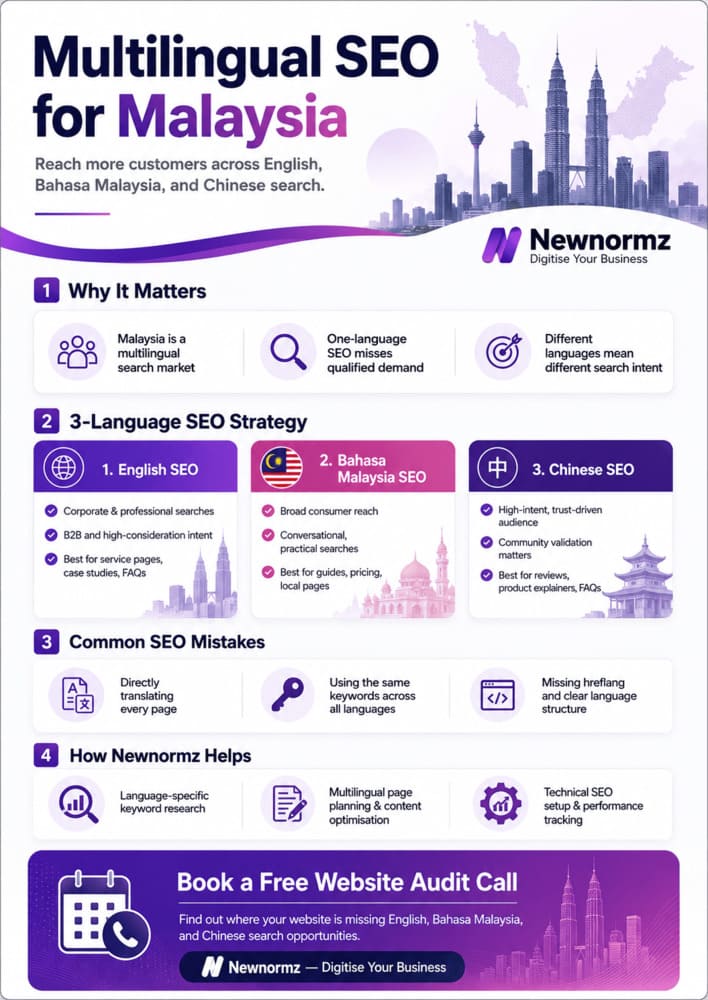
Digital marketing agency Newnormz helps Malaysian SMEs turn English, Bahasa Malaysia, and Chinese search behaviour into a structured local SEO strategy that attracts the right audience and drives qualified enquiries.
We start by identifying which language segments matter most for your business. For some companies, English pages may bring in B2B decision-makers. For others, Bahasa Malaysia content may capture wider consumer demand, while Chinese pages may build trust with high-intent buyers in specific communities.
We map the ideal keywords, page structure, content angles, and on-page SEO requirements for each language. This includes service pages, location pages, FAQs, product explainers, and blog content designed to match how Malaysians actually search.
Our multilingual SEO services can help your business:
- Capture leads from English, Bahasa Malaysia, and Chinese searches
- Avoid weak direct translations that do not rank or convert
- Build dedicated pages for different search intents
- Improve visibility across local, commercial, and industry-specific keywords
- Strengthen your website’s relevance for Malaysia’s multilingual market
We build multilingual SEO systems that connect language, search intent, and conversion strategy. The goal is not just to publish content in more languages, but to make every language page work harder for rankings, traffic, and enquiries.
What Results Can You Expect from Multilingual SEO?
Results depend on how competitive your industry is in each language and how well the content is executed. However, there are consistent patterns across businesses that implement this properly.
| Outcome | Typical Timeline | Notes |
| New language pages indexed | 2 to 4 weeks | Faster with sitemap submission |
| Initial keyword rankings in new language | 6 to 10 weeks | Varies by competition |
| Organic traffic from new language segment | 3 to 5 months | Builds steadily with consistent content |
| Lead quality improvement | Ongoing | Language-matched content pre-qualifies visitors |
| Ranking in all 3 languages (stable) | 6 to 12 months | Requires ongoing optimisation and content |
Build a Multilingual SEO Strategy That Reaches More Customers in Malaysia
Malaysia’s search market does not move in one language. Your potential customers may compare services in English, search practical answers in Bahasa Malaysia, or look for trusted providers in Chinese.
If your SEO strategy only focuses on one language, your business may be missing valuable enquiries from audiences who are already searching with intent.
Newnormz multilingual SEO strategy helps your website meet customers where they search, with the right keywords, page structure, and content angle for each language segment.
Done properly, it turns English, Bahasa Malaysia, and Chinese content into a stronger organic growth system instead of disconnected translated pages.
Book a free website audit call with Newnormz and uncover where your website stands across English, Bahasa Malaysia, and Chinese search.
Frequently Asked Questions About Multilingual SEO in Malaysia

As the Core Strategists at Newnormz, we don’t just follow digital trends, we engineer them. Our team bridges the gap between technical precision and creative growth, ensuring that every SEO campaign, ad spend, and web interface serves a single purpose: scaling your business with measurable ROI. By blending data-driven insights with a deep understanding of market psychology, we transform digital presences into high-performance engines. At Newnormz, our strategy is simple: Think bigger, optimize faster, and lead the norm.