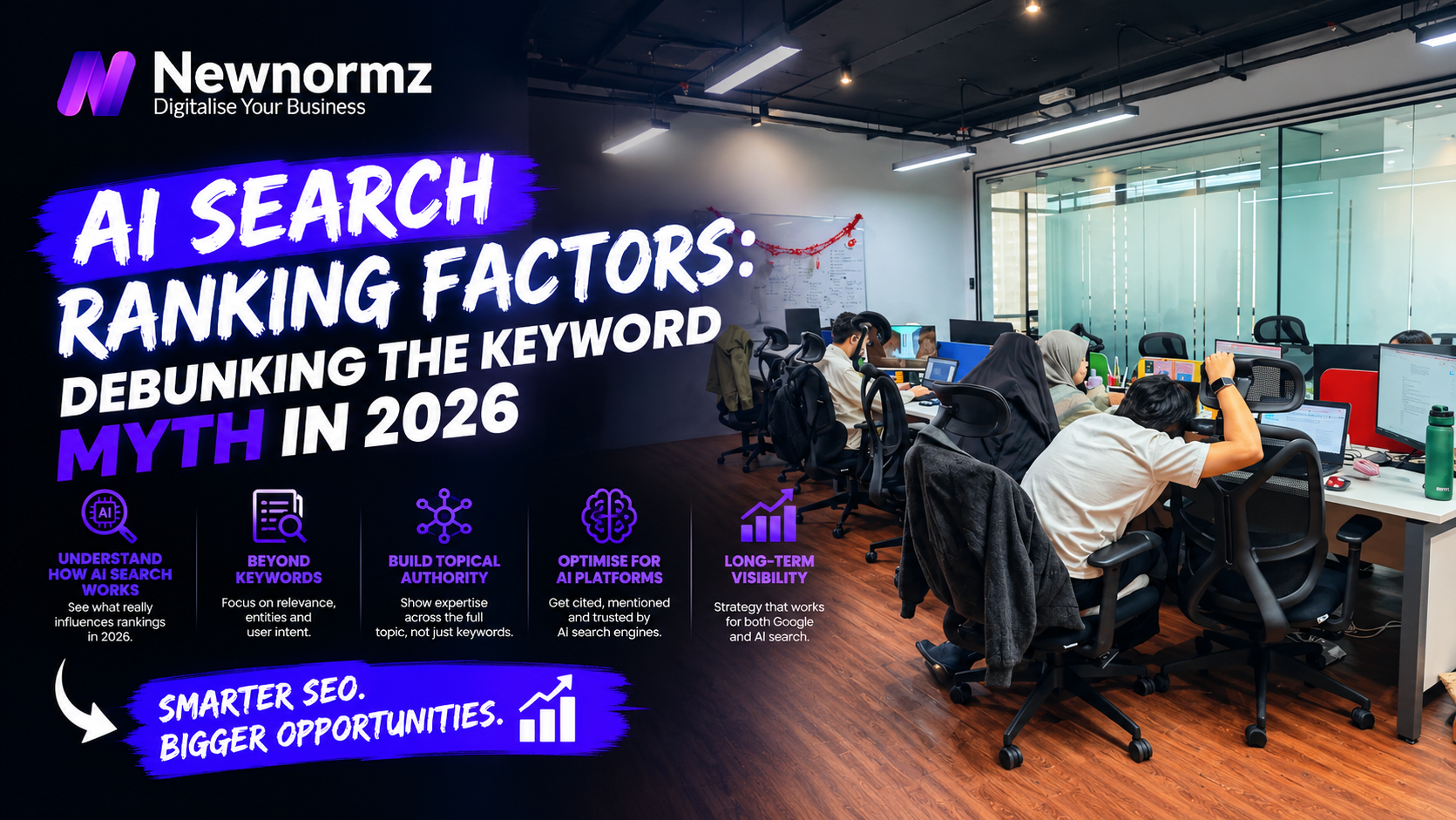
Repeating your keyword more often will not get you cited by Google’s AI Overviews, ChatGPT or Perplexity. These tools search the web, pull the passages that best answer the question, and favour sources that other sites also treat as credible. So the factors that matter are the ones good SEO has always rewarded: pages that answer the question directly, a business whose details match everywhere they appear online, and real mentions from people and sites other than yourself. Keywords still tell you what people are searching for. They just stopped being something you could win by repeating a long time ago. No one can guarantee your brand will appear in an AI answer, and anyone who promises that is selling something Google itself says can’t be promised.
A Simple Way to Think About It
Two Nasi Lemak Stalls
🪧 The stall with ten banners
Every banner says “Best Nasi Lemak in KL.” People walk straight past, because anyone can print a banner.
🍛 The stall with a queue
No banner at all. Just regulars who keep coming back and tell their friends where to go.
AI search sends people to the stall with the queue. The sections below cover what that means for your website.
Where the keyword myth comes from
The myth started out partly true. In the early days of search, engines mostly matched the words in your query to the words on a page, so the page that repeated “plumber Petaling Jaya” most often had an edge. That stopped working many years ago. Google’s spam policies now list keyword stuffing as a violation, so in 2026 it is a liability, not a strategy.
The myth hangs on because it’s easy to sell. A keyword density score is a simple number you can put in a report. “Be the most useful and most trusted answer to this question” is much harder to package, but that’s the job.
To be fair to keywords: they still matter as research. Knowing that Malaysians search “klinik gigi Subang” as well as “dentist Subang Jaya” tells you how your audience talks and which questions your pages need to answer. The mistake is treating that research as a word count to hit.
How AI search actually picks its sources
Google AI Overviews, Google’s AI Mode, ChatGPT search and Perplexity work in a broadly similar way. When someone asks a question, the system searches the web (or its own index), retrieves a set of pages that look relevant, pulls out the passages that answer the question, and writes a summary, usually with links to the sources it used.
That process tells you what actually decides whether you get cited:
- You have to be found first. If your page doesn’t show up in the underlying search, the AI never sees it. Google has said its AI features rely on the same core ranking systems as regular Search, and that there’s no special optimisation required beyond normal SEO best practice.
- Your answer has to be easy to pull out. A clear, self-contained paragraph that answers the question is far easier to quote than an answer buried in paragraph six of a long story.
- You have to look trustworthy from the outside. When several independent sources describe your business the same way, a system has more reason to rely on you than on a site that only talks about itself.
None of those three involves how many times a phrase appears on the page.
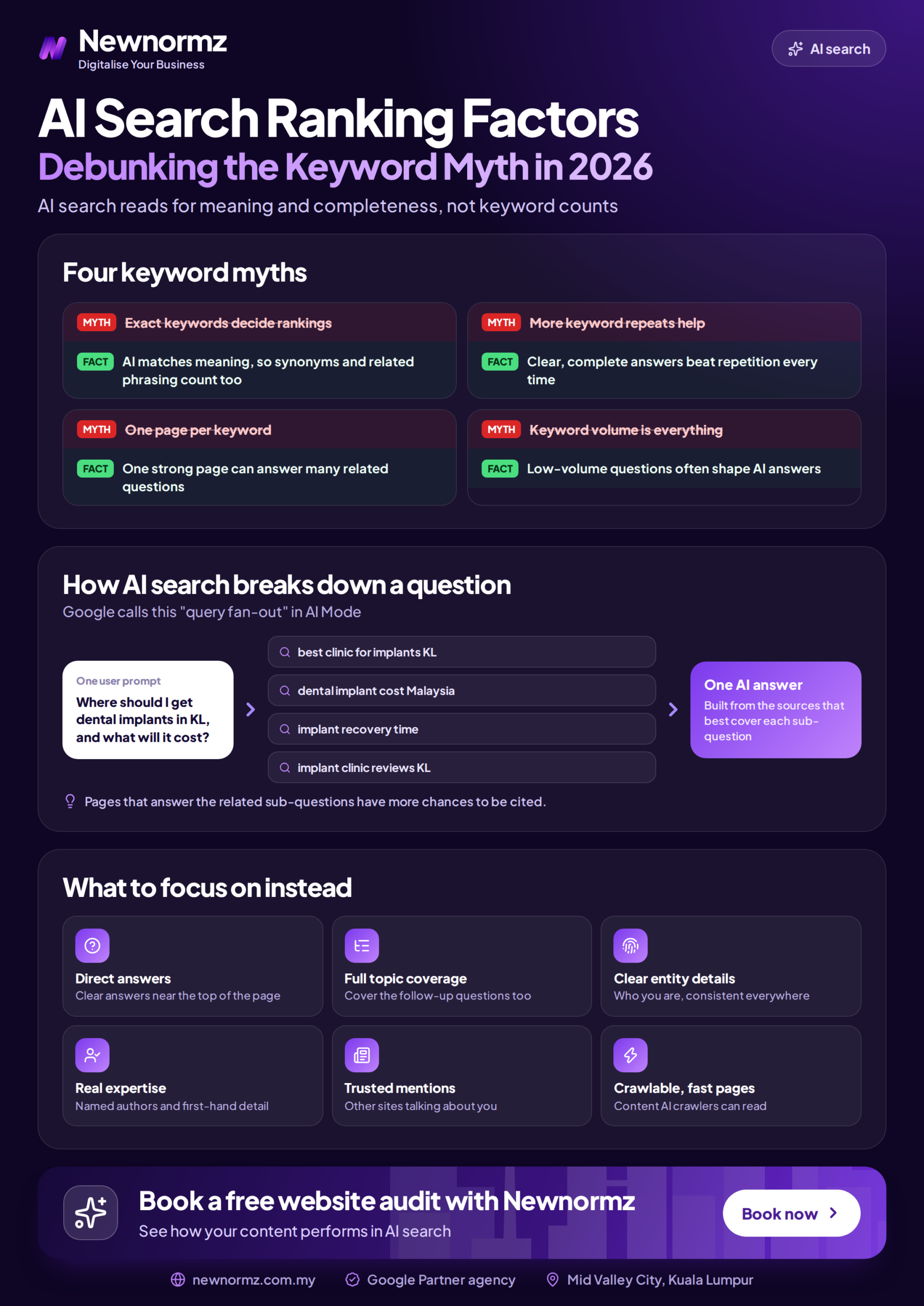
The signals actually worth your time
Nobody outside Google, OpenAI or Perplexity has a verified list of AI ranking factors with weightings attached. Be wary of anyone who presents one. What we can do is look at how these systems retrieve and summarise content, at what Google has said publicly, and at what has held up across our own campaigns. Here’s how the old habits compare with what matters now.
| Keyword-era habit | What matters now | Why |
|---|---|---|
| Hitting a target keyword density | Fully covering the topic and the follow-up questions | Search systems match on meaning, so synonyms and related questions count. Repetition doesn’t. |
| Long intros before the answer | Answer first, then explain | AI tools quote passages. A direct answer near the top of a section is easy to pull out. |
| Buying backlinks in bulk | Earning relevant mentions from credible sites in your industry | Independent sources describing you consistently are a stronger trust signal than link volume. |
| Writing only about yourself | Genuine reviews, forum discussions and press coverage | What others say about you is harder to fake than what you say about yourself. |
| Inconsistent business details across listings | One consistent name, address, phone and description everywhere | Conflicting information makes it harder for any system to be confident about who you are. |
Write passages that stand on their own
Treat every H2 as a question a real customer asks, and answer it in the first two or three sentences underneath. Then add the nuance, the exceptions and the examples. This isn’t writing for robots. It’s how a good consultant answers a client, and it happens to be the format AI systems find easiest to quote.
Make your business unambiguous
Your company name, address, phone number, services and description should match on your website, Google Business Profile, Facebook page, directories and any industry listings. If one listing says you’re in Mid Valley and another gives an old Damansara address, you’re making it harder for any system, AI or not, to describe you with confidence.
Use structured data, but don’t expect miracles
Schema markup (Organization, LocalBusiness, Product, FAQ and so on) helps machines read your page accurately, and linking your official social and industry profiles through the sameAs property makes your identity clearer. It’s worth doing properly. But Google has said you don’t need any special markup to appear in its AI features, so treat schema as good housekeeping rather than a ranking shortcut.
Earn mentions you didn’t write
Press coverage, industry association listings, genuine customer reviews and real discussions on forums like Lowyat.net all add to the picture of your brand that exists outside your own website. The key word is genuine. Planting fake reviews or seeding forum threads with fake accounts is risky: platforms remove it, readers spot it, and it can damage the reputation you’re trying to build.
The Malaysian angle most guides miss
Malaysia had 35.4 million internet users at the end of 2025, about 98% of the population (DataReportal, Digital 2026 Malaysia), and Google handles roughly 93% of searches here (Statcounter, May 2026). So Google’s AI Overviews and AI Mode are where most of your customers will see AI answers first.
What makes Malaysia different is how people search. One customer types in English, another in Bahasa Malaysia, a third in Chinese, and many mix languages in one query. A keyword-density mindset can’t handle that, because there’s no single phrase to repeat. Covering the topic properly, with key pages in the languages your customers actually use, can.
For businesses serving a specific area, the trust signals are local too: a well-maintained Google Business Profile, consistent listings on Malaysian directories, reviews from real local customers, and mentions in local media or trade bodies. That’s the groundwork of local SEO, and it does double duty, because it feeds both the map results and the AI answers that draw on them.
What we’ve seen in real campaigns
Our case studies come from organic search, not AI citation tracking, but they show the same principle at work.
Over a two-year campaign, Oriental Kopi grew to 24,500 more ranking keywords, 6.31 million impressions and 468,000 clicks. Nobody wrote 24,500 pages or worked 24,500 phrases into the copy. When you cover a topic properly and build a credible brand around it, search engines match you to the many ways real people ask about it.
Sunway Medispa saw 700% traffic growth and 70% more keywords ranking in six months, in healthcare, a category where Google applies especially high standards for trust. Times Parking reached 416 ranking keywords and 528,000 impressions in six months, in a niche most people wouldn’t think of as content-friendly. In all three cases the work went into relevance, structure and credibility, not keyword counts.
What nobody can honestly promise you
Google has said publicly, more than once, that no one can guarantee a specific ranking position. AI answers are even less predictable. The same question can produce a different answer and different sources depending on how it’s worded, who’s asking and when. Any agency promising “guaranteed ChatGPT citations” is guessing at best.
What you can do is measure honestly. Pick a set of real questions your customers ask, check them regularly across Google, ChatGPT and Perplexity, and note whether you appear, how you’re described, and which competitors show up. Google counts AI Overview appearances inside the normal Search Console performance totals rather than in a separate report, so your organic data still matters. Together, those give you a realistic picture without pretending to precision nobody has.
If you’d rather have someone run this for you, a good SEO agency in Malaysia should be able to explain exactly what they’re changing and why, without ever leaning on keyword density.
Frequently asked questions
Do keywords still matter at all for AI search?
Yes, as research. Keywords show you what your customers ask and in which language. Use them to decide which questions your pages should answer and to label those pages clearly. Just don’t use them as a repetition target.
Is GEO a replacement for SEO?
No. Generative engine optimisation builds on SEO rather than replacing it. AI tools mostly retrieve from pages that already rank or are indexed well, so weak SEO usually means weak AI visibility too. GEO adds extra attention to answer formatting, brand consistency and outside mentions.
Do backlinks still help in AI search?
Relevant, credible links still help, mainly because they help you rank in the search results that AI tools draw from. What has lost value is volume for its own sake. One mention from a respected industry publication is worth more than dozens of links from sites nobody reads.
Can I use AI-written content to rank in AI search?
Google’s position is that it judges content on quality, not on how it was produced. The problem is that generic AI content tends to say what every other page says, so there’s no reason to cite it. Original experience, real examples and specific local knowledge are what make a page worth quoting.
How quickly can I show up in AI answers?
It depends on where you start. A site that already ranks well can sometimes start appearing soon after its pages are restructured with clearer answers. A brand with little online presence has to build that foundation first, which follows the same months-long timeline as any serious SEO campaign.
Is your brand showing up in AI answers?
Find out what Google and AI search actually see when they look at your business
Newnormz has run SEO campaigns across F&B, healthcare, ecommerce, and local services in Malaysia, backed by a performance guarantee of 70 percent of targeted keywords on Google’s first page.
30 minutes, no obligation, including a check of how your brand appears in AI search answers.

Bryan Tan is an SEO Specialist and CEO at Newnormz, helping hundreds of businesses achieve first-page rankings on Google. With a passion for driving organic growth, Bryan blends innovative strategies with hands-on experience to optimize websites for maximum visibility. Always at the forefront of the latest SEO insights and trends, he consistently adapts to the evolving digital landscape.