A local citation is any place online that lists your business name, address, and phone number (NAP). That includes directories, map apps, social profiles, and review platforms. Google says local rankings come down to three things: relevance, distance, and prominence. What it finds about your business across the web feeds into prominence. Being consistent will not put you at the top of Google Maps by itself. Reviews, a complete Google Business Profile, and how close you are to the searcher usually count for more. Messy citations still hurt you quietly, though. They confuse Google, and they send customers to an old phone number or a shop you left two years ago. For most Malaysian businesses the work isn’t about adding hundreds of new listings. It’s about fixing the ones that already exist and then keeping them accurate.
A Simple Way to Think About It
One Parcel, Three Addresses
📦 Three versions of the address
A courier gets a parcel with three slightly different addresses written on it. They might still find you. More likely they slow down, check again, and leave it at the wrong door.
✅ One address, written the same way
The same parcel with one clear address, written the same way on every label. It reaches your door on the first try.
Google works a lot like that courier. The sections below show where Malaysian businesses usually end up with three addresses, and how to get back to one.
What a Local Citation Is, and How Much It Really Matters
Any time your business details show up somewhere other than your own website, that’s a citation. Your Google Business Profile, your Facebook page, a Yellow Pages Malaysia entry, a Waze place, a TripAdvisor listing, a mention on your trade association’s member page. All of them count.
Google has said publicly that local results depend on relevance, distance, and prominence. Prominence partly means how well known your business is across the web. When Google finds the same name, address, and phone number on many trusted sources, it can be more confident the business is real, is where it says it is, and is still operating.
In Malaysia the stakes are high because almost everyone searches on Google. Statcounter puts Google at about 93% of the Malaysian search market as of May 2026. DataReportal counted 35.4 million internet users at the end of 2025, which is 98% of the population. When someone types “klinik gigi near me” or “kopitiam Subang”, the map pack is often the first thing they see.
Citations are a supporting signal, not the main one. A business with perfect NAP across 80 directories can still lose to a nearby competitor with more recent reviews and a better Google Business Profile. Treat citations as the foundation you need to get right. They aren’t the thing that wins the race on their own.
Where NAP Goes Wrong for Malaysian Businesses
Very few businesses set out to have inconsistent details. It builds up over time. You move premises and update Google but forget Facebook. A former staff member creates a second listing. A directory scrapes your details from a 2019 brochure. Someone lists the WhatsApp number on one platform and the office line on another.
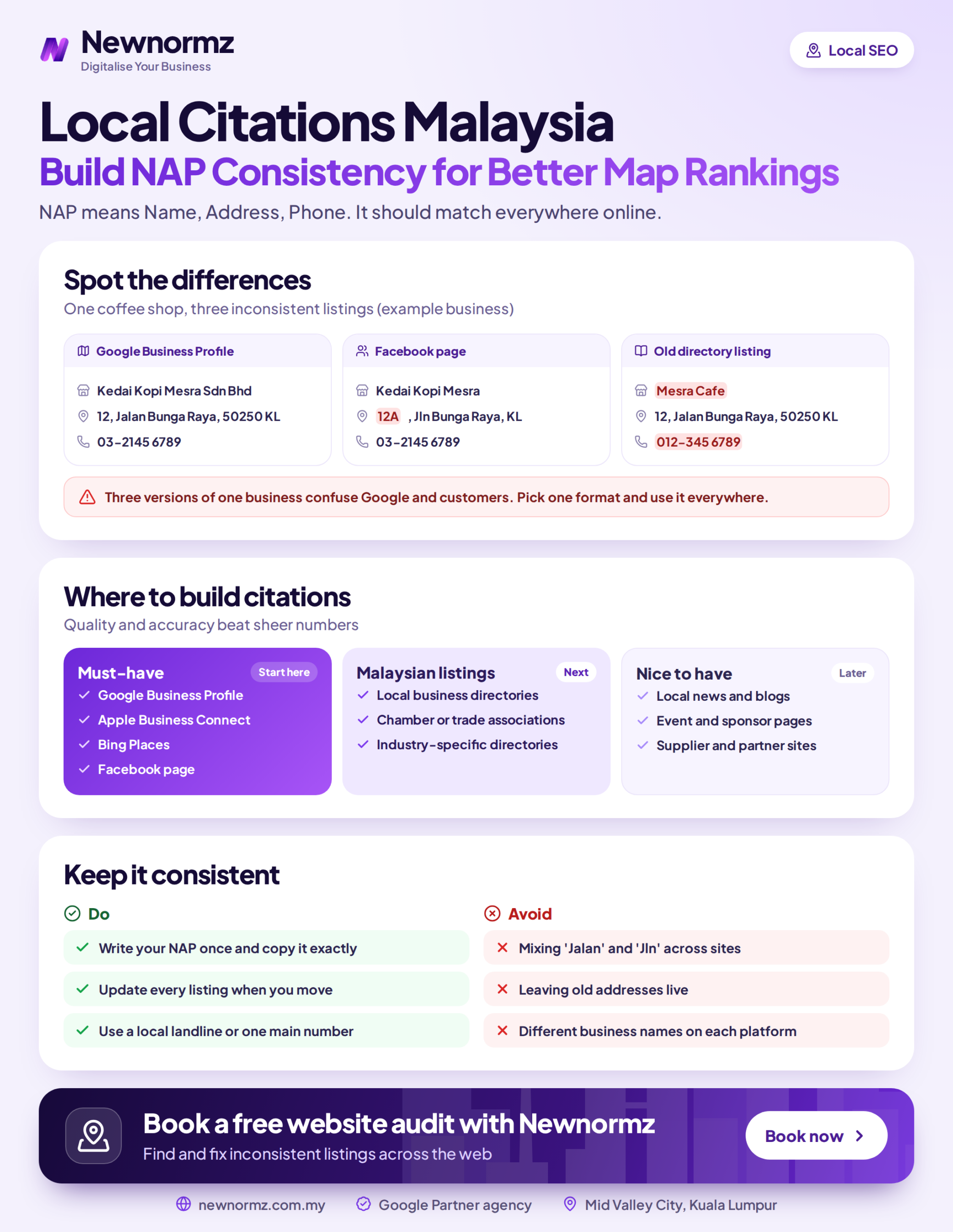
Malaysian addresses also come with plenty of ways to write the same thing:
| Field | How it typically drifts | What to lock in |
|---|---|---|
| Business name | Trading name on one site, “Sdn Bhd” name on another, Chinese name only on a third, keywords added to the name on Google | The name customers see on your signage, written the same way everywhere. Keep the SSM name for legal documents. |
| Street | Jalan vs Jln, Lorong vs Lrg, Taman vs Tmn, Persiaran vs Psrn | Choose full or short forms once and stick with them. Full forms are the safer choice. |
| Unit and floor | “17-3A” vs “Level 17, Unit 3A” vs “Lot 17-3A”, building name on some listings and missing from others | One unit format, with the building or mall name included every time |
| City and state | “Kuala Lumpur” vs “Wilayah Persekutuan Kuala Lumpur” vs “WP KL”, or Petaling Jaya placed under the wrong state | Postcode, city, and state written the same way on every listing |
| Phone | Office line on some listings, a mobile or WhatsApp number on others, an old number nobody answers | One primary number that you actually pick up |
One thing most citation guides skip: Google is quite good at working out that “Jln” and “Jalan” mean the same street. A formatting difference is worth tidying, but it rarely does real damage. What does the damage is data that’s actually different: an old address after a move, a disconnected phone number, or a duplicate listing that splits your reviews in two. Fix those first. Clean up formatting after.
Which Directories Are Worth Your Time
You don’t need to be listed everywhere. You need to be correct on the platforms Google trusts and your customers actually use. Here’s the order we’d work in.
The essentials
Google Business Profile matters most. Next come Apple Maps (through Apple Business Connect), Bing Places, your Facebook Business Page, and Waze, which many Malaysian drivers use for directions instead of Google Maps. If any of these are wrong, customers end up at the wrong place. Get these right before you touch anything else.
Malaysian directories
Yellow Pages Malaysia, the established Malaysian business directories, and the member listings of your trade association or chamber of commerce. Association listings tend to be worth more than generic directories because a real organisation stands behind them.
Industry platforms
A restaurant should be accurate on TripAdvisor and on the food delivery apps it uses. A clinic should be on the healthcare directories patients really browse. A law firm should be on Malaysian legal directories. These listings send a stronger relevance signal than a general directory nobody visits, and they bring in actual customers too.
Be careful with paid “500 directory submissions” packages. Most of those sites are low quality, almost none are Malaysian, and every one becomes another listing you’ll have to update the next time you move. Twenty accurate, relevant listings beat five hundred careless ones.
How to Clean Up and Build Your Citations
1. Find what already exists
Search Google for your business name, your current phone number in quotation marks, and every old address and old number you’ve ever used. The old-number search usually turns up listings you forgot about. Tools like BrightLocal and Moz Local can speed this up, but their coverage of Malaysian directories is patchy, so do the manual searches as well. Put every listing in a spreadsheet with its URL and the exact details it shows.
2. Write down your master NAP
Choose one exact version of your name, address, and phone number, down to the commas and abbreviations. If customers also search for you by a Chinese or Bahasa Malaysia name, write those versions down too so they stay consistent. From now on, this document is what everyone uses, including staff, agencies, and anyone filling in a directory form.
3. Fix the essentials first
Update Google Business Profile, Apple Maps, Bing Places, Facebook, and Waze to match the master NAP. Customers see these most, so errors here cost you the most.
4. Deal with duplicates
Claim any listing you didn’t create but that represents your business. Where the platform lets you, merge duplicates or report them. If a duplicate shows an old location, have it marked as moved or closed. Don’t just leave it.
5. Make your website match
Your website should show the master NAP on the contact page and in the footer. Add LocalBusiness schema markup so search engines can read your details directly. If you have several branches, give each one its own page with its own NAP.
6. Add new citations gradually
Once the existing listings are clean, add the Malaysian and industry directories that make sense for you. Do it steadily over time and choose sites for relevance, not for how many you can tick off.
7. Check every quarter, and after every change
Citations drift. Directories pull in old data, users suggest edits on Google Maps, and staff change things without telling anyone. A quick quarterly check catches most problems. Any move, new phone number, or rebrand should trigger a full check straight away.
What Citations Will Not Fix
Being honest about this saves you money. If your Google Business Profile has the wrong primary category, few reviews, and no photos, cleaning up citations won’t make up for it. The same goes if you’re simply far from where most searches happen. Citations remove a weakness. They don’t create an advantage on their own.
A few related points matter just as much:
- Categories should match. If Google lists you as a “Dental clinic” and directories say “Medical centre”, your relevance signal gets weaker. Use the closest matching category everywhere.
- Reviews count heavily. How many reviews you have, how recent they are, and how you reply to them all feed into prominence. A clean citation profile plus a steady flow of genuine reviews is far stronger than either one alone.
- Nobody can guarantee a map position. Google has said repeatedly that no one can guarantee a specific ranking. Anyone promising you “number one on Google Maps” through citations alone is selling something they can’t control.
Citations work best as one part of a wider local SEO plan that also covers your profile, reviews, and location pages.
Frequently Asked Questions
Does “Jln” vs “Jalan” really hurt my rankings?
Probably not much. Google usually understands common Malaysian abbreviations. It’s still worth standardising, but put an old address, a wrong phone number, or a duplicate listing first. Those cause the real problems.
How long until citation fixes affect my Map rankings?
It depends on how quickly each platform updates and how often Google recrawls those pages. Some fixes show up within a few weeks. Others take longer. How much your rankings move also depends on competition and on everything else in your local profile, so nobody can honestly promise you a fixed timeline.
Should I list my Chinese or Bahasa Malaysia business name?
Use the name that’s on your signage as your main name. If customers really do search for you by another-language name, platforms like Google Business Profile have ways to show it without changing your main name. Whatever you choose, use the same version every time.
We just moved premises. What do we update first?
Google Business Profile, then Apple Maps, Waze, Bing Places, Facebook, and your website, all on the same day if you can. After that, go through your citation spreadsheet and fix everything else. Old listings showing your previous address are the main reason customers turn up at an empty shop lot.
Can I do this myself, or do I need an agency?
A single-location business with a few listings can handle this in-house with the steps above. It gets harder with multiple branches, years of duplicates, or listings created by previous agencies you can’t reach. That’s when a structured audit from an SEO agency in Malaysia starts paying for itself.
Do your business details match everywhere?
Find out which listings are holding back your Google Maps rankings
Newnormz has run SEO campaigns across F&B, healthcare, ecommerce, and local services in Malaysia, backed by a performance guarantee of 70 percent of targeted keywords on Google’s first page.
30 minutes, no obligation, and we will flag any outdated or duplicate listings we find.

Bryan Tan is an SEO Specialist and CEO at Newnormz, helping hundreds of businesses achieve first-page rankings on Google. With a passion for driving organic growth, Bryan blends innovative strategies with hands-on experience to optimize websites for maximum visibility. Always at the forefront of the latest SEO insights and trends, he consistently adapts to the evolving digital landscape.