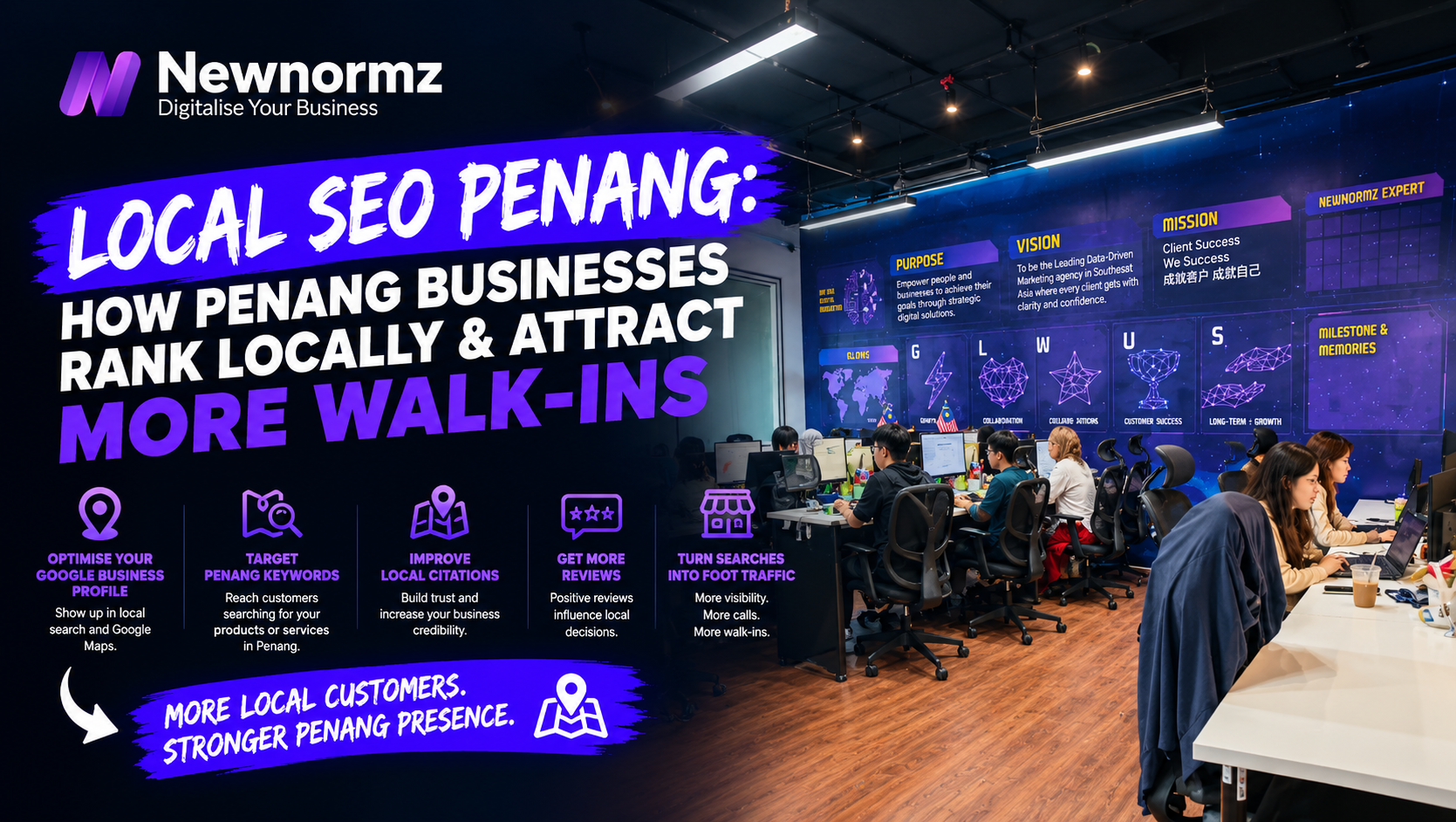
Local SEO in Penang comes down to three things Google has publicly said it weighs for local results: how relevant your business is to the search, how far you are from the person searching, and how well known and trusted you are. You can’t move your shop closer to every customer, but you control almost everything else: a complete and accurate Google Business Profile, a steady flow of genuine reviews, consistent contact details across the web, and website pages built for the specific Penang areas you serve. Get those right and you give yourself a real shot at the Map Pack for searches in your district. Nobody can honestly promise you the top spot (Google itself says no one can guarantee a ranking), but most Penang businesses lose walk-ins to gaps they could fix this month.
A Simple Way to Think About It
The Back-Lane Stall Problem
🍜 The stall nobody can find
The best char kway teow on the island, cooked in a George Town back lane with no signboard. Regulars know where it is. Everyone else walks past the junction and eats somewhere else.
🪧 The stall with a queue at the corner
Same food, but there’s a clear sign on the main road and a line of people already waiting. Strangers don’t need convincing. They just join the queue.
Online, Google Maps is the main road and your reviews are the queue. Here’s how to put your Penang business on both.
What Google Actually Looks At for Penang Searches
When someone types “dentist Bayan Lepas” or “kedai makan dekat sini” into Google, the results come from a different system than ordinary search. Google’s own guidance names three factors for local ranking: relevance, distance, and prominence.
Distance is the one you can’t change. If a customer is standing in Gurney and you’re in Bukit Mertajam, you’re unlikely to win that search no matter what you do. That’s fine. The aim isn’t to rank everywhere in Penang. It’s to rank strongly in the areas your customers actually come from.
Relevance and prominence are where the work happens. Relevance is whether Google understands what you do. Prominence is whether the internet treats you as a real, established business: reviews, mentions on other sites, and the strength of your website all feed into it.
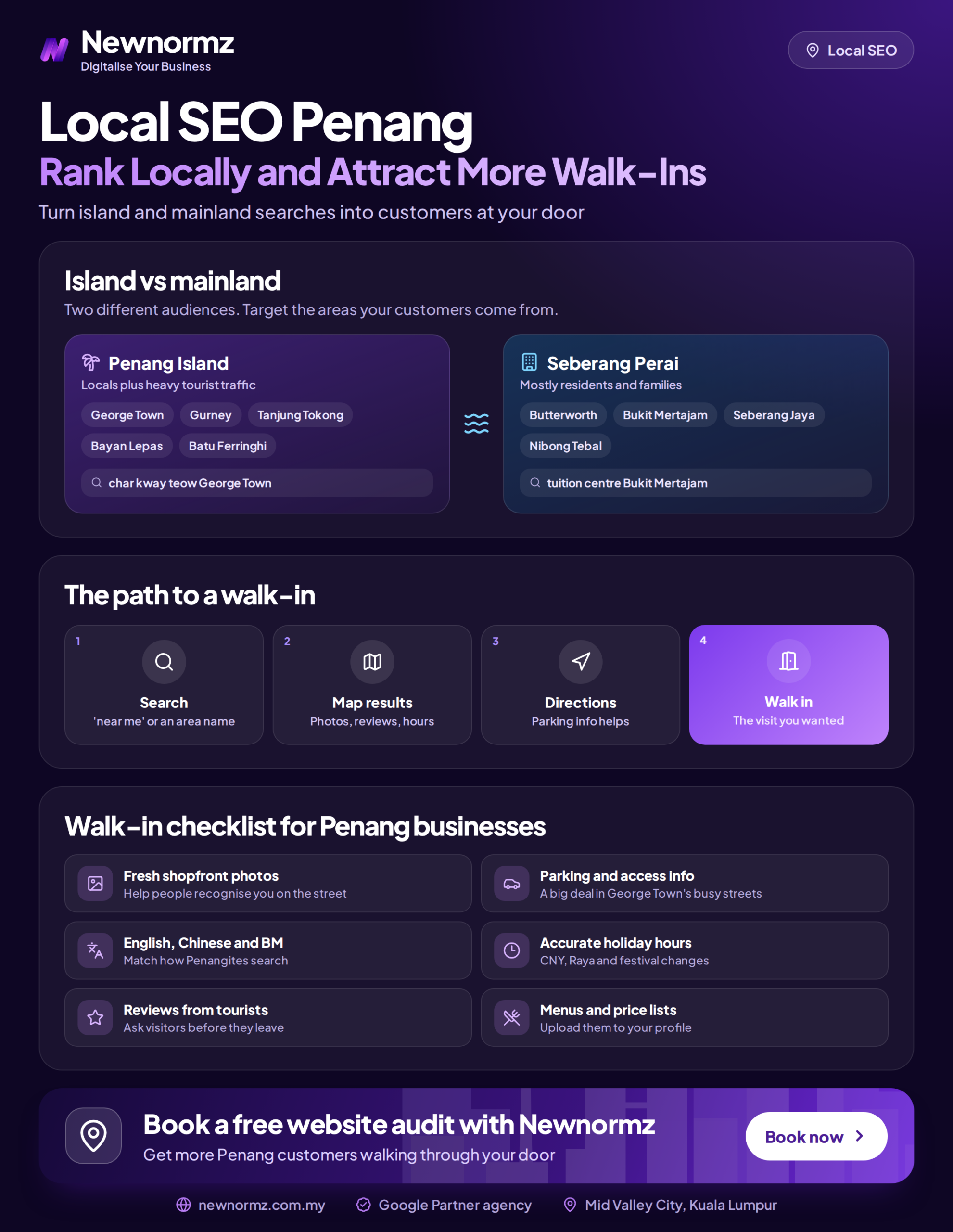
Penang adds some local quirks. People search in English, Bahasa Malaysia, and Chinese, often for the same thing. The island and the mainland act almost like two separate markets, since few people cross the bridge for a haircut. And in areas like George Town and Batu Ferringhi, a big share of searches come from tourists who have never been there and are choosing based purely on what they see on their phone.
Your Google Business Profile Does Most of the Heavy Lifting
For most walk-in businesses, the Google Business Profile matters more than the website. It’s what shows in the Map Pack (the block of three local results above the normal listings) and on Google Maps, and that’s where most “near me” decisions happen. An incomplete profile is the single most common reason we see Penang businesses missing from searches they should own.
Get the primary category exactly right
Your primary category is one of the strongest relevance signals you have. Pick the one that matches your main money-maker, not a broad catch-all. A clinic offering scaling and braces should be “Dental Clinic”, not “Medical Clinic”. Add secondary categories only for services you genuinely offer; padding the list with loosely related ones muddies what Google thinks you are.
Fill in every field like a customer will read it
Write the description in plain language, mentioning your service and the area you serve once or twice where it reads naturally. Keep hours accurate, and update them for Chinese New Year, Hari Raya, Deepavali, and other public holidays. A customer who drives to a shuttered shop because Google said you were open won’t come back, and they may leave a review saying so.
Photos do more selling than you think
Upload real photos: the shopfront as it looks from the street, the interior, your products or dishes, and your team. For a shophouse in a row of similar-looking units, a clear exterior photo is often the difference between a customer finding you and giving up. Recognisable nearby landmarks help too.
Post updates, but don’t overthink them
Google Posts let you share offers, new menu items, or seasonal promotions straight on your profile. They won’t transform your rankings on their own, but an active profile looks more trustworthy to customers comparing you with a competitor whose last update was two years ago.
Think in Districts, Not “Penang”
Targeting “Penang” as one market is the mistake we see most. A tuition centre in Bukit Mertajam and a café on Armenian Street aren’t competing for the same customers, and they shouldn’t chase the same keywords. Work out which areas your paying customers actually come from, then build around those.
The kind of search also changes what you need to have in place:
| Type of search | Example | What has to be in place |
|---|---|---|
| “Near me” from a phone | “aircon service near me” | Complete Google Business Profile, accurate address and hours, strong reviews |
| Service plus district | “plumber Butterworth” | A dedicated website page for that district, plus the profile basics |
| Bahasa Malaysia or Chinese | “klinik gigi Bayan Lepas” | Website content and profile wording that use the terms your customers actually type |
| Tourist planning a visit | “best nyonya food George Town” | Lots of recent reviews, great photos, and a presence on the listing sites travellers use |
Build a Page for Each Area You Genuinely Serve
If you only work from one shop, one well-built contact page is enough. If you serve several areas (a pest control company covering the island and Seberang Perai, for example), each area deserves its own page.
The test for a good location page is simple: could it only have been written about that area? Swapping “George Town” for “Bayan Lepas” in an otherwise identical page fools nobody, Google included. A real page talks about the jobs you do there. Termite problems in pre-war George Town shophouses are a different conversation from water leaks in new Bayan Lepas condos.
Each location page should include:
- The service and area in the main heading, page title, and URL
- Content specific to that area: the jobs, the property types, the common problems
- Reviews or project examples from customers in that area, where you have them
- An embedded map and your contact details, matching your Google Business Profile exactly
- LocalBusiness schema markup, so search engines can read your business details cleanly
Only build pages for areas where you can actually serve customers well. A page for every town in Penang that leads to “sorry, we don’t cover that area” wastes your time and the customer’s.
Reviews: Your Queue at the Corner
Reviews do two jobs at once. They feed into prominence, which affects where you rank, and they’re often what tips a customer choosing between three businesses in the Map Pack. How many reviews you have matters, but so do how recent they are and what they say.
Most businesses only get reviews when a happy customer happens to remember. Make it a routine instead:
- Ask in person at the moment the customer is happiest: after a good meal, a finished job, a successful treatment
- Follow up with a WhatsApp message containing your direct Google review link, so it takes them ten seconds
- Reply to every review, good and bad, within a day or two
- Let customers review in whatever language they’re comfortable with. A detailed review in Bahasa Malaysia or Chinese is far more useful than a forced one-liner in English
Two things not to do. Don’t offer discounts or freebies in exchange for reviews, because Google’s policies prohibit it and it can get reviews removed or your profile restricted. And don’t argue with negative reviews. A calm, specific reply that offers to fix the problem shows future customers how you handle things when they go wrong, which often earns more trust than another five-star review.
Consistency: The Unglamorous Fix That Matters
Your business name, address, and phone number need to match everywhere they appear: your Google Business Profile, your website, Facebook, Waze, Grab, and the directories your industry uses. When one listing says “Jalan Burmah” and another says “Jln. Burma” with an old phone number, it weakens Google’s confidence that you are who and where you say you are.
This happens to Penang businesses a lot, usually after a move, a phone number change, or a rebrand. Somebody updates Google but forgets the six other listings set up years ago. Auditing and cleaning these up is tedious, which is exactly why competitors skip it.
What a Structured Local SEO Campaign Looks Like
None of the above is secret. The difference between businesses that win local search and those that don’t is usually doing it properly and then keeping it up. Here’s how a one-off approach compares with a maintained one:
| Area | Set and forget | Structured and maintained |
|---|---|---|
| Google Business Profile | Claimed once, half filled in | Fully completed, hours and photos kept current, regular posts |
| Keyword targeting | Generic “Penang” wording | District-level pages in the languages customers search in |
| Reviews | Whenever someone remembers | A routine ask and reply process |
| Business listings | Old addresses and numbers floating around | Audited and corrected across platforms |
| Tracking | None | Monthly view of rankings, calls, direction requests, and website clicks |
When we run local SEO for a business, we start with an audit: your profile, your listings, your reviews, your website’s location pages, and how you compare with the businesses already in the Map Pack for your key searches in your area. That comparison shows where the gap really is, so the work goes into what’s holding you back rather than a generic checklist.
Measure Walk-Ins, Not Just Rankings
Rankings are a means to an end. For a local business, the numbers that matter are in your Google Business Profile’s performance data: calls, direction requests, website clicks, and bookings. A direction request is about as close to a confirmed walk-in as online data gets.
Check these monthly and compare them with the same period before you started. If rankings are rising but calls and direction requests aren’t, something is putting people off once they see you, usually reviews, photos, or hours, and that’s where to look next.
Frequently Asked Questions
How long does local SEO take to work in Penang?
Fixing a neglected Google Business Profile can show early movement within 60 to 90 days in many cases. Stronger, more stable positions take longer because reviews and prominence build over months. How fast it goes depends heavily on how competitive your category and district are: a dental clinic in George Town faces a different fight from a niche supplier in Seberang Perai.
Do I need a website, or is a Google Business Profile enough?
A strong profile alone can get you into the Map Pack, especially in less competitive categories. A website helps in two ways: it strengthens Google’s trust in your business, and it lets you rank for district-specific searches with dedicated pages. If you serve more than one area, you’ll struggle to cover them well without one.
Can I rank on the island if my business is on the mainland?
Not easily for “near me” searches, because distance is one of Google’s core local factors. You can still show up when people search for a service plus a specific area you cover, provided you have relevant pages and genuinely serve customers there. Focus first on where you’re physically strongest.
Should I run Google Ads instead?
Google Ads gets you visible immediately but stops the day you stop paying. Local SEO takes longer but keeps bringing in calls and visits without a cost per click. Many businesses run ads while the SEO builds up, then scale ad spend back as organic visibility takes over.
Can you guarantee my business will be number one on Google Maps?
No, and be wary of anyone who says they can. Google has stated publicly that no one can guarantee a ranking position. What a good campaign does is fix everything within your control so you’re competing on your full strength.
Missing from Google Maps in your part of Penang?
Find out what’s stopping nearby customers from finding your business.
Newnormz has run SEO campaigns across F&B, healthcare, ecommerce, and local services in Malaysia, backed by a performance guarantee of 70 percent of targeted keywords on Google’s first page.
30 minutes, no obligation, with a clear look at your Google Business Profile, reviews, and local rankings.

Bryan Tan is an SEO Specialist and CEO at Newnormz, helping hundreds of businesses achieve first-page rankings on Google. With a passion for driving organic growth, Bryan blends innovative strategies with hands-on experience to optimize websites for maximum visibility. Always at the forefront of the latest SEO insights and trends, he consistently adapts to the evolving digital landscape.