Scaling your digital presence in Malaysia in 2026 does not mean adding more channels or using every AI tool on the market. It means doing four things in the right order. First, build a website that actually converts the visitors you already get. Second, earn visibility in Google and in AI-generated answers, which mostly reward the same thing: clear, credible pages that answer real questions. Third, use paid search to bring in leads while organic traffic builds. Fourth, measure leads and revenue, not impressions. AI speeds up every one of these steps, but it does not replace any of them. And nobody, including us, can promise you a specific ranking or a guaranteed spot in an AI answer. Google has said publicly that no one can guarantee rankings. What you can control is how strong your foundation is when the opportunity shows up.
A Simple Way to Think About It
Opening More Outlets vs Fixing the First One
🏚️ Expanding Too Early
A café owner opens two new outlets while customers at the first one still complain about the coffee. Now there are three shops getting the same bad reviews.
☕ Expanding What Works
Another owner fixes the recipe until the first outlet is full every morning, then copies it. Every new branch opens with a formula that already works.
Digital growth works the same way. The blueprint below is about getting each layer right before you put more money into it.
What “Scaling” Actually Means in 2026
Most businesses that say they want to “scale online” really mean they want more leads without spending a lot more for each one. That is a useful way to define it, because it rules out a lot of busywork. Posting on five platforms, publishing ten AI-written blog posts a week, or chasing traffic that never turns into enquiries can all look like growth on a dashboard. None of them count as scaling if your cost per customer stays the same or goes up.
The market is there for you. Malaysia had 35.4 million internet users at the end of 2025, about 98 percent of the population (DataReportal, Digital 2026 Malaysia). Google handles roughly 93 percent of searches in the country (Statcounter, May 2026). Your customers are already online and already searching. What’s left to figure out is whether they find you, trust you, and take action when they do.
AI Search Changed the Results Page, Not the Fundamentals
You will hear a lot about Generative Engine Optimization (GEO) and Answer Engine Optimization (AEO): getting your brand cited inside Google’s AI Overviews, ChatGPT, Perplexity, and similar tools. The shift is real. More searches now end with an AI summary at the top of the page, and some people skip the blue links completely.
Here is what the hype usually leaves out. AI answers mostly pull from pages that are already credible, well-structured, and visible in normal search. If you drop your SEO service work to “do GEO instead,” you lose the base that AI citations are built on. In practice, the work overlaps heavily:
- Answer the question directly. Put a clear answer near the top of the page, then the detail. People skim, and AI systems pull out exactly that kind of passage.
- Be specific and verifiable. Real prices in RM, real locations, real service details. Vague marketing copy gives an AI system nothing worth quoting.
- Use structured data where it fits. Schema markup for your business, services, FAQs, and reviews helps search engines understand what you are. It makes your pages easier to understand, but it won’t guarantee you a citation.
- Get mentioned elsewhere. Reviews, directory listings, press coverage, and industry sites that name your brand all tell search engines and AI tools that you are a real, established business.
- Cover local languages where your customers use them. Many Malaysian buyers search in Bahasa Malaysia or Chinese, especially for local services and F&B. If your competitors only publish in English, those searches are wide open.
Be careful with anyone who promises to “get you into ChatGPT” within a fixed timeframe. These systems change often, and nobody outside the companies running them controls what they cite.
The Blueprint, Stage by Stage
This is the order we recommend for most Malaysian SMEs. You can run some stages in parallel, but skipping one usually means paying for it later.
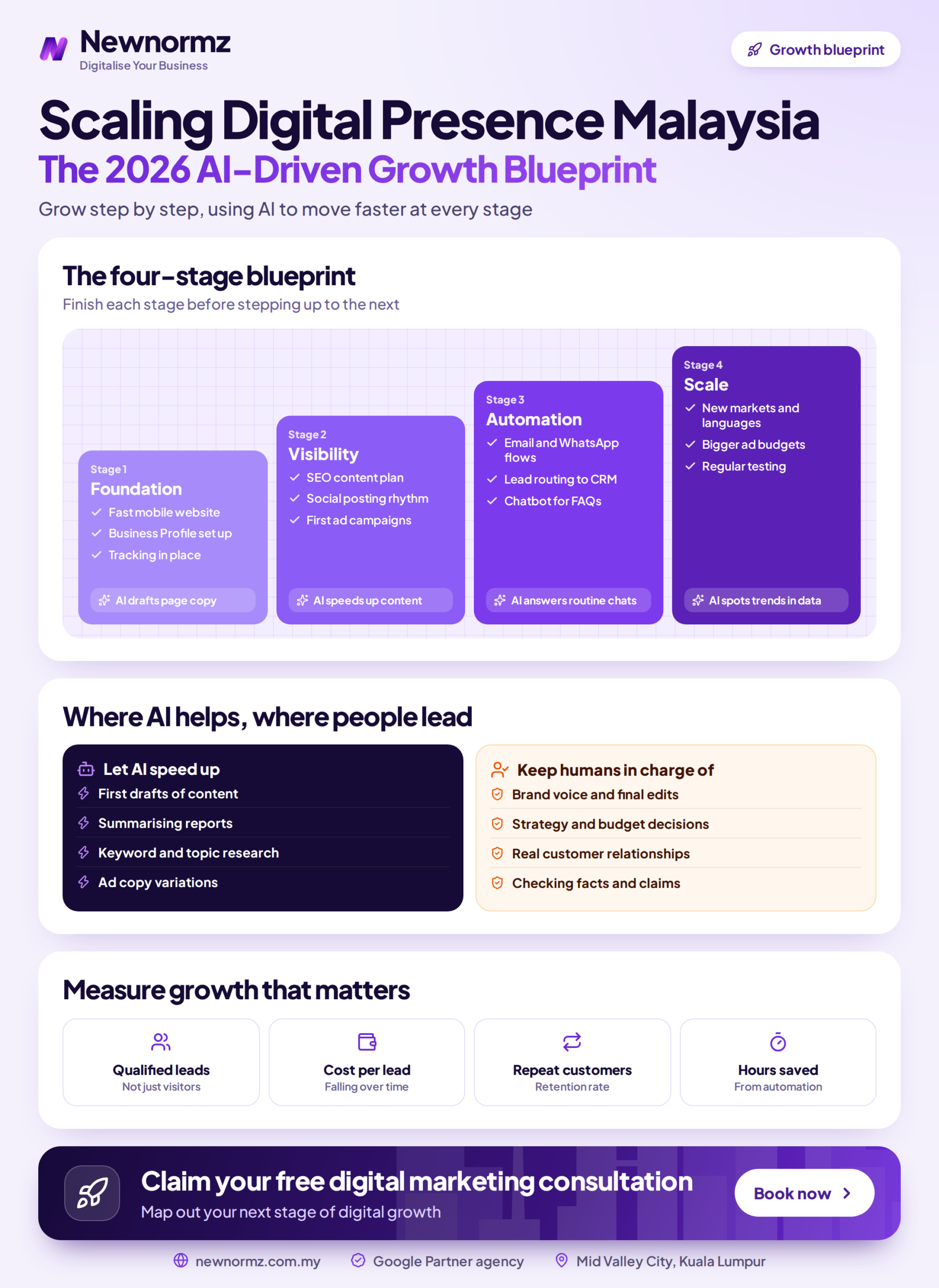
| Stage | What you are doing | Signal you are ready for the next stage |
|---|---|---|
| 1. Foundation | Fast, mobile-first website with clear service pages, visible pricing or enquiry paths, and conversion tracking set up properly | You can see exactly which pages generate WhatsApp clicks, calls, and form submissions |
| 2. Search visibility | Keyword research based on real buyer questions, on-page fixes, content that answers those questions, structured data, local listings | Ranking keywords and impressions are climbing steadily in Search Console |
| 3. Paid acceleration | Google Ads on high-intent searches you do not rank for yet, plus remarketing to people who visited but did not enquire | You know your cost per qualified lead and it fits your margins |
| 4. Compounding | Expand content into new topics, languages, and locations; shift budget toward whatever is producing the cheapest qualified leads | Organic leads are growing month on month and paid spend can be reduced or redirected |
Why the website comes first
Every ringgit you spend on SEO or ads sends people to your website. If that website is slow on a phone, hides the contact button, or reads like a company profile instead of answering what the buyer wants to know, you are paying to bring in visitors who leave. Fixing conversion first makes every channel you add later cheaper.
Why paid and organic work better together
SEO compounds, but it takes months. Google Ads can start producing leads within weeks, and it shows you which keywords actually convert, which tells you where SEO effort will pay off. When you budget for it, remember that ad spend on foreign digital platforms is subject to Malaysia’s 8 percent digital service tax, so a RM3,000 monthly budget really costs more than RM3,000.
Where AI Genuinely Helps (and Where It Hurts)
AI tools are useful for the work behind the scenes. They are less useful when you hand them the whole job.
| Good uses of AI | Risky uses of AI |
|---|---|
| Grouping hundreds of keywords by search intent | Publishing large volumes of unedited AI articles to “cover every keyword” |
| Spotting patterns in Search Console and ad data | Letting AI invent statistics, testimonials, or case results |
| Drafting outlines and first versions that an expert then rewrites | Machine-translating pages into Bahasa Malaysia or Chinese without a native review |
| Automated bidding in Google Ads once conversion tracking is reliable | Automated bidding fed by broken or missing conversion data |
Google has said publicly that it judges content on whether it is helpful, not on whether AI wrote it. It has also said that mass-producing pages mainly to manipulate rankings breaks its spam policies. The line between those two is human judgment, and that line is where your brand’s credibility comes from.
What Real Growth Looks Like
These are actual Newnormz campaigns. They show that results build over time:
- Times Parking (parking management), 6 months of SEO: 528,000 impressions, 31.5K clicks, and 416 ranking keywords.
- Sunway Medispa (healthcare), 6 months: 700 percent traffic increase, 54,000 impressions, and 70 percent more keywords ranking.
- Oriental Kopi (F&B), 2 years of SEO: 43,300 traffic growth, 6.31 million impressions, 24,500 more ranking keywords, and 468,000 clicks. This is what the compounding stage looks like when a brand keeps investing.
- A KL confinement centre: a RM2,550 monthly budget combining SEO with Google Ads brought qualified leads within 30 days, while organic visibility was still building.
The pattern holds across all four. The six-month campaigns built a solid base. The two-year campaign is where the numbers jumped. The confinement centre shows how paid search covers the gap in the meantime.
Measure the Numbers That Pay the Bills
Impressions and follower counts tell you whether you are visible, which is worth knowing. They do not tell you whether you are growing. Before you scale any channel, make sure you can answer three questions: How many qualified leads did this channel produce last month? What did each one cost? How many became paying customers? If you cannot answer those yet, fixing your tracking is your next step, before more content and before more ad spend.
Frequently Asked Questions
Do I need a separate GEO strategy on top of SEO?
For most SMEs, no. Good SEO in 2026 already includes the habits that help with AI citations: direct answers, structured data, accurate business information, and mentions on credible sites. Treat GEO as part of your SEO work, not a separate budget line.
How long before I see results?
Google Ads can produce leads within weeks. SEO usually shows meaningful movement in impressions and ranking keywords within about six months, as in the Times Parking and Sunway Medispa campaigns, and keeps compounding after that. Being cited in AI answers depends on the same signals, so it follows a similar or slower timeline, and nobody can guarantee it.
Should a small business start with SEO or Google Ads?
If you need leads this month, start with Ads on your highest-intent keywords and run SEO alongside it. If cash flow allows you to wait, SEO usually gives you cheaper leads over the long run. Most businesses do best with both, then shift budget toward SEO as organic results grow.
Does the MyDIGITAL blueprint affect my marketing?
Indirectly. MyDIGITAL is the government’s national framework for digital infrastructure and adoption, and it is part of why internet access in Malaysia is now close to universal. It does not change how Google ranks your website, so your marketing priorities stay the same.
Can I just use AI to write all my website content?
You can use it to draft, but someone who knows your business should rewrite and fact-check every page. AI does not know your prices, your customers’ real objections, or what makes you different from the competitor down the road. Those details are what earn rankings, citations, and enquiries.
Not sure which stage your business is at?
Find out what is holding back your growth before you spend more to scale it.
Newnormz has run SEO campaigns across F&B, healthcare, ecommerce, and local services in Malaysia, backed by a performance guarantee of 70 percent of targeted keywords on Google’s first page.
30 minutes, no obligation, with a clear view of your website, search visibility, and AI search presence.

Bryan Tan is an SEO Specialist and CEO at Newnormz, helping hundreds of businesses achieve first-page rankings on Google. With a passion for driving organic growth, Bryan blends innovative strategies with hands-on experience to optimize websites for maximum visibility. Always at the forefront of the latest SEO insights and trends, he consistently adapts to the evolving digital landscape.