A pillar page that AI engines cite is built around one broad topic. It answers the core question in the first few lines, uses one H1 and a clean H2/H3 hierarchy, and writes each section so it makes sense when lifted out on its own. It also links to a set of supporting cluster articles that cover the subtopics in depth. Length and keyword density matter much less than you’d think. What matters is whether a reader, or a machine, can find a clear answer fast and see that your site covers the rest of the topic properly. One honest caveat: nobody can guarantee that ChatGPT, Perplexity, or Google’s AI Overviews will cite your page, just as Google has publicly said nobody can guarantee a ranking position. Good structure raises your odds. It doesn’t buy you a slot.
A Simple Way to Think About It
Who Would You Ask for Directions?
🗣️ The friend who rambles
You ask where to get good nasi lemak, and they tell you a ten-minute story before naming the stall. Next time you ask someone else.
📍 The friend who knows the area
They name the stall in one sentence. If you ask, they can also tell you where to park, when it gets busy, and what to order.
AI engines pick their sources in much the same way. The sections below show you how to build a page that answers first and goes deeper second.
What a Pillar Page Is (and What It Isn’t)
A pillar page covers a broad topic at overview depth and links out to more detailed articles on each subtopic. Those detailed articles are the cluster, and they link back to the pillar. Taken together, the pillar and its cluster show that your site covers a subject properly, rather than having one lucky article on it.
A pillar page is not just your longest blog post. A 5,000-word article that tries to answer everything, with no supporting pages around it, is only a long article. It competes against your other pages for the same keywords instead of working with them.
Say you run a dental clinic in Petaling Jaya. Your pillar might be “dental implants in Malaysia”: what they are, who they suit, the rough cost range, and the steps involved. Your cluster articles then go deep on single questions: implant versus bridge, recovery time, whether implants hurt, and how to pick a clinic. Each of those answers one specific search well, and each points back to the pillar.
Why Structure Matters More Now That AI Answers the Question
Google still handles about 93% of searches in Malaysia, so ranking in standard Google results is still where most of your visibility comes from. What has changed is that AI Overviews, ChatGPT, and Perplexity now pull answers out of pages and present them directly. These systems don’t read your page from top to bottom the way a person would. They look for passages that answer a question cleanly.
That has a practical effect. If your clearest answer is buried in paragraph nine, mixed in with background and sales copy, the AI engine is more likely to pass over it and use a competitor whose answer is easier to lift. Structure is how you make your expertise easy to extract.
Structure can’t fix weak content, though. AI Overviews mostly draw on pages that Google already considers relevant and trustworthy. A well-formatted page on a site with no authority won’t get picked over an established one just because its headings are tidy. Treat structure as the thing that helps good content get credit. It can’t replace good content.
The Anatomy of a Citable Pillar Page
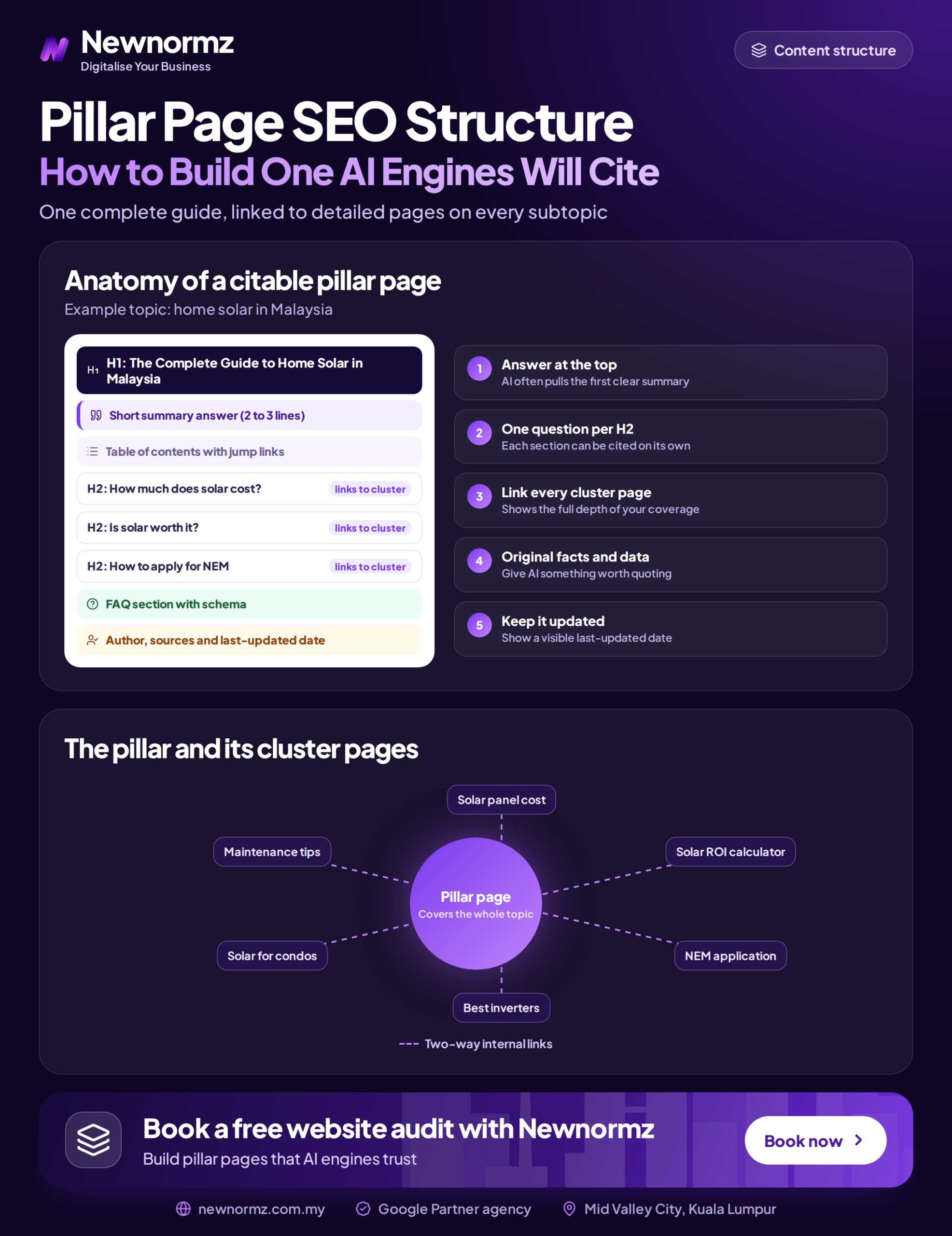
1. Answer first, explain second
Put the direct answer to the main question within the first 100 to 150 words, before any history or context. A visitor should know within seconds whether they’re on the right page. The same short block is the part an AI engine is most likely to quote.
2. One H1, then a heading hierarchy that makes sense
Use a single H1 containing your main topic. Use H2s for the major subtopics and H3s for points inside them. Don’t skip levels, and don’t use headings just to make text bigger. Write headings as plain statements or questions people actually ask, such as “How much do dental implants cost in Malaysia?”, rather than clever labels. On an existing page, this is one of the cheapest fixes you can make.
3. Sections that stand on their own
Write each H2 section so it still makes sense if someone reads only that section. Avoid openings like “As mentioned above” or “This is why”. Restate the subject in the first sentence of the section. AI engines extract passages, not whole pages, and a passage that depends on earlier context is harder to cite.
4. Tables where the content is actually tabular
Comparisons, cost ranges, timelines, and pros and cons are much easier to scan in a table than in prose, for people and machines alike. Use one only where the content really is a comparison. A table made up just to “look structured” adds nothing.
5. Descriptive links out to every cluster article
Each major section should link to the cluster article that goes deeper on it. Use anchor text that describes the destination, such as “implant recovery timeline”, not “click here” or “read more”. These links help Google crawl the cluster and understand how the pages relate. They also spread authority from the pillar to the supporting pages.
6. A short FAQ for the questions the body didn’t cover
Use the FAQ for real follow-up questions, answered in two to four sentences each. Note that since August 2023, Google only shows FAQ rich results for a small set of authoritative government and health sites. Don’t add an FAQ expecting the expandable search snippet. Add one because concise question-and-answer pairs are easy for readers to scan and easy for AI engines to extract.
| Element | What it does for the reader | What it does for search and AI engines |
|---|---|---|
| Direct answer at the top | Confirms they’re in the right place | Gives a clean, quotable passage |
| Clear H1 to H3 hierarchy | Lets them jump to the part they need | Shows how subtopics relate |
| Self-contained sections | Makes sense even when skimmed | Passages can be cited without surrounding context |
| Comparison table | Quick side-by-side overview | Structured data that’s easy to extract |
| Links to cluster articles | A path to more depth | Signals topical coverage and aids crawling |
| Short FAQ | Answers leftover questions | Matches long-tail and conversational queries |
Map the Cluster Before You Write a Word
Most pillar pages that fail were never planned as part of a cluster. Do this mapping first:
- Pick a pillar topic with real demand. It should be broad enough to support several subtopics and close enough to what you sell that the traffic is worth having.
- List the questions your customers actually ask. Use Google’s “People also ask” boxes, your sales team’s most common enquiries, and WhatsApp chats. Each distinct question with its own search intent is a candidate cluster article.
- Audit what you already have. You probably have older posts that could be updated and repositioned as cluster articles rather than rewritten from scratch.
- Check for overlap. If two existing pages target the same query, merge them or give each a distinct angle. Otherwise they’ll compete with each other, which is known as keyword cannibalisation.
- Draw the link map. Decide which pillar section links to which cluster article and make sure every cluster article links back to the pillar.
In Malaysia there’s one extra planning question: what language are your customers searching in? If a large share of your market searches in Bahasa Malaysia or Chinese, those searches need their own properly translated pages, not cluster articles bolted onto an English pillar. Likewise, if you serve customers in specific areas such as Klang Valley or Penang, location pages are part of your local SEO setup and should link into the cluster where it’s relevant.
Common Mistakes That Stop a Pillar Page From Working
| Mistake | Why it hurts | What to do instead |
|---|---|---|
| Covering several unrelated topics on one page | The page isn’t clearly about anything, so it ranks for nothing well | One core topic per pillar. Split the rest into their own pillars. |
| A pillar with no cluster around it | You lose most of the topical coverage signal | Plan and publish supporting articles alongside it |
| Keyword stuffing in headings | Reads badly, and Google’s spam policies explicitly cover keyword stuffing | Write headings the way people phrase the question |
| Letting it go stale | Outdated prices, rules, or facts erode trust with readers and search engines | Review it on a schedule and update anything that has changed |
| No path to your service | You get traffic but no enquiries | Link naturally to the relevant service page where the reader is ready for it |
What to Expect, Honestly
A pillar page is a long-term asset, not a quick win. A new pillar and its cluster usually take months to build up rankings, and the timeline depends on your competition, your domain’s existing authority, and how consistently you publish the supporting articles.
The payoff comes from breadth that compounds. Over a 2-year SEO campaign for Oriental Kopi, the brand gained 24,500 more ranking keywords and 6.31M impressions. Growth like that comes from many connected pages each ranking for their own queries, not from one hero article. For Sunway Medispa, a 6-month campaign produced a 700% increase in traffic and 70% more keywords ranking. Neither result came from structure alone, but both show what becomes possible when a site covers its topics properly and consistently.
If you’d rather not plan and build the cluster yourself, a specialist SEO agency in Malaysia can map your existing content, find the gaps, and restructure the pages you already have before writing anything new.
Frequently Asked Questions
How long should a pillar page be?
Long enough to give a complete overview of the topic and no longer. There’s no word count that Google rewards. If a section is getting long enough to be its own article, that usually means it should be a cluster article that the pillar links to.
How many cluster articles does a pillar page need?
As many as there are distinct questions with real search demand. For most SME topics that ends up somewhere between a handful and a dozen. Start with the subtopics that are closest to what you sell, then expand.
Can I turn an existing blog post into a pillar page?
Often, yes, especially if it already ranks or earns some traffic. Restructure it so the answer comes first, tighten the headings, move the deep detail into separate cluster articles, and add the links in both directions. Keep the URL the same so you don’t lose what it has already earned.
Will this guarantee that ChatGPT or AI Overviews cite my page?
No. Nobody controls which sources AI engines choose, and anyone promising guaranteed AI citations is overselling. What you can control is whether your page is easy to understand, easy to extract from, and backed by real coverage of the topic. That improves your odds.
Should cluster articles link to each other, or only to the pillar?
Both, where it’s natural. Every cluster article should link back to the pillar. Cluster articles that cover closely related questions can also link to each other. Just don’t add links that a reader wouldn’t actually want to click.
Is your content working as one system, or as scattered posts?
Find out which pages should be your pillars and what your cluster is missing.
Newnormz has run SEO campaigns across F&B, healthcare, ecommerce, and local services in Malaysia, backed by a performance guarantee of 70 percent of targeted keywords on Google’s first page.
30 minutes, no obligation, with a clear map of your pillar and cluster gaps.

Bryan Tan is an SEO Specialist and CEO at Newnormz, helping hundreds of businesses achieve first-page rankings on Google. With a passion for driving organic growth, Bryan blends innovative strategies with hands-on experience to optimize websites for maximum visibility. Always at the forefront of the latest SEO insights and trends, he consistently adapts to the evolving digital landscape.