Question-based content SEO means building your pages around the exact questions your buyers type into Google, then answering each one plainly in the first few sentences under it. AEO (Answer Engine Optimisation) is the same discipline applied to the places that now lift answers straight out of your page: featured snippets, People Also Ask boxes, Google’s AI Overviews, and tools like ChatGPT and Perplexity. It will not guarantee you a spot in any of them, and Google itself has said no one can guarantee a ranking. What it does is make your page the clearest, easiest answer to pick, and that’s the part you actually control.
A Simple Way to Think About It
Two Shop Assistants, One Question
📚 Hands you the catalogue
You ask if they have the shoe in size 42. The assistant gives you a thick catalogue and tells you it’s in there somewhere.
🙋 Answers, then helps
The other assistant says “Yes, two pairs left,” then asks if you’d like to try them on.
Search engines and AI tools pick the second assistant almost every time. The rest of this guide covers how to be that assistant on your own website.
What question-based content SEO actually means
Most SME websites are written around short keywords: “SEO Malaysia”, “aircond service KL”, “corporate catering”. Those terms matter. But they aren’t how buyers talk when they’re close to a decision.
When people are close to buying, they ask full questions. “How much does SEO cost in Malaysia?” “Is a confinement centre better than a confinement lady?” “Berapa lama SEO ambil masa untuk nampak hasil?” Question-based content SEO means finding those questions and giving each one a clear, honest answer on a page that deserves to rank.
It works because of how Google reads pages now. Since BERT, and more so since AI Overviews, Google is much better at matching what the searcher means to a passage that answers it. A page that states the answer clearly gives Google an easy match. A page that hides the answer under four paragraphs of warm-up makes Google work harder, and usually loses to a page that doesn’t.
Specific questions also tend to be easier to win. A big agency or marketplace usually owns “digital marketing Malaysia”. “How long does SEO take for a new website in Malaysia?” has fewer serious competitors, and the person searching it is much closer to picking up the phone.
Why AEO matters more than it did two years ago
Search results now answer a lot of questions directly. Featured snippets, People Also Ask boxes, and AI Overviews all show the answer before anyone clicks a blue link. SparkToro’s 2024 zero-click study found that close to 60% of Google searches in the US and EU ended without a click to any website.
That number gets quoted a lot to make people panic, so here’s the honest reading. Fewer clicks overall means the clicks still available go mostly to whoever gets shown as the answer, or cited next to it. If your answer is the one Google lifts, your brand gets seen even when the searcher doesn’t click. When they do click, they’ve already read your answer and want more of it. If a competitor’s answer gets lifted instead, you lose both the impression and the visit.
AEO is the work of making your content easy for these systems to extract and cite. It isn’t a separate thing that replaces SEO. You still need a page that ranks. AEO decides whether that page gets used as the answer once it’s there.
Why this fits Malaysian SMEs especially well
Malaysia had 35.4 million internet users at the end of 2025, about 98% of the population (DataReportal, Digital 2026 Malaysia). Google holds roughly 93% of the local search market (Statcounter, May 2026). Nearly all of your buyers are asking their questions in one place.
Three local factors make question-based content work better here than generic advice would suggest:
- People search in more than one language. The same buyer might search in English at work and in Bahasa Malaysia or Chinese at home. Most competitors only answer in English. A well-built BM or Chinese answer to a common question often faces far less competition.
- Local questions are very specific. “Klinik gigi buka Ahad Subang Jaya” or “best kopitiam near Mid Valley open late” are questions with location built in. Answering them overlaps directly with local SEO, where your Google Business Profile and your website content back each other up.
- Buyers research before they WhatsApp you. By the time a Malaysian prospect messages your business, they’ve usually read a few pages already. If your site answered their questions along the way, you’re on the shortlist before you know they exist.
How to build a question-based content strategy
Step 1: Collect the questions buyers actually ask
Don’t guess. The best sources are usually ones you already have:
- Your own enquiries. Scroll back through six months of WhatsApp chats, emails, and sales call notes. The same ten questions will keep coming up. That’s your first content list.
- Google Search Console. Filter queries for words like “how”, “what”, “berapa”, “apa”, “boleh”. These are questions your site already shows up for, often on page two, waiting for a proper answer.
- People Also Ask and AlsoAsked. They show how Google groups related questions, which tells you which questions belong on the same page.
- AnswerThePublic. Good for breadth, but filter hard. Plenty of what it shows has no real search volume in Malaysia.
Then sort the questions by where the buyer is in their decision. Each stage needs a different kind of answer.
| Buyer stage | Example question | What your answer needs to do |
|---|---|---|
| Awareness | “Why isn’t my business showing up on Google?” | Explain the problem plainly. Earn trust. Don’t sell yet. |
| Consideration | “How much does SEO cost in Malaysia?” | Give real ranges and what drives them. Vague answers lose here. |
| Decision | “Should I hire an agency or do SEO myself?” | Be honest about the trade-offs, then make the next step easy. |
Step 2: Answer first, explain second
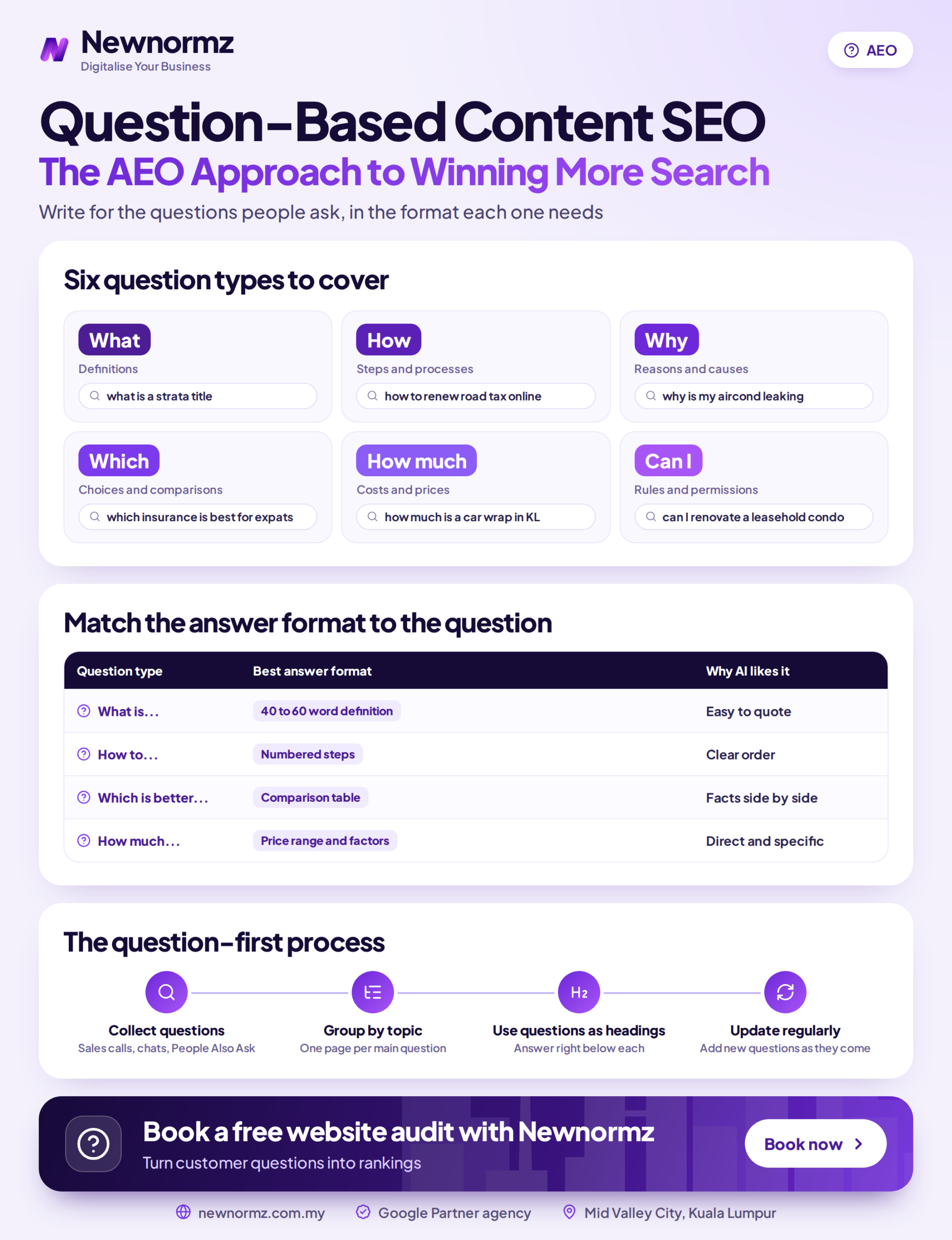
This is the core of AEO, and it’s simple. Use the question (or something close to it) as your H2 or H3. Directly under it, answer it in roughly 40 to 60 words, in a way that still makes sense if someone reads only that paragraph. Then go into the detail, the exceptions, and the examples.
That self-contained first paragraph is what Google and AI tools lift. If your answer starts with “Great question! In today’s fast-moving digital landscape…”, nothing in it is worth extracting. Lists and tables help for the same reason: steps, comparisons, and price ranges in a clean structure are easier for a machine to parse and quicker for a person to scan.
Step 3: Give each question one home
A common mistake is writing five near-identical blog posts that all answer “how much does X cost”. They end up competing with each other, and Google often ranks none of them well. Pick one page as the definitive answer to each core question and link to it from related articles.
Group closely related questions on the same page as subheadings. Give a question its own page only when it has enough search demand and enough depth to stand alone.
Step 4: Use schema, with realistic expectations
Structured data such as FAQPage, Article, and Organization schema helps search engines understand what your page is and who’s behind it. It’s worth adding. But a lot of outdated advice still says FAQ schema will put expandable questions under your listing. That stopped being true for most sites in 2023, when Google limited FAQ rich results to a small group of well-known government and health websites and dropped HowTo rich results completely.
So add schema because it makes your content clearer to machines, not because it’ll change how your listing looks. What actually gets you featured is the answer itself.
How to tell whether it’s working
Question-based content often shows up in impressions before clicks, so judging it on traffic alone in month two will mislead you. Track these instead:
| Signal | Where to check | What it tells you |
|---|---|---|
| Impressions on question queries | Google Search Console | Google is starting to show your page for the questions you targeted. |
| Number of ranking keywords | Search Console or a rank tracker | Your pages are matching a wider range of related questions, not just one. |
| Snippet, People Also Ask, and AI Overview presence | Manual checks in an incognito window, plus rank tracking tools that report SERP features | Your answer is the one being lifted, not just ranked. |
| Enquiries that mention the topic | WhatsApp, forms, sales notes | The content is reaching people who actually buy. |
Here’s what that looks like in a real campaign. In six months of SEO for Times Parking, the site reached 528,000 impressions and 416 ranking keywords, with 31.5K clicks. Over a two-year campaign, Oriental Kopi added 24,500 ranking keywords and reached 6.31M impressions. Neither result came from a single page. Both came from steadily covering more of what people were searching for, which is the same principle behind question-based content.
If you’d rather have this planned and measured for you, that’s the core of our SEO service: questions mapped to your services, pages built answer-first, and reporting on the signals above rather than vanity traffic.
Frequently asked questions
Is AEO different from SEO, or just a new name for it?
It’s a part of SEO, not a replacement. You still need pages that are indexed, fast, and trusted enough to rank. AEO is about how the answer on that page is written and structured so search engines and AI tools can pull it out and use it.
How long before question-based content shows results?
Usually impressions come first, often within a few weeks of a page being indexed. Steady clicks and enquiries normally take a few months, depending on your site’s existing authority and how competitive the questions are. Be wary of anyone who promises a fixed timeline.
Should I write separate pages in Bahasa Malaysia or Chinese?
If your customers really search in those languages, yes. Write them properly, not as machine translations of your English page. Search Console will often show you BM or Chinese queries already reaching your site, which is a good sign the demand is there.
Can I make ChatGPT or Google’s AI Overviews cite my website?
Nobody can force a citation. You can make it more likely by answering clearly, keeping facts accurate and up to date, showing who wrote the content and why they’re qualified, and ranking well in normal search, since AI Overviews mostly draw from pages that already rank.
Do I need to rewrite my whole website?
No. Start with the ten questions your sales team hears most often. Check whether your site answers each one clearly. Fix existing pages where it nearly does, and write new pages only for the gaps.
Is your website answering your buyers’ questions?
Find out which questions your competitors are answering and you’re not.
Newnormz has run SEO campaigns across F&B, healthcare, ecommerce, and local services in Malaysia, backed by a performance guarantee of 70 percent of targeted keywords on Google’s first page.
30 minutes, no obligation, and you’ll leave with a list of question gaps worth filling first.

Bryan Tan is an SEO Specialist and CEO at Newnormz, helping hundreds of businesses achieve first-page rankings on Google. With a passion for driving organic growth, Bryan blends innovative strategies with hands-on experience to optimize websites for maximum visibility. Always at the forefront of the latest SEO insights and trends, he consistently adapts to the evolving digital landscape.