SEO is the work that helps Google find, understand, and rank your website. Content marketing is the work of creating useful material that earns attention and trust, across Google and every other channel your customers use. They are not competitors. SEO without good content has nothing worth ranking, and content without SEO often gets written for topics nobody is searching for. For most Malaysian businesses that want leads from Google, the honest answer is yes, you need both. You just don’t need both at the same intensity on day one, and the right balance depends on your industry, budget, and how fast you need results.
A Simple Way to Think About It
The Kopitiam in the Back Lane
🍜 Great food, no signboard
The best char kuey teow in town, cooked in a back lane with no sign on the main road. The few people who find it love it. Everyone else walks straight past.
🪧 Same food, sign on the main road
The same stall, with a clear signboard at the junction pointing hungry people down the lane. Now the cooking gets the crowd it deserves.
The sections below break down which part of that picture is SEO, which part is content, and why one rarely works for long without the other.
What SEO Actually Is
Search engine optimisation is everything you do so that Google can find your pages, understand what they’re about, and decide they deserve to rank. It has a few layers:
- Technical SEO: site speed, mobile usability, crawlability, indexing, site structure. The plumbing.
- On-page SEO: matching each page to a specific search query through titles, headings, internal links, and the actual content on the page.
- Off-page SEO: signals from outside your site, mainly links from other reputable websites that act like votes of confidence.
- Local SEO: your Google Business Profile, reviews, and location signals, so you show up in the map pack when someone searches “near me”.
SEO has one channel: search, and in Malaysia that overwhelmingly means Google, which holds around 93 percent of the local search market (Statcounter, May 2026). Its job is narrow and specific: get the right page in front of someone at the exact moment they type a question into that search box.
What Content Marketing Actually Is
Content marketing is creating and distributing material your audience genuinely finds useful, so they come to know and trust your brand before they ever buy. Blog articles are one format. So are guides, videos, case studies, email newsletters, Instagram carousels, TikTok explainers, and the WhatsApp broadcast your regulars actually open.
The key difference: content marketing is not tied to Google. A good TikTok video can bring you customers without ranking for anything. A strong email newsletter can keep past clients coming back for years. Content marketing’s job is broader: earn attention, build trust, and stay top of mind across every channel your customer spends time on.
SEO vs Content Marketing, Side by Side
Here is how the two disciplines differ in practice. The overlap is real, but the goals, channels, and ways you measure success are not the same.
| SEO | Content Marketing | |
|---|---|---|
| Main goal | Get found on Google for searches that matter to your business | Earn attention and trust so people choose you |
| Channels | Search results and Google Maps | Website, social media, email, video, messaging apps, and search |
| Core work | Keyword research, technical fixes, on-page optimisation, links, local listings | Planning, writing, filming, designing, and distributing useful material |
| How success is measured | Rankings, impressions, organic clicks, organic leads | Engagement, shares, subscribers, return visits, assisted conversions |
| Fails without the other because | There is nothing worth ranking | Nobody finds it after the first week |
| Typical timeline | Usually months before meaningful movement, compounding after that | Social reach can be quick but short-lived; search-driven content builds slowly but lasts |
Where They Overlap (and Why People Confuse Them)
The confusion comes from the blog. A well-researched article on your website is both content marketing and SEO at the same time. It’s content because it helps a reader. It’s SEO because it was built around something people actually search, structured so Google understands it, and linked into the rest of your site.
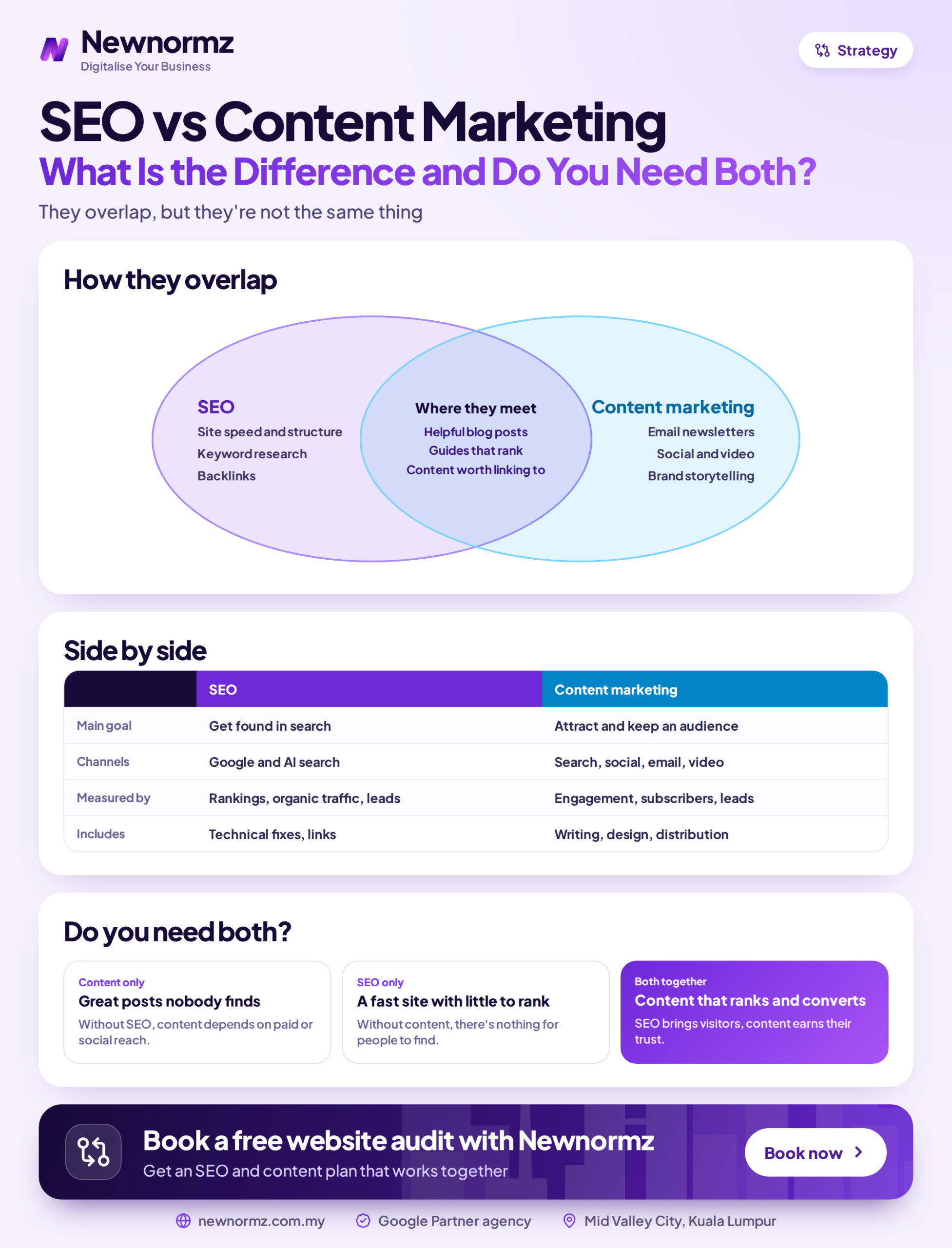
That overlap is where most of the value sits for a business that wants leads from Google. But not everything in one circle belongs in the other. Fixing a broken sitemap is pure SEO; no reader will ever see it. A behind-the-scenes Instagram Reel of your kitchen is pure content marketing; it will never rank for anything. Knowing which is which stops you from paying an agency for the wrong thing.
What Goes Wrong When You Only Do One
SEO without content
This is the business that pays for technical audits and backlinks but has a website with five thin service pages, each two paragraphs long. The site loads fast and has clean code, and Google still has very little reason to rank it above a competitor who actually answers the questions customers ask. You can optimise a page all you like. If the page itself isn’t the best answer, the ceiling is low.
Content without SEO
This is the opposite and, in our experience, the more common mistake. A business publishes a blog post every week for a year. The articles are well written. Traffic barely moves. When you look closely, the topics were picked because they sounded interesting internally, not because anyone in Malaysia was searching for them. Or the article targets an English phrase when most customers actually search in Bahasa Malaysia (“harga”, “terdekat”, “pakej”) or in Chinese. Good writing aimed at the wrong query is invisible on Google.
So Do You Need Both? It Depends on Your Situation
Yes, eventually. But “both” doesn’t mean “both, fully funded, starting Monday”. Here’s how we’d usually think about the balance for different types of Malaysian businesses:
| Your situation | Where to lean first | Why |
|---|---|---|
| Local service business (clinic, workshop, F&B outlet) | SEO, especially local SEO, plus strong service pages | Your customers search with clear intent and a location. Show up there before writing long-form blogs. |
| Ecommerce store | SEO-led product and category content | Category and product pages are your highest-intent content. Get them ranking before building a magazine. |
| B2B or high-ticket service with a long sales cycle | Content marketing heavy, with SEO guiding topic choice | Buyers research for weeks. Guides, case studies, and email nurture keep you in the conversation. |
| New business that needs leads this month | Paid search now, SEO and content building in the background | Organic growth takes time. Paid traffic covers the gap while the long-term asset gets built. |
That last row is worth a real example. A KL confinement centre we worked with ran on a RM2,550 monthly budget and got qualified leads within 30 days, because SEO was paired with Google Ads rather than relied on alone. SEO on its own would not have delivered in that window. Nobody honest will tell you otherwise.
What It Looks Like When Both Work Together
When SEO decides what to write and content marketing makes it worth reading, results compound. A few real numbers from Newnormz campaigns:
- Times Parking (parking management), 6 months: 528,000 impressions, 416 ranking keywords, and 31.5K clicks.
- Sunway Medispa (healthcare), 6 months: a 700 percent traffic increase and 70 percent more keywords ranking.
- Oriental Kopi (F&B), 2 years: 6.31M impressions, 24,500 more ranking keywords, and 468,000 clicks.
These are different businesses in different industries, so they aren’t a neat comparison. But look at what a longer runway does. The two-year campaign is in a different league from the six-month ones. Every page that ranks keeps working while the next one gets built. That’s the real argument for doing both properly: you’re building something that keeps paying back, not renting attention one post at a time.
How to Make SEO and Content Work as One System
- Start every piece of content with keyword research. Before anyone writes, confirm people actually search for the topic, and in which language. Malaysia has 35.4 million internet users (DataReportal, Digital 2026 Malaysia), and they don’t all search in English.
- One page, one search intent. Don’t cram “price”, “how it works”, and “best provider” into one article. Each is a different question with a different searcher.
- Write for the reader first, then structure for Google. Clear headings, a direct answer early, and internal links to your service pages. Google has said publicly that it rewards helpful content made for people, not content made to game rankings.
- Repurpose, don’t duplicate. A strong ranking article can become a carousel, a short video, and an email. Same idea, different channels. That’s content marketing riding on SEO groundwork.
- Update what already ranks. Refreshing a page sitting on page two is often a faster win than publishing something new.
- Measure both sides. Use Google Search Console for impressions, clicks, and queries. Use your analytics and CRM to see which content actually turns into enquiries.
If you’d rather have one team own that whole loop instead of splitting it between a writer and a technical freelancer, that’s what a proper SEO service should cover: the research, the technical groundwork, and content built to rank.
Frequently Asked Questions
Is blogging the same as SEO?
No. Blogging is a content format. It only becomes SEO when the topic is chosen from real search demand, the page is structured so Google understands it, and the site behind it is technically sound. Plenty of blogs get zero organic traffic.
Can content marketing replace SEO?
Only if you don’t care about Google traffic. If your customers find you through social media or referrals, content marketing alone can work. But if people search for what you sell, and in Malaysia most do, skipping SEO leaves that demand to your competitors.
Which one should I spend on first with a small budget?
For most local businesses, SEO fundamentals first: a technically sound site, solid service pages, and a well-maintained Google Business Profile. Add regular blog content once those foundations are in place. If you need leads immediately, consider paid search alongside.
How long before content starts ranking?
There’s no fixed number, and anyone promising a specific position by a specific date is guessing. Google itself has said no one can guarantee rankings. In practice, expect months rather than weeks for competitive terms, with less competitive, very specific queries moving faster.
Should one agency handle both?
It usually helps. When SEO and content are split between teams that never talk, you get technically perfect pages with nothing to say, or great articles nobody searches for. If you do use separate providers, make sure keyword research drives the content calendar.
Is your content actually being found?
Find out whether your website needs better SEO, better content, or both
Newnormz has run SEO campaigns across F&B, healthcare, ecommerce, and local services in Malaysia, backed by a performance guarantee of 70 percent of targeted keywords on Google’s first page.
30 minutes, no obligation, and a clear view of where your content is losing search traffic.

Bryan Tan is an SEO Specialist and CEO at Newnormz, helping hundreds of businesses achieve first-page rankings on Google. With a passion for driving organic growth, Bryan blends innovative strategies with hands-on experience to optimize websites for maximum visibility. Always at the forefront of the latest SEO insights and trends, he consistently adapts to the evolving digital landscape.