SEO ROI in Malaysia is real and measurable, but only if you track it against revenue and leads, not rankings or traffic. A keyword sitting on page one tells you SEO is working technically. It does not tell you whether the business made money. The businesses that get a straight answer connect organic sessions to enquiries, enquiries to closed deals, and the total cost of that pipeline to what the same leads would cost through Google Ads. Do that consistently for six months and you have a number, not a guess.
A Simple Way to Think About It
Renting Attention vs Owning It
🏙️ The billboard you rent
You pay every month for the same stretch of highway. The traffic passing it never changes, and the day you stop paying, someone else’s ad goes up in your place.
🏪 The shop you build
It takes longer to open and costs real effort upfront. But once people know where to find you, they keep walking through the door without you paying rent for their attention every month.
SEO is the shop. The metrics below are how you prove it is actually paying for itself, not just standing there.
What Counts as an SEO Return, and What Doesn’t
Google has said publicly, more than once, that no one can guarantee a specific ranking position. That alone should tell you rankings are not the finish line. Rankings and traffic are inputs. They describe visibility. Revenue, qualified leads, and cost per lead are the outputs, and those are what “SEO ROI” actually refers to: the business value generated through organic search compared to what you spent to get it, including agency fees, content production, and any tools.
The questions worth asking every month are simple:
How many qualified leads came through organic search? What are those leads worth in revenue terms? How does the cost per lead from SEO compare to what you pay per lead on Google Ads or social? Is organic traffic growing in a way that compounds, or does it flatline the moment you stop producing content?
If you can’t answer those four questions right now, you don’t have an SEO ROI problem yet. You have a tracking problem, and it needs fixing before ROI conversations mean anything.
The Metrics That Actually Show ROI
Malaysia had 35.4 million internet users at 98% penetration by the end of 2025, and Google holds roughly 93% of the search market here. That is a large, mostly-Google audience to measure against, so the metrics below should be tracked monthly, not glanced at once a quarter.
| Metric | What to Track | Why It Matters |
|---|---|---|
| Organic Traffic | Monthly sessions from search engines, segmented by location and device | Shows reach, but only means something once segmented to your real market |
| Leads Generated | Form fills, WhatsApp clicks, and calls from organic visitors | Ties SEO directly to the sales pipeline instead of vanity traffic |
| Conversion Rate | Percentage of organic visitors who take a lead action | Reveals whether the website, not just the traffic, is doing its job |
| Revenue from Organic | Sales or closed deals traced back to organic search in your CRM | The clearest, hardest-to-argue-with measure of SEO ROI |
| Cost per Lead (CPL) | Total monthly SEO spend divided by leads generated | The number that lets you compare SEO directly against paid channels |
Two things make this tracking possible at no extra cost: Google Analytics 4 and Google Search Console. GA4 shows which sessions convert into leads and where those sessions came from. Search Console shows which queries actually drive the impressions and clicks behind that traffic. Used together, they give you attribution without paying for a separate tool, and they stop you from crediting a lead to the wrong channel when a customer sees your organic page first and clicks a paid ad later.
How to Calculate Your SEO ROI
The formula itself is simple:
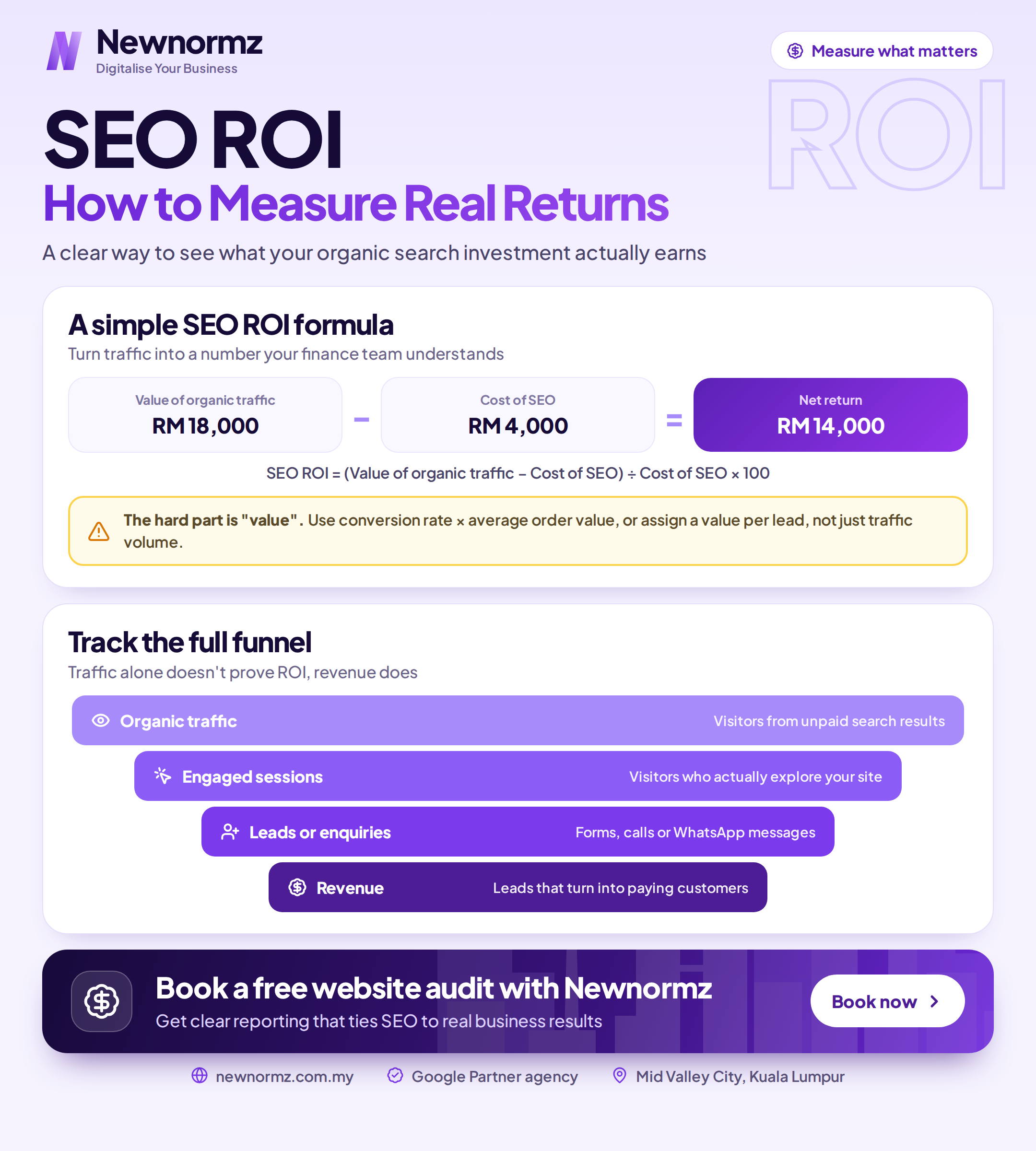
SEO ROI = (Revenue from Organic Search minus SEO Cost) divided by SEO Cost, x 100
As an example: if you spend RM3,000 a month on SEO and can trace RM15,000 in monthly revenue back to organic search, your SEO ROI for that month is 400%. The formula is the easy part. Attributing the revenue accurately is where most businesses fall short. To do it properly:
Set up goal tracking in GA4 for every conversion action that matters: form submissions, WhatsApp clicks, phone taps. Use UTM parameters consistently on every paid or social campaign so organic traffic isn’t accidentally credited with someone else’s clicks. Check Search Console monthly to see which queries are actually producing impressions and clicks, not just which keywords you wanted to rank for. Then cross-reference your organic session data against your CRM to confirm which closed deals genuinely started with a search.
Realistic Timelines: When the Return Actually Shows Up
Most disappointment with SEO ROI Malaysia comes down to timing, not performance. Here’s a realistic shape, based on what Newnormz has seen across real campaigns:
Months 1 to 3: Technical fixes and content foundation go in. Lower-competition keywords start moving. Leads are minimal, and that’s expected, not a warning sign.
Months 3 to 6: Sunway Medispa’s six-month campaign is a useful reference point here: a 700% increase in traffic and 70% more keywords ranking within that window. This is roughly when target keywords reach page one and the first real leads start arriving.
Months 6 to 12: Growth compounds. Times Parking saw 528,000 impressions, 416 ranking keywords, and 31.5K clicks over six months, and cost per lead typically drops well below paid channels by this stage.
Beyond 12 months: This is where SEO separates itself from advertising. Oriental Kopi’s two-year campaign produced 6.31 million impressions, 24,500 additional ranking keywords, and 468,000 clicks, growth that kept building because the content and rankings stayed in place rather than resetting every budget cycle.
A page that ranks keeps generating leads for months after it’s published. A Google Ads campaign stops the moment the budget runs out. That difference is the entire case for measuring SEO on a longer clock than paid media.
SEO vs Paid Ads: Where the ROI Difference Shows Up
Malaysian SMEs often ask which channel gives the better return. The honest answer is that it depends on your timeline, but the data leans toward SEO for cost efficiency once you look past month one.
Cost per lead: Paid ads in competitive Malaysian categories such as legal services, property, and F&B can run RM30 to RM150 or more per click. SEO doesn’t charge per click. Once a page ranks, leads arrive without an incremental cost attached to each one.
Trust: Malaysian consumers tend to trust organic results more than paid placements, since ranking naturally signals credibility that a paid slot can’t quite replicate.
Scalability: Paid campaigns need proportionally more budget to scale. SEO can generate returns that grow faster than the spend, as more pages rank and domain authority builds.
Budget efficiency at small scale: a Kuala Lumpur confinement centre ran SEO alongside Google Ads on a combined RM2,550 monthly budget and started getting qualified leads within 30 days, showing that a modest budget split across both channels can still produce a measurable pipeline for a small local business.
None of this makes paid ads pointless. They’re still the fastest way to get in front of customers while your organic presence builds. The strongest approach for most Malaysian SMEs runs both channels at once and lets each one do what it’s actually good at: Google Ads for immediate volume, SEO for the return that keeps compounding after the ad spend stops.
Why the ROI Often Doesn’t Show Up
Across campaigns, the same handful of issues explain most cases where SEO spend isn’t producing a visible return:
Targeting the wrong keywords. Ranking for high-volume terms that attract the wrong audience produces traffic, not leads. ROI comes from ranking for what your actual buyers search.
A weak landing page. SEO’s job is to bring the visitor. If the page is slow, confusing, or unconvincing once they arrive, no amount of ranking fixes that.
No tracking in place. Without GA4 and Search Console set up correctly, the ROI can exist and still be invisible to you.
Stopping too early. SEO compounds over time. Pulling out after three months hands that compounding advantage straight to competitors who kept going.
The wrong agency partner. Some agencies report on rankings and traffic and stop there, without ever tying the work back to leads or revenue. That’s a reporting problem dressed up as an SEO problem.
How Newnormz Helps Malaysian Businesses See Their Real ROI
Newnormz builds SEO campaigns around outcomes that show up in your revenue, not just your rankings. That means identifying search terms that match actual buying intent in the Malaysian market, fixing the technical issues that are quietly blocking visibility, and strengthening the pages that already have ranking potential.
Every campaign is reported against the indicators that actually matter: organic traffic growth, keyword movement, enquiry quality, landing page performance, and cost per lead compared to paid channels. If you want a structured SEO service that’s accountable to those numbers rather than a ranking screenshot, that’s the standard we hold campaigns to.
Still guessing what your SEO spend is returning?
Get a Clear Read on Your Organic Search ROI
Newnormz has run SEO campaigns across F&B, healthcare, ecommerce, and local services in Malaysia, backed by a performance guarantee of 70 percent of targeted keywords on Google’s first page.
30 minutes, no obligation, just a straight answer on where your SEO ROI actually stands.
Frequently Asked Questions About SEO ROI in Malaysia
How long before SEO produces a measurable return in Malaysia?
Most Malaysian SMEs see trackable leads within 3 to 6 months, with the return compounding more clearly from month 6 onwards as rankings, traffic, and lead volume build on each other.
What counts as a good SEO ROI?
It depends on your industry and sales cycle, but a good sign is organic traffic that converts into qualified leads at a lower cost per lead than your paid channels, not a ranking position on its own.
Is SEO actually cheaper than Google Ads long term?
Usually, yes, once pages rank, because you stop paying per click for the same traffic. Google Ads still wins on speed, which is why many businesses run both together.
What tools do I need to track SEO ROI?
Google Analytics 4 and Google Search Console cover most of it at no cost. Add call or WhatsApp click tracking and your CRM, and you can trace a lead all the way from search query to closed deal.
Can a small business with a limited budget still get SEO ROI?
Yes. A Kuala Lumpur confinement centre generated qualified leads within 30 days on a combined RM2,550 monthly SEO and Google Ads budget, which shows scale isn’t a prerequisite for a measurable return.
Why doesn’t a page-one ranking automatically mean SEO ROI?
Because a ranking is visibility, not a sale. If that page doesn’t generate an enquiry, a call, or a purchase, it hasn’t created business value yet, no matter where it sits on Google.

Bryan Tan is an SEO Specialist and CEO at Newnormz, helping hundreds of businesses achieve first-page rankings on Google. With a passion for driving organic growth, Bryan blends innovative strategies with hands-on experience to optimize websites for maximum visibility. Always at the forefront of the latest SEO insights and trends, he consistently adapts to the evolving digital landscape.