Malaysia’s logistics industry keeps expanding as e-commerce grows, infrastructure upgrades continue, and cross-border demand rises across ASEAN.
Companies in freight forwarding, warehousing, haulage, and last-mile delivery now compete in a busy landscape where decision-makers rely heavily on online research.
Google Ads for logistics companies in Malaysia is the key tool. This article explores a practical framework that helps logistics businesses move from clicks to valuable leads.
Table of Contents
The Digital Imperative for Logistics in Malaysia

Malaysia’s logistics ecosystem now operates at a fast pace. E-commerce is still one of the top growth sectors, and this fuels higher demand for freight, warehousing, and express delivery across major urban zones.
Many procurement managers and business owners search online before contacting a provider.
They often compare providers through Google Search ads, look for case studies, or check service areas.
Appearing at the top of these searches creates a strong advantage. With effective Google Ads management, logistics companies gain visibility where intent is highest.
We will unpack a Google Ads strategy that brings leads aligned with your capacity, pricing model, and specialisation.
A Strong Foundation: Hyper-Targeted Keywords and B2B Audiences
Building the right structure starts with keywords. Logistics carries broad meaning, so narrowing down to services and intent helps filter out unfit traffic.
a. Keyword Segmentation by Service and Intent
Short, focused keyword groups give better clarity. Examples include:
| Keyword Type | Examples |
| High-Intent Service Terms | – sea freight forwarding to Singapore – air freight Malaysia pricing – cold chain logistics Kuala Lumpur – bonded warehouse service Malaysia |
| Long-Tail Research Questions | – how to ship large cargo from Port Klang – best inventory management system Malaysia – customs clearance steps Malaysia |
Some brands target competitor names to capture comparison searches. It works well in logistics where clients often evaluate several vendors before requesting a quote.
Keyword segmentation works better when paired with an optimised website. Brands aiming to improve organic discoverability can explore SEO Services to support their Google Ads visibility.
b. Pinpoint Location and Language Targeting
Many searches come from commercial hubs such as Klang Valley, Penang, and Johor Bahru. Precise geotargeting helps avoid clicks from areas you do not serve.
Language preferences also matter. Searches for logistics topics appear in Malay, English, and Mandarin. Running multilingual ads creates more relevance and improves cost efficiency.
Adapting ads into Malay, Mandarin, and English works even better when landing pages match that quality.
Working on structured messaging through content marketing creates a smoother customer journey.
c. Custom Audience Segmentation
Google’s in-market audiences help you reach users already exploring logistics-related services. Relevant segments include:
- Commercial Shipping
- Supply Chain Management
- Business Services
You can also build custom segments with competitor terms and related search patterns. These work well when combined with remarketing data.
Teams that want to refine their campaign structure further can explore Google Ads Strategies designed for businesses managing targeted budgets and focused growth.
Campaign Mix Mastery: Performance Max and Core Search for Logistics Leads
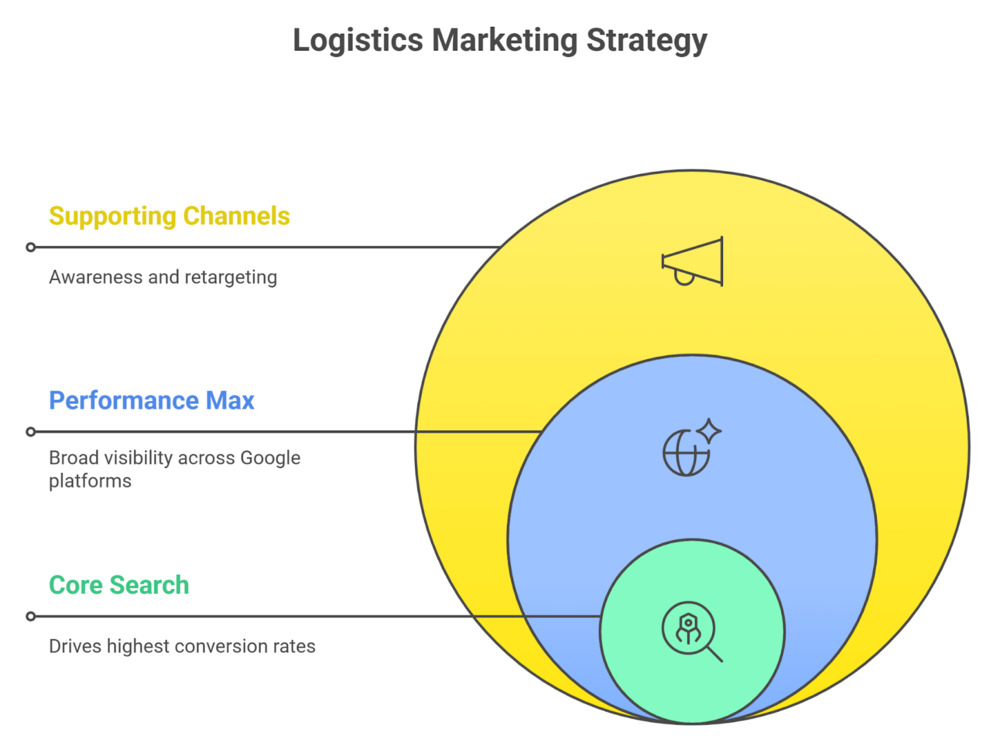
A balanced structure uses Performance Max (PMax), focused Search campaigns, and supporting channels for visibility and retargeting.
1. Performance Max for B2B Logistics
PMax spreads your visibility across Search, Display, YouTube, Gmail, and Maps. This creates multiple touchpoints for B2B decision-makers who evaluate providers over several days or weeks.
Supplying strong creative assets and case-study visuals strengthens performance. Many logistics companies refine their visuals through video making to help build stronger engagement.
Good PMax asset suggestions:
- warehouse facility videos
- last-mile delivery fleet photos
- freight forwarding process diagrams
- client testimonial snippets
Audience signals such as in-market segments and competitor lists can enhance the AI engine’s learning.
Readers curious about how automation strengthens multi-channel ads can explore Performance Max to see how AI-driven optimisation improves lead quality for logistics businesses.
2. Core Search Strategy for High-Intent Leads
Core Search still drives the highest conversion rate for logistics. Theme-based ad groups keep your ad copywriting aligned with user needs. Examples include:
- freight forwarding
- warehousing solutions
- road transport
- cross-border delivery
- cold chain logistics
This structure ensures relevant messaging and lowers cost per lead.
Supporting campaigns with visuals strengthens mid-funnel visibility. Brands exploring wider reach may find Youtube Ads and Google Display Ads useful for presenting service capabilities.
3. Supporting Channels for Awareness and Retargeting
Display advertising and YouTube campaigns help fill the mid-funnel by highlighting brand strengths. Examples include:
- fleet capacity videos
- port handling capabilities
- technology demonstrations
- warehouse automation walkthroughs
These channels also support remarketing campaigns that re-engage website visitors.
Localised Ad Copy That Speaks to Malaysian B2B Buyers

Creating trust through localisation often improves lead quality.
1. Multilingual Responsive Search Ads (RSAs)
Testing RSAs in English, Malay, and Mandarin improves performance. B2B buyers respond better to familiar language and phrasing, especially for technical logistics needs.
2. Highlighting Clear USPs
Logistics buyers care about reliability and capacity. Good ad copy highlights improvements, capabilities, or guarantees such as:
- reduce delivery delays by 25%
- real-time nationwide tracking
- compliance with customs requirements
- temperature-controlled storage
These messages help improve CTR for all Google Ads agency campaigns.
3. Use of Ad Extensions for Stronger Credibility
Key extensions that work well in logistics:
- Callouts for certifications and technology
- Sitelinks to “Get a Quote”, “Service Areas”, and “Warehousing Solutions”
- Call extensions for instant enquiries
These create direct pathways for qualified leads.
Alongside Google Search messaging, many logistics brands also scale awareness through paid social.
Using Instagram Ads or Facebook Ads strengthens brand familiarity before prospects perform a search.
Conversion Architecture: Landing Pages, Tracking and CRM Integration
The journey does not end with a click. Your landing experience and tracking determine lead quality.
a. Conversion-Focused Landing Pages
Logistics landing pages perform well when they include:
- a clear headline matching the ad
- USP highlights
- service areas
- a visible Request A Quote form
- trust signals like certifications or client logos
Adding rate calculators or downloadable capability sheets increases engagement.
b. Robust Conversion Tracking
Tracking must go beyond form submissions. Many logistics prospects prefer calls, so phone tracking helps capture actual leads.
Micro-interactions such as brochure downloads also provide signals for optimisation.
Improving conversion tracking also helps reveal which campaigns produce higher-value enquiries. Teams exploring optimisation techniques can refer to maximise ROI for deeper insights.
c. CRM Integration for Real Lead Quality
Connecting Google Ads to your CRM provides full-funnel visibility. This allows meaningful optimisation based on:
- deal size
- lead quality
- sales cycle length
Newnormz applies CRM integration so B2B clients can measure ROI properly, especially when conversion happens offline.
Advanced Bidding and Multi-Funnel Retargeting
Strong logistics campaigns rely on smart bidding and consistent data refinement.
| Category | Details | Purpose / Outcome |
| Smart Bidding Strategy | – Maximise Conversions (initial data collection) – Target CPA (cost-controlled optimisation) – Maximise Conversion Value (focus on high-value leads) | Helps Google’s algorithm learn from the strongest conversion signals and optimise towards quality leads |
| Power of Remarketing Lists | Remarketing content examples: – logistics case studies – cost-saving proposals – consult sessions – client highlights | Reconnects with visitors who showed interest but didn’t convert, prompting them to restart the enquiry process |
| Strong Negative Keyword Strategy | Common exclusions: – Jobs – internship – DIY shipping – personal parcel services | Filters out unqualified traffic to protect ad budget and maintain B2B lead quality |
Content plays a strong role in remarketing, especially when highlighting case studies. Some companies even use structured content through listicle marketing service to increase mid-funnel engagement.
Drive Higher-Value Logistics Enquiries with the Right Google Ads Partner
Measuring cost per qualified lead gives logistics companies a clearer path to sustainable ROI. Consistent refinements to keywords, creative assets, and bid management lift campaign performance, especially in a competitive market.
Many brands now choose a partner that manages everything from strategy to reporting. Working with a trusted digital marketing agency helps streamline multi-channel planning and ensures campaigns run smoothly.
Newnormz brings a full-funnel approach supported by Google Ads audit, Google Partner Certified specialists, CRM-driven optimisation, and proven results across supply chain and logistics enquiries.
Businesses ready to strengthen visibility or acquire higher-value leads can explore the Google Ads.
Frequently Asked Questions