Voice search optimization is the work of structuring your website, your Google Business Profile and your content so that voice assistants and AI answer engines such as ChatGPT, Gemini and Google AI Overviews can find your business, understand what you offer, and recommend you by name. For Malaysian SMEs this matters because a growing share of customers now ask a question out loud or type it into an AI chat instead of scrolling through a page of blue links, and if your business isn’t structured for that kind of answer, a competitor gets recommended in your place, sometimes before the customer ever visits a website at all.
A Simple Way to Think About It
Being Listed vs Being Chosen
📋 A phone directory
If your business isn’t in the top handful of names on a page, it’s still on the shelf. Someone can keep flipping and find you anyway.
🎙️ A friend’s recommendation
There’s no flipping past a friend to see who else is nearby. Whichever name gets said out loud is the one that gets the call.
The sections below break down exactly what separates the businesses that get picked as that single spoken answer from the ones left sitting on the list.
What Is Voice Search Optimization?
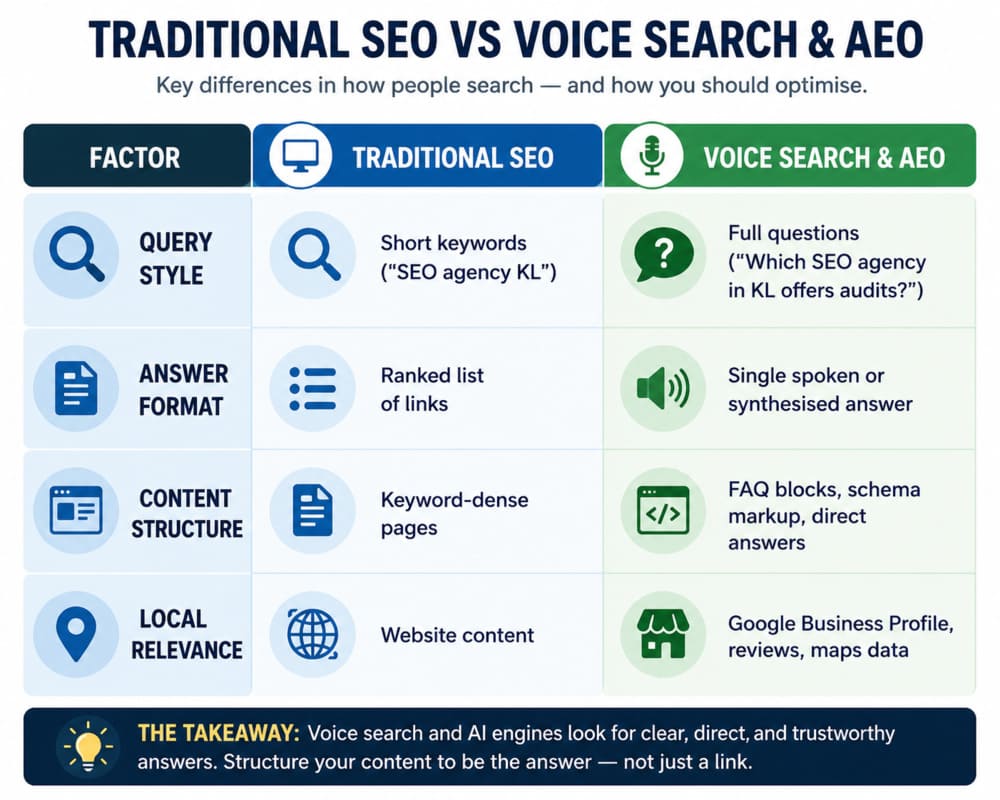
Voice search optimization helps your business show up when a customer asks a question out loud or gets a written answer from an AI assistant instead of a list of results. It centers on four things: conversational keywords that match how people actually speak, structured data (schema markup) that tells search engines exactly what your business does, an accurate and complete local SEO and Google Business Profile setup, and mobile pages fast enough that an assistant is willing to read from them.
Malaysia’s multilingual market makes this harder than it looks. A single customer’s buying journey might move between Bahasa Malaysia, English, Mandarin and Tamil, and a large share of local discovery happens through Google Maps voice search or a link shared straight into WhatsApp rather than a typed Google search. A business optimized only for typed, English-language queries is invisible for most of that journey.
Why This Matters for Malaysian SMEs Right Now
Search no longer happens through typing alone. Malaysia had 35.4 million internet users and 44 million mobile connections by the end of 2025, according to DataReportal, and a large share of that activity now runs through voice and AI interfaces rather than a search box.
Voice search in particular skews local. BrightLocal found that 76 percent of smart speaker users search for a local business at least weekly, which means a customer asking “where can I get an aircon service near me” is a routine query, not an edge case. Pew Research has also found that AI-generated summaries are reducing clicks to traditional search results, so the business that gets named in the summary keeps the enquiry, and the ones that don’t simply lose it before a click was ever possible.
Backlinko found that 40.7 percent of Google Home answers were pulled from featured snippets. That single number explains why clear, direct, snippet-ready content still carries real weight for voice visibility, even as AI answer engines add another layer on top.
How AI Answers Are Changing the Rules of SEO
AI answer engines are increasingly the first response a customer sees, before they ever reach a website. ChatGPT grew from 100 million weekly users in November 2023 to more than 800 million by late 2025, and Semrush projects that AI search referrals for digital marketing and SEO topics could overtake traditional organic referrals by early 2028.
Here’s the part worth being honest about: a page-one Google ranking helps your odds, but it does not guarantee a citation in ChatGPT, Gemini or AI Overviews. These systems weigh direct, well-structured content and credible data differently to how classic ranking algorithms do. A business can rank well and still be left out of the answer an AI gives out loud.
A Voice Search Optimization Checklist for Malaysian SMEs
None of this requires a rebuild. It requires fixing a specific, checkable set of gaps.
| Action | Why It Matters |
|---|---|
| Write FAQs as full-sentence questions and answers | Matches how customers actually speak in Bahasa Malaysia or English, which is what voice and AI engines are parsing for |
| Add FAQPage and LocalBusiness schema | Lets Google and AI crawlers read your services, hours and location without guessing |
| Claim and complete your Google Business Profile | Most voice searches carry local intent, and an incomplete profile is an easy reason to be skipped |
| Target long-tail, conversational keywords | Spoken queries run longer than typed ones, so short-fragment keywords miss most of the actual phrasing |
| Improve mobile page speed | Voice assistants favour fast, mobile-friendly pages when picking which answer to read aloud |
Even a handful of these fixes narrows the gap against competitors who haven’t touched their structured data yet, and none of them require waiting on a full website rebuild first.
How Newnormz Approaches Voice and AI Search Visibility
Newnormz combines its SEO service work with a dedicated review of schema markup, Google Business Profile accuracy, mobile speed and conversational keyword gaps, then hands back a prioritised fix list within five business days.
The recommendations are tailored to your industry and language mix rather than templated. That might mean restructuring FAQs into Bahasa Malaysia for a retail brand, or tightening local schema across every branch for a multi-outlet clinic. The point is a fix list you can act on immediately, not a generic report.
Is your business ready for voice and AI search?
Find Out What’s Keeping You Out of Voice and AI Answers
Newnormz has run SEO campaigns across F&B, healthcare, ecommerce, and local services in Malaysia, backed by a performance guarantee of 70 percent of targeted keywords on Google’s first page.
30 minutes, no obligation, including a check of your voice and AI search visibility.
Frequently Asked Questions About Voice Search Optimization
Why does my business show up on Google Maps but never in voice answers?
Usually because Google Maps visibility and voice answer eligibility rely on different signals. Newnormz checks your Google Business Profile data, local schema, mobile speed and conversational content to find where the gap actually sits.
Which voice search improvements should a Malaysian SME prioritise first?
Start with accurate local listings, direct answers to real service questions, mobile performance, and structured data that matches what you actually offer.
Why don’t my existing FAQs show up in voice or AI-generated answers?
Most FAQs are written for humans skimming a page, not for an engine looking for a direct answer. Rewriting them around real customer questions, with a clear answer up front, makes them far easier for answer engines to lift.
Can voice search optimization actually bring in more local enquiries?
Yes. Strengthening your location and service signals is what helps nearby customers find you through conversational, spoken-style searches in the first place.
Do I need a smart speaker app or a dedicated voice strategy?
No. The work happens on your website, your Google Business Profile, and your structured content, which is exactly what voice assistants and AI engines are already reading from.
What does Newnormz check during a free voice search audit?
Schema markup, local listing accuracy, mobile speed, conversational keyword coverage, and which of your pages are actually positioned to answer customer queries directly.

Bryan Tan is an SEO Specialist and CEO at Newnormz, helping hundreds of businesses achieve first-page rankings on Google. With a passion for driving organic growth, Bryan blends innovative strategies with hands-on experience to optimize websites for maximum visibility. Always at the forefront of the latest SEO insights and trends, he consistently adapts to the evolving digital landscape.