
A topic cluster is a group of pages built around one subject: a broad pillar page that gives the overview, and several narrower cluster posts that each go deep on one subtopic, all linked back to the pillar. That internal linking is what turns a folder of blog posts into something Google reads as one authoritative resource, and it is that authority signal, not the raw number of posts, that actually moves rankings for competitive terms. Scattered one-off posts with no links between them do not build that authority, no matter how many you publish.
A Simple Way to Think About It
The Scattered City vs. The Marketplace
🗺️ The Scattered City
Dozens of specialty shops spread across different neighbourhoods, none marked on a map and none pointing to each other. A shopper looking for one specific item wanders block by block and usually gives up before finding it.
🏛️ The Marketplace
One information booth at the centre, with every specialist stall arranged around it and a sign pointing back to the booth. A shopper walks in, asks one question, and is sent straight to the stall with the answer.
Most company blogs are the scattered city. Here is what it takes to build the marketplace instead, and why Google treats it so differently.
What a Topic Cluster Actually Is
A topic cluster has three parts. The pillar page is the hub: it covers a broad topic at a high level and targets a competitive head keyword, for example “SST compliance for SMEs.” It answers the big questions without going deep on any single one.
The cluster posts are the spokes. Each takes one narrow subtopic the pillar only touched on, such as “how to register for SST,” and answers it fully. These target long-tail keywords with clearer intent and less competition, which is usually where the actual enquiries come from.
The internal links are what hold the structure together. Every cluster post links up to the pillar, and the pillar links down to every post. This hub-and-spoke model is what turns a pile of individually weak pages into something search engines read as one comprehensive resource on the topic.
Why Google Rewards This Structure
Search has moved past ranking single keywords in isolation. Google increasingly evaluates how completely a site covers a subject, and a page that sits inside a well-linked cluster carries more weight than the same content published alone. A cluster is simply the cleanest way to demonstrate that coverage.
The mechanism is internal linking. When cluster posts point up to a pillar, they pass authority to it, which helps the pillar rank for the harder head term it could never win by itself. When HubSpot tested this model on its own site, the team found that the more it interlinked related pages, the higher those pages climbed in search results and the more impressions they earned. The effect compounds: every new cluster post is another vote for the pillar.
Structuring content this way also fixes a quieter problem. Left to chance, important pages become orphans that neither users nor crawlers reach easily. One large-scale study of internal linking, covering more than 23 million links, found that pages with more internal links tend to rank better, up to a point, with the gains flattening out beyond roughly 44 internal links on a single page. The lesson is to link with intent, not to stuff links in everywhere.
Pillar Page vs Cluster Post: The Difference
People confuse these constantly. The pillar is broad and shallow; the cluster post is narrow and deep. Here is how they compare.
| Element | Pillar page | Cluster post |
|---|---|---|
| Scope | Broad topic overview | One specific subtopic |
| Keyword type | Competitive head term | Long-tail, lower competition |
| Search intent | Broad, research stage | Specific, closer to a decision |
| Linking role | Links down to every cluster post | Links up to the pillar |
How to Build a Topic Cluster
The process holds up as long as you do it in order.
1. Pick a core topic tied to revenue. Choose a subject your ideal customers search for and that leads to enquiries, not one that is merely interesting to write about.
2. Map the subtopics. List every specific question a buyer asks around that topic. Each one becomes a cluster post with its own long-tail keyword.
3. Write the pillar first. Give a solid overview of the whole topic, with a short section pointing toward each subtopic you plan to expand on separately.
4. Write the cluster posts. Answer one subtopic per post, thoroughly. Depth is what earns the long-tail rankings, not length for its own sake.
5. Link deliberately. Every cluster post links up to the pillar with descriptive anchor text, and the pillar links down to each post. Add sideways links between related cluster posts too.
6. Keep it focused. Since the returns from internal links flatten out past roughly 44 per page, link with intent rather than stuffing them in wherever they will fit.
This is the same structural discipline behind a well-run SEO service: fewer, better-connected pages beat a large pile of disconnected ones.
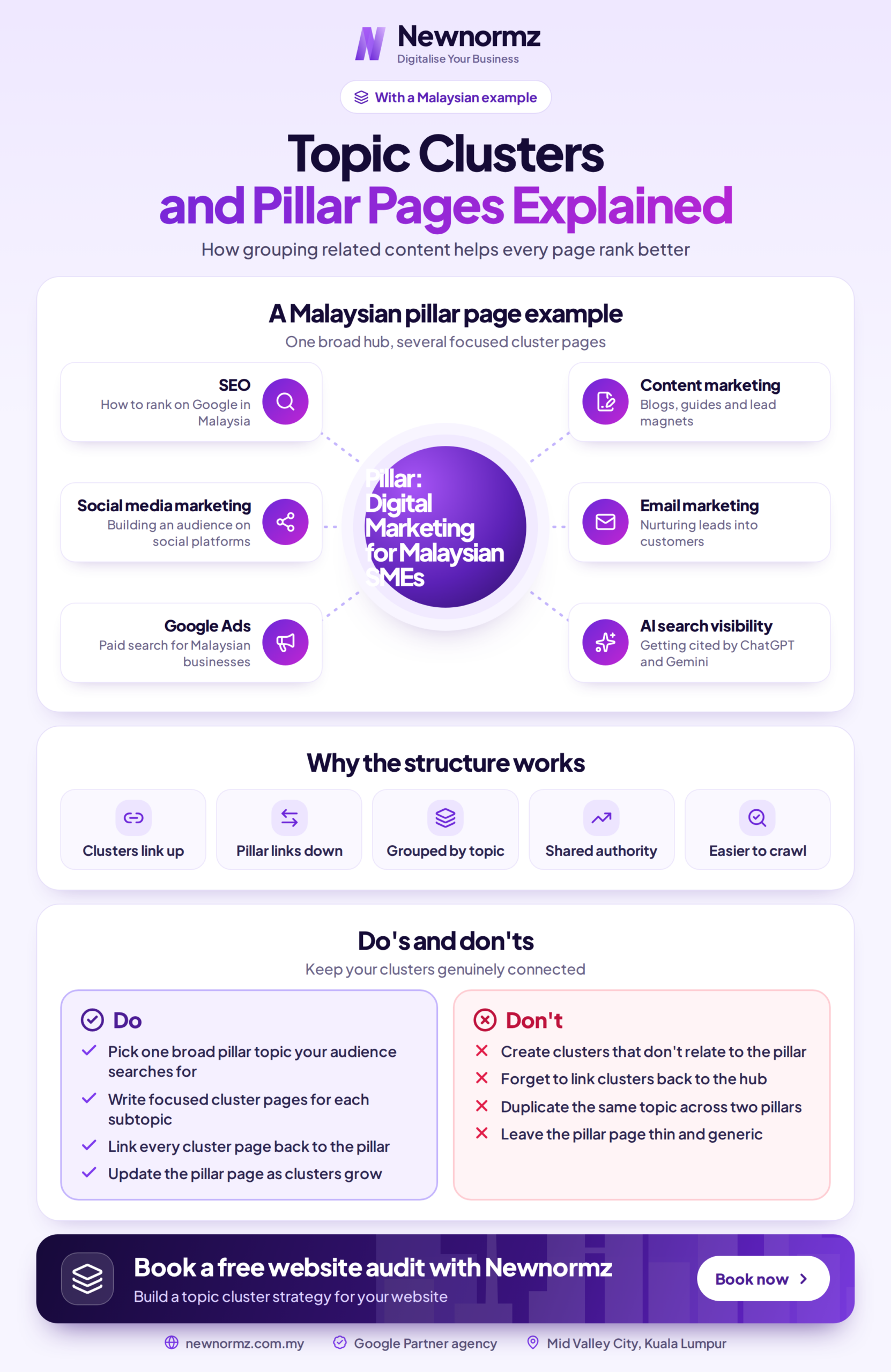
Example: A Topic Cluster Map for a Malaysian Business
Take a hypothetical accounting firm in Kuala Lumpur that wants to win clients searching for SST help. Its core topic is “SST compliance for SMEs,” which becomes the pillar page targeting the broad head term. Around it sit six cluster posts, each answering one specific question a business owner types into Google.
| Content piece | Target keyword | Links up to pillar? |
|---|---|---|
| PILLAR: SST compliance for SMEs | sst compliance for smes | Hub (links down to all) |
| How to register for SST in Malaysia | how to register for sst | Yes |
| SST rates and taxable services explained | sst rates malaysia | Yes |
| How to file an SST return | sst return filing | Yes |
| SST vs GST: what changed | sst vs gst malaysia | Yes |
| SST penalties for late payment | sst late payment penalty | Yes |
Here is what the links actually do. Each of the six cluster posts ranks for its own lower-competition query and pulls in visitors at the exact moment they have that question. Every post then links up to the pillar with relevant anchor text, passing authority toward it. To Google, six focused posts all pointing at one page is a strong signal that the firm covers SST end to end, which helps the pillar rank for the hard term “SST compliance for SMEs” that no single post could win on its own.
The structure also catches the whole customer journey. Someone reading about penalties is further along than someone comparing SST and GST, and the cluster serves both, then routes them to the pillar. This kind of deliberate structure is also what makes local SEO work for smaller Malaysian businesses competing against bigger, less organised rivals: it is not about publishing more, it is about publishing connected.
Common Mistakes to Avoid
Publishing posts with no home. A cluster post with no pillar to link to is just another orphan page. Decide the structure before you write.
Overlapping cluster posts. If two posts target the same keyword, they compete with each other instead of the competition. This is keyword cannibalisation, and it splits your ranking power.
A pillar that is too thin or too deep. Too thin and it ranks for nothing; too deep and it steals the subtopics your cluster posts are supposed to own.
Forgetting the links. Content without interlinking is not a cluster, it is just a folder. The links are the strategy, not a finishing touch.
Choosing topics no one searches for. Ground every cluster in real keyword demand rather than what feels important internally.
Frequently Asked Questions
What is a topic cluster in SEO?
A topic cluster is a group of related pages organised around one subject and joined by internal links. A central pillar page covers the broad topic, while several cluster posts each cover a narrow subtopic in depth and link back to the pillar. This structure signals topical authority to Google and lifts the whole group in search.
What is the difference between a pillar page and a cluster post?
A pillar page is broad and comprehensive, targeting a competitive head keyword and giving an overview of a whole topic. A cluster post is narrow and deep, targeting one long-tail subtopic in detail. The pillar links down to every cluster post, and each cluster post links back up to the pillar.
How many cluster posts do I need per pillar?
There is no fixed number, but a healthy cluster usually runs five to ten cluster posts feeding one pillar. Start with the specific questions your customers actually ask around the topic. Genuine depth matters far more than hitting a round number of shallow posts.
Do topic clusters actually improve rankings?
Generally, yes. The model works because internal links pass authority between related pages, and HubSpot’s own research found that the more it interlinked related content, the higher those pages ranked and the more impressions they earned. Google also rewards comprehensive topic coverage, which a well-built cluster demonstrates directly. No one, including Google itself, can guarantee a specific ranking position.
How is a topic cluster different from just blogging regularly?
Regular blogging produces disconnected posts that each fight alone for rankings. A topic cluster connects posts around one subject with deliberate internal linking, so they reinforce each other instead. The group builds authority together and tends to rank far better than the same posts would if published in isolation.
How long before a topic cluster shows results?
Like most SEO work, clusters take time. Expect the first movement over roughly three to six months as Google crawls the new links and assesses the coverage. The advantage of clusters is that they compound: each new post you add strengthens the pillar, so results tend to build rather than plateau.
Still publishing posts that go nowhere?
Get an Audit That Shows Exactly Which Topics You Should Be Clustering
Newnormz has run SEO campaigns across F&B, healthcare, ecommerce, and local services in Malaysia, backed by a performance guarantee of 70 percent of targeted keywords on Google’s first page.
30 minutes, no obligation, and you will leave knowing which pillar to build first.

Bryan Tan is an SEO Specialist and CEO at Newnormz, helping hundreds of businesses achieve first-page rankings on Google. With a passion for driving organic growth, Bryan blends innovative strategies with hands-on experience to optimize websites for maximum visibility. Always at the forefront of the latest SEO insights and trends, he consistently adapts to the evolving digital landscape.