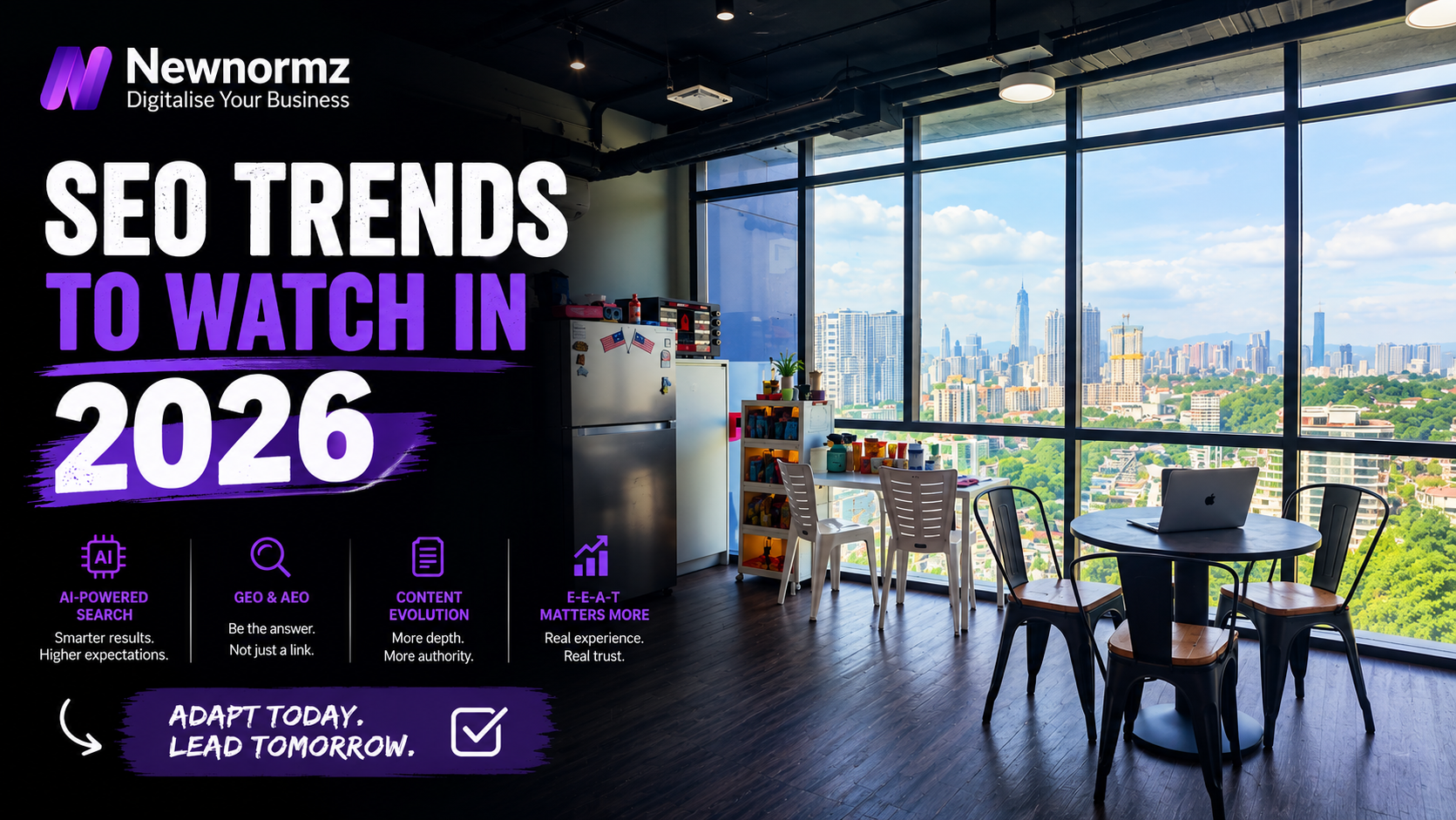
The biggest SEO trends for 2026 all point the same direction: AI Overviews, answer engine optimisation (AEO), generative engine optimisation (GEO), stronger E-E-A-T signals, short-form video, and genuinely fast, well-built pages. Less than a third of Google searches now send a click to a website, so ranking well is no longer the finish line. The businesses that grow this year will be the ones AI engines choose to quote, not just the ones sitting at position one.
A Simple Way to Think About It
The Signpost vs. The Local Guide
🪧 The Old Signpost
A signpost at a crossroads that simply lists every bakery in town by name. Drivers read it, get their bearings, and drive straight past all of them without stopping at a single door.
🧭 The Local Guide
A guide who has actually eaten at one of those bakeries, trusts the owner, and walks visitors straight to that one door by name because they can vouch for it themselves.
Search engines are behaving less like signposts and more like guides who vouch for specific businesses by name. Every trend below is really about earning that kind of vouching.
This shift is not a prediction; it is already showing up in the numbers. AI Overviews now sit between your business and the customer on a large share of searches, and when they appear, fewer people ever reach your site. That changes what a well-run SEO agency in Malaysia should be optimising for in 2026, and it changes how you should be judging your own results.
Trend 1: AI Overviews and Answer Engine Optimisation
AI Overviews are the AI-generated summaries Google places above the normal blue links. Answer engine optimisation, or AEO, is the practice of structuring your content so those summaries quote you directly. AI Overviews now appear on more than 20% of all searches, and when one shows up, click-through rate to the organic results below it drops by close to 60%. If the AI Overview does not cite your page, that traffic simply does not arrive.
What to do: Under every question-style heading on your money pages, add a tight 40 to 60 word answer that a machine can lift cleanly, then let the rest of the section add depth for human readers. Structure and clarity now matter as much as the words themselves.
Trend 2: Zero-Click Search Is Now the Default
A zero-click search ends on the results page itself; the user never visits a website. This is now normal behaviour, not the exception. In 2025, 58.5% of United States searches ended without a click, and that figure rose to 83% when an AI Overview appeared on the page. For businesses that rely on Google Maps and local pack results, this hits especially hard, since a lot of local SEO value now shows up as a phone call or a direction request rather than a website visit.
What to do: Stop grading every page purely on clicks. Track branded search volume and how often your business is mentioned, and make sure your core facts, pricing, hours, and selling points are visible high on the page, because a large share of visitors will never scroll to find them.
Trend 3: GEO and Getting Cited Inside AI Assistants
Generative engine optimisation, or GEO, is the practice of earning citations inside tools like ChatGPT, Gemini, Perplexity, and Google’s AI Mode. It is the fastest-moving part of search right now: referral traffic from generative AI platforms grew by roughly 796% year over year into 2025. The same research shows that spreading your content and mentions across trusted third-party sites can lift AI citation rates by up to 325%. Community platforms play a role too; Reddit threads in particular now surface often as sources inside AI answers.
What to do: Earn placements outside your own website: reputable Malaysian publications, industry directories, and genuine community discussions. AI models read the wider web, not just your blog, so your presence needs to exist in more than one place.

Trend 4: E-E-A-T and First-Hand Experience
E-E-A-T stands for Experience, Expertise, Authoritativeness, and Trustworthiness. Google added the Experience component in December 2022, specifically to reward content that shows first-hand knowledge rather than content assembled from other sources. As AI-generated content floods the web, these signals matter more, not less, because they are the cues that separate a real practitioner from a rewritten summary.
Proof is what gets you chosen. Princeton-backed GEO research found that adding quotations lifted AI citation likelihood by 41%, adding statistics lifted it by 32%, and adding citations lifted it by 30%. Original photos, real numbers, and specifics a generic AI summary cannot fabricate are what set a page apart.
What to do: Put a named author with a real bio and credentials on every important page, cite your sources, and include your own data, quotes, and results rather than paraphrased generalities.
Trend 5: Short-Form Video as a Search Surface
Short-form video on TikTok, Reels, and YouTube Shorts has moved from “nice to have” to a genuine discovery channel, and it feeds the brand recognition that drives zero-click branded search. It also performs: 21% of marketers rate short-form video as their highest-ROI format, 93% report positive ROI from video overall, and 78% of consumers say they prefer learning about a product through a short video over reading text.
What to do: Turn your strongest existing content into 30 to 60 second clips, each answering a single customer question, captioned for sound-off viewing, and repurposed across platforms rather than built fresh for each one.
Trend 6: Core Web Vitals and Technical Health
Core Web Vitals measure loading speed, interactivity, and visual stability, and they still decide whether a visitor sticks around long enough to convert. Most sites are still failing this test: only 33% of websites pass all three Core Web Vitals, and 53% of mobile visitors abandon a page that takes longer than 3 seconds to load. None of the trends above matter if the page itself drives people away before it loads.
What to do: Compress images, cut unnecessary scripts, and get mobile load times under 3 seconds. We have seen this compound directly in our own campaigns: Sunway Medispa saw a 700% increase in traffic within six months, and Times Parking added 31,500 clicks and 416 ranking keywords in the same window, both built on clean technical foundations rather than content volume alone.
| Trend | Key data point | First action |
|---|---|---|
| AI Overviews and AEO | Appear on 20%+ of searches, cut CTR by nearly 60% | Add a 40 to 60 word answer under question headings |
| Zero-click search | 58.5% of US searches end without a click | Track brand mentions, not just clicks |
| GEO and AI citations | AI referral traffic up roughly 796% year over year | Earn mentions on trusted third-party sites |
| E-E-A-T and experience | Statistics lift AI citation odds by 32% | Add named authors and real data |
| Short-form video | 21% of marketers rank it highest ROI | Repurpose content into 30 to 60 second clips |
| Core Web Vitals | 53% of mobile users leave after 3 seconds | Get mobile loads under 3 seconds |
A Worked Example: Turning AEO Into an Actual Rewrite
Here is Trend 1 applied to a real query a Malaysian accounting firm might target: “how much does bookkeeping cost in Malaysia.”
Before
Bookkeeping is essential for every business, and pricing varies depending on your size, industry, and how often you need support. We can tailor a package that suits your needs, so please get in touch to discuss your requirements.
After
How much does bookkeeping cost in Malaysia? Monthly bookkeeping in Malaysia typically costs between RM300 and RM1,500 for small businesses, depending on transaction volume and reporting needs. Micro businesses with under 50 transactions a month often pay RM300 to RM500, while companies needing management reports and payroll support usually pay RM800 to RM1,500 per month.
The rewritten version sits under the exact question a customer types, leads with the answer, and uses specific RM figures instead of vague reassurance. That is the format AI Overviews can lift word for word.
Common Mistakes to Avoid
- Chasing rankings while ignoring AI answers. Position one means little if the AI Overview above it already answered the query.
- Judging every page by clicks alone. In a zero-click world, impressions and mentions carry real value too.
- Publishing content with no named author. Faceless, generic pages are exactly what Google’s trust signals are built to filter out.
- Treating GEO as optional. Ignoring AI citations means giving up the fastest-growing traffic source without a fight.
- Neglecting mobile speed. A slow site wastes every ringgit spent on content and ads to get people there in the first place.
The 2026 SEO Readiness Checklist
- Add a 40 to 60 word answer under each key question heading on your money pages.
- Track branded search and AI citations alongside, not instead of, traffic and clicks.
- Earn mentions on reputable third-party sites and genuine community threads.
- Attach named authors with real bios, credentials, and original data to key pages.
- Repurpose your best content into short-form video with captions.
- Get mobile page loads under 3 seconds and pass all three Core Web Vitals.
Frequently Asked Questions
What are the most important SEO trends in 2026?
AI Overviews and AEO, zero-click search, GEO and AI citations, stronger E-E-A-T, short-form video, and technical health. They all point the same way: earn visibility inside AI answers, not just blue links, while keeping your site fast and trustworthy.
Is SEO still worth it with AI Overviews everywhere?
Yes, but the target has shifted. Since AI Overviews cut click-through rates by nearly 60% when they appear, the goal is now to be the cited source inside the answer, not just to rank first below it. Structured, trustworthy content still captures real demand.
What is the difference between AEO and GEO?
AEO focuses on being quoted inside answer boxes like Google’s AI Overviews. GEO focuses on being cited by AI assistants such as ChatGPT and Perplexity. They overlap heavily, and both reward clear, evidence-backed content that directly answers real questions.
How does zero-click search affect my business?
Over half of searches now end without a website visit, so fewer people reach your pages even when you rank well. The response is to put your key value on the results page itself and measure impressions and branded search alongside traffic and leads.
How fast should my website load in 2026?
Aim for under 3 seconds on mobile, since 53% of mobile visitors abandon slower pages. Passing all three Core Web Vitals, which only 33% of sites currently do, protects both rankings and conversions, so treat speed as a foundation, not an afterthought.
Can a small Malaysian business compete in AI search?
Yes. AI models reward clarity, expertise, and proof over brand size. A focused local business with genuine experience, specific data, and answer-first content can be cited ahead of larger, vaguer competitors. Start with your top pages and expand from there.
Which 2026 trend should you act on first?
Get a Free SEO and AI Visibility Audit From Newnormz
Newnormz has run SEO campaigns across F&B, healthcare, ecommerce, and local services in Malaysia, backed by a performance guarantee of 70 percent of targeted keywords on Google’s first page.
30 minutes, no obligation, just a clear view of where you stand for 2026.

Bryan Tan is an SEO Specialist and CEO at Newnormz, helping hundreds of businesses achieve first-page rankings on Google. With a passion for driving organic growth, Bryan blends innovative strategies with hands-on experience to optimize websites for maximum visibility. Always at the forefront of the latest SEO insights and trends, he consistently adapts to the evolving digital landscape.