Ranking in AI search means getting your business cited inside tools like ChatGPT, Google AI Overviews, Gemini, and Perplexity when someone asks a question your business can answer. There is no secret trick for this: Google has said publicly, more than once, that no one can guarantee a specific ranking position, and the same honesty applies to AI citations. What actually moves the needle is entity clarity (your business name and category matching everywhere), pages that answer the reader’s question in the first two sentences, structured data that helps AI systems parse your content, and consistent, verifiable facts about your business across the web. Get those fundamentals right and a Malaysian SME can be cited alongside, or instead of, a much bigger competitor, because AI systems reward clarity and specificity, not size or ad budget.
A Simple Way to Think About It
The Billboard vs. The Expert on Speed Dial
🪧 The billboard on the highway
Thousands of cars pass it every day, but almost none of them stop to ask a question. It just sits there hoping to be noticed.
📞 The expert a journalist calls
When a reporter needs a fast, accurate quote, they call the person known for giving a straight answer, not the loudest voice in the room.
The rest of this guide shows you how to become the second kind of business: the one AI systems call on for a straight answer, rather than the one they scroll past.
What Is AI Search Ranking?
AI search ranking describes how platforms choose which content to pull into a generated answer. The exact process differs by tool, but Google has said that AI Overviews and AI Mode run on its existing Search systems, sometimes firing off several related searches behind the scenes to find useful supporting pages. Google has also confirmed there is no special file or extra schema required to appear in AI Overviews or AI Mode: your pages simply need to be indexed, eligible to show a search snippet, and built on standard SEO practices.
This guide focuses on organic AI visibility for SMEs that already have a working website. It does not cover paid AI ads, enterprise data engineering, or app store optimisation, those are different problems with different playbooks.
Why This Matters for Malaysian SME Owners
AI is already part of how Malaysians shop. Adyen has reported that 58 percent of Malaysian shoppers use AI assistants during the shopping process, which means AI recommendations are already shaping product discovery before a customer ever lands on your website.
Three shifts are worth tracking. Google AI Overviews now appear above the normal organic results when triggered, and while they show up most often for informational searches, their presence in commercial and transactional queries is growing. ChatGPT, Gemini, and Perplexity are also giving direct answers to product and service questions, sometimes replacing the need to click through to a website at all. Through all of this, Google continues to say it prioritises helpful, reliable, people-first content, which is exactly what these AI systems are trained to look for and cite.
Backlinks still matter for authority, but on their own they no longer do the job. They work best paired with content that is clear enough for both a search engine and an AI model to understand and quote.
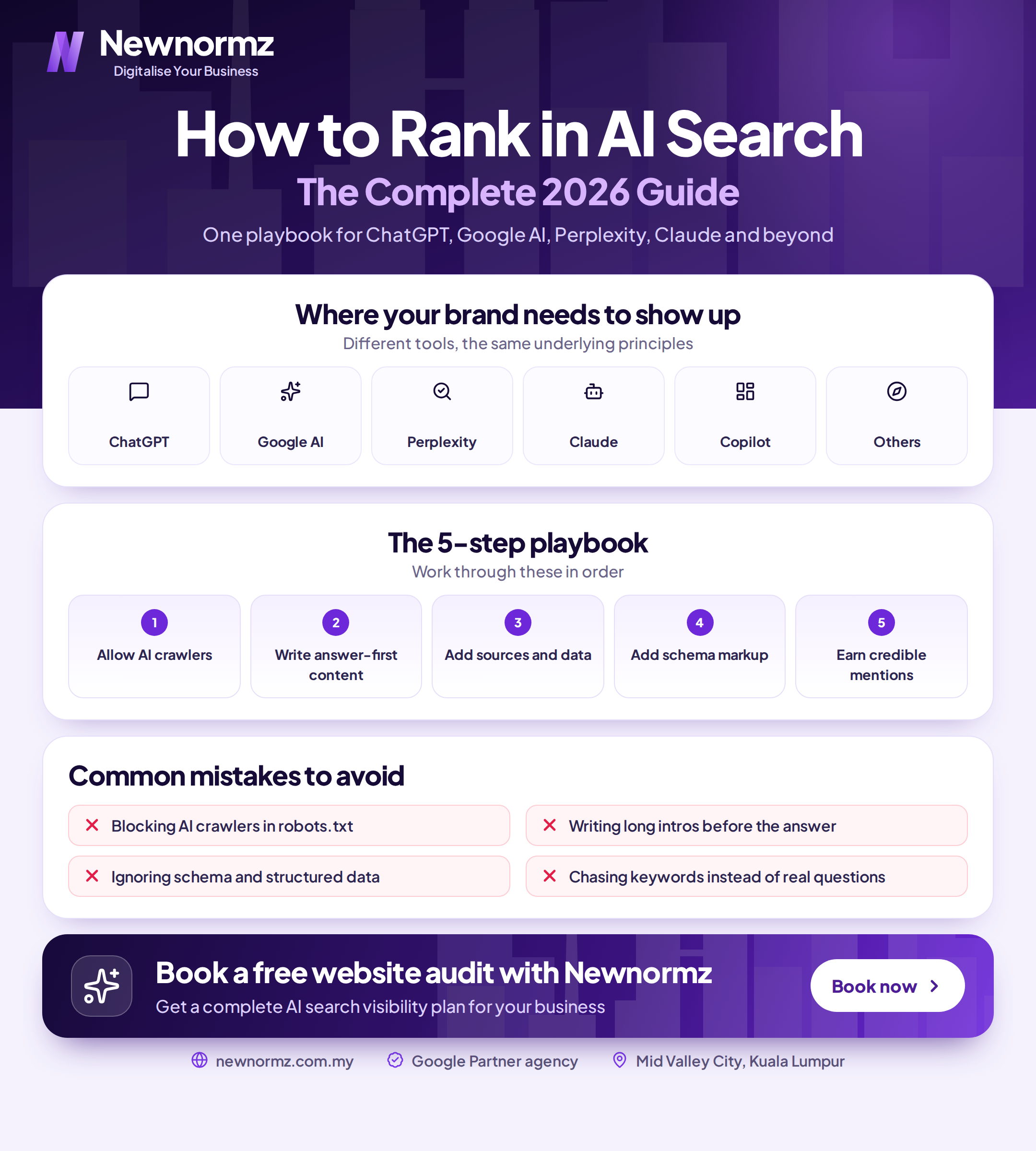
5 Core AI Search Ranking Factors to Build Sustainable Results
Sustainable AI visibility rests on five signals. Get these right and both traditional rankings and AI citations tend to follow.
| Factor | What It Means | Action for Malaysian SMEs |
|---|---|---|
| Entity clarity | AI maps your business to a knowledge graph | Use the same registered business name and category on your website, Google Business Profile, and directories |
| Direct-answer structure | AI extracts the clearest, most quotable sentence | Answer the reader’s question in the first two sentences under every H2 |
| Topical authority | AI trusts sites that cover one subject repeatedly | Publish a cluster of related service pages instead of one long page |
| Freshness | AI systems pull live data through retrieval | Update core service pages and pricing at least every quarter |
| Trust signals | AI checks for consistent, verifiable facts | Keep your business name, address, and phone number identical across every listing |
Newnormz’s SEO services team checks all five factors against your website before recommending a single fix, so nothing gets rebuilt that was never broken.
How to Rank in AI Search: A 7-Step Framework
Follow these seven steps in order. Each one builds on the last, and skipping ahead usually means redoing earlier work later.
1. Audit your current AI visibility
Type your top ten buyer questions into ChatGPT, Gemini, and Google to see which competitor gets cited for each one. This tells you exactly who you are up against before you change anything.
2. Restructure key pages around direct answers
Open every section with a two-sentence answer before adding supporting detail. AI systems tend to lift the clearest, most self-contained sentence on the page, so make sure that sentence exists.
3. Build topical clusters, not single pages
Group related service pages under one pillar page linked together with descriptive anchor text. A single page trying to cover everything rarely reads as authoritative to either Google or an AI model.
4. Add structured data
Apply Article, FAQPage, and LocalBusiness schema so AI systems can parse your page structure without guessing at it.
5. Strengthen local entity signals
Verify your Google Business Profile and keep your business details identical across Facebook, Instagram, and Malaysian directory listings. This is the same groundwork that local SEO has always required, and it now doubles as an AI trust signal.
6. Publish original data
Add local pricing benchmarks or project results that a competitor cannot simply copy from your page. Original numbers are harder to fake and easier for AI systems to treat as a primary source.
7. Track AI citations alongside rankings
Where available, review Search Console’s generative AI performance data each month to see how your AI Overview and AI Mode visibility is moving, not just your traditional rankings.
How Newnormz Helps Malaysian SMEs Rank in AI Search
Most SME teams do not have the time to review schema, entity consistency, and content structure across every page on their site, on top of running the business. Newnormz’s SEO team audits visibility across ChatGPT, Gemini, and Google AI Overviews, then hands over a prioritised fix list matched to the client’s actual budget and timeline, not a generic checklist.
As a digital marketing agency, Newnormz aligns SEO, content marketing, social media marketing, and web design under one strategy, so brand signals stay consistent across every channel instead of drifting apart, with reporting that shows what changed and why.
Rank Beyond Traditional Google Search
Malaysian SMEs that optimise only for traditional Google rankings are losing visibility as buyers turn straight to AI tools for direct answers and recommendations. Closing that gap takes an integrated SEO, content, and entity strategy built specifically for how Malaysian businesses are found today, not the playbook that worked five years ago.
Frequently Asked Questions About Ranking in AI Search
Why does my website rank on Google but stay missing from AI answers?
Traditional rankings and AI citations use overlapping but different signals. Checking answer clarity, page structure, schema markup, and entity signals usually finds the gap that a standard SEO report misses.
Which pages should a Malaysian SME optimise for AI search first?
Start with high-value service pages, product pages, and any cornerstone content tied to real customer questions. These are the pages most likely to get cited when someone asks a direct question.
Can a smaller business compete with established brands in AI search?
Yes. Specific, well-supported answers can outperform generic content from a bigger competitor, because AI systems are looking for clarity, not company size.
How soon can AI search visibility start improving?
Early citation changes can sometimes show up soon after priority pages are restructured, while broader authority and ranking gains typically develop over several months.
Can my internal team handle AI search optimisation?
Some of it, yes. A proper audit separates the practical in-house fixes from the technical, content, and entity work that may need specialist support.
What does a free website audit actually review?
A proper audit covers AI citations, on-page SEO, Core Web Vitals, schema coverage, and how consistent your business information is across key platforms.
Not sure where your site stands in AI search?
Find out if ChatGPT and Google AI Overviews are citing you or your competitor.
Newnormz has run SEO campaigns across F&B, healthcare, ecommerce, and local services in Malaysia, backed by a performance guarantee of 70 percent of targeted keywords on Google’s first page.
30 minutes, no obligation, includes an AI visibility check.

Bryan Tan is an SEO Specialist and CEO at Newnormz, helping hundreds of businesses achieve first-page rankings on Google. With a passion for driving organic growth, Bryan blends innovative strategies with hands-on experience to optimize websites for maximum visibility. Always at the forefront of the latest SEO insights and trends, he consistently adapts to the evolving digital landscape.