If you want quality backlinks in Malaysia, you earn them, you don’t buy them. Focus on digital PR and local media coverage, guest posts on sites your customers actually read, expert quotes for journalists, genuine partnerships with suppliers and industry bodies, listings in real Malaysian and Bahasa Malaysia or Chinese-language directories, and at least one linkable asset such as original data or a free tool. Vet every prospect on relevance, Domain Rating, and whether the site gets real organic traffic before you spend a minute on outreach, and never buy links or build a private blog network. The shortcut is never worth what it costs you when it’s caught.
Backlinks still decide who sits at the top of Google’s results. Backlinko’s analysis of 11.8 million search results found that the number one ranking page carries 3.8 times more backlinks than positions two through ten, and referring domains remain one of the strongest ranking signals anyone can measure. Yet roughly 94 percent of published content earns zero backlinks at all. With Google holding around 93 percent of the search market in Malaysia and internet penetration sitting at 98 percent, the businesses that put in the work to earn real links are the ones that end up outranking everyone else, quietly, over months, not overnight.
A Simple Way to Think About It
The Stranger vs. The Trusted Colleague
🗣️ The stranger on the street
Someone you’ve never met hands you a flyer and tells everyone nearby you’re the best in town. Nobody in the crowd changes their mind because of it.
🤝 The trusted colleague
Someone respected in your industry mentions your name unprompted, because you actually helped them once. People listen.
Google reads backlinks the same way. Below is exactly how to tell which kind you’re getting, and how to go earn more of the second kind.
What Makes a Backlink “Quality” in Malaysia
A quality backlink is an editorial link, given because your content is genuinely useful, from a site that’s relevant to your topic and trusted by Google. A link from a Malaysian F&B blog to your restaurant, or from a KL business publication to your agency, carries real weight. A link buried in the footer of an unrelated overseas directory carries almost none.
Links still matter because they’re votes Google struggles to fake. That’s also why the volume of links matters far less than where they come from. One link from a respected local source that actually sends you referral clicks is worth more than hundreds of low-value links, and it’s much safer. This is one reason link building sits inside a wider SEO service in Malaysia rather than as a one-off task: it only works when your content and technical foundation are strong enough to deserve the link in the first place.
Vet Every Link on Three Things
Score every prospect before you spend time on outreach. Get comfortable running these checks quickly using Ahrefs, Semrush, or a free tool from our guide to the best free SEO tools.
| Signal | What to check | Green light |
|---|---|---|
| Domain Rating (DR) | The site’s overall link authority in Ahrefs (0 to 100) | Equal to or higher than yours, ideally 20+ and rising |
| Relevance | Is the site’s topic related to yours or your Malaysian audience? | Same industry, adjacent niche, or same local market |
| Real traffic | Does the site actually get organic search traffic? | Steady monthly organic visits, not a flat zero |
Relevance and traffic together catch the biggest trap: a high-DR site with no organic traffic is usually a manipulated or dying domain, not a real opportunity. Run all three checks before you reach out, not after.
White-Hat Tactics That Actually Earn Links in Malaysia
These tactics work because they give the linking site a genuine reason to point at you, not because you asked nicely.
Digital PR and local media
Turn a story, a survey, or a milestone into something a Malaysian publication wants to cover. Digital PR is consistently rated the single most effective link tactic available, well ahead of standalone guest posting. Pitch business desks, industry portals, and local news sites with a genuine angle: a first-of-its-kind local data point, a comment on a trend, or a launch that actually matters to their readers.
Local, BM, and Chinese-language business directories
Get listed where Malaysian buyers and Google both look: your Google Business Profile, established local directories, and industry association pages. Add reputable Bahasa Malaysia and Chinese-language business listings and chamber-of-commerce directories that actually serve your market. These links won’t win any DR trophies, but they build the natural, geographically relevant foundation that local SEO in Malaysia depends on. Skip any directory that lists thousands of unrelated sites with no editorial control.
Guest posts on genuinely relevant sites
A guest post on a real Malaysian blog or industry site, approved by a human editor, is still white-hat. The line you never cross is paying for a “guest post network” or mass-publishing thin articles purely for the link. One well-placed article on a site your customers actually read beats ten on irrelevant blogs.
Expert quotes for journalists
Journalists and bloggers constantly need expert sources. Reply to relevant queries with a sharp, quotable answer and you earn a link from a strong domain. Placements like this typically carry a Domain Rating of 50 or higher, and replying within the first hour lifts your placement rate by more than 60 percent. Speed and a genuinely useful quote win here, not a long pitch.
Partnerships and co-marketing
Suppliers, clients, associations, and non-competing local brands all run websites that can link to you. Sponsor a local event, co-author a report, join an industry body, or swap a genuine case-study feature. Warm, relationship-based outreach converts at roughly 15 to 30 percent, against 1 to 3 percent for cold requests to strangers, so your existing network is your fastest source of quality links.
Linkable assets
Build one thing worth linking to: original Malaysian market data, a free calculator, a definitive local guide, or a template pack. Since 94 percent of content earns zero links, the few assets that genuinely help people become link magnets almost by default. That’s the difference between asking for a favour and offering something worth citing.
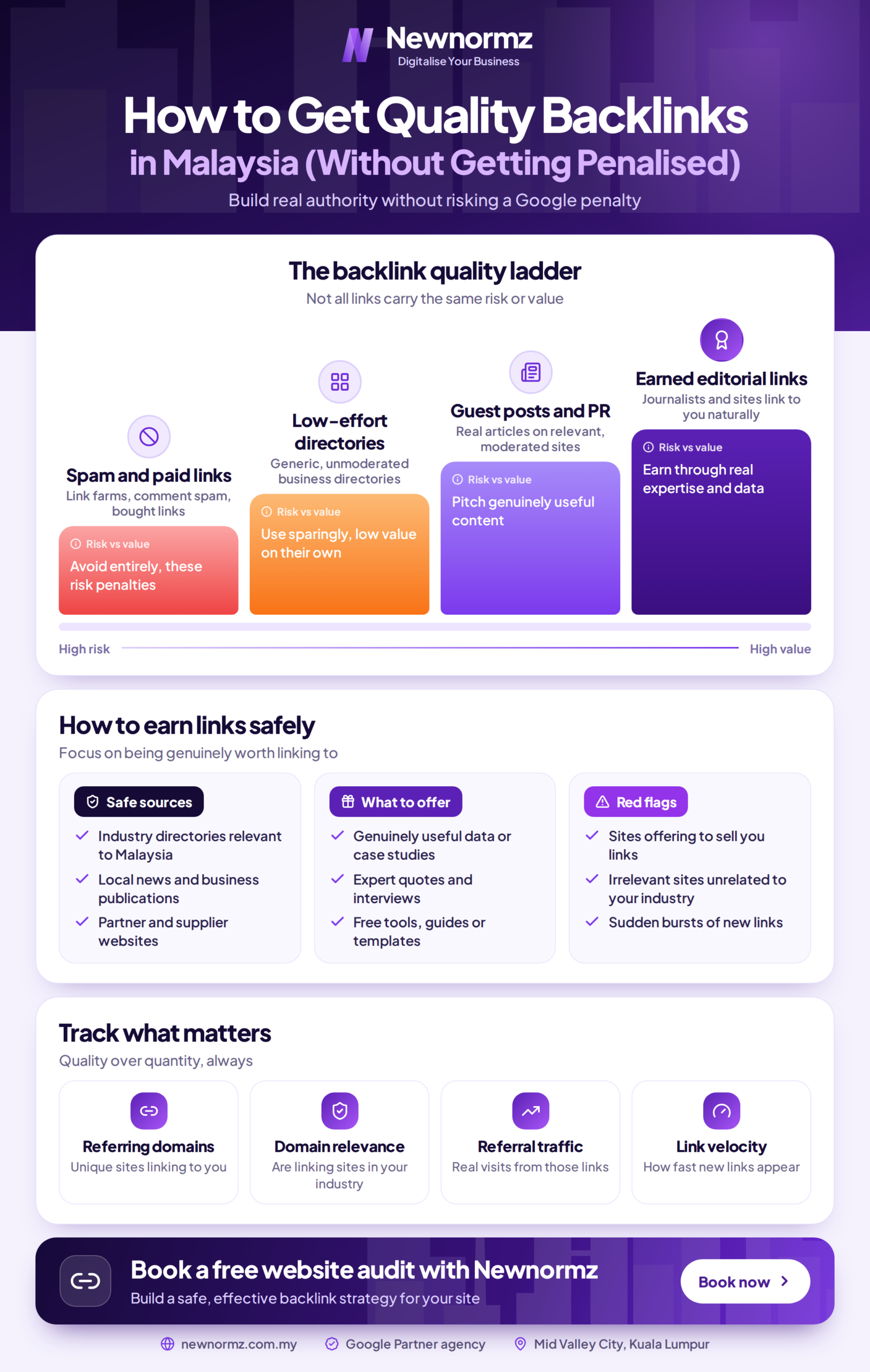
What to Avoid: Bought Links, PBNs, and Spam Schemes
The fastest way to undo months of honest work is to chase a shortcut. A few are especially common in Malaysia, where “cheap backlink packages” are still sold openly online.
| What’s being sold | Why it’s risky |
|---|---|
| Paid links that pass ranking value | Violates Google’s spam policies directly; a manual action can cut organic traffic by 50 to 90 percent and take 6 to 12 months to recover from |
| Private blog networks (PBNs) | Google’s spam-detection systems flag shared hosting, registration, and linking patterns; it’s a matter of when, not if, they’re caught |
| Mass link exchanges and spam directories | Large-scale “you link me, I link you” schemes and directories with no editorial control add risk without adding authority |
If a vendor promises hundreds of links for a flat fee in ringgit with no mention of relevance or editorial approval, treat it as a liability, not a deal. Slow, earned links are the only ones that stay put.
A Real Outreach Example: How One Link Gets Earned
Here’s a walkthrough using a hypothetical Petaling Jaya coffee roaster, “Kopi Rimba,” to show the repeatable unit you’d scale up.
1. Find a relevant local target. Kopi Rimba searches for Malaysian food and cafe blogs that already rank, and finds a KL lifestyle blog (DR 34, steady organic traffic) that recently published “Best Local Coffee Roasters in the Klang Valley” without mentioning sourcing at all.
2. Find the gap. The post explains where to buy beans but not how to tell fresh, locally roasted beans from stale imports. Kopi Rimba already has a short, genuinely useful guide on reading roast dates. That gap is the whole reason to reach out.
3. Send a short email, no essay. Subject: “A small add-on for your Klang Valley roasters post.” Body: “Hi Aisyah, loved your roundup of Klang Valley roasters, shared it with our team. One thing readers often ask us is how to tell fresh local beans from stale imports. We put together a quick guide on reading roast dates that might be a useful add-on for your readers: [link]. Either way, keep the great posts coming. Cheers, Wei from Kopi Rimba.”
4. Follow up once. No reply after five to seven days? One short, polite nudge: “Hi Aisyah, just floating this back up in case it’s useful for the roasters post, no worries if not.” One follow-up is enough; a third starts to read as spam.
5. Let the link land. Aisyah adds a line linking to the guide as a helpful resource. Kopi Rimba now has one relevant, traffic-backed link and a warm contact for the next story. Repeat this twenty times a month and the profile compounds on its own.
The link is a byproduct of being useful. That’s why the email leads with value, not a request.
Common Mistakes That Slow Down Link Building
Chasing DR and ignoring relevance. A DR 70 link from an unrelated site helps less than a DR 30 link from your exact niche.
Sending generic, templated outreach. Cold blasts convert at 1 to 3 percent; a personalised, relevant pitch is what earns the yes.
Having nothing worth linking to. Outreach with no linkable asset behind it is just asking for a favour.
Buying “cheap” link packages. The penalty risk far outweighs any short-term ranking bump.
Giving up after one send. A single follow-up often doubles your reply rate, and most people never send it.
The Backlink Quality Checklist
Run every prospect through this before you send a single email:
Is the linking site relevant to your topic or your Malaysian audience? Does it have a reasonable DR and, more importantly, real organic traffic? Is the link editorial, given because your content is genuinely useful? Would this link send you actual referral clicks, not just theoretical “SEO value”? Are you earning it, rather than buying it or trading it in a scheme? Do you have a linkable asset that gives the outreach a real reason to exist?
Frequently Asked Questions
How do I get backlinks if I’m just starting out?
Start with the easiest wins: your Google Business Profile, relevant local and industry directories, and any supplier, client, or association you already work with. In parallel, build one linkable asset, such as a local guide or free tool, then do short, personalised outreach to relevant Malaysian blogs. Warm contacts convert far better than cold ones, so use your existing network first.
How many backlinks do I need to rank?
There’s no fixed number; it depends on your competitors. Check how many referring domains the pages currently ranking for your keyword actually have, then aim to match their quality and relevance rather than chase a raw count. Ten relevant, high-traffic links usually beat a hundred weak ones.
Are paid backlinks worth the risk in Malaysia?
No. Paying for links that pass ranking value breaches Google’s spam policies, and a manual action can cut your organic traffic by 50 to 90 percent and take 6 to 12 months to recover from. The cheap packages sold locally are the highest-risk category. Put that budget into content and outreach that earns links safely instead.
What’s a good Domain Rating for a backlink?
There’s no magic threshold, but a useful rule is to target sites with a DR equal to or higher than yours that also have real organic traffic and topical relevance. A DR 30 site in your exact niche often beats a DR 70 site with no relevance. Always check traffic too, since a high DR with zero traffic usually signals a manipulated domain.
How long does link building take to show results?
Earned links take time, both to acquire and for Google to credit. Expect a few months of consistent outreach before rankings shift meaningfully, longer in competitive niches. This is normal, and it’s exactly why buying links looks tempting even though the shortcut carries penalty risk that a steady, earned profile avoids.
Should I build links myself or hire an agency?
You can start yourself with the tactics above, especially directories, expert quotes, and outreach to warm contacts. An agency helps once you need scale, digital PR relationships with Malaysian media, or a strategy that ties links to the pages that actually drive enquiries. If you’re unsure where the gaps are, a professional backlink audit is the fastest way to prioritise.
Strong content but still stuck on page 2?
Find out exactly which links are missing from your profile
Newnormz has run SEO campaigns across F&B, healthcare, ecommerce, and local services in Malaysia, backed by a performance guarantee of 70 percent of targeted keywords on Google’s first page.
30 minutes, no obligation, no jargon.

Bryan Tan is an SEO Specialist and CEO at Newnormz, helping hundreds of businesses achieve first-page rankings on Google. With a passion for driving organic growth, Bryan blends innovative strategies with hands-on experience to optimize websites for maximum visibility. Always at the forefront of the latest SEO insights and trends, he consistently adapts to the evolving digital landscape.