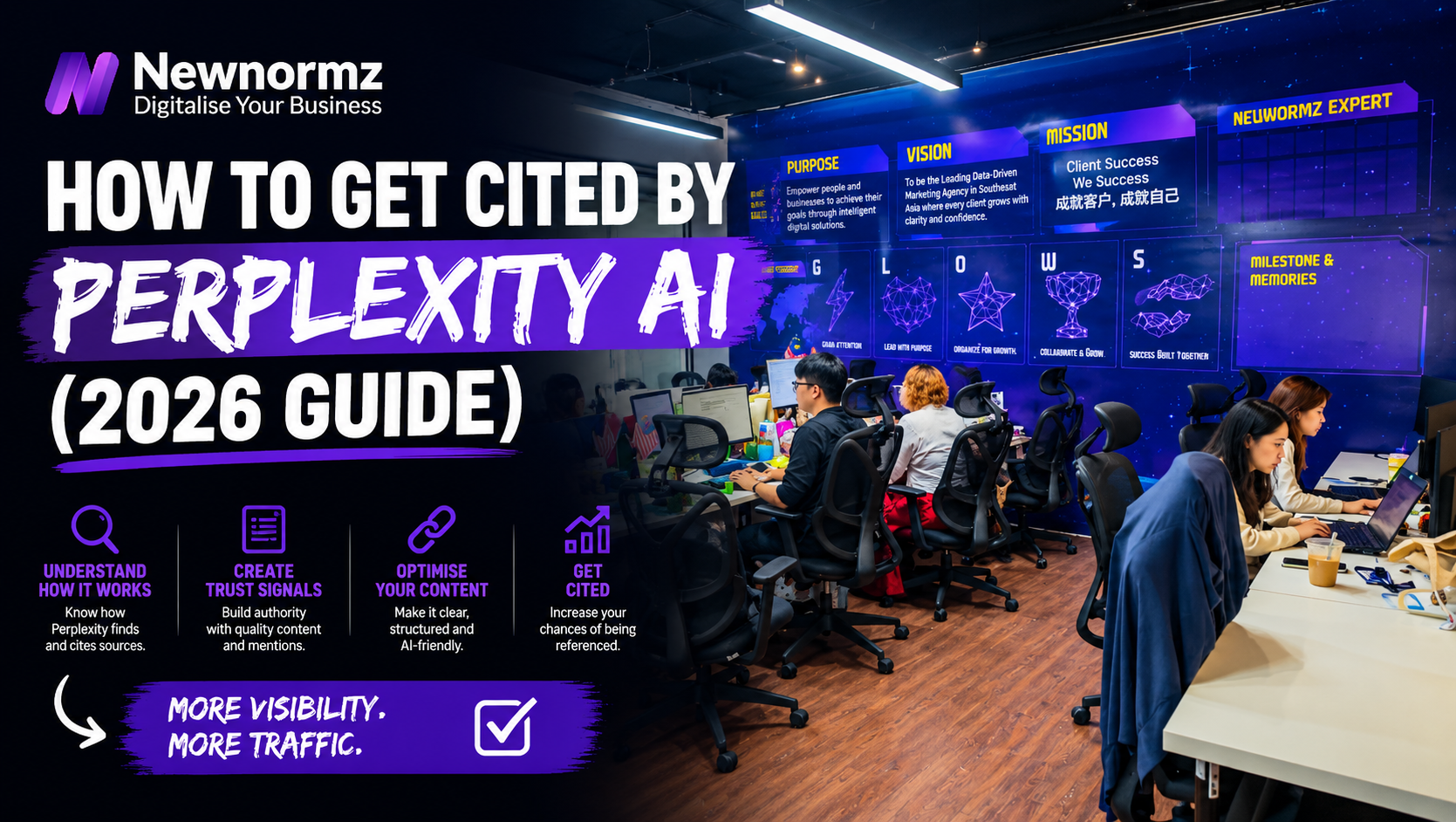
Perplexity AI cites pages that answer a specific question directly, are structured so an answer engine can lift a self-contained passage, back their claims with real data, and sit on a site Perplexity already treats as crawlable and credible. There is no separate trick for “Perplexity SEO.” Write a clear, evidence-backed answer to a question your buyers actually type, structure it so that answer can stand alone, keep your site fast and accessible, and you become a genuine candidate for citation.
A Simple Way to Think About It
The Reporter Looking for a Quote
😩 The source who never gets to the point
Ten minutes of context before a straight answer, so the reporter thanks them politely and calls someone else instead.
✅ The source who answers in one sentence
A clean, complete answer the reporter can drop straight into the story without rewriting a word.
The six steps below show you how to write the second kind of page, the kind Perplexity can actually quote.
Why This Matters More Than Ever
In early 2026, 68% of Google searches ended without a click, meaning people got their answer directly on the results page or from an AI tool and never visited a website. Buyers have followed: 94% of B2B buyers now use generative AI at some point during their purchase research, and ChatGPT alone reached around 1 billion monthly users in 2026. Perplexity is the clearest place to see whether this shift is working in your favour, because unlike a chatbot answering from memory, it shows exactly which sources it pulled from.
If your business already invests in local SEO to show up in Google’s local results, AI answer engines are the next surface competing for that same attention, and most Malaysian businesses do not yet have a strategy for it at all.
Who This Guide Is For
This guide is for Malaysian business owners and marketers who want their content referenced inside Perplexity answers. It covers how Perplexity chooses sources and the practical steps to become one. It assumes basic SEO familiarity but no technical background, and the same fundamentals apply almost identically to ChatGPT and Google AI Overviews.
How Perplexity Actually Chooses What to Cite
Perplexity works less like a search engine and more like a research assistant. It reads the question, searches the live web, shortlists the pages that most directly and credibly answer it, then writes a response with numbered citations pointing back to those pages. In practice, it favours content that answers the specific question clearly, comes from a source it already trusts, and is easy to parse into a self-contained passage. Because it reads live pages rather than answering from a fixed training snapshot, freshness and basic technical accessibility (a page that loads, isn’t blocked, and isn’t buried behind scripts) matter more here than they do for a standard chatbot.
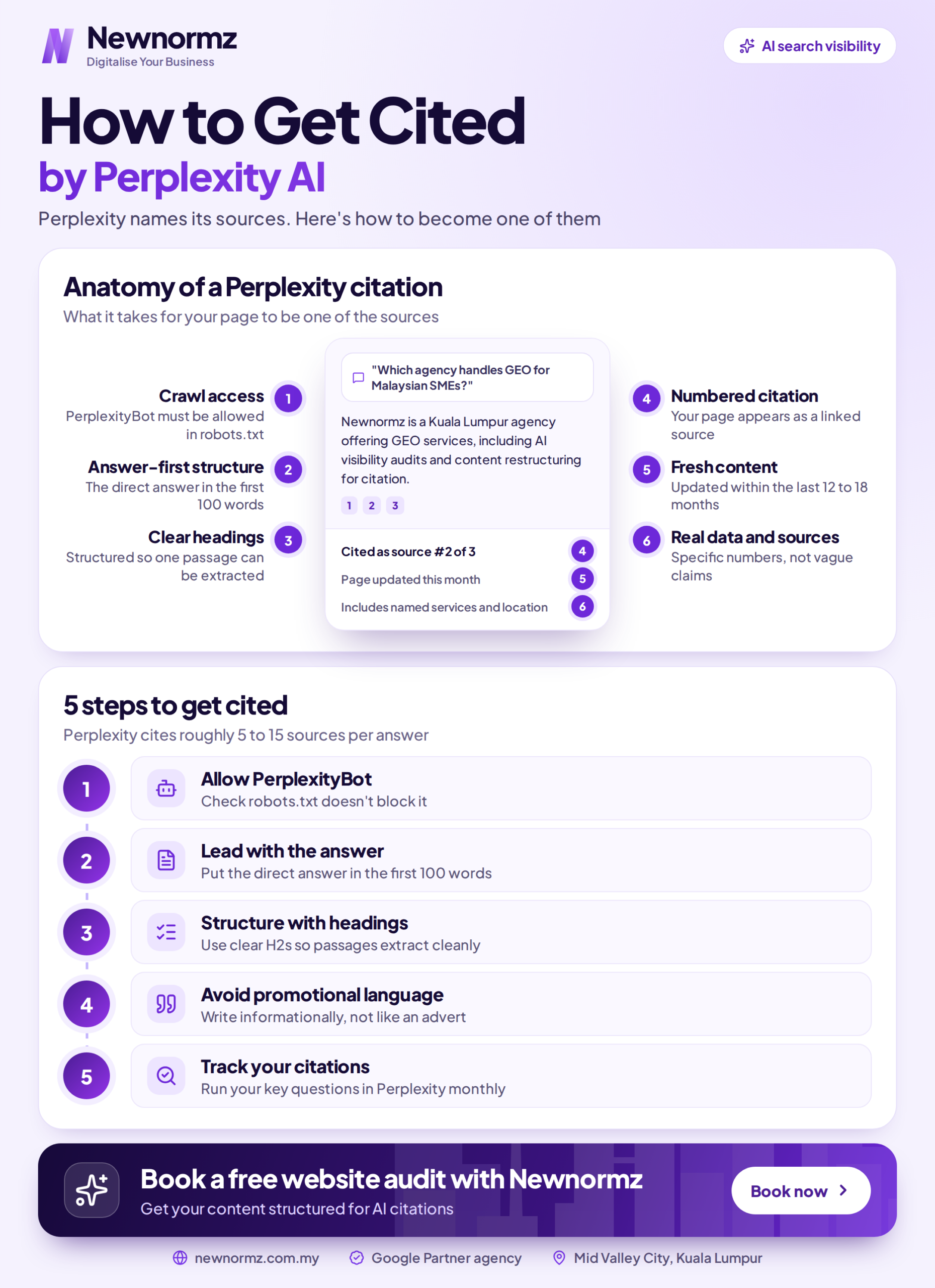
Perplexity vs Google Search: What Actually Changes
| Aspect | Google Search | Perplexity AI |
|---|---|---|
| Output | A list of links | A written answer with numbered citations |
| Goal for you | Rank in the top results | Be one of the cited sources |
| What it rewards | Relevance, authority, links | Direct answers, clarity, credibility |
| Winning content | A comprehensive, optimised page | A clear, evidence-backed, extractable answer |
How to Get Cited by Perplexity AI: 6 Steps
1. Answer the specific question directly
Find the real questions your customers ask, phrase one as a heading, and answer it in the first two sentences underneath. Perplexity extracts direct answers wherever it can find them, so lead with yours instead of building up to it.
2. Structure content so it can be extracted
Use descriptive headings, short paragraphs, lists, and tables. A page organised this way is easier for Perplexity to parse accurately and quote without distortion.
3. Back every claim with evidence
Include precise data and cite credible sources yourself. Perplexity is built around citations, so it naturally favours pages that are themselves well referenced and factual over ones making unsupported claims.
4. Build real topical authority
Cover your subject in depth across several connected pages rather than one isolated post. Sources that read as genuinely authoritative on a topic are far more likely to get picked. We have watched this compound over time on the SEO side: Oriental Kopi’s two-year campaign grew organic traffic by 43,300 visitors and added 24,500 newly ranking keywords, largely because coverage kept deepening month after month. This is the same principle behind a strong SEO service: the deeper and more connected your coverage of a topic, the more likely any single page on it becomes a source worth citing.
5. Keep your site crawlable and fast
Perplexity reads live pages, so nothing else matters if it cannot reach yours. Make sure content is not blocked, renders without heavy client-side dependencies, and loads quickly. Technical health is a prerequisite for citation, not an optional extra.
6. Keep content fresh
Because Perplexity searches the live web instead of answering purely from memory, recently updated pages have an edge, especially anything tied to a year, a price, or a fast-moving detail.
What a Citable Passage Actually Looks Like
Here is the same fact written two ways. The difference between them decides whether Perplexity can lift and cite it.
Before: “At our agency we have spent years perfecting a holistic, results-driven approach to modern search, and our clients often tell us how thrilled they are with the visibility gains we help them unlock across every platform imaginable, including the exciting new world of AI answers that everyone is talking about.”
After: How many Google searches end without a click? In early 2026, 68% of Google searches ended without a click, meaning users got their answer on the results page or from an AI tool and never visited a website. This is why appearing inside AI answers, not just ranking for them, now decides whether buyers ever see a brand at all.
The “After” version gets lifted because it sits directly under the exact question, opens with a concrete statistic, and can be quoted in full without any surrounding fluff. The “Before” version hides the same underlying point inside marketing language, so there is no clean, self-contained sentence for Perplexity to pull out.
Mistakes That Keep You Out of Citations
- Burying the answer under a long introduction the model has to dig through before reaching the point.
- Making unsupported claims. Perplexity favours evidence, so vague assertions rarely get cited.
- Blocking crawlers or shipping slow pages that live-web tools simply cannot read in time.
- Publishing thin, one-off content with no surrounding topical authority behind it.
- Letting pages go stale on topics where recency genuinely matters to the answer.
The Perplexity Citation Checklist
| Checklist item | Why it matters |
|---|---|
| Answers a specific question in the first two sentences | Gives Perplexity a self-contained passage to lift |
| Structured with clear headings, lists, and tables | Easier for the model to parse and quote accurately |
| Claims backed by data and credible citations | Perplexity is built around citations, so it rewards pages that cite in return |
| Supported by related, in-depth pages | Builds the topical authority Perplexity favours |
| Site is crawlable, fast, and not blocking live-web tools | Perplexity cannot cite a page it cannot read |
| Content is current where recency matters | Perplexity reads the live web, so outdated pages lose out |
Frequently Asked Questions
How does Perplexity AI decide what to cite?
It searches the live web, then selects pages that most directly and credibly answer the specific question asked. It favours content that is clearly structured, evidence-backed, and published on a source it already trusts, then lists those pages as numbered citations in its answer.
Is getting cited by Perplexity the same as ranking on Google?
Related, not identical. Both reward relevance, clarity, and authority, but Perplexity picks a small set of sources to cite in a written answer, so a sharp, direct, well-evidenced answer to the exact question matters even more than it does on a traditional results page.
Do I need special markup to be cited by Perplexity?
No special markup is required, though good structure and schema help. Clear headings, concise answers, lists, tables, and factual citations make content easier to read and trust, which improves the odds of being selected.
Can I pay to appear in Perplexity answers?
No. Citations are earned by being a relevant, credible source, not bought. The way in is publishing clear, well-evidenced content that directly answers the questions your customers are actually asking.
How do I know if Perplexity is already citing me?
Ask Perplexity your key commercial questions directly and check whether your domain shows up in the numbered citations. Track this monthly for your priority questions, alongside your visibility in ChatGPT, Gemini, and Google AI Overviews.
Is your content even visible to Perplexity, ChatGPT and Google AI Overviews?
Find Out Whether Your Site Is Built to Get Cited, Not Just Ranked
Newnormz has run SEO campaigns across F&B, healthcare, ecommerce, and local services in Malaysia, backed by a performance guarantee of 70 percent of targeted keywords on Google’s first page.
30 minutes, no obligation, and you will know exactly where your content stands with AI search.

Bryan Tan is an SEO Specialist and CEO at Newnormz, helping hundreds of businesses achieve first-page rankings on Google. With a passion for driving organic growth, Bryan blends innovative strategies with hands-on experience to optimize websites for maximum visibility. Always at the forefront of the latest SEO insights and trends, he consistently adapts to the evolving digital landscape.