AI search engines such as Google AI Overviews, ChatGPT Search and Perplexity work in three steps: they use a language model to understand what you’re actually asking, they pull in current information from the web, and they write a single answer instead of handing you ten blue links. For a Malaysian SME, that changes the game. Ranking on page one no longer guarantees a click, because a customer might get their answer, and see your competitor’s name in it, without ever visiting your website.
A Simple Way to Think About It
The Shop With No Sign vs The Shop the Guide Recommends
😶 The Shop With No Sign
A genuinely good shop, tucked down a street, with no sign outside. People walk right past it every day, not because it isn’t good, but because they never knew it was there.
📣 The Shop the Guide Recommends
A tour guide who stops the group, points at one specific shop, and tells everyone exactly why it’s worth walking into. Nobody needs to keep looking after that.
The rest of this article looks at what makes an AI system pick one business to point at, and what that means if you run an SME in Malaysia.
What Is an AI Search Engine?
An AI search engine uses a large language model (LLM), natural language processing, and a technique called retrieval-augmented generation (RAG) to produce one written answer instead of a results page. Google AI Overviews, ChatGPT Search, Microsoft Copilot and Perplexity all work this way.
Traditional Google Search matches keywords and ranks pages using backlinks and on-page signals, then leaves you to click through and read. An AI search engine instead tries to understand what a Malaysian SME owner actually needs, such as “best accounting software for a small retail business” or “how SST affects my invoicing,” and answers the question directly on the results page.
How AI Search Engines Actually Work
Strip away the branding and every AI search system runs through the same three steps.
1. Understanding intent
The language model reads your query for meaning, not just keywords. It works out whether you’re comparing options, looking for a price, or trying to solve a problem.
2. Retrieving current information
When the query needs up-to-date facts, the system searches the web and pulls in sources it considers reliable and relevant, rather than relying only on what the model was originally trained on.
3. Generating a response
The model combines what it retrieved into a single written answer, often citing a small number of sources. Google’s AI features may run several related searches behind the scenes before producing that answer, a process sometimes called query fan-out. ChatGPT Search works similarly, pairing its answer with source links.
| Factor | Traditional Search | AI Search |
|---|---|---|
| How it answers | A ranked list of links | One synthesised, written answer |
| What earns visibility | Backlinks and keyword matching | Clear structure and facts an AI can cite directly |
| Typical answer length | Ten blue links | Around 119 words on desktop, 91 on mobile* |
| Click behaviour | User visits multiple sites | Many users read the answer and never click through |
| Where SME visibility comes from | A page-one ranking | Being one of the sources the AI chooses to cite |
*Based on Semrush’s analysis of 200,000 Google AI Overview results.
OpenAI reported over 2.5 billion ChatGPT messages a day by July 2025, and over 900 million weekly users by February 2026, up from roughly 400 million a year earlier. That is a lot of queries that now bypass a traditional results page entirely.
Why This Matters for Malaysian SMEs
Being cited now matters as much as ranking. In Semrush’s study of 200,000 AI Overview results, the top organic result appeared in only 46% of desktop AI Overviews and 34% on mobile. A page-one ranking does not guarantee your business gets included in the answer.
AI Overviews show up mostly for informational queries, the research people do before choosing a product or service. In the same Semrush sample, that accounted for 80% of desktop results and 76% of mobile results. But commercial searches are catching up fast: the share of AI Overview queries with clear commercial intent rose from 8.15% to 18.57% between October 2024 and October 2025.
Malaysia is a heavily search-driven market to begin with. The country had roughly 35.4 million internet users and 98% internet penetration at the end of 2025, and Google still holds around 93% of the search market share here as of May 2026. When a search engine that dominant starts answering questions directly instead of listing links, SMEs that only optimise for rankings, and not for being the source an AI actually quotes, start losing visibility they can’t easily see in their analytics.
Where Newnormz Fits In
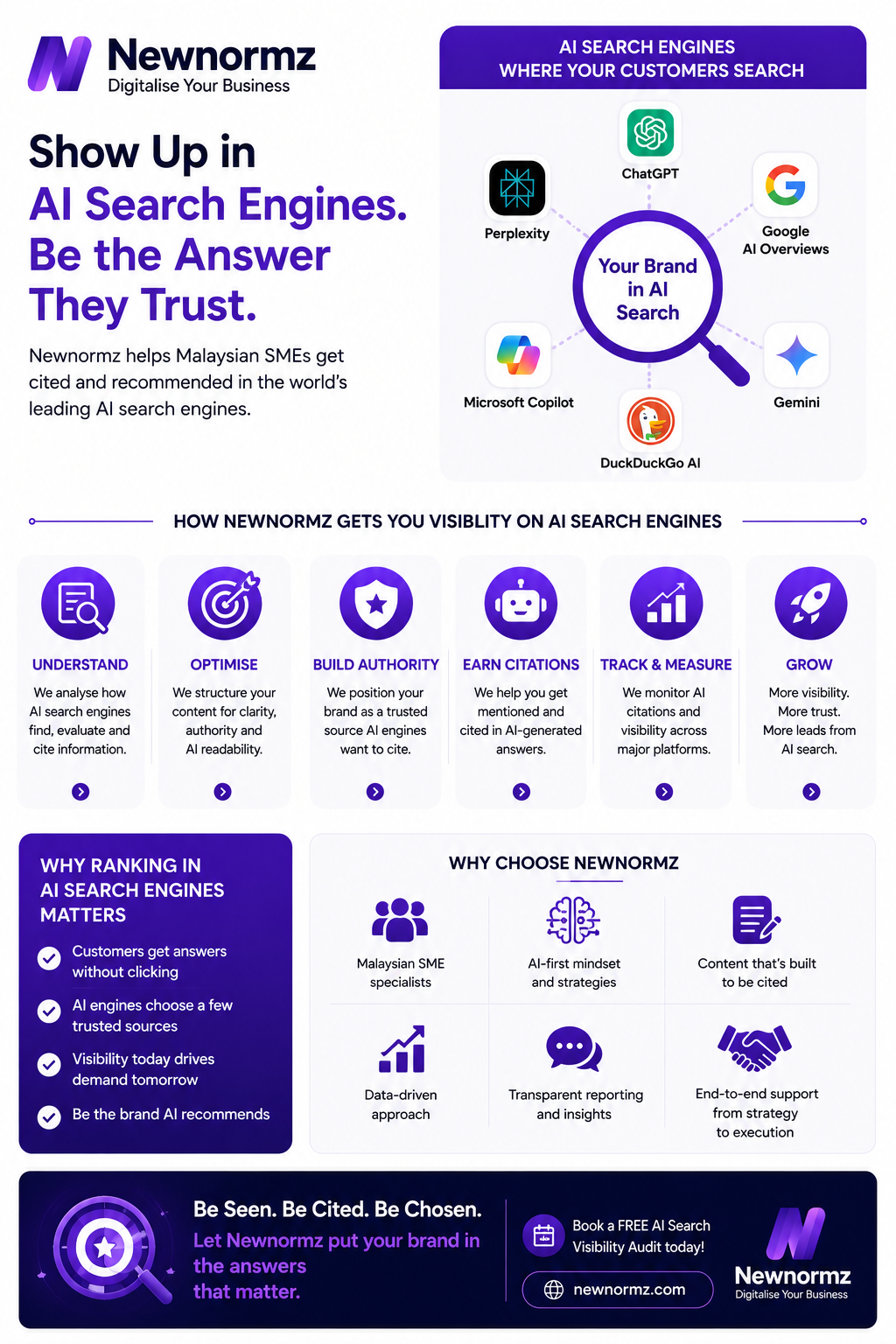
Turning this into something actionable means treating AI visibility as an extension of good SEO service work, not a separate discipline. That means clean technical foundations, content structured so an AI system can lift a clear answer out of it, and consistent business information that AI models can trust enough to cite. For SMEs competing on local SEO terms, such as a specific service in a specific Malaysian city, this matters even more, since AI answers to local queries tend to draw from a small pool of consistently well-structured sources.
None of this replaces the basics. Indexing, internal linking and credible content still have to be right before any AI-specific optimisation can work.
Frequently Asked Questions
Is AI search replacing Google Search for Malaysian users?
Not yet, and not entirely. Google still handles the vast majority of searches in Malaysia. What’s changing is that a growing share of those searches now return an AI-generated answer at the top of the page, which is why both matter together rather than one replacing the other.
Do I still need SEO if AI search engines write the answer?
Yes. AI search engines still pull their answers from indexed, crawlable websites. Weak technical SEO or thin content means there’s nothing worth citing in the first place, regardless of how good your product is.
How do AI search engines decide which website to cite?
They favour sources that answer a question clearly, are structured in a way that’s easy to extract from, and show consistent signals of credibility across the web. There’s no fixed formula published by any provider, so this is closer to an educated, evidence-based practice than an exact science.
Does ChatGPT Search work the same way as Google AI Overviews?
Broadly, yes: both retrieve current sources and generate an answer. The details differ, such as how each system decides when to search the live web versus rely on its training data, but the underlying goal is the same for both.
Can a new website get cited in AI search results?
It’s harder, since AI systems tend to lean on sources with an established track record. It isn’t impossible, but a newer site usually needs stronger technical foundations and clearer, more directly quotable content to compete for the same citation.
Is your business visible in AI search results, or invisible?
Find Out Where You Actually Stand in Google and AI Search
Newnormz has run SEO campaigns across F&B, healthcare, ecommerce, and local services in Malaysia, backed by a performance guarantee of 70 percent of targeted keywords on Google’s first page.
30 minutes, no obligation, including a check on your current AI search visibility.

Bryan Tan is an SEO Specialist and CEO at Newnormz, helping hundreds of businesses achieve first-page rankings on Google. With a passion for driving organic growth, Bryan blends innovative strategies with hands-on experience to optimize websites for maximum visibility. Always at the forefront of the latest SEO insights and trends, he consistently adapts to the evolving digital landscape.