Digital marketing trends in 2026 for Malaysian SMEs come down to one shift: artificial intelligence now sits between your business and your customer at almost every stage of the buying journey, deciding what shows up in Google’s AI Overviews, what TikTok’s algorithm surfaces first, and what a chatbot recommends when someone asks for a supplier. The businesses that adapt, by writing content AI systems can actually cite, showing up in short-form video and social commerce, and collecting first-party customer data instead of depending only on cookies, are the ones that stay visible while competitors lose ground. This is not a call to chase every new platform. It is a call to get the fundamentals right, since those are exactly what both humans and AI systems reward: clear answers, fast sites, and a direct way to reach your own customers.
A Simple Way to Think About It
Being Listed vs Being Recommended
🛑 Paying for a Billboard No One Sees
Buying a billboard on the busiest highway in town, except every car on that highway now drives itself, and the passenger hasn’t looked up from their phone in years.
✅ Being the Answer Before They Ask
Being the exact shop the car’s own assistant already suggests before the passenger even thinks to ask where to stop.
That’s the practical difference between old-style SEO and the AI-era approach Malaysian SMEs need in 2026, starting with why AI Overviews are changing what a “good ranking” even means.
What’s Actually Changed in Malaysian Digital Marketing for 2026
A digital marketing trend is only worth acting on if it changes how your customers actually find you. In 2026, the biggest force behind those changes is generative AI, which now inserts itself between a business and its customer at nearly every stage of search, social discovery, and even after-sales support.
The stakes are already high in Malaysia. Micro, small, and medium enterprises make up 96.1% of business establishments and contribute 39.5% of the country’s GDP, and the Department of Statistics Malaysia found that 98.3% of individuals used the internet in 2025. Almost every customer an SME is trying to reach is already online, comparing options across Google, social platforms, and now AI tools, before they ever pick up the phone. Staying visible across all three is no longer optional, which is exactly the gap a focused SEO service is built to close.
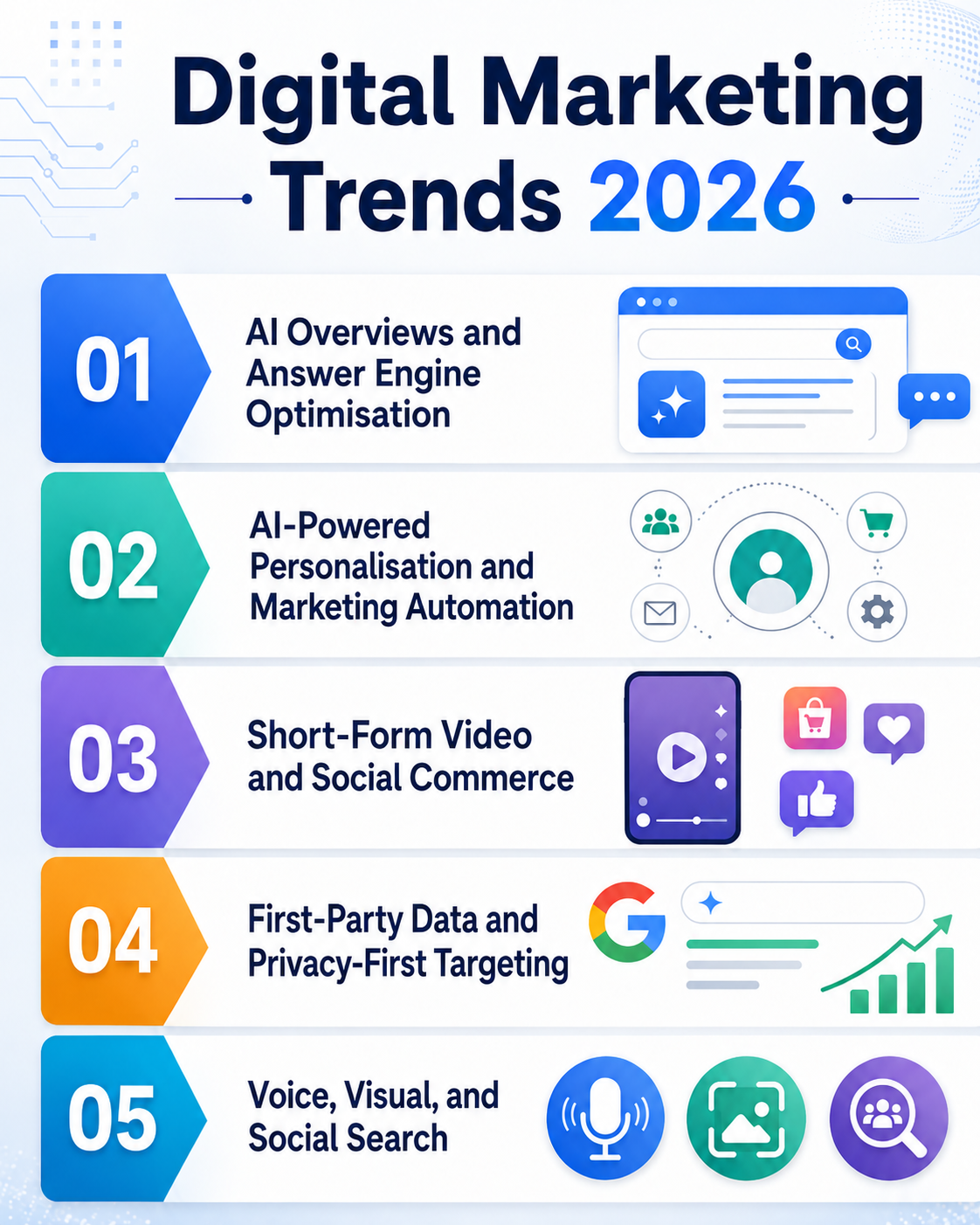
Trend 1: AI Overviews and Answer Engine Optimisation Replace Clicks
Google’s AI Overviews and AI Mode now answer many informational searches directly on the results page, before a user ever scrolls to a blue link. A Malaysian SME that only tracks traditional keyword rankings can be doing “fine” on paper while quietly losing visibility inside these AI-generated answers.
Answer Engine Optimisation (AEO) is the practice of structuring content so AI systems can understand it and cite it: direct answers near the top of a page, clear headings, useful FAQ sections, and schema markup that tells search engines what the content actually is. It builds on the same technical foundation as traditional SEO; it just adds a second audience (the AI system reading the page) alongside the human one.
None of this replaces sound SEO. It’s applied on top of existing service pages and blog content, which is why AEO work usually shows up as part of ongoing technical SEO rather than as a separate line item.
Trend 2: AI-Powered Personalisation and Marketing Automation at SME Scale
AI-driven personalisation, once only affordable for large advertisers, is now built into the tools most Malaysian SMEs already use. Meta Ads Manager and Google Ads can generate multiple ad variations, test them automatically, and adjust bids and delivery in real time.
Faster testing is genuinely useful, but it doesn’t remove the need for judgment. AI can produce a dozen ad versions in minutes; deciding which insight actually supports the business goal, whether that’s leads, sales, or a lower cost per acquisition, still needs someone who understands the client’s margins and sales cycle, not just the platform’s optimisation target.
Trend 3: Short-Form Video and Social Commerce Drive Discovery
Short-form video has become a genuine discovery channel in Malaysia, not just an entertainment format. A growing share of consumers now use TikTok and Instagram Reels to search for products and services the way they’d previously have used Google.
The scale is hard to ignore: TikTok’s own advertising tools showed a potential reach of 30.7 million Malaysian adults in late 2025. Social commerce features like TikTok Shop and Instagram Shops then close the loop, letting a customer discover and buy a product without leaving the app.
For an SME with no in-house content team, the practical takeaway isn’t “post more.” It’s picking a small number of formats that match how the target customer actually searches, and being consistent about it.
Trend 4: First-Party Data and Privacy-First Targeting Replace Cookies
Third-party tracking keeps getting less reliable. Safari blocks third-party cookies by default, Firefox limits tracking cookies, and Chrome now gives users more control over the ones it allows. Ad platforms that used to lean on cross-site tracking are adjusting accordingly.
That makes first-party data, the kind collected directly through a business’s own website, email list, or loyalty programme, more valuable than it used to be. An SME with an opt-in email or WhatsApp list can reach its customers directly, without depending entirely on a paid platform’s algorithm. Any business collecting this data in Malaysia still needs to follow the PDPA’s consent, notice, security, and retention requirements; first-party data collection doesn’t remove that obligation, it just makes doing it properly worth the effort.
Trend 5: Voice, Visual, and Social Search Reshape Keyword Strategy
As more Malaysians search by voice, by image, or by typing full questions instead of short keywords, a keyword list built only around two or three-word phrases starts to miss real search behaviour.
| Search Approach | Traditional SEO Focus | AI-Era Approach |
|---|---|---|
| Query type | Short, generic keywords | Long-tail, conversational questions |
| Content format | Keyword-heavy paragraphs | Direct answers, FAQ structure, tables |
| Platform scope | Google search only | Google, TikTok search, visual search, AI chat |
| Success metric | Ranking position | Citation in AI answers, plus ranking position |
In practice, that means researching both the short keyword and the fuller question behind it, then writing content that can satisfy both at once.
How Newnormz Approaches the AI Shift
Plenty of Malaysian SMEs already spend on marketing and still see few measurable leads. That’s usually not an effort problem; it’s a coordination problem between SEO, social, and the website that’s supposed to convert the traffic both bring in.
The fundamentals haven’t actually changed as much as the trend headlines suggest. Sunway Medispa’s six-month SEO campaign with Newnormz delivered a 700% increase in traffic and 70% more ranking keywords, built on the same technical foundation (clear content, solid site structure, real keyword research) that now also happens to be what AI systems reward. Adapting to AI Overviews and answer engines is less about abandoning SEO and more about extending it to a second audience.
Newnormz reviews AEO readiness, Core Web Vitals, and indexation issues as part of its technical SEO work, and prioritises fixes by potential impact rather than handing over a generic checklist.
Which digital marketing trend should a Malaysian SME prioritise first in 2026?
Start with AI-ready SEO and AEO content, since search is still where most buying decisions begin, and it’s the foundation the other trends build on.
Do I need to be on TikTok if my customers are mostly older or B2B?
Not necessarily. Short-form video works best where the buying decision is visual or impulse-driven; a B2B or older audience is often still better served by search and email.
Does AEO replace the need for traditional SEO?
No. AEO is built on top of solid technical SEO; a page that isn’t indexed properly or loads slowly won’t get cited by an AI system either.
Is it worth collecting first-party data if I already run paid ads?
Yes. An opt-in email or WhatsApp list gives you a way to reach customers directly, so a platform’s algorithm or rising ad costs affect you less.
How fast can these changes show measurable results?
It depends on your site’s current condition and competition, which is why realistic milestones should come after a technical audit, not before one.
Not sure where your site stands in the AI shift?
Find Out If Your Business Is Ready for AI-Era Search
Newnormz has run SEO campaigns across F&B, healthcare, ecommerce, and local services in Malaysia, backed by a performance guarantee of 70 percent of targeted keywords on Google’s first page.
30 minutes, no obligation, and a prioritised fix list before you commit any budget.

Bryan Tan is an SEO Specialist and CEO at Newnormz, helping hundreds of businesses achieve first-page rankings on Google. With a passion for driving organic growth, Bryan blends innovative strategies with hands-on experience to optimize websites for maximum visibility. Always at the forefront of the latest SEO insights and trends, he consistently adapts to the evolving digital landscape.