The best time to post on social media Malaysia SMEs can start testing this week is weekday lunch (12pm to 2pm MYT) and after dinner (8pm to 10pm MYT). LinkedIn usually does better on weekday mornings before 9am. TikTok picks up in the evening and late at night, from about 9pm to midnight. These windows are guesses for you to test, not rules. Your own audience data will beat any chart, including ours. Timing also matters less than most guides suggest, because what happens in the first hour after you post matters more than the minute you press publish.
This guide is for Malaysian SME owners and social media managers whose reach is falling. By the end you will have starting times for each platform and a 4-week test that finds your own best slots, without paying anyone.
Best Time to Post on Social Media Malaysia: Starting Windows by Platform
Most “best time” charts online average out global accounts, so they follow American or European routines. The windows below follow Malaysian ones: scrolling on the LRT or in Grab rides in the morning, a phone at the lunch table, the long scroll after dinner, and late-night TikTok. They come from our team’s experience running Malaysian accounts, not from a published Malaysian dataset. Use them as your first round of tests.
| Platform | Starting windows to test (MYT) | Best days to test first | What decides reach more than timing |
|---|---|---|---|
| 12pm to 2pm, 8pm to 10pm; weekends 9am to 11am | Tuesday to Thursday, Saturday morning | Shares into WhatsApp and family groups, first-hour comments | |
| Instagram (feed and Reels) | 12pm to 1:30pm, 8pm to 11pm | Wednesday to Friday, Sunday evening | Reels hook, saves and shares; Stories timing |
| TikTok | 7pm to 12am | Thursday to Sunday | Hook rate and watch time |
| 7:30am to 9am, 12pm to 1pm, 5pm to 6pm | Tuesday to Thursday | Comments from the right people, posts from personal profiles | |
| YouTube Shorts | 6pm to 10pm | Friday to Sunday | Search, suggested viewing and a steady upload rhythm |
| Xiaohongshu | 8pm to 11pm | Weekday evenings, weekends | Search keywords in the title and note, cover image |
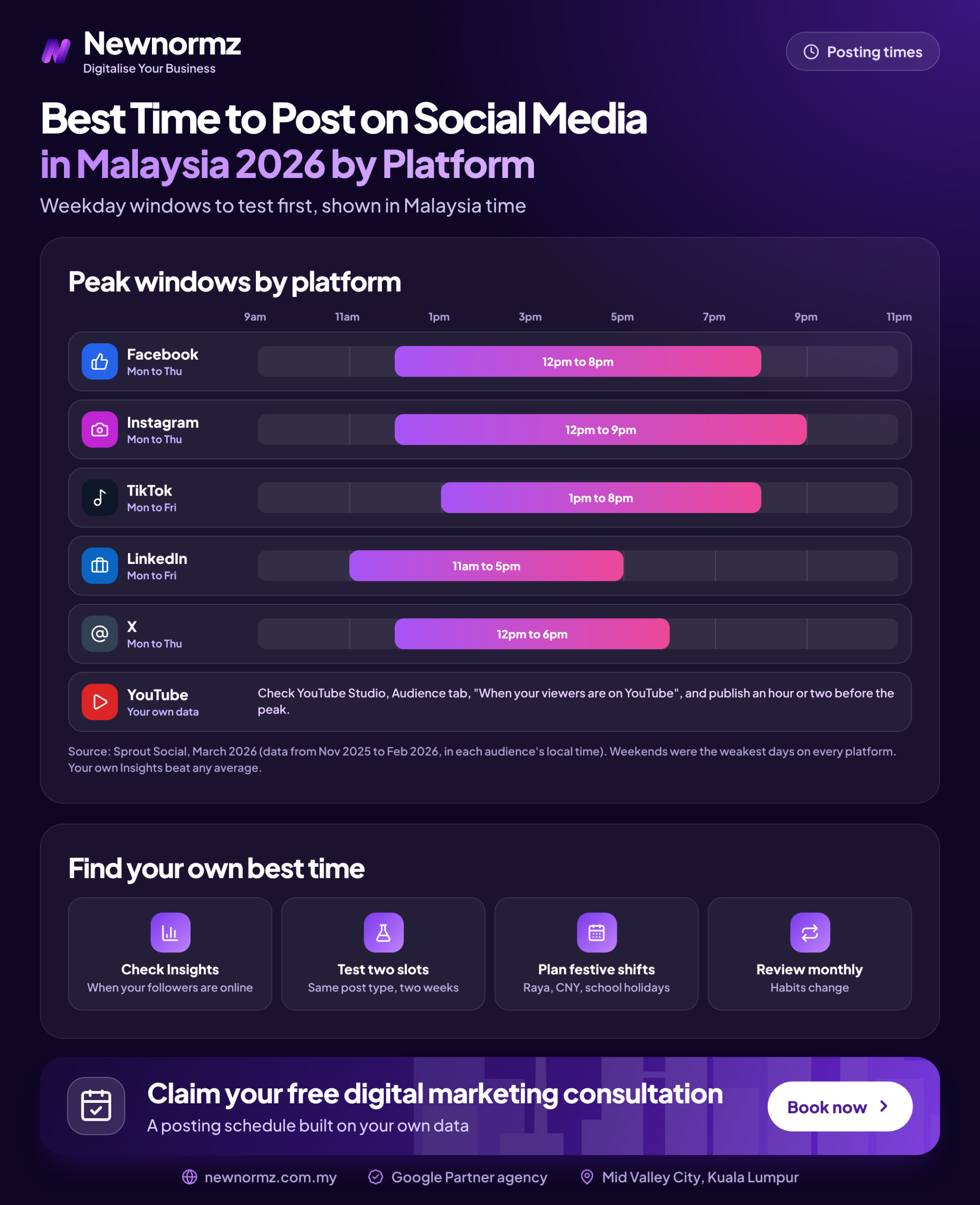
Best Time to Post on Facebook Malaysia (and Why Older Decision-Makers Change It)
Facebook is still where many Malaysian parents and family decision-makers spend time, and they do not scroll on the same schedule as a 24-year-old. They tend to check Facebook after dinner and on weekend mornings, so the best time to post on Facebook in Malaysia for family-led purchases (tuition, confinement care, property, home renovation) is often 8pm to 10pm on weekdays or 9am to 11am on Saturday.
Facebook posts can also live longer than their reach numbers show. A useful post gets screenshotted or shared into WhatsApp family groups and keeps travelling for days. A post that people share in private does more for you than one that gets likes in the first hour, so write it to be forwarded: one clear tip, a price guide or a checklist someone wants to send to their spouse.
Best Time to Post on Instagram Malaysia: Feed vs Reels
Instagram Reels are recommended to people who don’t follow you, and that can carry on for several days. So if you’re looking for the best time to post Reels Malaysia audiences will actually watch, the honest answer is that the slot matters less than the first two seconds of the Reel. Feed posts rely more on your followers seeing them early, so lunch and the 8pm to 11pm window are worth testing for carousels.
Stories are where timing matters most on Instagram. They disappear after 24 hours and show to followers who are active at the time, so post Stories when your Insights show your followers online, and use them for time-sensitive things like promos, polls and “slots left this week”. For format-by-format detail, see our full Instagram timing breakdown.
Best Time to Post on TikTok Malaysia: Why the Clock Matters Least Here
TikTok’s For You feed can pick up a video hours or even days after you post it. A video that holds viewers past the first three seconds gets shown to more people whenever it was posted. A weak hook won’t be saved by a perfect slot. The best time to post on TikTok in Malaysia is a tiebreaker. What actually decides your reach is the hook and watch time.
Use the follower activity chart in TikTok Analytics as your first hypothesis, then post when you can stay online for 30 to 60 minutes to reply to comments. We cover TikTok-specific patterns in our TikTok posting time guide.
Best Time to Post on LinkedIn Malaysia for B2B
LinkedIn follows the working day. People check it before 9am, at lunch and around 5pm to 6pm, before the drive home. Tuesday to Thursday is the safest place to start. Friday afternoons and weekends are usually weak for B2B, and on Fridays many Muslim professionals are away for Jumaat prayers in the early afternoon.
On LinkedIn, who comments counts for more than when you post. A post from the founder’s personal profile with five thoughtful comments from people in your industry will usually reach further than a company Page post published at the “perfect” time. If you’re building a full B2B plan, our guide to B2B social media pillars covers what to post as well as when.
Xiaohongshu and YouTube: Search-Led Platforms Where Timing Barely Counts
On Xiaohongshu and YouTube, people find content by searching for weeks or months after it goes up. A Xiaohongshu note titled “KL brunch cafe with parking” keeps getting found long after launch day. For both platforms, posting regularly, writing search-friendly titles and choosing a strong cover image matter far more than the time slot. If you want a starting point for the best time to post on Xiaohongshu Malaysia accounts can test, try weekday evenings, when Chinese-Malaysian audiences browse lifestyle and beauty content.
Why Posting Time Matters Less Than It Did (and What Matters More)
Feeds used to be chronological, so posting when people were online decided whether they saw you. Today, Facebook, Instagram and TikTok all rank content on how people react to it. Your posting time only decides who sees the post first. Those first viewers then decide whether the platform shows it to anyone else.
The algorithm decides who sees your post. The clock only decides who sees it first.
So the best time to post for engagement is a time when three things can happen. Your followers are around to react. Someone on your team can reply to comments within the first hour, which keeps the conversation going and brings more people in. And on video, your hook rate (the share of viewers who stay past the first three seconds) is high enough for the platform to keep testing it with new viewers. Of the three, posting time is the smallest lever. A better hook can change a post’s reach far more than any slot change. Test timing, but put most of your effort into the content itself.
How to Find Your Own Best Time to Post in 4 Weeks
This test runs inside the free tools you already have. It takes about 20 minutes to set up and 15 minutes a week to record results.
Before you start
- ✓An Instagram professional account (business or creator) connected to your Facebook Page in Meta Business Suite
- ✓A TikTok business or creator account, so TikTok Analytics is switched on
- ✓Admin access to your LinkedIn Page analytics
- ✓A simple spreadsheet: date, platform, slot, format, reach, saves, shares, comments, WhatsApp clicks and DMs
- ✓12 posts planned in a single content pillar, so you are testing time and not topic
Step 1: Set Your Analytics to Malaysia Time and Check the Time Zone
Before you read any “most active” chart, check the time zone label on it. Malaysia runs on MYT (UTC+8), and some analytics views may report in UTC, which is 8 hours behind. If a chart shows a peak at 1pm and the label says UTC, your audience is actually most active at 9pm in Malaysia. Many teams change their whole posting schedule based on a chart that was 8 hours off. In Meta Business Suite and your ad account settings, confirm the time zone says Malaysia or Kuala Lumpur.
Step 2: Pull Audience Activity from Meta Business Suite, TikTok Analytics and LinkedIn
In Meta Business Suite, open Insights and look at the Audience section. If your Insights shows most active times, note the top two or three hours for Facebook and Instagram separately, because they often differ. In the Instagram app, Instagram Insights on a professional account shows follower activity under your total followers.
In TikTok Analytics, the Followers tab shows follower activity by hour and day (check the time zone label again). In YouTube Studio, the Audience tab may show when your viewers are on YouTube. LinkedIn Page analytics often gives no clean hourly chart, so export your post data and compare impressions by publishing time instead. Write down three candidate slots per platform.
Step 3: Pick 3 Test Slots and Hold Everything Else Constant
Choose three slots: one lunch, one evening, one late night. For the whole test, keep the format, content pillar and caption length similar across all three slots. If your 8:30pm post is a Reel and your 12:30pm post is a text graphic, you’re testing format, not time.
Week 1: Baseline
Post once in each slot on three different weekdays (Tuesday, Wednesday, Thursday works well). Record reach and engagement 24 hours after each post, not a week later.
Week 2: Rotate the days
Move each slot to a different day so no slot always gets the “good” day. This stops the day of the week from skewing the result.
Week 3: Rotate again
Same pillar, same format, same reply routine. Make sure someone replies to comments in the first hour for every slot, including the late one.
Week 4: Add a weekend run
Run one post per slot including a Saturday or Sunday, to test the best day to post on social media for your audience, not just the best hour.
Then compare reach per follower (reach divided by follower count) and engagement rate in the first 24 hours. Here is what the results might look like.
| Example only: 4,000-follower page | 12:30pm | 8:30pm | 10:30pm |
|---|---|---|---|
| Average 24-hour reach | 1,100 | 1,600 | 1,400 |
| Reach per follower | 0.28 | 0.40 | 0.35 |
| Engagement rate | 3.1% | 4.2% | 3.8% |
| WhatsApp clicks and DMs (4 weeks) | 7 | 12 | 4 |
In this example, 8:30pm wins on every row. The 10:30pm slot gets decent reach but few enquiries, because people who message at 11pm wait until morning for a reply and many lose interest. With only four posts per slot, treat differences under about 20% as noise and keep testing.
Step 4: Judge on Saves, Shares, Comments and Enquiries, Not Likes
Likes are the easiest reaction to give and tell you the least. Saves and shares show that someone found the post useful enough to keep or send on. Comments start conversations. Enquiries pay the bills. At Newnormz we judge social media on enquiries and leads, not views or likes, and your timing test should do the same.
To track enquiries per slot, give each slot its own pre-filled WhatsApp message (for example “Hi, I saw your lunch post” versus “Hi, I saw your evening post”), and tag DMs in your inbox by the post they came from. After four weeks you’ll know which slot produces conversations, not just reach.
Step 5: Lock the Winners into Your Content Calendar and Retest Each Quarter
Put your two winning slots per platform into your content calendar as the default social media posting schedule. On how often to post on social media, choose a rhythm your team can keep for a year. Three good posts a week, every week, beat seven rushed ones that stop in month two.
Audiences shift with school terms, festive seasons and your own follower growth, so rerun a shorter two-week version of the test every quarter. If you’re setting the bigger plan at the same time, our guide to building a social media strategy shows where timing fits next to pillars, formats and budget.
The Malaysian Calendar Moves Your Best Times
One fixed chart can’t account for the Malaysian calendar. These are the rules we apply when planning posts around the year.
Post When Someone Can Answer the WhatsApp Chat
From our audits
We see this again and again: a brand posts at 10pm because a chart said so, the enquiries come in overnight, and nobody replies until 10am. By then the person has messaged two competitors. In Malaysia most enquiries end up in WhatsApp, so a slot that produces chats nobody answers is not your best slot, however good its reach looks.
The rule is simple. For lead-generation posts, choose the best slot inside your team’s reply hours. If you must post late, set up WhatsApp Business away messages and greeting messages so every overnight enquiry gets an instant reply that says when a person will follow up. Brand and entertainment content can go out late. Posts that ask people to message you should go out when someone can answer.
Replying to comments and chats is part of performance, not an afterthought. Our team runs social media alongside SEO and Google Ads, so we look at reply speed and WhatsApp enquiries next to reach. If covering reply hours, running timing tests and producing new creative every week is more than your team can handle, working with a social media agency in Malaysia is the natural next step.
Does Posting Time Matter for Paid Social?
Much less than for organic posts. By default, Meta Ads Manager delivers ads throughout the day and puts budget where it expects results, so you don’t need to time a launch for 8pm. Meta’s ad scheduling (dayparting) works only with a lifetime budget, so check whether the option appears in your Ads Manager under the ad set’s budget and schedule settings. TikTok Ads Manager has a similar setting. Check whether it’s available for your campaign type.
Only daypart when your own conversion data shows a clear pattern. For example, if leads who call during your call centre’s hours convert far better than leads who submit at 2am, limiting delivery to those hours can make sense. Otherwise you are limiting how far the algorithm can learn. To check whether the paid side actually pays back, run your numbers through our free social media ROAS calculator.
Scheduled or Manual? Tools That Keep the Calendar Running
Scheduling is fine. The platforms don’t visibly penalise native scheduling, and it is the only way most small teams stick to a calendar. Meta Business Suite Planner handles Facebook and Instagram. LinkedIn has native post scheduling on Pages. TikTok offers scheduling on desktop for many accounts, but check whether it’s available on yours.
The catch is that scheduling takes care of publishing but not the first hour after it. Put a reminder for someone on the team to be online for 30 minutes after each scheduled post to reply to comments and DMs. If you want reporting across platforms in one place, compare the social media analytics tools that suit your budget.
FAQ
What is the best time to post on social media in Malaysia?
Start with weekday lunch (12pm to 2pm MYT) and after dinner (8pm to 10pm MYT), with LinkedIn on weekday mornings and TikTok from 9pm to midnight. Treat these as starting points, then run a 4-week test on your own account to find the slots that bring the most saves, shares and enquiries.
Does posting time still matter with the TikTok and Instagram algorithms?
Yes, but only a little. Recommendation feeds can pick up a video hours or days later, so the hook and watch time matter far more. Timing still affects Instagram Stories and feed posts, and it decides whether you’re online to reply to comments in the first hour.
What is the best day to post on Facebook in Malaysia?
Tuesday to Thursday evenings and Saturday morning are the best days to test first on Facebook in Malaysia. If your audience is largely Muslim, avoid early Friday afternoon around prayers, and remember that some states take Friday as part of the weekend.
Should I post at different times during Ramadan?
Yes. During Ramadan, test the period after iftar and the late-night to sahur window, because daily routines change for Muslim audiences. Lunch slots often weaken, and festive creative for Hari Raya should be planned before Ramadan begins.
How often should a Malaysian business post on each platform?
A practical starting rhythm is 3 to 5 posts a week on Facebook, Instagram and TikTok, Instagram Stories on most days, and 2 to 3 posts a week on LinkedIn and Xiaohongshu. The right number is the one your team can keep up every week without the quality dropping.
Why does my TikTok follower activity chart look 8 hours off?
The chart is most likely showing a different time zone from Malaysia Time, such as UTC, which is 8 hours behind MYT. Check the time zone label on the chart. If it says UTC, add 8 hours to every peak before you build your schedule around it.
Want us to look at your page’s activity data and posting rhythm?
Newnormz plans, creates and runs social media and paid social for Malaysian brands, and judges every campaign on enquiries, not just views. 5.0 rating from 214+ Google reviews. Send us a WhatsApp message and a strategist will reply within business hours.
Prefer a form? Free social media audit

Bryan Tan is an SEO Specialist and CEO at Newnormz, helping hundreds of businesses achieve first-page rankings on Google. With a passion for driving organic growth, Bryan blends innovative strategies with hands-on experience to optimize websites for maximum visibility. Always at the forefront of the latest SEO insights and trends, he consistently adapts to the evolving digital landscape.