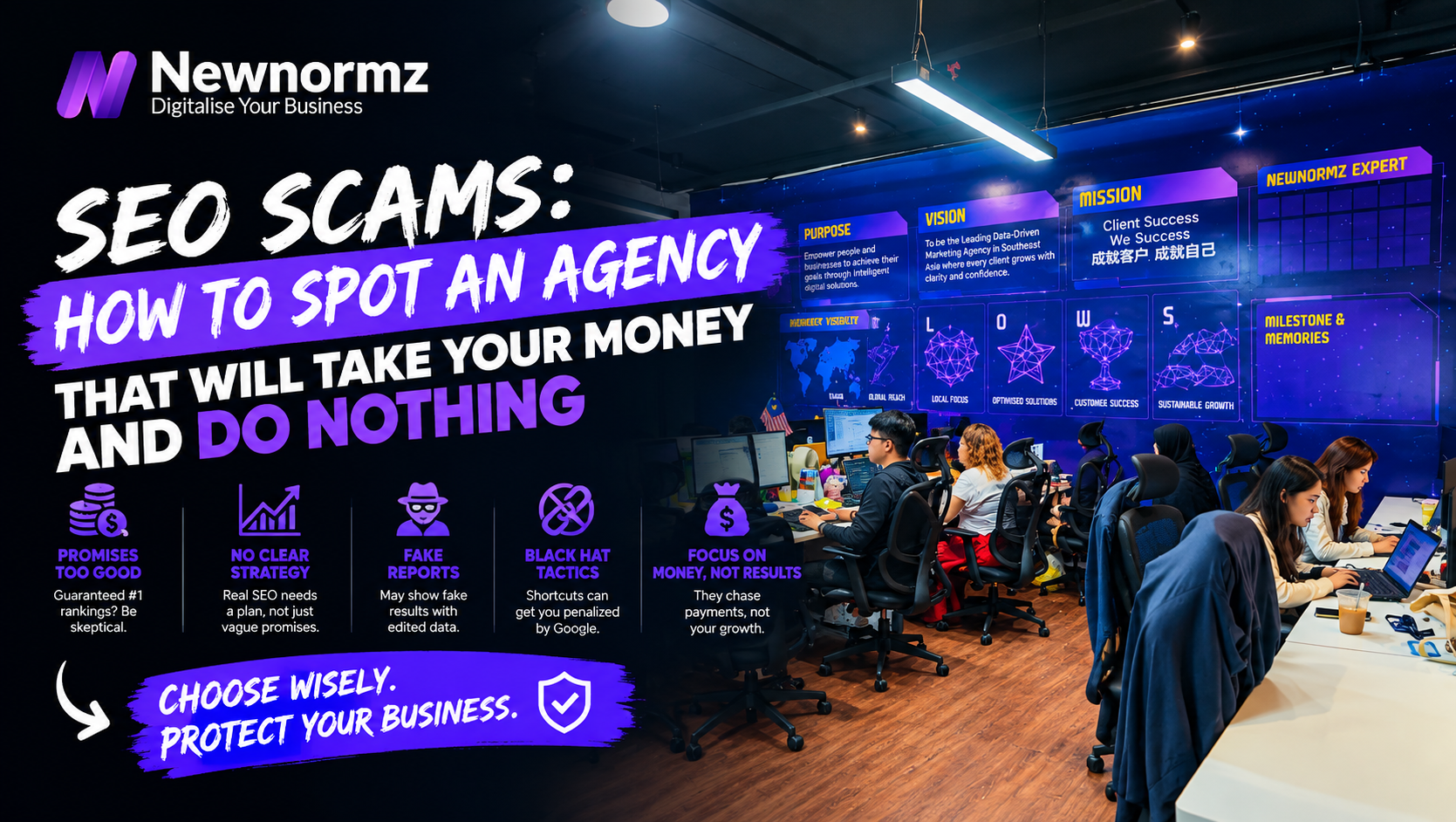
Most SEO scams in Malaysia don’t look like scams. They look like a professional agency with a nice deck, a monthly retainer, and a report full of numbers that never seem to turn into enquiries. You can usually spot them before you sign: they promise a #1 ranking, they won’t tell you what work they’ll actually do, they report on keywords nobody searches, and they get vague when you ask for access to your own Google Search Console. A real agency tells you what it will do each month, shows you the work, reports on traffic and leads from searches that matter to your business, and is honest that SEO takes months and that nobody controls Google. If an agency won’t give you that level of openness before you pay, it won’t give it to you after.
A Simple Way to Think About It
Two Renovation Contractors
🔒 The contractor who keeps the door locked
He collects your payment every month, tells you the work is going great, and never lets you inside the house to see it.
🔑 The contractor who hands you the key
She gives you a spare key on day one, so you can walk in any time and see exactly which wall went up this week.
Almost every red flag below comes back to that key: whether the agency lets you see the work, or asks you to trust them instead.
Why SEO Is Easy to Scam
SEO is unusually easy to fake because most business owners can’t see the work. A Google Ads campaign spends money you can watch leave your account. A new website is something you can click around. SEO happens in places you don’t normally look: your site’s code, content you might not read, links on other websites, and data that sits in tools you may never have logged into.
Add a slow feedback loop and you have the perfect conditions for a scam. Real SEO usually takes three to six months to show meaningful movement, and longer in competitive industries. That gives a dishonest agency half a year of retainer payments where “it takes time” sounds like a perfectly reasonable excuse. Sometimes it is reasonable. The difference is whether they can show you what they’re doing during that time.
In Malaysia, the setup makes this worse. Google holds around 93% of the local search market (Statcounter, May 2026), and with 35.4 million internet users at 98% penetration (DataReportal Digital 2026 Malaysia), every SME owner knows they “need to be on Google.” That urgency is exactly what cheap package sellers on Facebook, WhatsApp blasts, and cold calls rely on.
The Red Flags That Matter Most
Not every warning sign means you’re dealing with a scammer. Some agencies are just disorganised. But when you see several of these together, walk away.
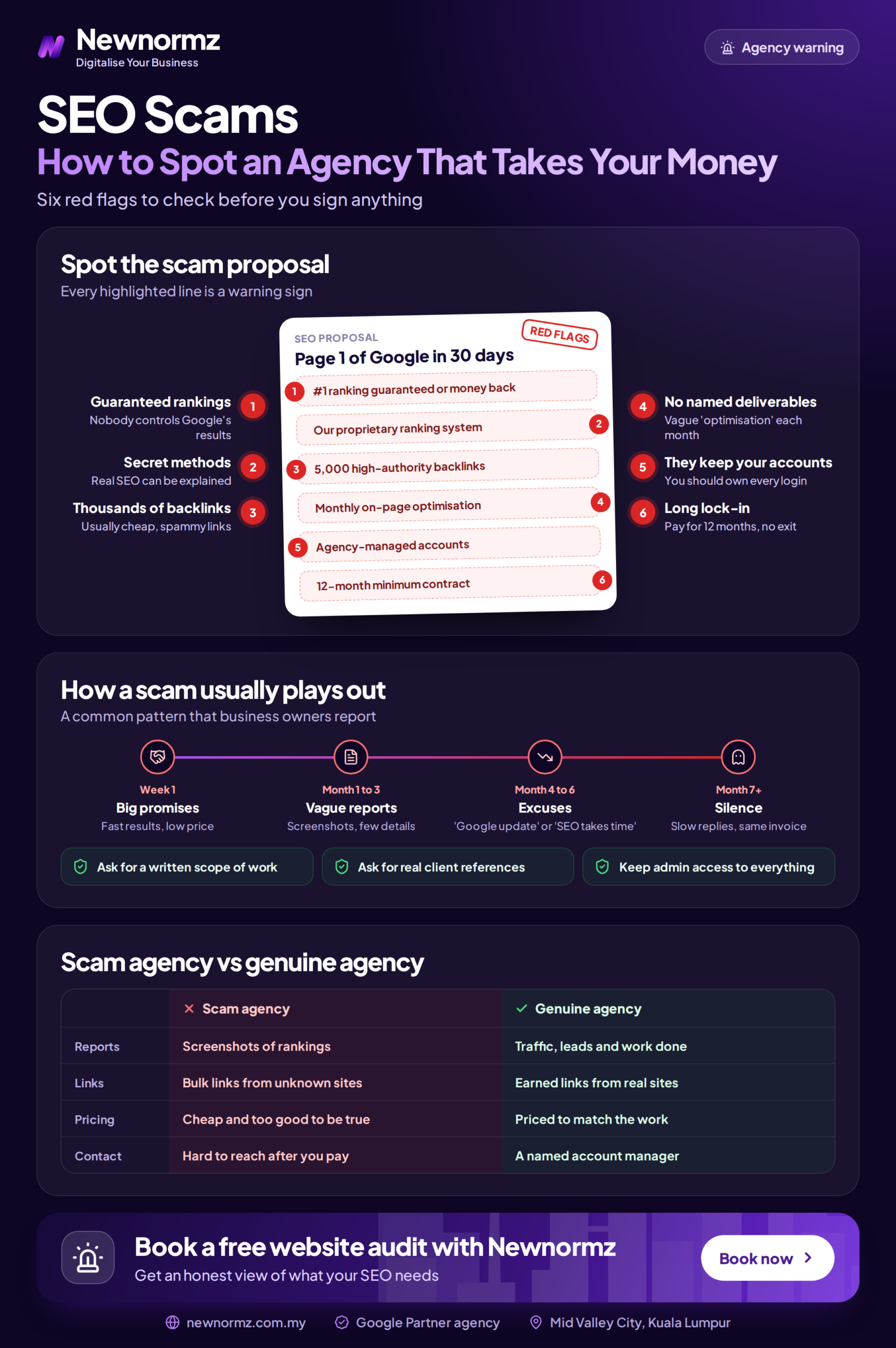
1. They guarantee a #1 ranking
This one is the most common, and the easiest to check. Google has stated publicly, more than once, that no one can guarantee a specific ranking position. Google doesn’t sell rankings, doesn’t partner with agencies on them, and changes its algorithm constantly. An agency promising “#1 on Google in 30 days” is either lying or planning to rank you for a phrase so obscure that nobody searches it.
There is a difference between a guaranteed position and a performance commitment. An agency can reasonably commit to a measurable outcome across a set of agreed keywords, with written terms on what happens if it isn’t met. What it can’t honestly do is promise you the top spot for “lawyer KL” by next month.
2. They won’t tell you what they’re actually doing
“Our methods are proprietary” is the classic line. Real SEO isn’t a secret. Technical fixes, content, on-page optimisation, local listings, and link building are all well documented. A legitimate agency will happily tell you which pages they’re working on this month and why. Secrecy usually means there’s nothing to show, or what they’re doing would get your site penalised if you knew about it.
3. They report on the wrong keywords
This is the quietest scam and the most effective. The monthly report shows 40 keywords on page one. It looks impressive. Then you look closer and they’re all phrases like “best affordable premium [your brand name] service Selangor 2026.” Nobody types that. Ranking for it is worth nothing.
The test is simple: are these keywords your customers actually search for? Ask to see the search volume next to each one. Check whether they cover how Malaysians actually search, including Bahasa Malaysia and Chinese-language terms if your customers use them.
4. They own your accounts, not you
Some agencies set up Google Search Console, Google Analytics, or your Google Business Profile under their own login. When you leave, your data leaves with them, and sometimes your Google listing too. This isn’t always a scam. Sometimes it’s just laziness. But it puts all the power on their side, and that’s a bad place to start any working relationship.
5. They sell “1,000 backlinks for RM299”
Cheap bulk links come from spam networks, hacked sites, and link farms. Google’s spam policies specifically target link schemes, and buying links in bulk is one of the fastest ways to get a manual action against your site. The cheap package doesn’t just fail to help. It can actively push you down, and cleaning that up later costs more than the package did.
6. They lock you into a long contract with no exit
SEO needs time, so a six-month minimum commitment is fair. A 24-month contract with heavy penalties for leaving early, and no performance conditions at all, is the agency protecting itself from you finding out.
| Red flag | What it usually means | What a legitimate agency does instead |
|---|---|---|
| “Guaranteed #1 on Google” | Ranking for phrases nobody searches, or an outright lie | Agrees measurable targets on real keywords, with written terms |
| “Our methods are confidential” | Little or no work being done, or risky tactics | Shares a monthly task list: pages fixed, content published, links earned |
| Reports show rankings only | Vanity keywords chosen because they’re easy to rank | Reports on traffic, impressions, clicks, and enquiries from Search Console and Analytics |
| Agency owns your Google accounts | You lose your data and leverage when you leave | Accounts are in your name; the agency gets user access |
| Bulk backlink packages at low prices | Spam links that can trigger a Google penalty | Fewer, relevant links from real Malaysian sites in your industry |
| Long contract, no performance terms | The agency is protecting its income, not your results | Reasonable minimum term with clear performance conditions |
What Real SEO Reporting Looks Like
The fastest way to spot a fake report is to know what a real one contains. It should be built on data from Google’s own tools, which you can log into yourself and check. At minimum, you should see organic traffic, impressions, clicks, the number of keywords you rank for, and ideally the leads or sales that came from organic search.
Here’s what that looks like in practice. Over a 6-month campaign for Times Parking, a parking management company, our reporting tracked 528,000 impressions, 416 ranking keywords, and 31.5K clicks. For Sunway Medispa, a 6-month campaign produced a 700% traffic increase and 70% more keywords ranking. Every one of those numbers came straight from Search Console and Analytics, and the client could see the same figures in their own accounts.
That last part is the whole point. If the numbers in your agency’s PDF don’t match what you see when you log into Search Console yourself, you have your answer.
Questions to Ask Before You Sign
You don’t need to understand SEO to vet an agency. You just need to ask the right questions and listen to how they answer. Evasion tells you more than any sales deck.
| Question | Why it matters | Red-flag answer |
|---|---|---|
| What exactly will you do in the first three months? | Shows whether there’s a real plan | “We’ll optimise your site and build authority.” Nothing specific. |
| Which keywords will you target, and how many people search them? | Filters out vanity keywords | They can’t show search volume, or won’t share the list |
| Will Search Console and Analytics be under my account? | Protects your data if you leave | “We manage all that for you, you don’t need access.” |
| How do you get backlinks? | Reveals whether they use spam tactics | A fixed number of links per month at a suspiciously low price |
| Can I speak to a current client? | Case studies are easy to dress up; clients aren’t | Every client is “under NDA” |
| What happens if results don’t come? | Tests whether they’ll stand behind their work | “Results always come.” Or a long contract with no exit clause. |
A few basic checks are worth five minutes too. Look the company up on SSM to confirm it’s a registered Malaysian business. Search the agency’s own name on Google: an SEO company that can’t rank for its own brand is telling you something. And check that the case studies on their website name real businesses you can look up.
Already Paying an Agency You Don’t Trust?
If you’re a few months in and something feels off, don’t just cancel in frustration. Protect yourself first.
Ask for admin access to your Google Search Console, Google Analytics, and Google Business Profile, plus your website hosting and CMS logins. If they refuse or stall, that’s your confirmation. Then compare their reports against what Search Console actually shows. Look at the backlinks report there too. If you see hundreds of links from unrelated foreign sites you’ve never heard of, get a second opinion before you do anything else, because you may need a cleanup.
Finally, ask for a written list of every change they’ve made to your site. A legitimate agency can produce that in a day. One that can’t, didn’t do the work.
Cheap Isn’t Always a Scam, and Expensive Isn’t Always Safe
Price alone won’t tell you much. Some smaller Malaysian agencies charge modest retainers and do honest, careful work. Some agencies with glossy offices in KL charge RM8,000 a month and send you a ranking report built on keywords nobody types. What separates them is transparency, not price.
That said, be realistic about what a budget buys. A RM300-a-month package can’t pay for a strategist, a writer, and someone doing technical fixes. Something has to be cut, and usually that something is the actual work. If you need results quickly and your budget is small, SEO may not be the right first move. When a KL confinement centre came to us with RM2,550 a month and needed enquiries fast, we paired SEO with Google Ads so they got qualified leads within 30 days while the organic work built up in the background. An honest agency will tell you when SEO alone isn’t the answer.
When you’re comparing options for an SEO agency in Malaysia, judge every proposal on the same thing: how much it lets you see.
Frequently Asked Questions
How long should I wait before deciding an SEO agency isn’t working?
Give a legitimate campaign three to six months before expecting meaningful traffic growth. But you should see evidence of work from the first month: an audit, technical fixes, a keyword plan, new or improved content. No visible work in month one is a problem regardless of rankings.
Can a bad SEO agency actually hurt my website?
Yes. Spammy link building, copied content, and keyword stuffing all break Google’s spam policies. The result can be a manual action or an algorithmic drop that takes months to recover from. Doing nothing wastes your money; doing the wrong thing can cost you rankings you already had.
Is it a scam if an agency offers a performance guarantee?
Not necessarily. Promising a specific position like #1 is a red flag, because Google itself says no one can guarantee that. A guarantee based on a measurable outcome across agreed keywords, with clear written terms, is a different thing. Read the terms and check that the keywords are ones your customers actually search.
I got a cold email saying my site has SEO errors. Should I reply?
Be cautious. Google’s own guidance warns about unsolicited SEO emails. These are usually automated scans sent to thousands of businesses, and the “errors” are often trivial or made up. If you want to know your site’s real issues, ask for an audit from an agency you’ve checked yourself.
What should I get back when I leave an agency?
Full access to your Google Search Console, Google Analytics, Google Business Profile, hosting, domain, and CMS, plus any content they wrote for you if your contract says you own it. Ideally, ask for these in your name from day one so leaving is never a negotiation.
Not sure your current agency is doing the work?
Get an honest second opinion on your SEO before you pay another month.
Newnormz has run SEO campaigns across F&B, healthcare, ecommerce, and local services in Malaysia, backed by a performance guarantee of 70 percent of targeted keywords on Google’s first page.
30 minutes, no obligation, and a straight answer on whether your current SEO is actually working.

Bryan Tan is an SEO Specialist and CEO at Newnormz, helping hundreds of businesses achieve first-page rankings on Google. With a passion for driving organic growth, Bryan blends innovative strategies with hands-on experience to optimize websites for maximum visibility. Always at the forefront of the latest SEO insights and trends, he consistently adapts to the evolving digital landscape.