SEO blog posts rank when they match what a Malaysian searcher actually typed into Google, when they are structured so a reader can scan the answer in ten seconds, and when every claim is backed by a real number instead of a vague promise. Skip any one of those three, and the post sits on page four no matter how well it reads. The framework below walks through seven steps, in the order they need to happen, that take a post from unpublished draft to a genuine page one contender.
A Simple Way to Think About It
The Hawker Stall Owner Who Actually Listens
📢 Shouting the Whole Menu
A hawker stall owner who shouts every dish on the menu at everyone who walks past, hoping something eventually sticks. Most people just keep walking.
🎯 Answering What They Came For
A stall owner who asks what you’re hungry for, then points straight to the one dish that fits. That customer orders, and comes back the next week.
The seven steps below turn the second stall owner’s habit into a repeatable writing process, one that answers the exact question a reader typed into Google instead of shouting a topic at them.
What Actually Counts as an SEO Blog Post
A regular blog post shares an opinion, an update, or a story. An SEO blog post is built around a specific keyword, a specific reader question, and a specific business outcome, such as an enquiry form submission or a booked call. The finished writing might look similar on the page. The planning behind it is not, and that difference is what separates a post that generates leads from one that just sits there.
Why This Is Worth the Effort in Malaysia
That distinction matters more here than it might elsewhere, simply because of how many people are already searching. Malaysia had 35.4 million internet users at 98 percent penetration by the end of 2025, and Google holds roughly 93 percent of the Malaysian search market. A blog post that ranks isn’t competing for a niche corner of the internet. It’s sitting in front of nearly everyone in the country who goes online.
A ranking post also keeps generating enquiries long after it’s published, which is the opposite of how paid ads behave: the moment the ad budget stops, the traffic stops with it. A well-optimised blog post can keep showing up in search results for years, with no ongoing spend beyond an occasional refresh. Buyers also tend to read several pieces of content before they commit to a decision, so a useful post often sits several steps inside the actual purchase journey, not just at the discovery stage.
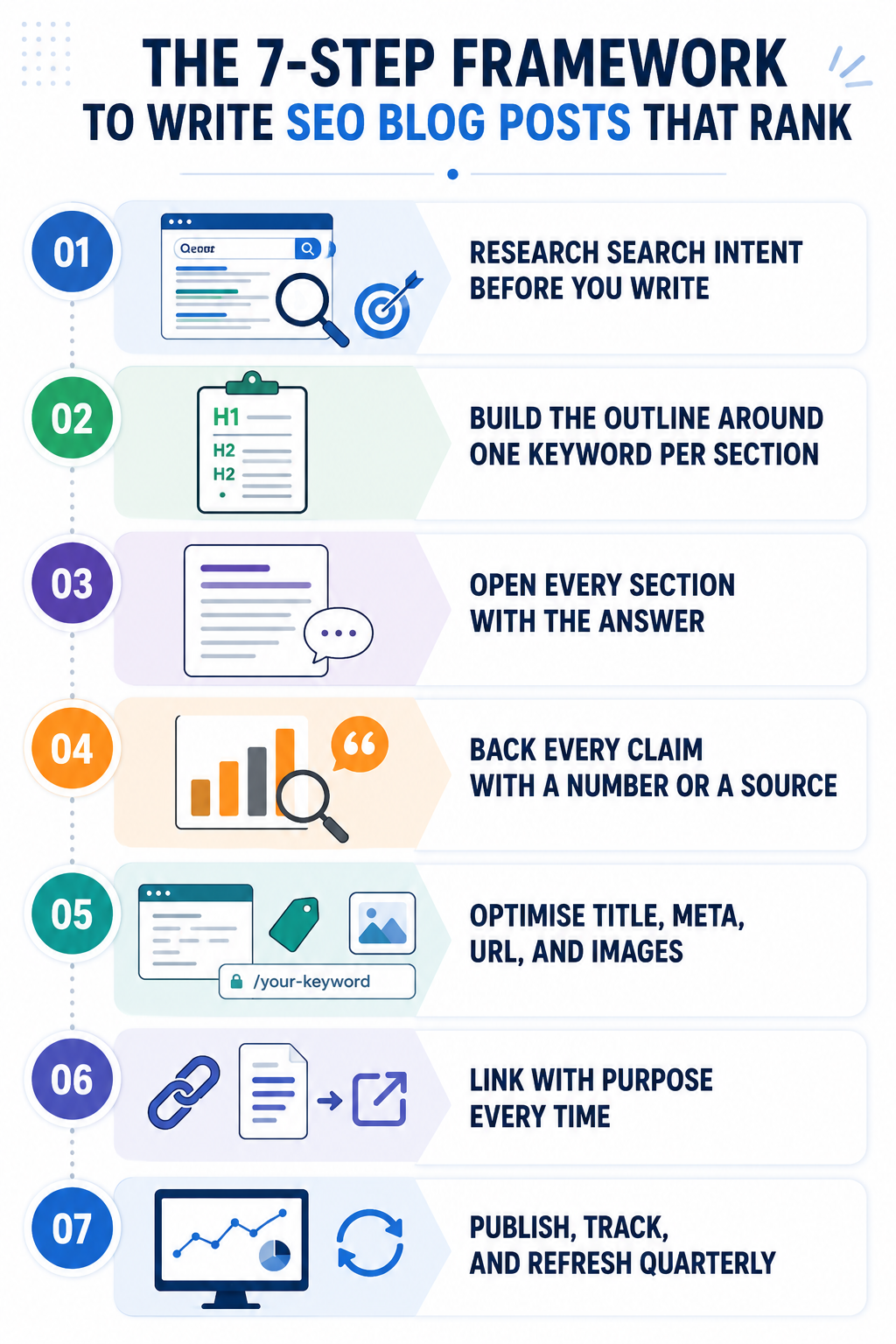
The 7-Step Framework to Write SEO Blog Posts That Rank
Each step below builds on the one before it. Skipping the keyword and structure decisions in steps one and two is the most common reason a post underperforms after publishing, regardless of how well the later steps are executed.
Step 1: Research Search Intent Before Writing a Word
Search intent decides whether a page should be a guide, a comparison, or a service page. Check what Google’s top 10 results actually look like for the target keyword and match that format instead of guessing. Then use Search Console or a keyword tool to find Malaysian-specific phrasing, such as “SEO agency Kuala Lumpur” or “SEO pricing Malaysia,” which tends to carry stronger commercial intent than a broad international term. This is also where local SEO keyword patterns, tied to specific cities or neighbourhoods, tend to convert better than a generic national phrase.
Step 2: Build the Outline Around One Keyword Per Section
Each H2 should carry one secondary keyword or subtopic, no more. Planning the outline before writing a single sentence forces every section to answer a different question, and it usually exposes gaps that competing articles left unaddressed.
Step 3: Open Every Section With the Answer
Start each section with its main point, then support it with data, an example, or a named source. Readers scan before they read, and search engines tend to reward that same bottom-line-first structure when deciding what to show in a featured snippet.
Step 4: Back Every Claim With a Number or a Source
“SEO takes time” builds no trust with a reader who has heard it a hundred times before. A specific figure, tied to a real source, does. Specific claims also give AI-powered search tools something precise to cite when they summarise a topic, which matters more each year as more searches never reach a traditional results page at all.
Step 5: Optimise the Title, Meta, URL, and Images
Keep the title tag under 60 characters with the primary keyword near the front. Write a meta description between 150 and 160 characters that ends on a clear, complete sentence. Compress every image before uploading, write alt text that describes what the image actually shows, and keep the URL slug short and keyword-matched.
Step 6: Link With Purpose, Every Time
Internal links should point to a genuinely relevant service page or related article, using anchor text that describes the claim rather than the destination. A post about ranking factors, for instance, naturally links out to a page like SEO service in Malaysia when the topic calls for it, rather than being forced in for the sake of having a link. External links to authoritative sources, marked as nofollow, show both readers and search engines that the data behind a claim can be checked.
Step 7: Publish, Track, and Refresh Quarterly
Publishing is the midpoint, not the finish line. Track ranking position and organic clicks in Google Search Console, then refresh any post that has slipped past page one with updated statistics, fresh examples, and new internal links. Most posts need at least one refresh within the first year to hold their position, since Google tends to reward ongoing depth over a single publishing sprint.
Three Mistakes That Keep Malaysian SME Posts Off Page One
| Mistake | Why It Blocks Rankings | The Fix |
|---|---|---|
| One broad keyword instead of a cluster | A post built around “digital marketing” competes against national media outlets and rarely ranks | Narrow the keyword to something like “digital marketing agency for retail SMEs in Malaysia” |
| Published once, never revisited | A post untouched for two years reads as outdated, even when the underlying advice still holds | Refresh with new statistics and internal links on a quarterly cycle |
| Written for the algorithm, not the reader | Keyword-stuffed sentences read poorly, raise bounce rate, and work against rankings rather than for them | Answer the real question first, and let the keyword count take care of itself |
DIY Blogging vs Agency-Managed Blogging: Which Fits Your SME
Both paths can rank. They carry very different time and consistency trade-offs, and the right choice usually comes down to whether the business has someone who genuinely enjoys writing and can commit to it every month.
| Factor | DIY In-House Blogging | Agency-Managed Blogging |
|---|---|---|
| Time investment | 4 to 8 hours per post | Under 1 hour of owner review per post |
| Keyword research | Manual, trial and error | Data-backed and tool-driven |
| Publishing consistency | Often irregular | Scheduled and maintained monthly |
Choose in-house blogging when someone on the team enjoys writing and can hold to a fixed schedule. Choose an SEO agency in Malaysia when the owner would rather spend that time on operations or customers, while still wanting a content calendar that keeps running without weekly reminders.
What This Framework Looks Like in Practice
Newnormz has applied this same approach to blog and on-page content across F&B, healthcare, and local services in Malaysia. Oriental Kopi’s two-year SEO campaign added 43,300 in traffic growth and 24,500 more ranking keywords, alongside 6.31 million impressions. Sunway Medispa saw a 700 percent traffic increase and 70 percent more keywords ranking within six months. Neither result came from simply publishing more content. Both came from matching search intent, structuring content to be scannable, and refreshing what already existed instead of only adding new pages.
Turning This Framework Into Long-Term Growth
Blog posts that rank need intent-matched keywords, a scannable structure, and real evidence, not more words on a page. That’s the whole answer to how to write SEO blog posts that keep generating enquiries long after publish day.
How long should an SEO blog post be to rank in Malaysia?
There is no fixed word count. The right length matches what the search intent and competing pages actually require, sometimes a focused 800 words, sometimes a comprehensive 2,000.
Do I need a paid keyword research tool before I start writing?
Google Search Console and Google’s own autocomplete and “People also ask” results cover the basics for free. A paid tool speeds up the process but isn’t required to apply this framework.
How soon will a new blog post start ranking?
Timelines vary with keyword difficulty and how established the domain already is. Google has repeatedly said no one can guarantee a specific ranking position or date, which is why tracking and refreshing matter as much as the initial publish.
Can an SME owner write these posts without hiring a copywriter?
Yes, provided the seven steps are followed in order. Many owners eventually hand off the keyword mapping and formatting stages once the writing volume grows beyond what a lean team can sustain monthly.
Not sure why your blog isn’t ranking?
Find Out Exactly What’s Holding Your Blog Content Back
Newnormz has run SEO campaigns across F&B, healthcare, ecommerce, and local services in Malaysia, backed by a performance guarantee of 70 percent of targeted keywords on Google’s first page.
30 minutes, no obligation, worth RM1,200.

Bryan Tan is an SEO Specialist and CEO at Newnormz, helping hundreds of businesses achieve first-page rankings on Google. With a passion for driving organic growth, Bryan blends innovative strategies with hands-on experience to optimize websites for maximum visibility. Always at the forefront of the latest SEO insights and trends, he consistently adapts to the evolving digital landscape.