A content cluster strategy means building one pillar page that covers a topic in full, then linking five to eight supporting articles to it that each answer a narrower question a real customer would type into Google. Done properly, this tells Google that a site understands a subject in depth rather than guessing at keywords one post at a time, which is what actually earns rankings for competitive terms in Malaysia’s crowded search results. It is not a quick fix. A cluster takes months of consistent writing and linking to build, but it compounds in a way a single blog post never does.
A Simple Way to Think About It
Scattered Shelves vs. the Reference Shelf
📚 Scattered Shelves
A library where books on one subject are scattered across random shelves, fiction, travel, biography, with no catalogue linking them. A reader trying to learn something has to get lucky.
📖 The Reference Shelf
A library with one shelf built entirely around a single subject: the core reference book up front, every related book beside it, each one cross-referenced back to the first.
That is the difference between a handful of unconnected blog posts and a real content cluster, and the steps below show how a cluster like that actually gets built.
What a Content Cluster Actually Is
A content cluster is one pillar page that covers a broad topic comprehensively, supported by five to eight spoke articles that each dig into a specific subtopic and link back to that pillar. The pillar targets a high-volume, competitive keyword such as “digital marketing strategy.” The spokes target long-tail variations a real buyer searches for, such as “how to choose a digital marketing agency in Malaysia” or “social media marketing budget for SMEs.” Every spoke links to the pillar, and the pillar links out to every spoke, concentrating ranking signals on the one page you most want to rank.
Google’s own guidance on creating helpful, reliable, people-first content rewards sites that demonstrate depth and firsthand expertise on a subject, not isolated posts written to chase individual keywords. A cluster is the structural answer to that guidance.
Why Scattered Blog Posts Lose in Malaysia’s Search Market
Google holds roughly 93 percent of the search market in Malaysia as of May 2026, and the country had 35.4 million internet users at 98 percent penetration heading into this year. That is a large, competitive pool of searchers, and a single blog post going up against established local and regional brands has limited ranking power on its own. A content cluster changes that by building topical authority, the signal Google uses to identify which sites genuinely understand a subject rather than just publishing around it.
Backlinko recommends linking supporting articles back to a central pillar page precisely because it helps search engines understand how related content connects, which in turn strengthens the pillar’s own relevance for the term you actually want to win. Three outcomes tend to follow from that structure:
Higher rankings for competitive keywords. A pillar backed by five to eight supporting articles has a stronger internal link profile than a single post trying to carry the same term alone.
Lower cost per lead over time. Once a cluster ranks, it keeps attracting organic traffic without ongoing spend, unlike Google Ads campaigns that stop generating leads the moment budget runs out.
Stronger AI search visibility. Clustered, clearly linked content is easier for AI engines like ChatGPT and Google’s AI Overviews to cite, which is the core focus of a proper Generative Engine Optimisation (GEO) layer sitting on top of SEO.
How a Cluster Gets Built, Step by Step
Step 1: Topic and Keyword Mapping
Start by identifying three to five cluster topics tied directly to revenue-generating services, not vanity topics. Map one pillar keyword and five to eight supporting long-tail keywords per cluster using competitor gap analysis, so every spoke is chosen because a competitor is already winning traffic there.
Step 2: Pillar Page Development
The pillar page runs 1,500 words or more. Blog posts between 500 and 1,500 words tend to rank most consistently for standard SME topics, but a pillar needs the longer end of that range because it has to cover the subject comprehensively enough to anchor everything linking into it.
Step 3: Spoke Article Production
Each spoke is written in the priority languages a business actually sells in. Producing in English, Bahasa Malaysia, and Chinese lets one cluster capture search demand across Malaysia’s three major language markets instead of just one.
Step 4: Internal Linking and Technical Structure
Every spoke links back to the pillar, and the pillar links out to every spoke, forming the hub-and-spoke pattern search engines use to identify the most important page in a topic.
| Approach | Structure | Typical Outcome |
|---|---|---|
| Ad hoc blogging | Standalone posts, no fixed linking pattern | Traffic spikes then fades; rankings stay volatile |
| Content cluster strategy | One pillar, 5 to 8 linked spokes, defined keyword map | Compounding rankings; pillar page gains authority over time |
Step 5: Measurement and Iteration
Track ranking movement, organic traffic, and lead volume monthly, then expand the clusters showing traction with additional spoke articles rather than starting new, unrelated ones.
What Compounding Content Actually Looks Like
This is the part that is easy to promise and hard to prove, so it is worth pointing to a real example instead. A two-year SEO and content campaign for Oriental Kopi, an F&B brand, produced 43,300 in traffic growth, 6.31 million impressions, 24,500 more ranking keywords, and 468,000 clicks. That kind of growth does not come from one viral post. It comes from sustained, linked content built up over time, which is exactly what a cluster is designed to produce, one connected topic at a time.
Trilingual Clusters for Malaysia’s Language Markets
A cluster built only in English leaves demand on the table in a market where Bahasa Malaysia and Chinese-language search behaviour matter just as much for many categories. Producing spokes in all three languages, anchored to the same pillar topic, means one cluster can capture search intent across audiences that would otherwise need three separate content plans. This is also where local SEO and cluster strategy overlap: a well-linked, multilingual cluster is what gives a business credibility for local, city-specific searches, not just national ones.
Where AI Search Fits In
Clustered content has a second job beyond ranking on Google’s results page. AI Overviews and tools like ChatGPT tend to cite content that clearly demonstrates depth and internal relationships between topics, because that structure makes it easier for those systems to verify a source understands the subject rather than skimming it. A cluster built for topical authority is, by construction, also built to be cited by AI search. That overlap is the reason GEO and a proper SEO service increasingly need to be planned together rather than as separate line items.
Build Lasting Topical Authority, Not Isolated Posts
Scattered blog posts without a linking structure struggle to build the topical authority Google rewards, which leaves Malaysian SMEs stuck behind competitors with a stronger content foundation. A cluster fixes that by turning individual articles into a system: one pillar, several linked spokes, and a keyword map tied to the services that actually generate revenue.
Frequently Asked Questions About Content Cluster Strategy
Why are my blog posts ranking separately instead of building topical authority?
Most likely because they were never linked together around a shared keyword map. A pillar page connected to supporting spoke articles is what signals depth to Google, not the number of posts published.
How many articles should a first content cluster include?
Typically one pillar plus five to eight spokes, though the exact number should follow search demand and how many service pages the cluster needs to support, not a fixed rule.
How long before a new content cluster starts gaining rankings?
Usually several months. Clusters compound rather than spike, so rankings, traffic, and enquiries need to be tracked monthly to see the trend rather than judged after one report.
Do I still need content clusters if I am already running Google Ads?
Yes. Paid ads stop producing leads the moment budget runs out, while a ranking cluster keeps attracting organic traffic. They solve different problems and work best run alongside each other.
Can a content cluster be built in multiple languages for Malaysia?
Yes. Producing spoke articles in English, Bahasa Malaysia, and Chinese under one pillar lets a single cluster capture search demand across all three language markets instead of one.
What does a content cluster strategy cost?
It depends on the number of topics, article volume, and languages required, which is why a proper plan should start with an audit of existing content before any new pages are scoped.
Ready to stop publishing posts that go nowhere?
Get a Content Cluster Map Built Around Your Own Services
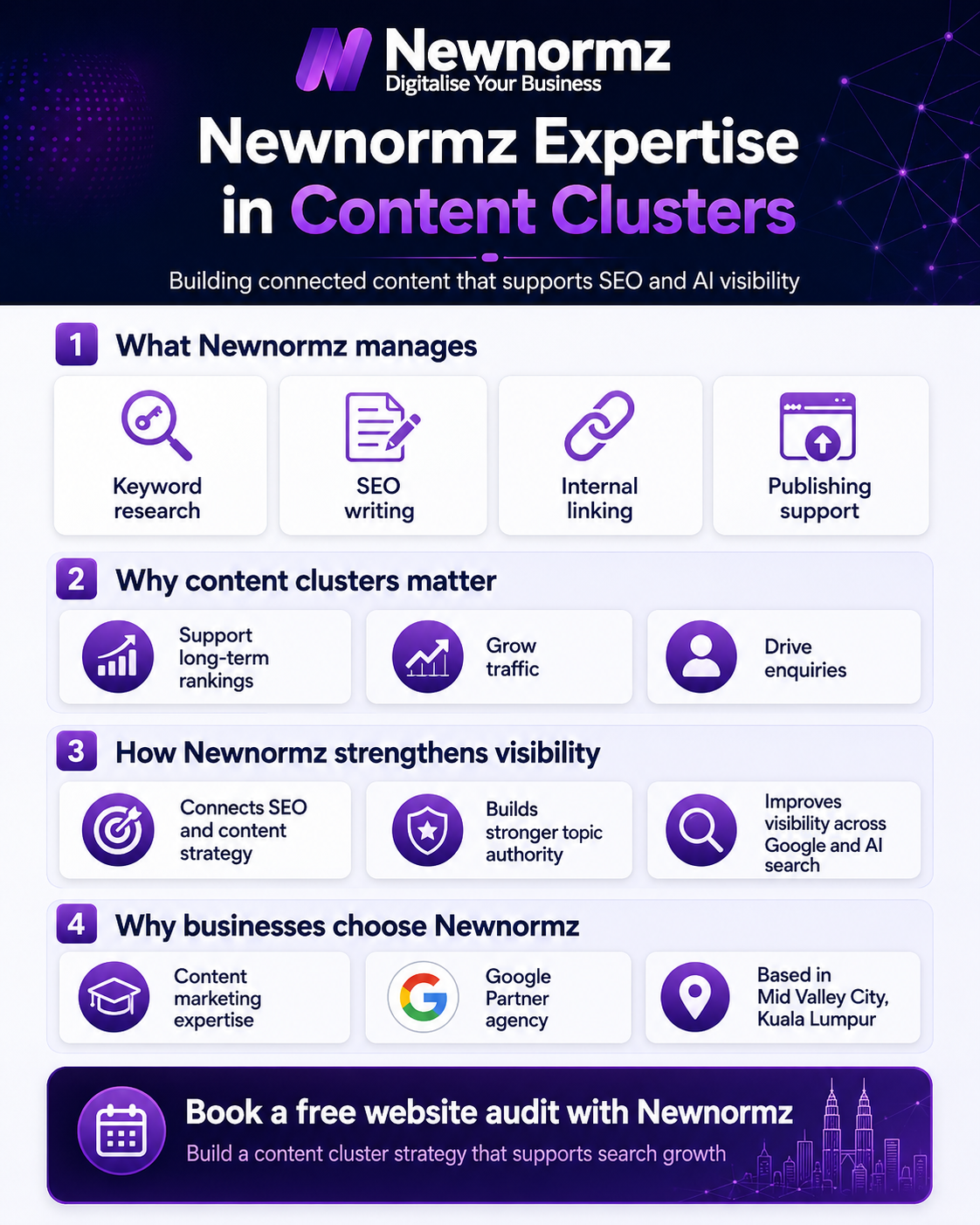
Newnormz has run SEO campaigns across F&B, healthcare, ecommerce, and local services in Malaysia, backed by a performance guarantee of 70 percent of targeted keywords on Google’s first page.
30 minutes, no obligation, and you’ll see which topics your site should own first.

Bryan Tan is an SEO Specialist and CEO at Newnormz, helping hundreds of businesses achieve first-page rankings on Google. With a passion for driving organic growth, Bryan blends innovative strategies with hands-on experience to optimize websites for maximum visibility. Always at the forefront of the latest SEO insights and trends, he consistently adapts to the evolving digital landscape.