To rank a brand new website on Google, get it indexed first through Search Console and an XML sitemap, then fix the on-page basics, target low-competition long-tail keywords, publish helpful content on a schedule you can actually keep, and earn your first links and local citations. Expect three to six months before you see meaningful movement. No new site ranks overnight, and no shortcut, tool, or paid package changes that.
The odds are steeper than most founders realise. Ahrefs found that 96.55% of all pages get zero search traffic from Google, and only 1.74% of newly published pages reach the top 10 within their first year. Most of that gap isn’t bad luck. It’s sites that skip the boring foundational steps and go straight for keywords they were never going to win. This guide lays out the first 90 days as a concrete sequence, so your site has a real shot at landing in that winning minority.
A Simple Way to Think About It
The New Restaurant on the Block
😕 Opening Night
A restaurant that just opened has zero reviews and an empty dining room, even if the food is genuinely excellent. People walk straight past it for the place next door with fifty reviews and a queue out the front.
🌱 One Year In
Same restaurant, twelve months later: regulars, reviews, and a reputation that took every one of those months to build. Nobody thinks twice about walking straight in.
Your website is that new restaurant. The steps below are how you get from empty dining room to full reservations, starting with the one thing that has to happen before anything else: getting Google to notice you exist.
Why a New Site Takes Time to Rank
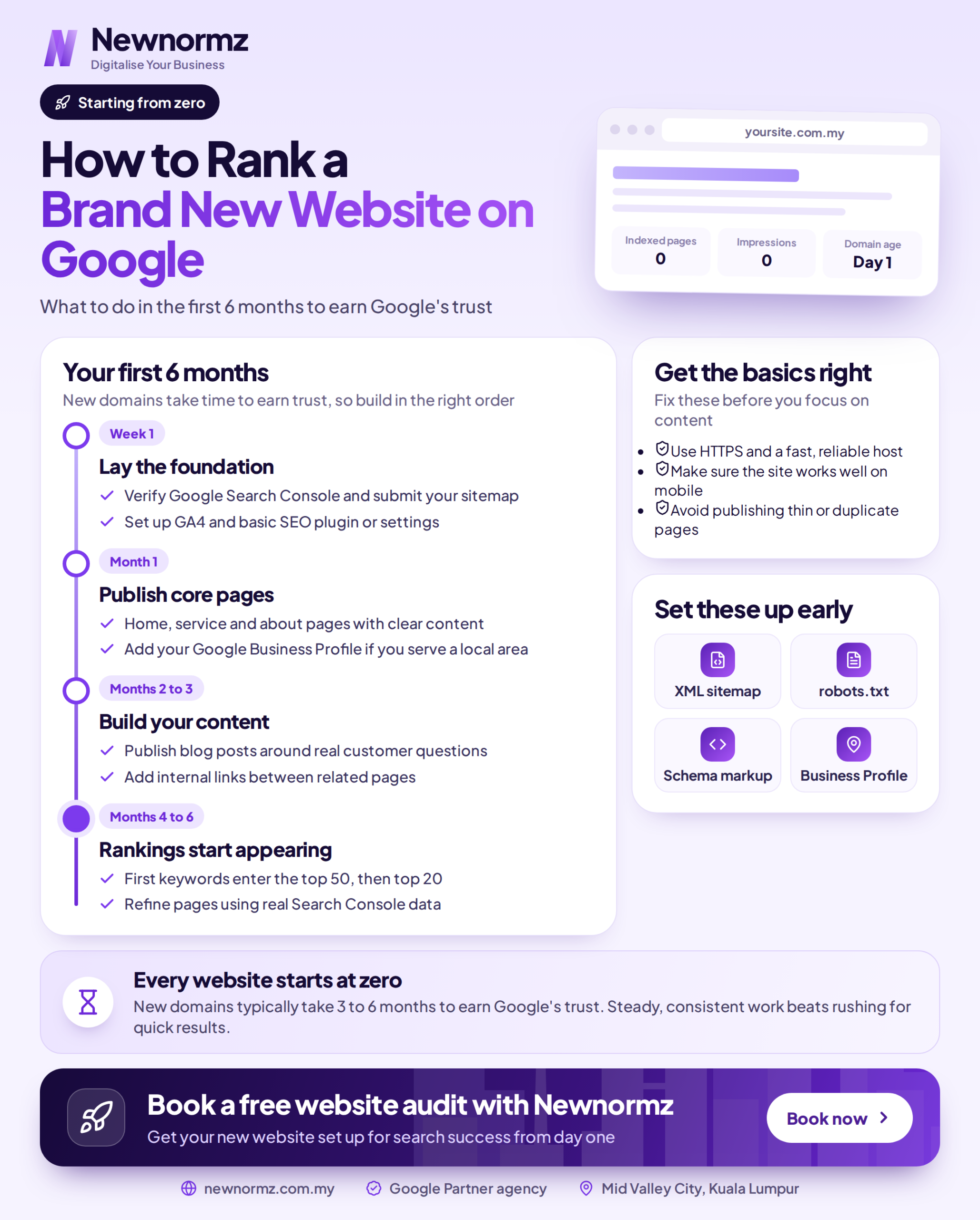
A new domain starts with no history, no authority, and no trust signals. Google has to discover it, crawl it, work out what it’s actually about, and decide whether it deserves to sit near sites that have been earning links and traffic for years. That evaluation takes time, and there’s no way to skip it.
This is often described as a “sandbox” effect: new sites tend to sit quiet for roughly two to nine months, with low-competition niches clearing in two to three months and competitive YMYL topics (think finance, health, legal) taking six to twelve months or longer. It isn’t a penalty. It’s Google withholding judgment until your site has proven it deserves trust.
The mistake most founders make is treating this quiet period as a problem to solve, when it’s really a phase to work through. The trap is doing nothing, or reaching for shortcuts that trigger a penalty instead of a ranking. The first 90 days should be spent stacking trust signals deliberately: clean technical foundations, genuinely useful content, and early links. Do that well and you shorten the wait; you don’t skip it.
Step 1: Get Indexed First
You cannot rank for anything until Google has your pages in its index. Brand new sites typically take two to four weeks to index on their own, but you can speed that up considerably by doing three things in the first week:
Verify Google Search Console
This is your direct line to Google. It confirms ownership of the domain and shows you exactly which pages are indexed and which aren’t.
Submit an XML sitemap
Most WordPress SEO plugins generate one automatically. Submit it through Search Console so Google can find every page that matters without having to stumble onto it by chance.
Use the URL Inspection tool
Manually request indexing for your most important pages. It won’t guarantee same-day indexing, but it does nudge Google to crawl sooner rather than later.
While you’re in there, confirm nothing is quietly blocking crawlers: no stray “noindex” tag left on a page, no “Discourage search engines” box still ticked in WordPress, and a clean robots.txt file. A single overlooked setting can keep an otherwise solid site invisible for weeks.
Step 2: Fix the On-Page Basics
On-page SEO tells Google what each page is actually about. On a new site, the priority is getting the fundamentals right everywhere, not chasing advanced tactics on one or two pages:
- Unique title tags and meta descriptions that include the target keyword naturally, not stuffed.
- One clear H1 per page and a logical heading structure underneath it.
- Descriptive, short URLs and internal links connecting related pages, so Google can crawl and understand how your site fits together.
- Fast, mobile-friendly pages, since the majority of Malaysian search traffic is mobile and Google indexes mobile-first.
None of this is glamorous, but it’s decisive. A technically clean site with clear on-page signals will out-rank a beautifully designed one that Google struggles to parse, every time.
Step 3: Target Long-Tail Keywords Before Head Terms
The single biggest mistake new sites make is chasing broad terms like “SEO” or “skincare” in month one. You will not win those for years, and every week spent trying is a week not spent on keywords you could actually rank for.
Go after long-tail keywords instead: specific, lower-volume phrases with weaker competition, such as “affordable SEO services for cafes in Penang” rather than “SEO Malaysia.” Long-tail terms rank faster, carry clearer intent, and convert better because the person searching already knows roughly what they want.
New domains typically start ranking for long-tail, low-competition keywords within two to four months. Win a cluster of those, build topical authority around them, and you earn the right to target bigger keywords later. This is also the foundation of solid local SEO for any business competing in a specific city or region rather than nationally.
Step 4: Publish Content on a Schedule You Can Actually Keep
Content is what turns a keyword target into a ranked page, but volume on its own is worthless. Remember that 96.55% figure: most pages get zero traffic because they’re thin, generic, or don’t fully answer the question the searcher typed in. Aim for pages that resolve the question completely, not pages that exist to hold a keyword.
Consistency matters as much as quality. A steady cadence of one or two solid articles a week signals to Google that the site is active and growing, and simply gives it more pages that could rank. Pick a rhythm you can sustain for a full year, not a burst you’ll abandon after a month. A launch dump followed by silence reads to Google exactly like a dormant site.
Step 5: Earn Your First Links and Citations
Backlinks remain one of the strongest ranking signals, and the bar to clear is lower than most people assume. Around 95% of pages have zero backlinks, so even a handful of quality links from real, relevant sites puts a new domain ahead of most of its competition. Focus on the foundations before chasing anything ambitious:
- Local citations: list your business consistently across Google Business Profile and Malaysian directories.
- Relationship links: suppliers, partners, industry associations, and local press you already have a genuine connection to.
- Earned links: content that’s actually useful enough for other sites to want to reference it.
Avoid cheap link packages entirely. They’re the fastest route to a penalty on a young domain with no trust built up to absorb it. A slow, clean link profile beats a fast, spammy one on every timeline that matters.
A First-90-Days Plan for a New Site
Here’s how the five steps sequence across a first quarter, with the signal you should realistically expect at each stage.
| Phase | Focus and actions | Expected signal |
|---|---|---|
| Weeks 1 to 2: Setup and indexing | Verify Search Console, submit sitemap, request indexing, fix crawl blockers, set on-page basics | Key pages indexed; site appears for a branded search of your business name |
| Weeks 3 to 6: Foundational content | Publish 4 to 8 helpful articles on long-tail, low-competition keywords; build internal links between them | First impressions and clicks appear; a few pages sit on page 2 to 5 |
| Weeks 7 to 12: Links and expansion | Set up citations and Google Business Profile, earn first links, keep publishing weekly, refresh early pages | Long-tail keywords climb toward page 1; steady growth in impressions and first leads |
By day 90, don’t expect to dominate competitive terms. Expect a site that is fully indexed, ranking for a cluster of long-tail keywords, and trending clearly upward. That’s the foundation months four to eight turn into real, compounding traffic.
If you’d rather not run this sequence alone, this is exactly the groundwork an SEO agency in Malaysia should be laying for you in the first quarter of any new-site engagement, before any conversation about bigger keywords happens.
Common Mistakes That Slow New Sites Down
| Mistake | Why it backfires |
|---|---|
| Expecting results in weeks | The sandbox period runs two to nine months. Impatience leads to abandoning the strategy right before it starts working. |
| Chasing head terms too early | Broad keywords are effectively unwinnable for a new domain competing against sites with years of authority. |
| Publishing thin content in bulk | Quantity without depth just adds pages to the 96.55% that get no traffic at all. |
| Buying cheap backlinks | Spammy links on a young, unproven domain invite a penalty far more often than a ranking. |
| Publishing once, then stopping | An inconsistent schedule tells Google the site is dormant, which undoes the momentum built in the first weeks. |
What a Realistic Outcome Looks Like
Businesses that follow this sequence with discipline, rather than skipping straight to content or links, tend to see the same pattern: a quiet first two months, then a visible acceleration once indexing, on-page basics, and the first links are all in place together. Sunway Medispa’s six-month SEO campaign, for example, produced a 700% increase in traffic and 70% more ranking keywords once the foundational work compounded. That kind of curve, slow start, sharp acceleration, is normal, not a sign that something’s wrong in month one.
If you need leads sooner than organic timelines allow, pairing SEO with paid search while the site matures is a reasonable bridge. One Newnormz client, a KL confinement centre running a RM2,550 monthly budget, generated qualified leads within 30 days by combining a modest Google Ads spend with the SEO groundwork running in parallel underneath it.
The New Site Launch Checklist
- Google Search Console verified and connected.
- XML sitemap generated and submitted.
- Core pages manually submitted for indexing.
- No accidental noindex tags or robots.txt blocks.
- Unique titles, meta descriptions, and one H1 per page.
- A keyword list focused on long-tail, low-competition terms.
- A realistic weekly publishing schedule you can sustain for a year.
- Google Business Profile and local citations set up.
- Realistic expectations set: three to six months to meaningful movement.
Frequently Asked Questions
How long does it take to rank a brand new website?
Expect three to six months for meaningful movement on long-tail keywords, and twelve months or more for competitive head terms. New domains pass through a trust-building phase often called the sandbox, lasting two to nine months depending on the niche. Consistent content and clean technical foundations shorten the wait, but nothing removes it entirely.
How do I get Google to index my new site faster?
Verify Google Search Console, submit an XML sitemap, and use the URL Inspection tool to manually request indexing of your key pages. Confirm nothing is blocking crawlers, such as a stray noindex tag or a robots.txt disallow. New sites usually index within two to four weeks on their own, but these steps speed the process up.
Should I target competitive keywords right away?
No. Broad head terms are effectively unwinnable for a new domain in its first year. Start with long-tail, low-competition keywords that carry clear intent, since new sites often begin ranking for these within two to four months. Win a cluster of them, build topical authority, and you earn the right to pursue bigger terms later.
How many backlinks does a new website need?
There’s no fixed number, but the bar is lower than most expect: around 95% of pages have zero backlinks. A handful of quality links from relevant, real sites, plus consistent local citations, puts a new site ahead of most of its competition. Prioritise quality over volume, and never buy cheap link packages.
How often should I publish content on a new site?
Consistency beats bursts. One or two genuinely helpful articles a week signals an active, growing site and gives Google more pages it could rank. The exact cadence matters less than sustaining it for a full year. A launch dump followed by silence tells Google the site has gone dormant.
Can I rank a new site without spending on ads?
Yes. Organic ranking through SEO needs no ad spend, only time, consistent content, and clean technical foundations. Paid ads can bring in traffic while SEO matures, but they aren’t required to rank. Many Malaysian SMEs build durable organic traffic through this exact sequence, then layer ads on top once it’s compounding.
Just launched a site and wondering why Google is ignoring it?
Find Out Exactly What’s Holding Your New Site Back
Newnormz has run SEO campaigns across F&B, healthcare, ecommerce, and local services in Malaysia, backed by a performance guarantee of 70 percent of targeted keywords on Google’s first page.
30 minutes, no obligation, and a prioritised plan for your first 90 days.

Bryan Tan is an SEO Specialist and CEO at Newnormz, helping hundreds of businesses achieve first-page rankings on Google. With a passion for driving organic growth, Bryan blends innovative strategies with hands-on experience to optimize websites for maximum visibility. Always at the forefront of the latest SEO insights and trends, he consistently adapts to the evolving digital landscape.