Property developer SEO is the work of getting your project pages, location guides and enquiry forms to rank on Google before a buyer ever books a showroom visit, because the shortlist gets decided during the research phase, not the site tour. Malaysia has around 98 percent internet penetration and Google handles roughly 93 percent of local searches, so a buyer typing “new condo Cyberjaya” or “freehold landed Johor” is narrowing their shortlist in real time, and a development that doesn’t show up on that first page is invisible to them regardless of how good the actual project is. The work breaks into four parts: a dedicated page for every project, content that answers a buyer’s questions before a salesperson does, a lead capture flow that actually converts visits into enquiries, and the technical basics (speed, mobile performance, structured data) that let Google display all of it properly.
A Simple Way to Think About It
Renting Attention vs Owning It
💸 Renting the Billboard
Every ringgit spent on a portal listing or a paid ad buys attention for exactly as long as the invoice is paid. The moment the campaign ends or the subscription lapses, the billboard comes down, and so does every buyer who might have found you through it.
🔑 Owning the Street
A ranked project page sits on the road buyers are already walking down every time they search for a launch in that area. It keeps bringing in enquiries in month four, month nine, and long after that phase’s ad budget has run out.
That difference, between attention you rent and visibility you own, is what the rest of this guide is built around.
Why the Search Happens Before the Showroom Visit
A property purchase is one of the largest decisions most buyers make, and it starts with research, not a phone call. Studies on buyer behaviour, including data published by the National Association of Realtors, consistently show that a majority of buyers begin their search online, often weeks or months before they contact a sales gallery. In Malaysia, that research increasingly happens through Google and property portals well before anyone visits a show unit. Roughly three in four property searches carry a location term such as an area, township or landmark. Buyers rarely search “condo”; they search “condo in Cyberjaya” or “landed home near MRT”. If your project pages aren’t built around that intent, portals and competitors capture the buyer first.
Search Engine Optimization also tends to outlast a pure paid strategy over a launch cycle. Organic search generally converts better than paid search in industry benchmark studies, and a ranked page keeps generating enquiries for months without a per-click cost. Since most property searches in Malaysia now happen on mobile, a buyer near your site can find the project and book a viewing on the spot. Paid ads stop the moment the budget does; a ranked page keeps working through a consideration cycle that typically runs three to nine months.
One Page Per Project, Not One Homepage Carrying Everything
The most common mistake developers make is burying every launch inside one corporate homepage. Google ranks pages, not companies, so a generic “our projects” page will struggle against a competitor with a dedicated, keyword-matched landing page for that exact development. Build one page per active project, and where search volume justifies it, one page per key location. A project landing page should target a primary term like “freehold condo Cyberjaya” plus supporting phrases such as “new launch Cyberjaya”.
| Page type | Target search | Primary job |
|---|---|---|
| Project landing page | “freehold condo Cyberjaya” | Rank the launch, capture the enquiry |
| Location / area guide | “living in Cyberjaya”, “Cyberjaya amenities” | Attract early-stage researchers |
| Buying guide | “first home buyer Malaysia steps” | Build trust, feed retargeting |
| Corporate / developer page | “[developer name] projects” | Brand authority and navigation |
Content That Answers Questions Before the Sales Gallery Does
Buyers have questions long before they have a shortlist: what’s the area like, what are the schools and commute times, is freehold worth the premium over leasehold, how does the loan process actually work. Buying guides and area guides catch these searchers early and build the trust that later turns into a booked viewing. A “Guide to Living in Cyberjaya” page can rank for dozens of long-tail searches, position you as the local authority on that township, and link through to your active project pages.
This kind of content also compounds with paid media rather than competing with it. Our Google Ads campaigns tend to perform best when they retarget the warm audience that SEO content has already attracted, rather than trying to cold-sell a launch from scratch.
A Ranking Without a Working Enquiry Form Is Wasted Traffic
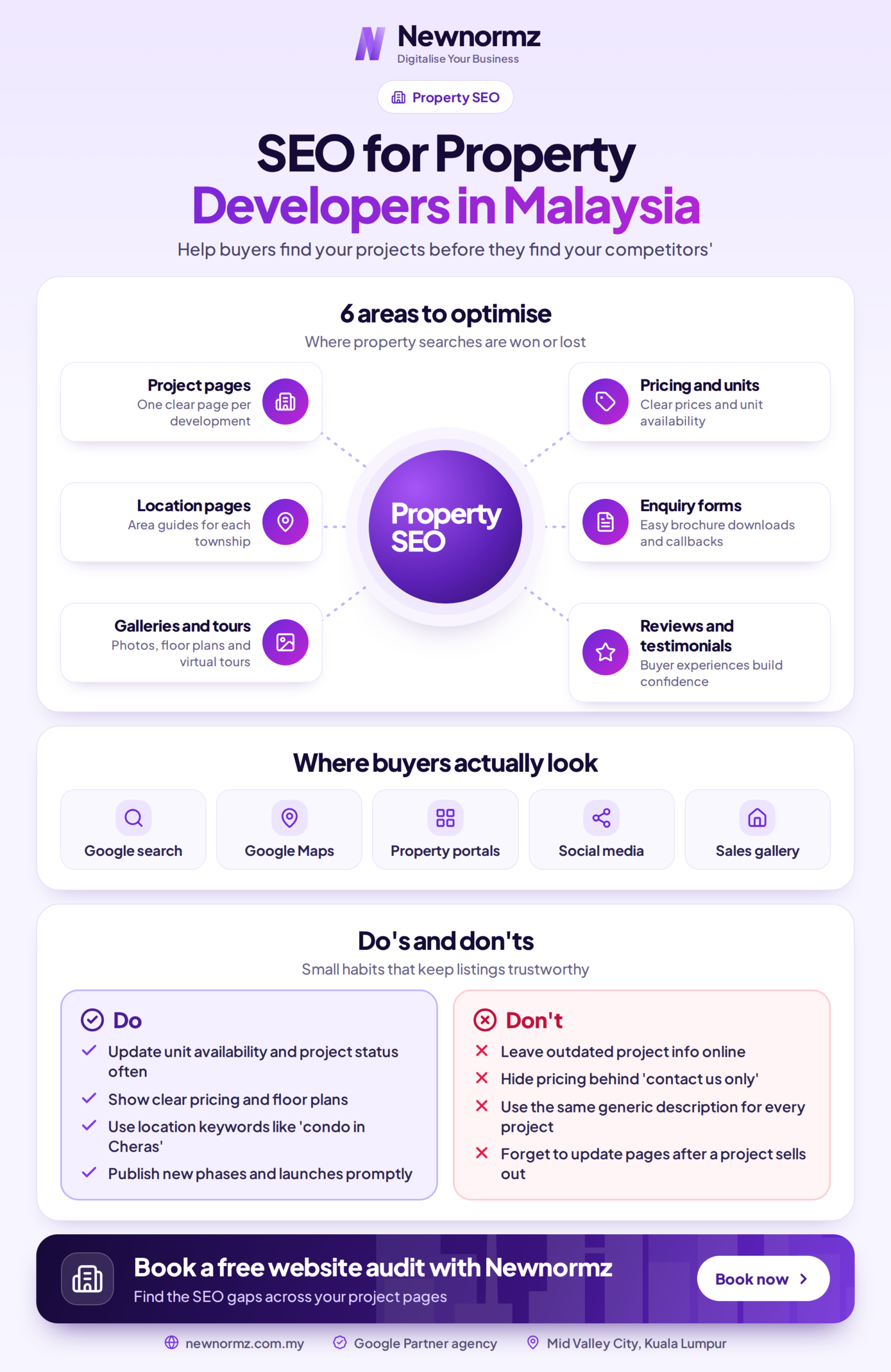
Ranking is only half the job. A property decision plays out over months, so every page needs to capture the enquiry and keep the conversation alive rather than letting an interested buyer bounce. Make it effortless: a short, above-the-fold form for name, phone number and unit type, a WhatsApp button, and an e-brochure that trades a PDF for an email address. Route every lead straight into a CRM so sales can follow up while the buyer is still warm, not days later when they’ve already booked a viewing somewhere else.
What a Launch-Ready Project Page Actually Includes
A landing page for a hypothetical freehold condo launch in Cyberjaya should carry, below the H1, these elements in roughly this order:
- A hero section with the facts buyers scan for first: tenure, price from, built-up size and completion date.
- An above-the-fold lead form capturing name, phone and preferred unit type, plus a WhatsApp button.
- A location and connectivity block with a map and distances to key landmarks, MRT, schools and malls.
- Unit types and floor plans, with the full e-brochure gated behind an email capture.
- Facilities, developer track record and an FAQ covering financing, maintenance fees and handover.
- Schema markup for the residence and offer, so Google can display rich details in search results.
Every one of those elements does double duty: it satisfies what the buyer came to research, and it gives Google the signals needed to rank the page for a term like “freehold condo Cyberjaya”.
Common Mistakes That Cost Developers Enquiries
| Mistake | Why it costs you |
|---|---|
| One page for every project | Google ranks pages, not companies, so cramming launches onto the homepage kills each project’s visibility. |
| No location or area content | Skipping area guides forfeits the large share of searches that carry a location term. |
| Slow, image-heavy pages | With most buyers browsing on mobile, a slow-loading page loses both the ranking and the lead. |
| Weak or buried lead forms | A form buyers have to scroll to find quietly drags conversion down across every campaign. |
| Deleting sold-out project pages | These pages often hold real ranking authority and backlinks; redirect or repurpose them instead. |
Frequently Asked Questions
What is property developer SEO?
It’s the practice of optimising your website so buyers researching new launches find your projects on Google. It covers project and location landing pages, area and buying guides, lead-capture forms and technical health, aimed at capturing demand during the research phase, before a buyer ever reaches a sales gallery.
How long does SEO take to work for a property launch?
Meaningful ranking movement usually takes three to six months, which fits well with the buyer’s long consideration cycle. For a launch, it’s worth optimising the project page before the official reveal so it has time to gain authority. Pages built for one launch also keep working as templates for the next project.
Should developers use SEO or Google Ads?
Both, ideally. Google Ads deliver instant visibility around a launch date, while SEO builds durable rankings that keep converting without a per-click cost. The strongest setup uses SEO content to attract researchers first, then retargets that warm audience with paid ads, so the two channels reinforce each other instead of competing for the same budget.
Do I need a separate page for every project?
Yes. Google ranks individual pages, not companies, so one page per development is essential. Each page can target that project’s specific keywords, tenure, property type and location, which is exactly how buyers search. A single corporate page trying to rank for every launch at once will consistently underperform dedicated pages.
What about sold-out projects? Should those pages be deleted?
No. Sold-out project pages often carry real ranking authority and backlinks, so deleting them throws that value away. Mark the project as sold, redirect the page to an active launch or a relevant area guide, or repurpose it as a completed-project case study that builds your track record with future buyers.
Buyers researching new launches, but not finding yours?
Find out exactly what’s holding your project pages back from ranking
Newnormz has run SEO campaigns across F&B, healthcare, ecommerce, and local services in Malaysia, backed by a performance guarantee of 70 percent of targeted keywords on Google’s first page.
30 minutes, no obligation, just a clear look at your project pages and lead capture.

Bryan Tan is an SEO Specialist and CEO at Newnormz, helping hundreds of businesses achieve first-page rankings on Google. With a passion for driving organic growth, Bryan blends innovative strategies with hands-on experience to optimize websites for maximum visibility. Always at the forefront of the latest SEO insights and trends, he consistently adapts to the evolving digital landscape.