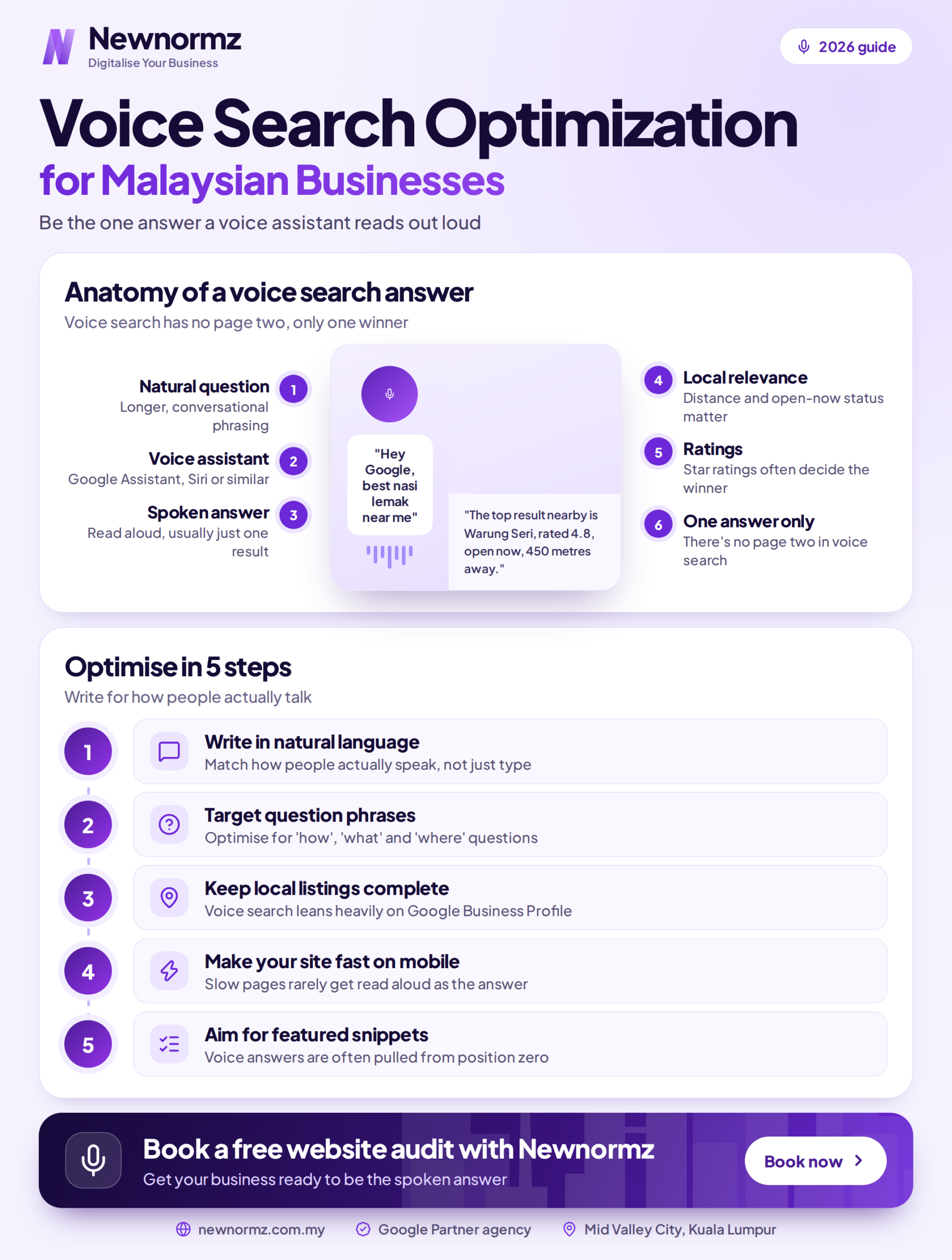
Voice search optimization means structuring your website and business listings so a voice assistant, or an AI tool reading an answer aloud, can confidently pick your business as the single spoken answer to a customer’s question. Unlike typed search, voice usually returns one result, not a page of ten links, so the goal shifts from ranking well to being the answer. For a Malaysian business, that answer is almost always local: someone asking their phone “halal cafe near me open now” is a customer minutes away from walking through your door.
A Simple Way to Think About It
The Friend You’d Ask, Not the Ten Shops You’d Browse
🔇 The Friend Who Rambles
You ask where to eat, and they take five minutes circling before naming a place. Most people stop listening halfway through and just ask someone else.
🎙️ The Friend Who Answers Straight
You ask the same question, and they name one place in their first breath, plus why it works right now. That’s the friend everyone keeps coming back to.
A voice assistant behaves like that second friend: it picks one answer and reads it straight back. The sections below cover exactly how to become the business it picks.
What Is Voice Search Optimization?
Voice search optimization is the practice of preparing your content and listings so a voice assistant, whether that’s Google Assistant, Siri, or an AI tool that speaks answers, can confidently select your business as the answer to a spoken question. It overlaps heavily with answer engine optimization, since both aim to make your content the extracted answer rather than one link among many. Voice adds two extra demands on top of that: the answer has to be short enough to say out loud in a natural way, and local intent shows up constantly, because people mostly ask their phones questions while they’re out and about, not sitting at a desk.
How Voice Search Differs From Typing
The mechanics of a voice query are different enough from a typed one that optimising for one doesn’t automatically win the other. Here’s the practical breakdown.
| Aspect | Typed search | Voice search |
|---|---|---|
| Query style | Short keywords (“seo agency kl”) | Full questions (“who is the best seo agency in kl”) |
| Intent | Broad, research-stage | Local and immediate (“near me”, “open now”) |
| Device | Desktop and mobile | Overwhelmingly mobile |
| What wins | A comprehensive page | A concise answer plus strong local signals |
Why Voice Search Matters for Malaysian Businesses
Malaysia is a mobile-first, multilingual market, and voice search rewards exactly that kind of behaviour. Three things make this worth acting on now rather than later.
1. Voice search is local, and local is commercial
Local business questions make up a large share of voice queries, and a majority of voice searches are used to find a nearby store or restaurant. A query like “halal cafe near me open now” comes from someone who is minutes from a decision, not weeks away from one. If your local SEO foundations and Google Business Profile are solid, you’re the one who gets the visit.
2. The click is disappearing
Voice and AI-spoken answers are part of a bigger shift away from the traditional list of blue links. A large and growing share of Google searches now end without a click at all, because the answer is read out or shown directly on the results page. Being the spoken or displayed answer is becoming one of the only ways left to actually be seen.
3. Speed and mobile are non-negotiable
Voice search happens on phones, where patience runs out fast. A large share of users expect a page to load in around two seconds, and a slow page can lose the answer before it’s ever read aloud. Speed isn’t a nice-to-have here, it functions as a voice ranking factor in practice.
Most Malaysian businesses in your niche have probably not structured any of their content for a spoken answer yet. That gap won’t stay open forever, but for now it means the questions your customers are already asking out loud are often unclaimed.
How to Optimise for Voice Search: 6 Steps
1. Target real spoken questions
Pull the actual questions customers ask from your sales calls, WhatsApp enquiries, and Google Search Console queries. Turn each one into a heading, and write a Bahasa Malaysia version where it makes sense, since mixed-language phrasing often has far less competition than the English equivalent.
2. Answer in one or two sentences first
Put a direct answer, roughly 30 to 50 words, immediately under the question heading, then expand with detail afterward. Assistants read the concise answer, so lead with it and keep the wording conversational rather than formal.
3. Get your local signals right
Keep your Google Business Profile complete and accurate: consistent name, address, phone number, opening hours, and categories across every listing. Most voice queries with local intent are answered straight from these listings, not from your homepage, so this step matters as much as anything you write on the page itself.
4. Add FAQ and structured data
Use FAQPage schema on your question-and-answer blocks so an assistant can identify the exact answer more easily. Schema doesn’t guarantee you get picked, but it makes a well-written answer far easier for a machine to read and trust.
5. Make the page fast and mobile-friendly
Follow Google’s page experience guidance and aim to get your main content loading in around 2.5 seconds. Fast, stable, mobile-friendly pages consistently win spoken answers over slower ones with better content.
6. Write the way people actually speak
Use plain, conversational language and short sentences. This matches how people phrase spoken questions and how assistants read answers back, and as a side effect it also helps you win featured snippets, which voice assistants frequently pull from.
Example: Optimising a Page for a Voice Query
Here’s the same plumber service page written two ways. The first is built for typing, the second for a spoken question. The difference is what an assistant can actually lift and read aloud.
Before: a keyword-style heading with a generic sentence no assistant can read as a clean answer.
<h2>Plumber Kuala Lumpur</h2>
<p>We are a leading plumbing company offering a wide range of
professional plumbing services across Kuala Lumpur and beyond.</p>
After: a conversational FAQ heading matching how people actually speak, followed by a direct, self-contained answer an assistant can read back word for word.
<h3>Where can I find a 24-hour plumber near me in KL?</h3>
<p>Yes, you can reach a 24-hour plumber in Kuala Lumpur. Our team
covers KL and Petaling Jaya round the clock for burst pipes,
blocked drains and water heater faults. Call 03-1234 5678 any
time and we aim to reach most KL addresses within 60 minutes,
including public holidays.</p>
The “after” version mirrors the spoken question in the heading, answers in the first sentence, stays inside a comfortable word count, and names the location clearly. That’s what lets an assistant read it back with confidence as the single best answer.
Common Voice Search Mistakes to Avoid
- Burying the answer. Three paragraphs of preamble means the assistant never finds a concise answer worth reading.
- Ignoring your Google Business Profile. Most local voice results come from listings, so an incomplete or inconsistent profile quietly costs you answers.
- Slow, heavy mobile pages. Speed loses the spoken answer before it’s ever read.
- Writing only for keywords. Voice is full questions, not two-word terms, so keyword-stuffed pages miss the actual intent.
- Skipping Bahasa Malaysia phrasing. You leave low-competition local questions sitting there for a competitor to claim.
The Voice Search Readiness Checklist
Work through this on any page you want read aloud. Tick every box and you’re ahead of most local competitors.
- The page targets a real spoken question, used as the heading.
- A 30 to 50 word answer sits directly under that heading.
- The answer is self-contained and makes sense when read aloud.
- Your Google Business Profile is complete, verified, and consistent everywhere it appears.
- FAQPage schema is implemented and validates correctly.
- The page loads in around 2.5 seconds or less on mobile.
- Local and Bahasa Malaysia variants of the question are covered.
Frequently Asked Questions
What is voice search optimization?
It’s the practice of structuring your content and business listings so voice assistants and AI tools can select and read your answer aloud. Because voice usually returns one spoken result, the goal is to be that single best answer, not just a top-ten ranking.
Is voice search optimization the same as SEO?
No, it builds on SEO but focuses on winning one spoken answer to a natural-language question, with extra weight on concise answers, accurate local listings, and fast mobile pages. You still need a healthy, crawlable site underneath for any of it to work.
How do I optimise for voice search in Malaysia?
Target the real questions customers ask in English and Bahasa Malaysia, answer each in one or two sentences first, keep your Google Business Profile accurate, add FAQ schema, and make your pages fast on mobile. Because local intent is so common, your listings matter as much as your website.
Does schema markup actually help voice search?
Yes. FAQPage and other structured data make it easier for assistants to identify and read the correct answer. Schema doesn’t guarantee selection, but a well-structured answer with schema is far more likely to be chosen than plain, unmarked text.
Which voice assistant should I optimise for first?
Start with Google Assistant, since it draws from Google Search and Google Business Profile, which is what most Malaysian customers already use. The same habits, concise answers, clean listings, and fast pages, also help with Siri and other AI tools that read answers aloud.
The Bottom Line
Voice search rewards the business with the clearest, fastest, best-structured answer and the most accurate local listings, not necessarily the biggest budget. Pick your top customer questions, answer each one in a sentence or two, tidy up your Google Business Profile, add FAQ schema, and speed up your mobile pages. If you’d rather have this handled properly across your site, our SEO service builds exactly this kind of foundation.
Does your site show up when customers speak their search?
Find Out If You’re Voice Search Ready
Newnormz has run SEO campaigns across F&B, healthcare, ecommerce, and local services in Malaysia, backed by a performance guarantee of 70 percent of targeted keywords on Google’s first page.
30 minutes, no obligation, and you’ll leave with a clear voice and mobile readiness fix list.

Bryan Tan is an SEO Specialist and CEO at Newnormz, helping hundreds of businesses achieve first-page rankings on Google. With a passion for driving organic growth, Bryan blends innovative strategies with hands-on experience to optimize websites for maximum visibility. Always at the forefront of the latest SEO insights and trends, he consistently adapts to the evolving digital landscape.