Generative engine optimization (GEO) is the work of making your brand one of the sources that tools like Google AI Overviews, ChatGPT, Gemini and Perplexity pull from when they answer a question in your industry. It doesn’t replace SEO. It’s built on top of it, because these tools mostly draw on pages that are already crawlable, trusted and clearly written. The honest part: no agency can guarantee that ChatGPT will name your brand, just as nobody can guarantee a #1 ranking on Google. What a good GEO service can do is remove the reasons AI systems skip you. That means making your site easy for machines to read, writing answers that can be quoted, and getting your brand mentioned consistently in places those systems already trust.
A Simple Way to Think About It
The Mall Directory vs the Concierge
📋 Listed on the directory board
Your shop is on the mall directory, along with two hundred others. More and more visitors walk straight past the board without reading it.
🛎️ Named by the concierge
A visitor asks the concierge where to go, and the concierge names your shop straight away, because everyone the concierge trusts has said the same thing.
The concierge still reads the directory. The sections below explain how to get onto both, and why you can’t skip the first one to get to the second.
What generative engine optimization actually is
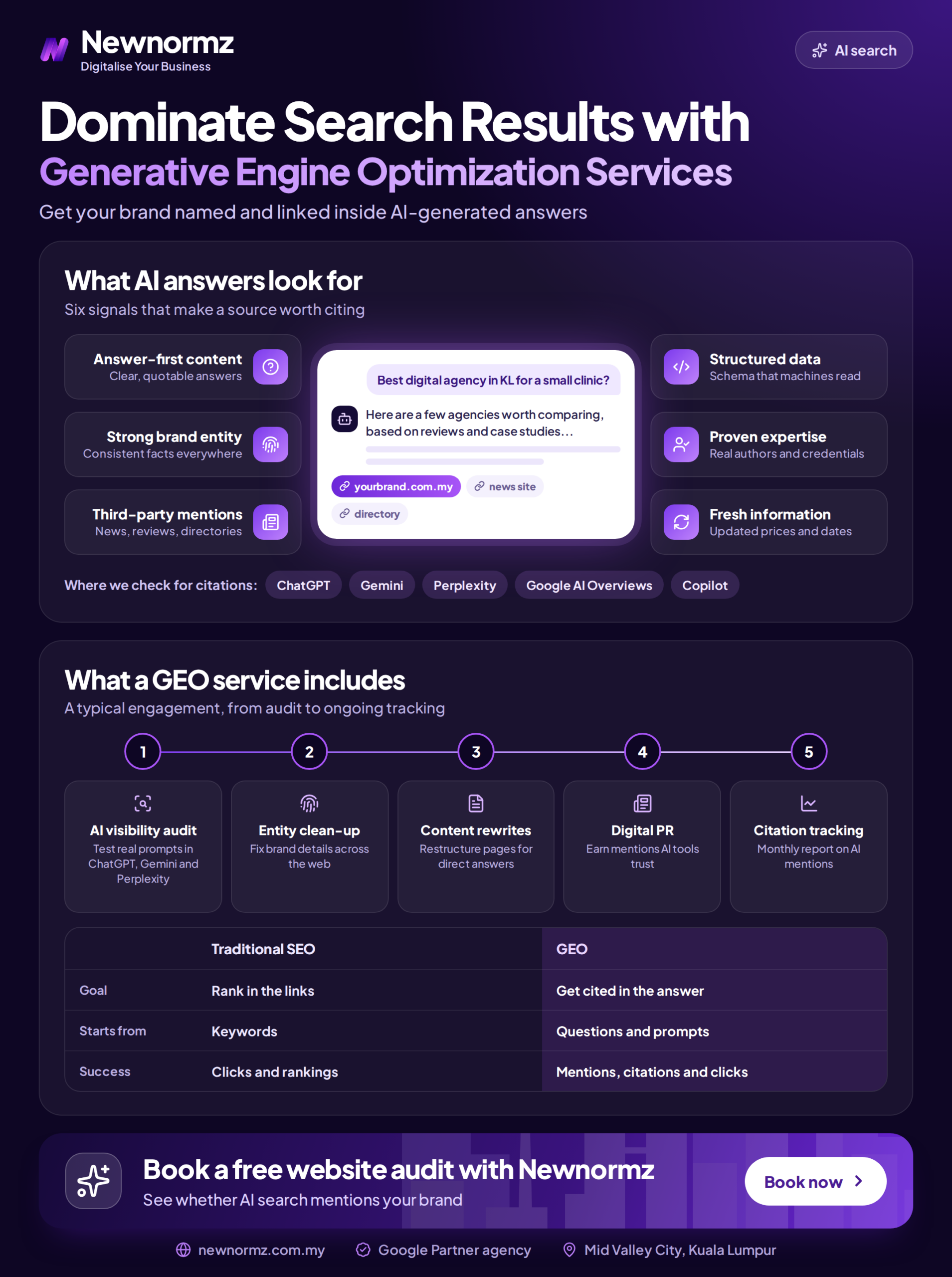
Traditional SEO is about getting a page to rank in a list of links. GEO is about getting your information picked up and repeated when an AI tool writes the answer itself.
Those are related problems, but they aren’t the same. A ranking page gets a click if the searcher chooses it. A cited source gets named inside the answer, sometimes with a link, sometimes without. The person may never visit your site, but they now know your brand as the one the answer mentioned.
The term comes from academic research published in 2023, where researchers tested which content changes made a source more likely to show up in AI-generated answers. Adding clear statistics, citing credible sources and including direct quotations helped. Stuffing in keywords didn’t. That matches what we see in practice: AI tools reward content that states specific, checkable facts plainly.
Why this matters for Malaysian businesses right now
Google holds roughly 93% of the Malaysian search market (Statcounter, May 2026), and Google now shows AI Overviews above the regular results for many queries. So for most Malaysian businesses, the most important AI answer engine isn’t ChatGPT. It’s the box at the top of Google.
The audience is large. Malaysia had 35.4 million internet users at the end of 2025, about 98% of the population (DataReportal Digital 2026 Malaysia). Some of those users now ask ChatGPT or Gemini “which clinic in PJ does X” rather than typing a short keyword into Google. Gartner has forecast that traditional search engine volume will fall 25% by 2026 as people move to AI chatbots. Treat that as a forecast, not a measured fact. The direction is clear though: some discovery now happens inside an AI answer rather than on a results page.
There’s also a language angle most agencies ignore. Your customers ask questions in English, Bahasa Malaysia and Chinese, often mixing all three. If your site only answers in one language, you’re only eligible to be the source for part of those conversations.
GEO vs SEO: what changes and what doesn’t
The fastest way to spot an overhyped GEO pitch is to hear someone say SEO is dead. It isn’t. AI Overviews are built from Google’s own index, and ChatGPT and Perplexity search the live web for many answers. If you can’t be found and trusted in ordinary search, you’re very unlikely to be cited in AI search.
| Area | Traditional SEO | GEO |
|---|---|---|
| Goal | Rank a page in the list of results | Be a named or linked source inside the AI answer |
| Unit of success | A ranking page and a click | A quotable passage and a brand mention |
| Content style | Covers the topic well for a human reader | Same, plus short, direct answers with specific facts that can be lifted cleanly |
| Off-site signals | Backlinks | Backlinks plus consistent mentions of your brand in reviews, directories, news and forums |
| Technical base | Crawlable, fast, indexable pages | The same, plus structured data and not blocking the AI crawlers you want to reach you |
| Measurement | Rankings, impressions, clicks in Search Console | AI referral traffic in analytics, plus regular manual or tool-based checks of which brands AI answers mention |
Look down the right-hand column and most of it is still SEO, done with more care. That’s why a serious GEO engagement usually starts with an SEO service foundation, not a separate “AI package” bolted onto a weak site.
What a GEO service should actually do
Make your site readable to machines
Start with the basics: pages that load properly, a clean sitemap, and no important content hidden behind scripts that crawlers struggle to render. Then check your robots.txt. Many Malaysian sites block AI crawlers such as GPTBot or PerplexityBot by accident because of a security plugin default. If you want to appear in those tools, you have to let them in.
One detail often gets mixed up. Blocking Google-Extended controls whether Google can use your content for Gemini training. According to Google, it doesn’t remove you from AI Overviews, which rely on regular Googlebot crawling. Know which setting does what before you change anything.
Structured data (schema markup in JSON-LD) tells machines exactly what your business is, what you offer, where you operate and how to contact you. It doesn’t guarantee a citation. It does remove guesswork, and AI systems are more likely to repeat information they can read without guessing.
Write answers that can be quoted
AI tools pull passages, not whole pages. A paragraph that opens with a clear answer, gives a specific fact (a price range in RM, a timeline, a requirement) and then explains it is far easier to lift than three paragraphs of warm-up.
In practice, that means rewriting key service pages and FAQs so each important question has a short, standalone answer. It also means publishing in the languages your customers actually search in, not just English.
Build consistent mentions outside your own site
AI answers tend to reflect consensus. If reputable Malaysian publications, industry directories, review platforms and your Google Business Profile all describe your business the same way, you become the safe answer. If your address, phone number or service list differs from one platform to the next, you look less certain, and uncertain sources get left out.
For businesses serving a specific area, this overlaps heavily with local SEO: accurate listings, genuine reviews and local press mentions do double duty in both Google Maps and AI answers.
Measure what can be measured, and be honest about the rest
AI visibility is harder to track than rankings. Google Search Console folds AI Overview activity into its overall performance data rather than giving you a clean, separate report. What you can track: referral visits from chatgpt.com, perplexity.ai and similar sources in your analytics, leads that say they found you through an AI tool, and regular checks of the questions your buyers ask to see which brands get named. Any agency showing you a precise “AI visibility score” should be able to explain exactly how it’s calculated.
Red flags when you’re hiring a GEO agency
GEO is new enough that the pitches have gotten ahead of the evidence. Here’s how to tell a real practitioner from someone who just renamed their SEO package.
| What they say | Why it’s a problem | What to ask instead |
|---|---|---|
| “We guarantee ChatGPT will recommend you.” | Nobody controls what a language model says. AI answers change from one conversation to the next. | “Which specific changes will you make, and how will we track whether they’re working?” |
| “SEO is dead, you only need GEO now.” | AI Overviews come from Google’s index, and many AI tools search the web live. Weak SEO means weak GEO. | “How does your GEO work connect to our existing rankings?” |
| “We’ll get you into the AI’s training data.” | No outside agency controls what model makers train on or when they retrain. | “What are you doing for live retrieval, which is what AI search tools actually use?” |
| A proprietary score with no explanation | If you can’t check the method, you can’t tell whether things are improving. | “Show me the raw prompts you test and the answers they returned.” |
Where proven SEO results fit in
We won’t claim case-study numbers for AI citations that we haven’t measured. What we can show is the foundation that AI answers draw on: sustained organic visibility in Google.
For Oriental Kopi, a two-year SEO campaign produced 43,300 in traffic growth, 6.31 million impressions, 468,000 clicks and 24,500 more ranking keywords. For Sunway Medispa, a six-month campaign delivered a 700% increase in traffic, 54,000 impressions and 70% more keywords ranking. Times Parking reached 528,000 impressions and 416 ranking keywords in six months.
Brands with that much indexed, trusted, frequently shown content are the kind AI systems already come across again and again when they build an answer. That’s the realistic way to think about GEO: it isn’t a shortcut around authority. It’s a way to make sure the authority you’ve built is easy for machines to read and repeat.
Frequently asked questions
Can I do GEO without doing SEO?
Not effectively. Google’s AI Overviews come from its search index, and ChatGPT and Perplexity often run web searches before they answer. If your pages aren’t indexed, trusted and ranking for related queries, there’s little for these tools to pick up. Think of GEO as an extra layer on top of SEO, not a replacement for it.
How long does generative engine optimization take to show results?
Expect months, not weeks. Technical fixes such as unblocking AI crawlers or adding schema can be done quickly. Building the consistent mentions and authority that make AI tools confident in naming you takes about as long as good SEO does. Anyone promising AI visibility in days is guessing.
Does schema markup guarantee my brand gets cited?
No. Schema helps machines understand what your business is and what you offer, which removes one reason to skip you. Whether you get cited still depends on the quality of your content and how much the wider web trusts and mentions your brand.
How do I know if AI tools are already mentioning my business?
Check your analytics for referral traffic from chatgpt.com, perplexity.ai and gemini.google.com. Then ask those tools the questions your customers actually ask, in English, Bahasa Malaysia and Chinese, and note which brands come up. Repeat this regularly, because answers change over time.
Should I block AI crawlers to protect my content?
That’s a business decision, not a technical default. Blocking crawlers like GPTBot means those tools can’t read your site, so they’re unlikely to cite it. For most service businesses that want to be found, letting them in is worth more than keeping them out. Check your settings deliberately rather than leaving it to a plugin’s default.
Is AI search skipping your brand?
Find out what’s stopping Google and AI tools from citing you
Newnormz has run SEO campaigns across F&B, healthcare, ecommerce, and local services in Malaysia, backed by a performance guarantee of 70 percent of targeted keywords on Google’s first page.
30 minutes, no obligation, including a check of how AI search currently sees your site.

Bryan Tan is an SEO Specialist and CEO at Newnormz, helping hundreds of businesses achieve first-page rankings on Google. With a passion for driving organic growth, Bryan blends innovative strategies with hands-on experience to optimize websites for maximum visibility. Always at the forefront of the latest SEO insights and trends, he consistently adapts to the evolving digital landscape.