Logistics companies in Malaysia rank on Google by being specific. Each service gets its own page, and each important location gets its own page: sea freight, air freight, customs clearance, warehousing in Shah Alam, trucking to Singapore. Your Google Business Profile has to be fully set up, your site has to load quickly on a phone, and your content has to answer what a procurement manager asks before they shortlist a provider. Most freight and supply chain websites do none of this. They have one generic “Our Services” page that tries to rank for everything and ends up ranking for nothing. Fix that structure and you can expect early ranking movement in roughly 3 to 6 months, depending on your site’s condition and how competitive your services are. No one can honestly guarantee a specific position on Google, and Google has said so publicly. What you can control is whether Google understands what you do and where you do it.
A Simple Way to Think About It
Two Warehouses on the Same Road
🚫 The Unmarked Gate
A huge warehouse in Pulau Indah with no sign on the gate. Every day, lorries drive straight past it looking for exactly what’s inside.
✅ The Clearly Signed Gate
A smaller warehouse down the road has a sign saying what it handles and who it serves. That’s the one the drivers turn into.
The sections below show how to put that sign up for Google, one service and one location at a time.
Your Next Logistics Client Is Already Searching
Malaysia had 35.4 million internet users at the end of 2025, which is 98% of the population (DataReportal, Digital 2026 Malaysia). Google handles about 93% of all search in the country (Statcounter, May 2026). So when a business needs a logistics provider, it almost always searches Google.
These people aren’t browsing for fun. A manufacturer needs faster customs clearance on imports. An ecommerce brand is comparing fulfilment partners before peak season. A distributor wants warehouse space closer to the Klang Valley, Penang or Johor. Each of them builds a shortlist from what they find on page one. If you don’t show up there, you’re off the list before your sales team knows the buyer exists.
Referrals still matter in this industry. But a referred buyer usually checks you on Google too. If all they find is a thin website with one vague services page, the referral loses some of its weight.
What they actually type
Logistics searches are specific. People rarely type “logistics company”. They type a service plus a place, or a service plus a route: “freight forwarder Port Klang”, “customs broker Penang”, “gudang untuk disewa Shah Alam”, “lori sewa Johor Bahru”, or Chinese-language searches from importers who deal with suppliers in China. Every one of those searches has its own results page. Every one is a separate chance to rank, and you need a page that matches it.
One Service, One Page: The Structure That Ranks
The most common mistake on Malaysian logistics websites is putting every service on one page. Air freight, sea freight, warehousing, customs and last-mile delivery all end up in one long list. Google can’t tell what that page is mainly about, so it doesn’t rank the page strongly for any of them.
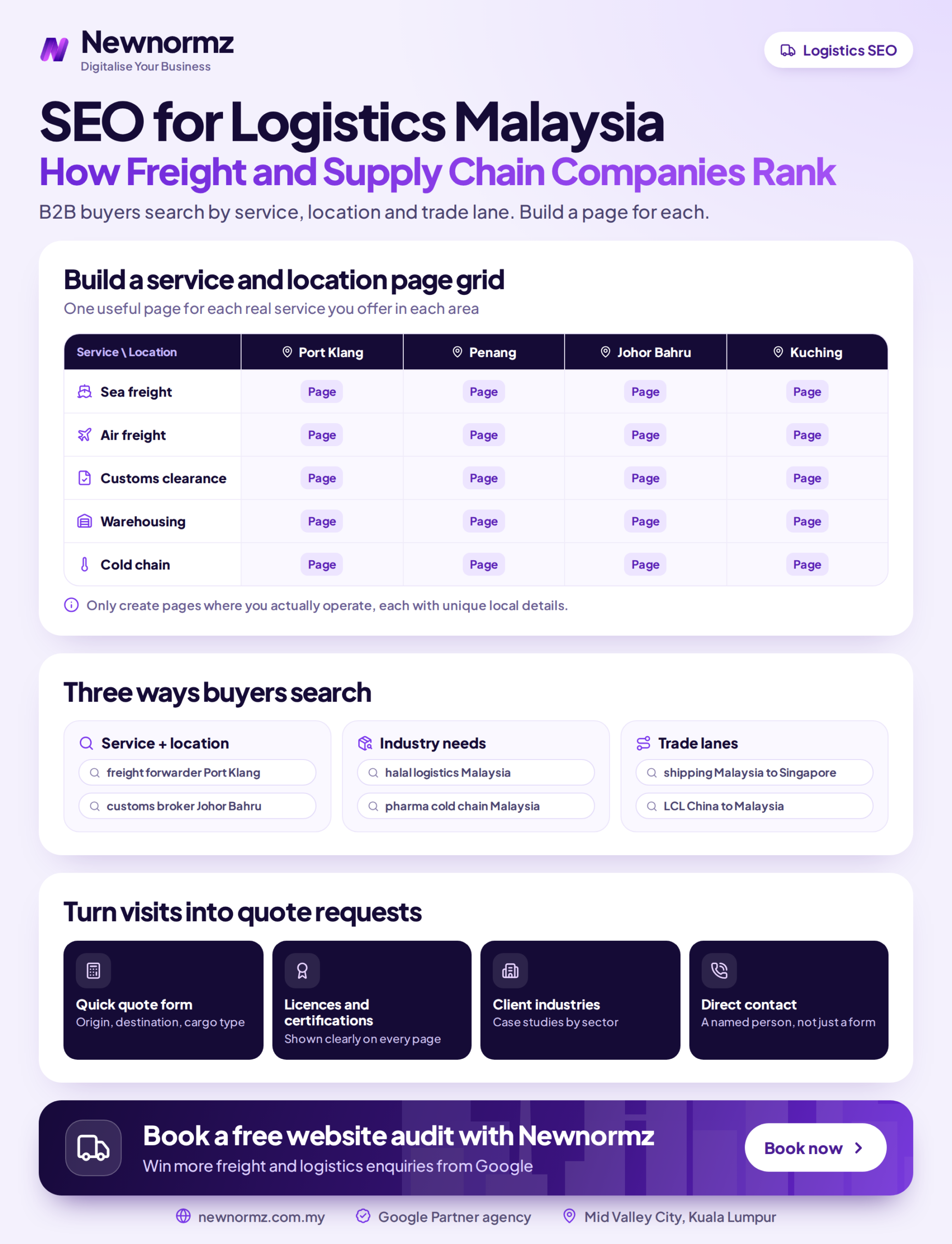
The fix is a site structure that mirrors how buyers search:
| Example search | Page that should answer it | What the page needs |
|---|---|---|
| sea freight forwarder Malaysia | Sea freight service page | FCL and LCL options, ports you use, typical transit lanes, how to request a quote |
| customs clearance agent Penang | Customs brokerage page, Penang section or location page | Penang Port and Prai coverage, documents you handle, who to contact locally |
| warehouse rental Shah Alam | Warehousing location page | Facility address, storage types, access to major highways, photos of the real site |
| cross border trucking Malaysia Singapore | Cross-border trucking page | Route details, border handling, cargo types accepted |
| 3PL fulfilment for ecommerce | Ecommerce fulfilment page | Pick and pack process, marketplace integrations, returns handling |
Don’t create a location page for every town in Malaysia. Build them only where you actually operate or where you have a real reason to serve buyers. A page for a city you don’t cover won’t hold its rankings, and the buyer who lands on it will feel misled.
Local Visibility: Ports, Industrial Areas and the Map Pack
Logistics is a local business. A client in Subang Jaya wants a warehouse nearby. A manufacturer in Prai wants a forwarder who knows Penang Port well. When proximity matters, Google shows map results above the regular listings, and those come from your Google Business Profile.
Good local SEO for a logistics company comes down to a few things done properly:
- A complete Google Business Profile for each real facility. Correct categories, accurate hours, real photos of your warehouse and fleet, and reviews from actual clients.
- Location terms that buyers use. Port Klang, Westports, Pulau Indah, Pasir Gudang, Tanjung Pelepas, Prai, Batu Kawan and Bayan Lepas belong in your content wherever they’re genuinely relevant to your operations.
- Consistent business details everywhere. Your name, address and phone number should match on your website, your profile and industry directories.
Five Gaps We Keep Finding on Logistics Websites
When we audit Malaysian freight, warehousing and supply chain websites, the same problems come up again and again. None of them are hard to fix. They just tend to get ignored because the website was built once and never touched again.
| Gap | Why it hurts | The fix |
|---|---|---|
| One catch-all services page | Google can’t match it confidently to any single search | A dedicated page per core service |
| Slow, image-heavy pages | Buyers on mobile leave before the page loads, and rankings suffer | Compress images, clean up outdated code, test on real phones |
| No local terms | You miss the port and industrial area searches that bring in the best leads | Name the ports, zones and routes you actually serve |
| Template content | Generic copy reads like every other forwarder, so nothing sets you apart | Write about your real fleet, facilities, lanes and processes |
| Neglected Google Business Profile | Competitors take the map results for nearby searches | Claim it, complete it, and keep photos and reviews current |
Content That Reaches Buyers Before They Shortlist
Logistics purchases are researched. Before a procurement manager sends an RFQ, they’re often trying to understand something first. Those questions are search queries, and the companies that answer them well get noticed early.
Good topics come straight from your sales team’s inbox. What do prospects ask on the first call? For example:
- How to choose a freight forwarder for imports from China
- Which documents customs clearance in Malaysia requires
- FCL vs LCL: which one makes sense for your shipment size
- What to check before signing a warehousing contract
- Realistic delivery timelines from Port Klang to East Malaysia
Each article should answer the question properly and then link to the service page that solves the problem. That’s how informational traffic turns into enquiries. Volume doesn’t matter much here. Ten genuinely useful articles written from your operational experience will do more than fifty generic ones.
How a Logistics SEO Campaign Actually Runs
A sensible campaign starts with foundations, not content volume. Adding articles to a site Google can’t crawl properly, or to a structure that confuses it, is wasted effort.
| Stage | What happens | What you should see |
|---|---|---|
| Audit and roadmap | Review site structure, current rankings, competitors and technical health | A clear priority list tied to your core services and locations |
| Keyword mapping | Match service, location and Bahasa Malaysia search terms to specific pages | Every target search has one page responsible for it |
| Technical fixes | Speed, mobile performance, crawl errors, URL structure, schema markup, duplicate pages | Google can read and index your pages properly |
| Service and location pages | Rewrite or build pages around search intent and trust signals | Early ranking movement, often within 3 to 6 months |
| Content and local signals | Buyer-question articles, Google Business Profile work, citation checks | Rankings that compound and more qualified enquiries over time |
To set expectations, here’s a real example from another service business. Times Parking, a parking management operator, ran a 6-month SEO campaign with us and reached 528,000 impressions, 416 ranking keywords and 31.5K clicks. That isn’t a logistics company, and your numbers will depend on your market, your site and your competition. What it shows is that a B2B-style operator with a clear structure can build real search visibility within six months.
Measure Enquiries, Not Just Rankings
Ranking first for a search nobody makes is pointless. For a logistics company, the useful numbers are:
- Rankings for the specific service and location searches you mapped
- Organic traffic to service pages, not just to the blog
- Quote requests, calls and WhatsApp enquiries that come from Google
- How many of those enquiries turn into qualified opportunities
Make sure your enquiry forms and call buttons are tracked from day one. Otherwise, six months from now, you’ll know traffic went up but you won’t be able to say whether it brought in business.
Frequently Asked Questions
How long does SEO take for a logistics company in Malaysia?
Most logistics websites see early ranking movement within 3 to 6 months. The exact timeline depends on your site’s technical condition, how many services you target and how strong the competition is for those searches. Lasting results build over a longer period.
Can a small logistics company compete with the big players on Google?
Yes, if you’re specific. Large generalist providers often have weak pages for niche services, particular routes or particular industrial areas. A smaller company with a well-built page for exactly that search can outrank them there.
Do I need a new website before starting SEO?
Not always. Start with an audit. Many logistics sites can be fixed with technical work, a better page structure and new content. A rebuild only makes sense when the existing platform itself is the bottleneck.
Should I target Bahasa Malaysia and Chinese-language searches?
If your buyers search that way, yes. Many SME owners and importers search in Bahasa Malaysia or Chinese. Check real search data for your services first, then build content in those languages where the demand is there.
What makes logistics SEO different from general SEO?
Logistics buyers search by service, location and route all at once, and they research carefully before committing. That means you need tighter keyword mapping, location pages tied to real operations, and content written for procurement decisions rather than casual readers.
Are shippers finding your competitors first?
Get your freight and warehousing services in front of the buyers already searching for them.
Newnormz has run SEO campaigns across F&B, healthcare, ecommerce, and local services in Malaysia, backed by a performance guarantee of 70 percent of targeted keywords on Google’s first page.
30 minutes, no obligation, and a clear view of which service and location searches you’re missing.

Bryan Tan is an SEO Specialist and CEO at Newnormz, helping hundreds of businesses achieve first-page rankings on Google. With a passion for driving organic growth, Bryan blends innovative strategies with hands-on experience to optimize websites for maximum visibility. Always at the forefront of the latest SEO insights and trends, he consistently adapts to the evolving digital landscape.