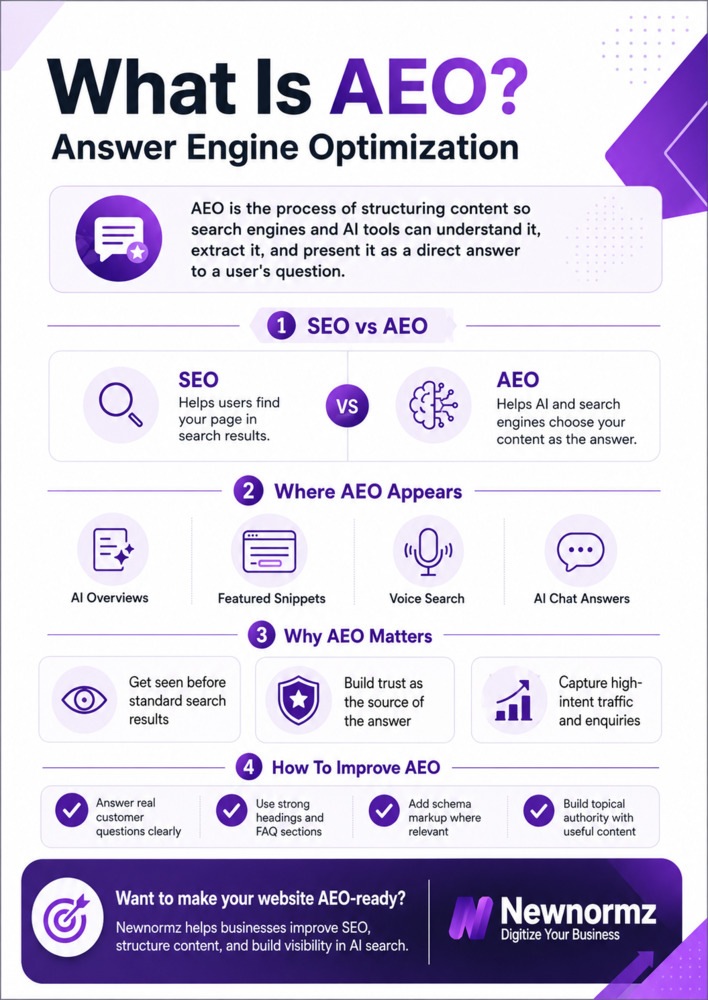
Answer Engine Optimization (AEO) is the practice of structuring your content so search engines and AI tools can extract a direct answer from it and show that answer to the user. Instead of competing only for a blue link, AEO makes your brand the answer inside Google AI Overviews, featured snippets, People Also Ask boxes, voice results and AI assistants such as ChatGPT and Gemini.
This matters because the click is disappearing. In the first four months of 2026, 68.01% of Google searches in the United States ended without a click, up from 60.45% in 2024, according to SparkToro research using Similarweb clickstream data. Your customer gets their answer on the results page. If that answer does not mention you, you are invisible, no matter how well you rank.
Key Takeaways
- AEO makes your content the answer, not just a ranking link. It optimises for AI Overviews, snippets, voice and AI assistants.
- The click is vanishing. 68.01% of US Google searches ended without a click in early 2026, and click-through rates drop by nearly 60% when an AI Overview appears.
- AEO is not a replacement for SEO. It sits on top of it. You still need a crawlable, authoritative site.
- AEO and GEO are different. AEO wins the specific answer. GEO wins the recommendation inside AI-generated results.
- Answer first, in 40 to 60 words, directly under a question heading. This single habit is the highest-leverage change most Malaysian sites can make.
- Malaysia is an open field. Most local competitors have not started, so the questions in your niche are still unclaimed.
Table of Contents
- Who This Guide Is For
- What Is AEO (Answer Engine Optimization)?
- AEO vs SEO vs GEO: How They Differ
- Why AEO Matters for Malaysian Businesses in 2026
- 5 Core Principles of How AEO Works
- The Newnormz AEO Checklist
- How to Measure AEO Success
- Common AEO Mistakes and Limits
- Example: Answer-First vs Buried
- Frequently Asked Questions About AEO
Who This Guide Is For
This guide is written for Malaysian business owners and marketing managers who already have a website, are getting some organic traffic, and want to stay visible as search shifts to AI answers. It assumes basic familiarity with SEO but no technical background.
It covers what AEO is, how it differs from SEO and GEO, the five principles that make content quotable, and a checklist you can act on this week. It does not cover paid search, technical server configuration, or how to build an SEO strategy from zero. If you have no organic foundation yet, start with SEO services in Malaysia before layering AEO on top.
What Is AEO (Answer Engine Optimization)?
Answer Engine Optimization is the process of optimising content so it can be selected, extracted and displayed as the direct answer to a user’s question. An answer engine is any system that responds with an answer rather than a list of links. That includes Google AI Overviews and featured snippets, voice assistants, and AI chat tools such as ChatGPT, Google Gemini, Perplexity and Microsoft Copilot.
Traditional SEO asks how you rank a page. AEO asks a sharper question: if a machine had to answer this in two sentences, would it use yours?
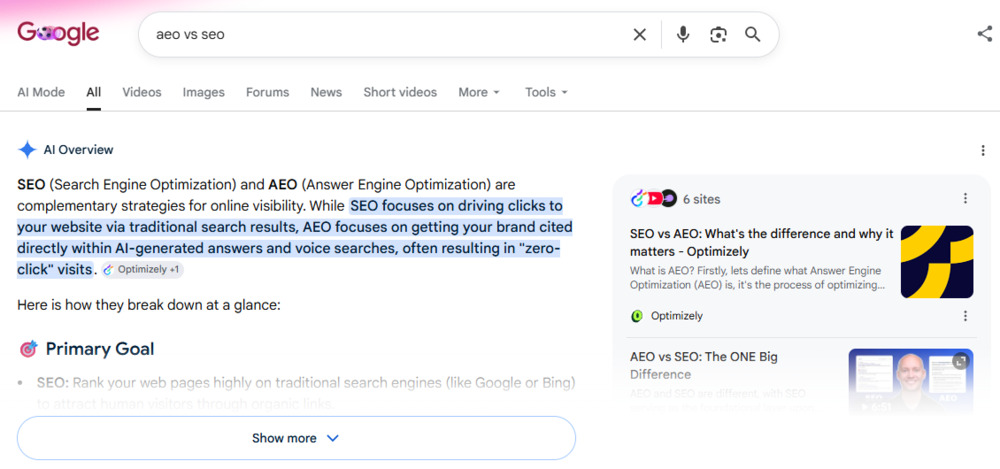
In practice, AEO focuses on four things:
- Question targeting. Optimising for the real questions people ask, not just short keywords.
- Extractable answers. A clear, self-contained answer a machine can lift without the rest of the page.
- Structure. Headings, lists, tables and schema that make the answer easy to parse.
- Trust. Proving, through expertise and corroboration, that your answer is worth quoting.
AEO vs SEO vs GEO: How They Differ
These three get used interchangeably, and that confusion costs money when you brief an agency. Here is the clean distinction.
| Aspect | SEO | AEO | GEO |
|---|---|---|---|
| Goal | Rank a page in results | Become the extracted answer | Be recommended inside AI results |
| Target | Keywords | Questions | Entities and topics |
| Surface | Blue links, Map Pack | Snippets, PAA, voice, AI Overviews | ChatGPT, Gemini, Perplexity |
| Core lever | Keywords, links, technical health | Structure, schema, concise answers | Entity strength, topical authority, corroboration |
| Wins when | You hold position 1 to 10 | A machine quotes your sentence | An AI names your brand |
The shorthand: SEO earns the position, AEO wins the sentence, GEO wins the shortlist. Most Malaysian businesses need all three, delivered together. That is what our GEO and AEO agency services are built around.
Why AEO Matters for Malaysian Businesses in 2026
1. The click is disappearing
The zero-click shift is measurable. Alongside the 68.01% zero-click rate, AI Overviews now appear on more than 20% of Google searches, and when one appears, click-through rates drop by nearly 60%. SparkToro’s analysis also found that fewer than one third of Google searches now send a click to the open web. A separate Pew Research study of 900 US adults found users clicked a traditional link just 8% of the time when an AI summary appeared, versus 15% when it did not. Ranking without being quoted is becoming a silent loss.

2. Buyers now research with AI before they ever reach you
This is no longer an early-adopter habit. In the 6sense 2025 B2B Buyer Experience Report, 94% of buyers used generative AI tools during their purchase process. The habit scales fast: ChatGPT reached 100 million monthly active users within two months of launch, the fastest-growing consumer application in history. If an AI assistant is shaping a shortlist before a prospect visits your site, being absent from that answer removes you from consideration entirely.
3. AI-referred visitors are better visitors
The traffic AEO earns tends to convert. Adobe Digital Insights found that during the 2025 holiday season, AI referrals converted 31% better than non-AI traffic, and SE Ranking reported that visitors arriving from AI search tools spend 68% more time on site than those from traditional organic search. Fewer clicks, but warmer ones, because the buyer arrives already partly convinced.
4. Malaysian competitors have not started
Most Malaysian businesses are still optimising for two-word keywords while their customers ask full questions, often mixing English and Bahasa Malaysia, and often with local intent attached such as “near me”, “in KL” or “harga berapa”. That gap is the opportunity. The questions in your niche are, for now, unclaimed.
Want to know which answers in your market are still unclaimed? Newnormz runs a free SEO audit and website health check that pinpoints exactly what is holding your rankings back. Get your free website health check.
5 Core Principles of How AEO Works
1. Structure content around questions
Start from real questions, not keyword lists. Mine People Also Ask boxes, your sales inbox, WhatsApp enquiries and Google Search Console queries. Make the H2 or H3 the literal question, for example “How much does AEO cost in Malaysia?”. This gives the engine an unambiguous handle to match against the query. In Malaysia, capture the Bahasa and mixed-language versions too, because they carry far less competition.
2. Provide direct, concise answers first
Put the answer immediately under the question heading, in 40 to 60 words, before any storytelling. Then expand with detail and proof underneath for the humans who keep reading. This is the highest-leverage change most sites can make, because every major engine extracts from the opening passage.
3. Use structured data and schema markup
Schema hands a machine the answer on a plate. Prioritise FAQPage for question blocks, HowTo for step-by-step guides, Article with a named author, and Organization plus LocalBusiness so your entity is unambiguous. Schema will not rescue a weak answer, but it reliably helps a good one get parsed correctly.
4. Write in plain, accessible language
Short paragraphs of three to five sentences. Bulleted steps for processes. Tables for comparisons. If your answer is a list, format it as a list. Answer engines lift structured, plainly worded content far more readily than dense prose, and so do busy buyers.
5. Build topic authority across multiple pages
A single page rarely wins. Answer engines favour sources that demonstrate depth across a topic and are corroborated elsewhere. Build a cluster of related answers, keep your business details consistent across your Google Business Profile and directories, and earn mentions on independent sites. If a claim exists only on your own site, an AI has little reason to trust it.
The Newnormz AEO Checklist
Work through this on any page you want quoted. If you can tick every box, you are ahead of most Malaysian competitors.
- The page targets a real question, and that question is the H2 or H3.
- The answer appears in the first 40 to 60 words under that heading.
- The answer is self-contained and makes sense lifted out of context.
- Paragraphs run three to five sentences; processes use numbered lists.
- Comparisons are in a table, not prose.
- FAQPage or HowTo schema is implemented and validates.
- The page has a named author with real credentials.
- Claims are backed by a cited source or first-party data.
- Business name, address and phone are consistent everywhere.
- Bahasa Malaysia and local variants of the question are covered.
- The page has been updated within 12 months.
How to Measure AEO Success
AEO breaks the old reporting model, because a win often produces no click. Track these instead:
- Snippet and PAA ownership for your target questions.
- AI Overview citations. Check whether your domain is cited for priority questions.
- AI assistant mentions. Ask ChatGPT, Gemini and Perplexity your key commercial questions monthly and record whether your brand appears.
- Impressions on question queries in Google Search Console, even where clicks stay flat.
- Branded search volume. When AI recommends you, people search your name next. This is usually the first visible sign AEO is working.
Common AEO Mistakes and Limits
- Burying the answer. Three paragraphs of preamble and the engine never finds it.
- Schema without substance. FAQ schema on weak answers will not save you.
- Fabricating claims or reviews. Answer engines cross-check. Unverifiable claims damage trust and can get pages suppressed.
- Ignoring traditional SEO. If your site cannot be crawled or has no authority, there is nothing to quote.
Where AEO does not help. It is a poor fit for purely transactional queries where the user wants to buy immediately, and it will not fix a product or pricing problem. It also has limits in Malaysia specifically: most published zero-click and AI-adoption data comes from US and global samples, so treat the numbers above as directional for the Malaysian market rather than local measurements.
Example: Answer-First vs Buried
Take one common question, “How much does AEO cost in Malaysia?”, and see how the same information wins or loses depending on where the answer sits.
Before: “Pricing is one of the most common things clients ask us about, and it is a fair question because every agency seems to quote differently. Before we talk numbers, it helps to understand that AEO is not a single service but a mix of research, writing, schema and ongoing measurement. With all of that in mind, most Malaysian businesses pay somewhere in the region of RM2,000 to RM6,000 a month.” The number is real, but it is buried under three sentences of preamble, so an engine scanning the opening passage cannot extract a clean answer and skips your page.
After: “AEO in Malaysia typically costs between RM2,000 and RM6,000 per month, depending on how many questions you target and whether schema and content production are included. Smaller single-page projects can start near RM1,500, while multi-page authority builds run higher. Most agencies price it as a monthly retainer rather than a one-off fee.”
The After version is 52 words, sits immediately under the question heading, and stands alone without the rest of the page. That is exactly what Google AI Overviews and Perplexity quote, because they lift the first self-contained passage that answers the query. The Before version says the same thing but hides it, so the machine never finds it.
Frequently Asked Questions About AEO
What does AEO stand for?
AEO stands for Answer Engine Optimization. It is the practice of structuring content so search engines and AI tools can extract it and present it as the direct answer to a user’s question, in formats like AI Overviews, featured snippets and voice results.
Is AEO the same as SEO?
No. SEO optimises to rank a page in search results, while AEO optimises to become the answer that gets quoted in snippets, AI Overviews and AI assistants. AEO builds on SEO rather than replacing it, so you need both working together.
What is the difference between AEO and GEO?
AEO focuses on winning the direct answer to a specific question, usually in snippets, voice and AI Overviews. GEO, or Generative Engine Optimisation, focuses on getting your brand cited and recommended inside AI-generated results. AEO wins the sentence, GEO wins the shortlist.
Does AEO still matter if nobody clicks?
Yes. Being named in the answer builds trust and drives branded searches and direct enquiries later. Adobe Digital Insights found AI referrals converted 31% better than non-AI traffic, so the fewer clicks you do get tend to be warmer and closer to buying.
How long does AEO take to work?
Snippet and People Also Ask wins can appear within a few weeks on low-competition questions. Consistent citation in AI Overviews and AI assistants usually takes a few months, because it depends on entity strength and corroboration that build over time.
Do I need schema markup for AEO?
It is not strictly mandatory, but it helps significantly. FAQPage, HowTo, Article, Organization and LocalBusiness schema make your content far easier for machines to interpret and quote correctly, which improves your odds of being selected as the answer.
How do I know if AI is recommending my business?
Ask the assistants directly. Put your key commercial questions into ChatGPT, Gemini and Perplexity and record whether your brand appears and how it is described. Track this monthly alongside your snippet ownership and branded search volume in Google Search Console.
Is AEO worth it for a small business in Malaysia?
Yes, and arguably more so. Most Malaysian competitors have not started, so the questions in your niche are often unclaimed. A small business that answers its market’s real questions clearly can win answers that far larger competitors have ignored.
Build an AEO-Ready Website with Newnormz
Most agencies will still sell you rankings. We build for the answer as well as the position, combining traditional SEO with AEO and GEO so your brand shows up when a customer asks Google, ChatGPT or Gemini who to trust. Explore our GEO and AEO agency services in Malaysia, or see the wider picture in our guide to AI SEO in Malaysia.
Get Your Website Ready for the AEO Shift
We opened with a question: what is Answer Engine Optimization? The short answer is that it is how you stay visible when search stops sending clicks. With 68.01% of US searches already ending without one, and 94% of B2B buyers researching through generative AI, the businesses that win in 2026 will not be the ones with the most keywords. They will be the ones whose answers are clearest, best structured and most trusted.
Your next step is small. Pick the single question your customers ask most, put a 40 to 60 word answer directly under it as a heading, add FAQ schema, and work down the checklist above. Then repeat it for the next question.
If you would rather have it done for you, book a free SEO audit with Newnormz and we will show you exactly which answers in your market are still unclaimed.
Get a Free Website Health Check from Newnormz
Understanding AEO is one thing; knowing which of your pages AI can actually quote is another. Our team will audit your site’s AI visibility, schema and answer structure, indexing and technical health, show you exactly what is costing you rankings and enquiries, and hand you a clear, prioritised fix list. No obligation, no jargon.
Request your free SEO audit and website health check, or explore our SEO services in Malaysia.

As the Core Strategists at Newnormz, we don’t just follow digital trends, we engineer them. Our team bridges the gap between technical precision and creative growth, ensuring that every SEO campaign, ad spend, and web interface serves a single purpose: scaling your business with measurable ROI. By blending data-driven insights with a deep understanding of market psychology, we transform digital presences into high-performance engines. At Newnormz, our strategy is simple: Think bigger, optimize faster, and lead the norm.