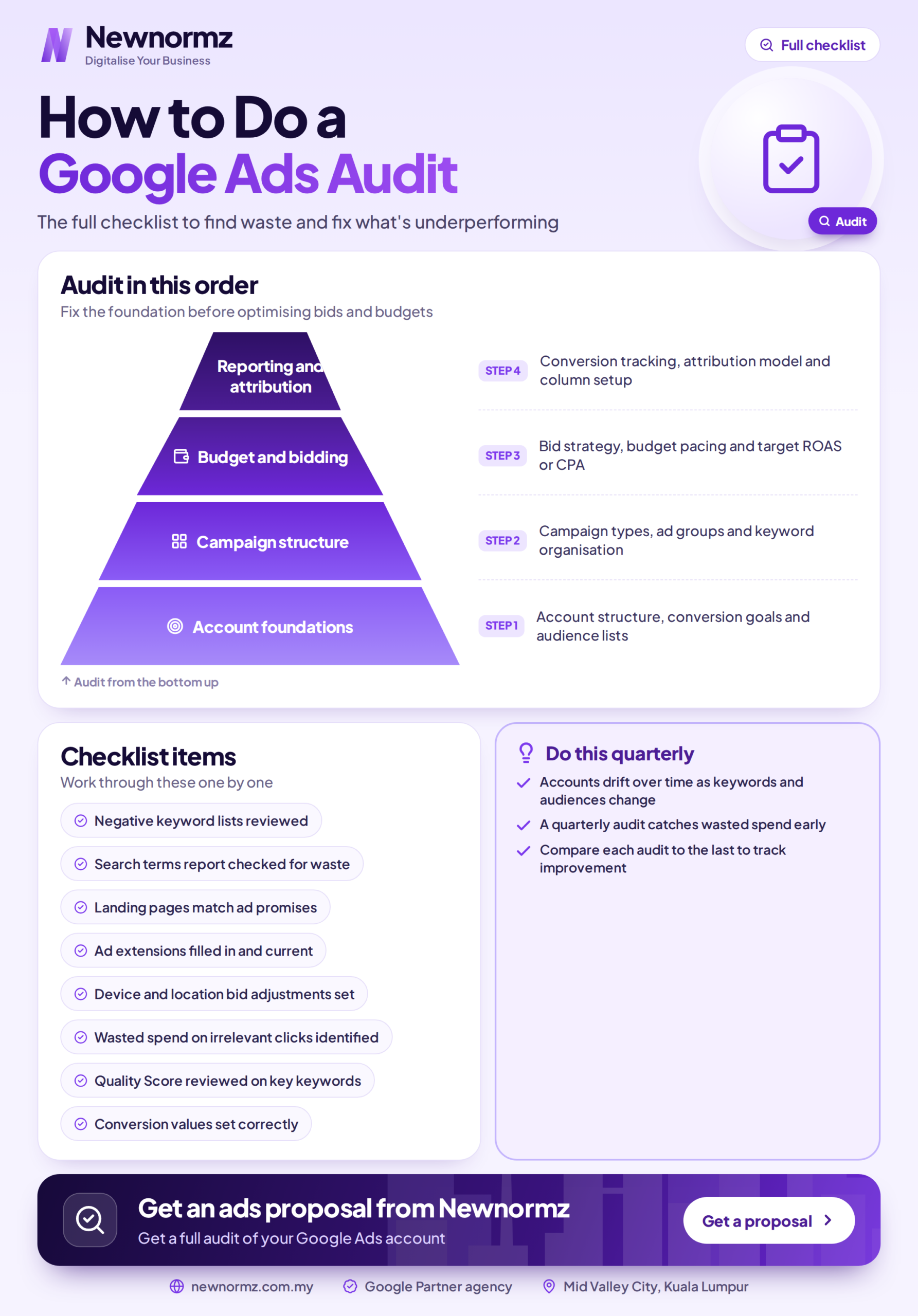
A Google Ads audit is a structured walk through nine parts of your account: structure, search terms, negative keywords, match types, Quality Score, ad copy and assets, bidding strategy, conversion tracking, and budget allocation. You are looking for one thing: spend that produces clicks but never produces a sale. Most Malaysian accounts leak money quietly through irrelevant search terms and unmanaged match types, and a first audit usually recovers enough waste to fund a real jump in return without adding a single ringgit to the budget. Work through this checklist in order and you can complete a solid audit yourself in about two hours.
A Simple Way to Think About It
The Leak Behind the Wall
🚰 The Pipe Nobody Checks
A cracked pipe hidden behind a wall does not stop the water from running. The bill keeps climbing every month until someone finally opens the wall and finds it.
🔧 The Plumber Who Reads the Meter First
A plumber who checks the meter before touching anything finds the exact section that is leaking, seals it, and the same water pressure now reaches every tap that actually needed it.
Your Google Ads account works the same way. The checklist below is the meter check, and it tells you exactly which section to seal before you spend another ringgit.
Who This Audit Is For
This is for Malaysian business owners and marketers running Google Ads who suspect the budget is not working as hard as it should. It applies whether you are spending RM3,000 or RM100,000 a month. The steps below find where the money is leaking before you consider raising the budget further.
Why Accounts Drift Without One
An unaudited account does not stay still. Search terms broaden on their own, keywords lose relevance as your business or market shifts, ad creative fatigues, and tracking quietly breaks after a website update nobody flagged to the ads team. None of this shows up as a dramatic failure. It shows up as a slow, steady rise in cost per lead that gets blamed on “the market” instead of the account.
Poorly managed negative keyword lists alone can waste 20% to 40% of total ad spend, which on a RM10,000 monthly budget is roughly RM2,000 to RM4,000 disappearing every single month. An audit is not about spending more. It is about redirecting spend from waste to winners, and it should happen before you scale a campaign, not after results disappoint.
Step 1: Account Structure
Start at the top, because a messy structure hides waste and makes every later fix harder to see. Campaigns should be split by clear intent (brand, non-brand, product category) so you can control budget and bids for each independently. Ad groups should be tight, ideally a small cluster of closely related keywords, so the ad and landing page stay relevant to what was searched. An ad group holding 200 unrelated keywords cannot stay relevant to all of them, and relevance is exactly what drives your cost per click down. Also check that a strong campaign is not sharing a shared budget with a weak one that is quietly stealing its impressions.
Step 2: Search Terms and Negative Keywords
This is where the biggest money hides. Open the search terms report and read what people actually typed, not the keywords you bid on. You will typically find job seekers, freebie hunters, DIY researchers, and competitor brand names sitting in there. Every one of those is spend with almost no chance of a sale.
Add negatives aggressively. Accounts that skip a search term review for a month can waste 20% to 30% of budget on irrelevant traffic in that window alone, which makes this the single highest-leverage move in most audits. Build a shared negative keyword list for the recurring junk terms and apply it across every relevant campaign, not just the one where you spotted the problem.
Step 3: Match Types and Quality Score
Review your match types next. Broad match without tight negatives and smart bidding is a common sinkhole, because it can match queries far outside your actual intent. Phrase and exact match give you tighter control. If broad match is running, confirm it is paired with a target ROAS or target CPA strategy and a genuinely strong negative list to keep it contained.
Then check Quality Score, because it is a direct cost lever, not a vanity metric. A score of 8 to 10 can cut your cost per click by up to 50% compared to a low score, while a score of 1 to 3 can raise CPC by as much as 400%. Sort keywords by Quality Score and focus on the high-spend ones scoring 5 or below. Improving ad relevance, expected click-through rate, and landing page experience lowers cost per click without you touching a single bid.
Step 4: Ad Copy, Assets and Bidding Strategy
Every ad group should be running at least two or three responsive search ads with distinct headlines and a clear call to action, so Google has something to test against. Check that every relevant asset is switched on: sitelinks, callouts, structured snippets, images, and location assets where applicable. Missing assets mean you occupy less of the results page than a competitor running the full set, and that costs you click-through rate for free.
For bidding, match the strategy to the data you actually have. Manual bidding or maximise clicks makes sense with little conversion history. Once you have consistent conversion volume, a target ROAS or target CPA strategy usually performs better. The catch is that automated bidding is only as trustworthy as the conversion data feeding it, which is exactly what you check next.
Step 5: Conversion Tracking and Budget Allocation
Conversion tracking accuracy is the foundation the rest of the account stands on. Verify that your conversion actions fire correctly on every real purchase or lead, with no duplicates and no missing events. This matters more than most people assume: businesses with broken or inaccurate tracking waste an average of 23% of their annual ad budget, because Google’s bidding algorithm optimises toward conversions that are either phantom or missing entirely.
Finally, look at budget allocation. Are your best campaigns capped while weak ones spend freely? Which keywords, ad groups, or placements carry high spend and zero conversions? Cutting those and reallocating the saved budget to proven winners is often the single biggest improvement a Google Ads audit produces, and it usually does not require a bigger monthly spend to see it.
A Worked Example: One Campaign, One Audit
Take a Malaysian home services business spending RM12,000 a month on one Search campaign, generating 60 leads at a 3x return. The search terms report shows RM3,000 of that spend went to queries like “free quote template,” “plumber jobs,” and “how to fix tap DIY.” None of those were ever going to convert.
| Metric | Before Audit | After Adding Negatives |
|---|---|---|
| Monthly spend | RM12,000 | RM9,000 |
| Wasted spend on junk terms | RM3,000 | RM0 |
| Leads | 60 | 60 |
| ROAS | 3.0x | 4.0x |
Adding negative keywords removes the RM3,000 that was never producing a lead in the first place. Leads hold steady at 60 and revenue stays the same, but spend drops to RM9,000, so return climbs from 3.0x to 4.0x. That is a 33% improvement from one report and a negative keyword list, before the saved RM3,000 is even reinvested into the keywords that were already converting.
Mistakes That Undo an Audit
Auditing the keywords you bid on but ignoring the search terms report is the most common one. The keywords in your account are not the same as the queries you are actually paying for. A close second is trusting conversion data you never verified: a broken tag makes every other metric in the account fiction, no matter how good the rest of your setup looks. Leaving broad match unmanaged without tight negatives and smart bidding is a third. And pausing everything with zero conversions the moment you see it is a mistake too, since some terms convert on a longer cycle than the date range you happen to be looking at. Auditing once a year instead of quarterly lets all of the above compound quietly in the meantime.
The Full Checklist
| Area | What to Check |
|---|---|
| Structure | Campaigns split by intent, ad groups tightly themed, no shared budget stealing from top performers. |
| Search terms | Read the actual queries, add negatives for every irrelevant one, build a shared negative list. |
| Match types | Broad match paired with tight negatives and a smart bidding strategy, never left unmanaged. |
| Quality Score | Sort by score, fix high-spend keywords scoring 5 or below first. |
| Ads and assets | 2 to 3 strong ads per group, every relevant asset switched on. |
| Bidding | Strategy matches your actual conversion volume, not a default left over from setup. |
| Tracking | Conversion actions fire once, correctly, on every real conversion, no duplicates or gaps. |
| Budget | Zero-conversion keywords and placements identified and reallocated to proven winners. |
Frequently Asked Questions
What is a Google Ads audit?
It is a structured review of your account covering structure, keywords, search terms, Quality Score, ads, bidding, tracking, and budget. The goal is to find where spend is wasted and where quick wins exist, so you can cut the leaks and reinvest that budget into the campaigns actually driving sales.
How often should I audit my account?
Run a full audit quarterly and a light search terms review every one to two weeks. Skipping search term reviews for a month can waste 20% to 30% of budget on irrelevant traffic. High-spend accounts benefit from a monthly deep audit to catch leaks before they compound.
What is the most important part of the audit?
The search terms report and conversion tracking. The search terms report shows you the irrelevant queries draining your budget, usually the fastest win. Conversion tracking accuracy underpins everything else, because if the data feeding Google is wrong, every bidding decision it makes rests on fiction.
How much does Quality Score actually affect cost?
A score of 8 to 10 can cut your cost per click by up to 50% compared to a low score, while a score of 1 to 3 can raise it by as much as 400%. Improving ad relevance and landing page experience lowers cost without you having to raise a single bid.
Can I run this audit myself?
Yes. Using this checklist, a business owner can run a solid audit in about two hours and catch most of the obvious leaks. Deeper issues, such as bidding strategy, attribution, or a structural rebuild, often benefit from an outside set of eyes, which is why many businesses pair a self-audit with a professional review before scaling spend.
Not sure where your budget is leaking?
Get a Free Google Ads Audit From Newnormz
Newnormz has run SEO campaigns across F&B, healthcare, ecommerce, and local services in Malaysia, backed by a performance guarantee of 70 percent of targeted keywords on Google’s first page.
Claim Your Free Google Ads Audit →
30 minutes, no obligation, no jargon.

Bryan Tan is an SEO Specialist and CEO at Newnormz, helping hundreds of businesses achieve first-page rankings on Google. With a passion for driving organic growth, Bryan blends innovative strategies with hands-on experience to optimize websites for maximum visibility. Always at the forefront of the latest SEO insights and trends, he consistently adapts to the evolving digital landscape.